I’ll just never stop finding it funny listening to Rush Limbaugh lament the loss of traditional marriage as he sits next to his 4th wife
— Glenn Greenwald (@ggreenwald) March 29, 2013
I’ll just never stop finding it funny listening to Rush Limbaugh lament the loss of traditional marriage as he sits next to his 4th wife
— Glenn Greenwald (@ggreenwald) March 29, 2013
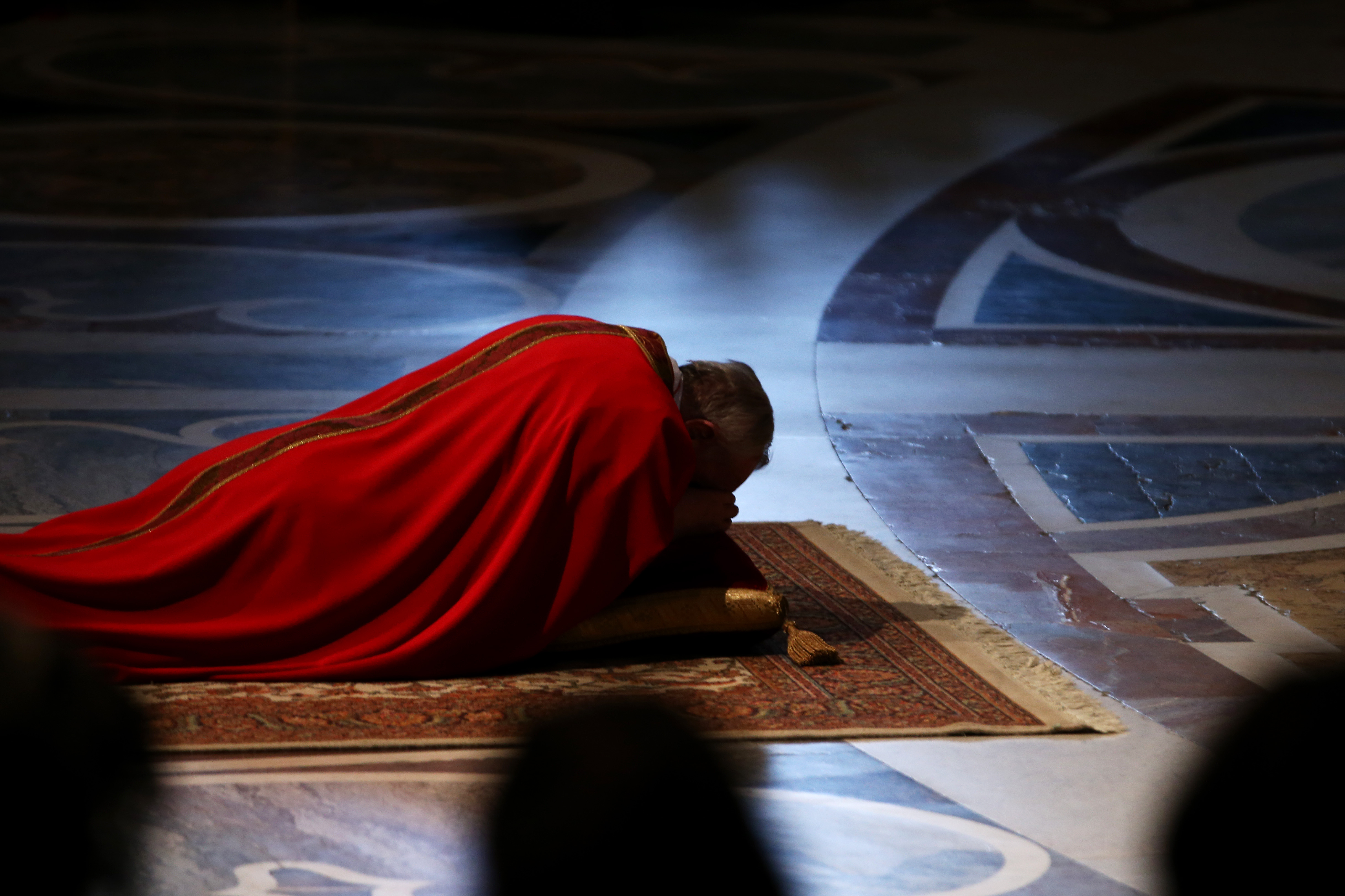
The symbolism – a stark departure from Pope Liberace – is like a breath of spring air in a wintry March. From abandoning the papal throne to living communally, Francis is living up to his chosen saint. But this is more significant, it seems to me more than merely a change of tone:
In his most significant break with tradition yet, Pope Francis washed and kissed the feet of two young women at a juvenile detention center — a surprising departure from church rules that restrict the Holy Thursday ritual to men.
No pope has ever washed the feet of a woman before, and Francis’ gesture sparked a debate among some conservatives and liturgical purists, who lamented he had set a “questionable example.” Liberals welcomed the move as a sign of greater inclusiveness in the church.
Speaking to the young offenders, including Muslims and Orthodox Christians, Francis said that Jesus washed the feet of his disciples on the eve of his crucifixion in a gesture of love and service. “This is a symbol, it is a sign. Washing your feet means I am at your service,” Francis told the group, aged 14 to 21, at the Casal del Marmo detention facility in Rome.
“Help one another. This is what Jesus teaches us,” the pope said. “This is what I do. And I do it with my heart. I do this with my heart because it is my duty. As a priest and bishop, I must be at your service.”
Know hope.
(Photo: Pope Francis prays on the floor as he presides over a Papal Mass with the Celebration of the Lord’s Passion inside St Peter’s Basilica on March 29, 2013 in Vatican City, Vatican. By Dan Kitwood/Getty Images)

$4 to $6 trillion, according to a new study. This does not count the uncountable human loss, or the brutal toll of PTSD and suicide among the survivors. Last year saw more military suicides in America (349) than military combat deaths in Afghanistan (295). The post-war is becoming more deadly than the war. Yglesias adds:
What should really strike fear into your heart is [professor Linda Bilmes’s] finding that “the largest portion of that bill is yet to be paid.” That’s because equipment lost or destroyed in the wars is going to have to be replaced, interest on the money borrowed to finance the wars is going to have to be paid, and most of all because health care and disability benefits are going to have to be paid well out into the future.
Spencer blames the cost on America’s overreaction to terrorism:
Money, ultimately, is power. In context, it would take a nuclear strike on the United States to inflict the kind of economic damage that the wars have reaped. The only nations capable of inflicting such damage are disinclined toward doing so; and no non-state actor will plausibly obtain the capability to match such a threat. All of that damage is the result not of what bin Laden or Saddam Hussein or the insurgencies that began in their wake did to America, but because of how American strategiests chose to respond. As Radiohead once sang, you do it to yourself, and that’s why it really hurts.
(Photo: Army veteran Brad Schwarz walks through the garage of the home he rents with his girlfriend on May 3, 2012 in Hanover Park, Illinois. The tattoo on Schwarz’s back, a quote from William Shakespeare’s Henry V, is a tribute to friends he served with in Iraq.
Schwarz uses a service dog to help him cope with post-traumatic stress disorder (PTSD) related to his 2008 tour in Iraq. In addition to suffering from PTSD Schwarz has memory loss related to Traumatic Brain Injury (TBI) and he must walk with a cane because of vertebrae and nerve damage in his back and legs.
Ten days before he was scheduled to rotate home from a 15-month deployment in Iraq, his second, the Humvee in which he was riding was struck by an Improvised Explosive Device (IED). Of the 5 soldiers riding in the vehicle, which caught fire after the explosion, Schwarz was the only one to survive. By Scott Olson/Getty Images.)
As we mark Good Friday, a meditation on prayer in the depth of pain:
I pray today for my friend, David Kuo, whose long battle against a brain tumor is in its final days. And for all those enduring war or plague or illness or despair. Especially despair. In one Gospel, Jesus himself seems to feel the loneliness of that despair on the cross. He had to go there to show how deeply he is still with us – perhaps especially in the valleys of our life when the sky itself recedes from view.
“Obama is very possibly a world-historical political figure, and until those who oppose him come to grips with this fact, they will get him wrong every time,” – JPod, finally getting it.

Jon Hamm is tired of commentary about the size of his dick. Alyssa sympathizes:
The questions that Hamm faces, from whether he should just invest in some Calvins to whether he should be flattered by the attention, are ones actresses have fielded forever. It’s a framing that acts as if the problem were the kind of underwear starlets and their stylists were picking out, rather than the photographers who zoom telephoto lenses in on their crotches. It says that if people get a glimpse of your body once, they’re entitled to speculate it about it forever, and you’re a prude for reminding people that you’re more than the sum of your junk.
What makes Hamm different from, say, Anne Hathaway, who had to weather discussion about the appearance of her nipples in her Academy Awards dress, is that Hamm isn’t used to being objectified. He has outrage left to burn, rather than being exhausted by endless appearance-based prying and insane body standards.
This is surely connected to a shift in the public’s understanding of male sexiness. This began in the 1990s, as Calvin Klein recruited Marky Mark’s abs, as Herb Ritts and Bruce Weber changed the presentation of the male body in photography (influenced by Robert Mapplethorpe), and as women became more empowered and gay men became more public. I wrote a cover-story on this for TNR in, er, 1988. This is male objectification turned back on the male. Alyssa is kind to empathize. But after all that women have had to endure over the centuries, a little payback isn’t so terrible a thing. And Jon Hamm simply cannot look bad. But I miss the beard.
(Photo: Actor Jon Hamm arrives at the Premiere of AMC’s ‘Mad Men’ Season 6 at DGA Theater on March 20, 2013 in Los Angeles, California. By Jason Merritt/Getty Images)

A question has often occurred to me as opponents of marriage equality cite gay people’s biological inability to procreate as a reason to bar us from marriage. What are they implicitly saying about infertile couples who adopt children? Tom Junod takes it personally, as well he should:
I have been married for 28 years. I met my wife in my freshman year of college. We started dating in my second semester, and have been so exclusive that we celebrate the anniversary of our first kiss rather than our wedding day… We have never thought of our marriage as anything but pleasing to anyone who cared to judge it, and have never imagined that the sanctity of our marriage might threaten the sanctity of other marriages, not to mention the institution of marriage itself.
Until now.
What has changed our understanding of the way some people see our marriage is, of course, the general debate unleashed by the last two days of argument before the Supreme Court on the subject of same-sex marriage. No, my wife and I are not of the same sex; I am a man and she is a woman. But we are infertile. We did not procreate. For the past nine years, we have been the adoptive parents of our daughter; we are legally her mother and father, but not biologically, and since Tuesday have been surprised and saddened to be reminded that for a sizable minority of the American public our lack of biological capacity makes all the difference — and dooms our marriage and our family to second-class status.
Read the whole thing, especially the arguments of NOM that uphold biological parenting as the only truly moral option. The logical contortions opponents of marriage equality have gotten themselves into just to justify excluding gays from their own families has led to this. I doubt whether any anti-equality campaigner wants to stigmatize adoption. But their arguments inevitably do – and are becoming a growing liability across American society.
(Photo: Jamie Lieberman (L) of New York City, cries as she holds her adopted son Theo, 2, an orphan originally from Ethiopia, after he received American citizenship November 18, 2010 at the US Citizenship and Immigration Services offices in New York City. Eighteen children, originally from Haiti, Ethiopia, China, and others countries, were sworn in as citizens with their American adopted parents standing by in a ceremony at the New York headquarters from USCIS. By Chris Hondros/Getty Images)
“This issue is lost. I don’t care what the Supreme Court does, this is now inevitable,” – Rush Limbaugh, yesterday, on marriage equality.
A reader writes:
Tatum saying “I’d have sex with [Clooney]” has been a sort of macho way for younger straight men to indicate they’re comfortably and confidently hetero for over a decade now. I, at least, remember starting to hear it in college at the end of the ’90s. It might date to this classic scene from the Tarantino-penned movie True Romance. It’s sort of a hyperbolic way of re-affirming straightness: “I can express my admiration for that man’s good looks and charm without compromising my own straight, masculine self-image only by doing it in this over-the-top way.” We “self-confident” straight men no longer feel the need to add Clarence’s qualifier from the movie: “I ain’t no fag, but…”. We obviously aren’t that insecure.
Update from two readers:
There is a movie scene that predates True Romance’s by 14 years, in the 1979 musical Hair.
One of the characters is asked by an Army recruiter if he is attracted to men and answeres, “Well, I wouldn’t kick Mick Jagger out of bed, but I’m not a homosexual, no”, which then leads to the hit song “Hair” being performed. Here’s the scene on YouTube.
So give credit where it is due; it started with the ’60s freedoms, where men chose to grow their hair long while still being masculine, at a time when much of the general population could mistake you for being a female if you wore your hair long.
I actually used that Mick Jagger line myself for a few years afterwards, when I was living in a smaller Midwest college town. It was more to throw a curve into other’s persons assumptions that most everyone was straight. It allowed me to be part trickster, playing with their minds a bit, and suggesting and planting the seed in their mind for a few seconds that I might actually be gay – or that others might be gay. The effectiveness of this declined as more and more people actually came out as being gay.
Another:
While Hair is a good earlier example of the phenomenon, it goes deeper. To me the classic expression of male-on-male adulation comes from 1942’s Casablanca. Claude Raines’s Inspector Renault explains to Ingrid Berman’s Ilasa Lund that “He (Bogart’s Rick) is the kind of man that – well, if I were a woman and I were not around, I should be in love with Rick”. Maybe it just serves as characterization of Vichy French turpitude, but the character of Renault is portrayed as an inveterate skirt chaser whose real kinship rests with Rick Blaine.
 Here’s a reminder of why “sponsored content” should be anathema to a free and independent press: E.B. White’s letter to Xerox after the company sponsored content in a 1976 issue of Esquire:
A funded article is a tempting morsel for any publication—particularly for one that is having a hard time making ends meet. A funded assignment is a tempting dish for a writer, who may pocket a much larger fee than he is accustomed to getting. And sponsorship is attractive to the sponsor himself, who, for one reason or another, feels an urge to penetrate the editorial columns after being so long pent up in the advertising pages. These temptations are real, and if the barriers were to be let down I believe corruption and abuse would soon follow.
Not all corporations would approach subsidy in the immaculate way Xerox did or in the same spirit of benefaction. There are a thousand reasons for someone’s wishing to buy his way into print, many of them unpalatable, all of them to some degree self-serving. Buying and selling space in news columns could become a serious disease of the press. If it reached epidemic proportions, it could destroy the press. I don’t want IBM or the National Rifle Association providing me with a funded spectacular when I open my paper. I want to read what the editor and the publisher have managed to dig up on their own—and paid for out of the till. …
The funded article is not in itself evil, but it is the beginning of evil, and it is an invitation to evil. I hope the invitation will not again be extended, and, if extended, I hope it will be declined.
At the time, the NYT covered the uproar over the Xerox-sponsored content:
The article by Mr. [Harrison E.] Salisbury, former associate editor of The New York Times, provoked editorials around the country and protests from writers who feared that it would set a precedent for encroachment by advertisers into the traditionally independent editorial side of journalism. Under the arrangement, Xerox paid Esquire to commission Mr. Salisbury to write “Travels Through America,” a 23-page article that took six months to complete. Mr. Salisbury was paid $40,000 plus $15,000 in expenses. Esquire in turn received a contract for a $115,000 advertising package from Xerox for one year.
The agreement stipulated that Xerox would not interfere with or have any influence over the article, but would run full-page ads at the beginning and the end of the article. If the corporation did not like the essay, Esquire would be free to publish it, without returning Xerox’s money, but without identifying it with Xerox in any way. “It was an experimental idea and since the big corporations sponsor television specials and other cultural enterprises, I saw nothing wrong with it,” said Mr. Salisbury yesterday to Mr. White’s criticism. He added that “magazines are suffering from lack of funds to pay their writers. “I’ve had no bad feedback from the article and if it is done just like our arrangement, that’s fine,” he said. “It worked like a charm.”
The NYT is prepping a report on this phenomenon, which is now spreading like wildfire in online media and in danger of becoming the norm. It’s a rare moment when the press has covered this issue – perhaps because the NYT is one of the few media brands self-confident enough to take it on, without worrying it will need to go there in the near-future.
(Hat tip: Ernie Smith)
 The Dish