The Alleged HIV “Cure”

There are reports that an HIV-infected infant was “cured” of the disease. Kent Sepkowitz is skeptical:

Amid all the excitement, debate continues on two fronts. First, was the child truly infected? The low viral load was a very unusual but not unheard-of finding, meaning we may never know Screen shot 2013-03-05 at 11.27.21 AMthe truth. Second, does the current spate of normal tests truly indicate a cure? With ultrasensitive testing, the child does have some evidence of scraps of HIV in its [sic] bloodstream, not enough to duplicate and then spread but still something that remains present, at least in shadow form. That’s not nothing. And 10 years of stability is but a moment of time for HIV, for which progression is measured in years.

Therefore, “cure” or even “functional cure” seems a reach. A stable suppression in the absence of ongoing therapy would be a more accurate description—and one that likely would have been used in a less dramatic and headline-grabbing disease.

My issue is also with the word “cure”. The child is still infected, but her own immune system is keeping it in check after a period of strong anti-retroviral treatment. Her levels are as undetectable as mine. But perhaps because she was treated so quickly and aggressively, as her body was still developing, it was neutered before it could get more firmly established in her own DNA.

As Sepkowitz notes, there is already a cure for children born to mothers with HIV: anti-retroviral treatment of the mother in pregnancy. One of my hopes for Obamacare is that rural mothers like the woman who gave birth to this child can get tested and treated for HIV so that they don’t need a new miracle “cure” to keep their children healthy.

(Photo: HIV in yellow infecting a CD4 cell in blue. Via NIAID via Flickr.)
Spot The Sponsored Content, Ctd

Buzzfeed’s Rosie Gray uncovers a more clear-cut and troubling example of paid content (without even Buzzfeed’s and the Atlantic’s fig-leaf disclosures) masquerading as editorial:

A range of mainstream American publications printed paid propaganda for the government of Malaysia, much of it focused on the campaign against a pro-democracy figure there. The payments to conservative American opinion writers — whose work appeared in outlets from the Huffington Post and San Francisco Examiner to the Washington Times to National Review and RedState — emerged in a filing this week to the Department of Justice. The filing under the Foreign Agent Registration Act outlines a campaign spanning May 2008 to April 2011 and led by Joshua Trevino, a conservative pundit, who received $389,724.70 under the contract and paid smaller sums to a series of conservative writers.

Let’s name the offenders, shall we?

Trevino’s subcontractors included conservative writer Ben Domenech, who made $36,000 from the arrangement, and Rachel Ehrenfeld, the director of the American Center for Democracy, who made $30,000. Seth Mandel, an editor at Commentary, made $5,500 (his byline is attached to the National Review item linked to above). Brad Jackson, writing at the time for RedState, made $24,700. Overall, 10 writers were part of the arrangement.

Treviño, amazingly, maintains he did not cross any lines:

“It was actually a fairly standard PR operation,” Trevino told BuzzFeed Friday. “To be blunt with you, and I think the filing is clear about this, it was a lot looser than a typical PR operation. I wanted to respect these guys’ independence and not have them be placement machines.”

Rich Abdill pushes back:

If “a fairly standard PR operation” involves paying off columnists to write about certain things, it seems journalists at every other publication ever were just misinformed about what was “ethical.” Jayson Blair stole quotes, made up stories, reported on events he never went to, then put it all in the New York Times, and he still did not take any bribes.

Joyner takes a similarly skeptical approach:

I’m more than a little leery of a pay-for-play arrangement. It’s hard for opinion writers, even good ones, to get paid. So I’m not four-square against bloggers taking money for writing posts supporting causes they already agree with. But it’s problematic, not to mention rather weird, for writers to suddenly start crusading on an issue they never cared about previously and which seems remote to their natural interest.

This is bribery and unethical journalism in my book. It also raises questions about the good faith of other work by the journalists involved. When there is no disclosure we can never know what is paid propaganda and what is actual journalism. Which, of course, is the point.

Is Modern Conservatism Inherently Racist?

Confederate_currency_$100_John_Calhoun

That was Sam Tanenhaus’s argument, charting the origins of today’s Republicans back to Calhoun. Peter Berkowitz goes to task dismantling the piece’s over-reach. Money quote:

What one cannot argue — at least not consistent with a decent respect for facts and reason — is that John C. Calhoun’s doctrine of nullification forms the basis of modern American conservatism — and that the very appeal to limited government has been, is, and will continue to be a thinly veiled attempt to keep non-whites and women in their places. The reduction of conservatism to a racially charged politics of nullification is not only illicit in its means but is also illiberal in its aim. It is an attempt to de-legitimize all dissent from left-liberal orthodoxy.

I urge you to read the Tanenhaus essay as well, and mull it over. I think Peter’s corrections – and philosophical defense of conservatism’s principle of limited government – are well taken. Maybe my English take on conservatism distorts my take – because Britain never had a third of its population under racist tyranny. But the GOP’s legacy on race since the 1950s has been painfully obtuse and many of the strains on today’s actual right are obviously influenced by Calhoun. Some of the ugliness came simply from ignoring the existence of an actual civil rights movement, or the existence of African-Americans, period, other than through a prism of fear:

When it came to discussing the concrete realities of race in America, NR had almost nothing to say, and the little NR said did not differ much from what was appearing in the Mercury. Other small-circulation journals, including The New Republic and The Nation, sent reporters to the South, commissioned articles from Southern journalists, and combed the local press, black and white, for up-to-date information on school desegregation campaigns, sit-in strikes, and protests. But none of these were covered or even seriously discussed in the country’s most ambitious and high-minded conservative journal.

It reminds me of their position on gay rights this past decade or so. There has been no attempt – and I’ve read a lot of the conservative media on this subject – to understand or report from the perspective of gay Americans. It makes for an irrelevant politics, and a desiccated moral imagination. And, in the end, mercifully, electoral defeat.

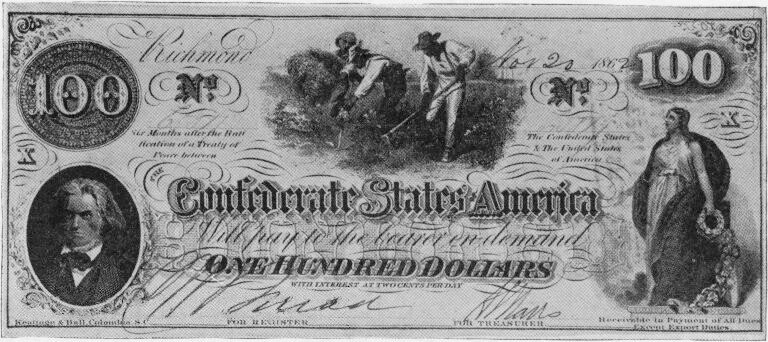
(Engraving: South Carolina politician John C. Calhoun pictured on a $100 bill issued by the Confederate States of America, 1862.)

Quote For The Day

“It all goes back to (the Affordable Care Act) and how it changes so many components of the way we do business. The language I use now in the health care business is completely different than the language I used even five years ago …  Until now, the government has paid on volume. Now, it’s trying to pay more on quality,” – Peter Person, chief executive of Essentia Health, a 12,800-employee hospital system based in Duluth, Minn.

It’s from a USA Today piece that really does seem to show that Obamacare is helping to restrain healthcare costs which actually fell a teensy bit last year as a share of the  economy.

The Era Of Cheap Airfare

Flight Cost Per Mile

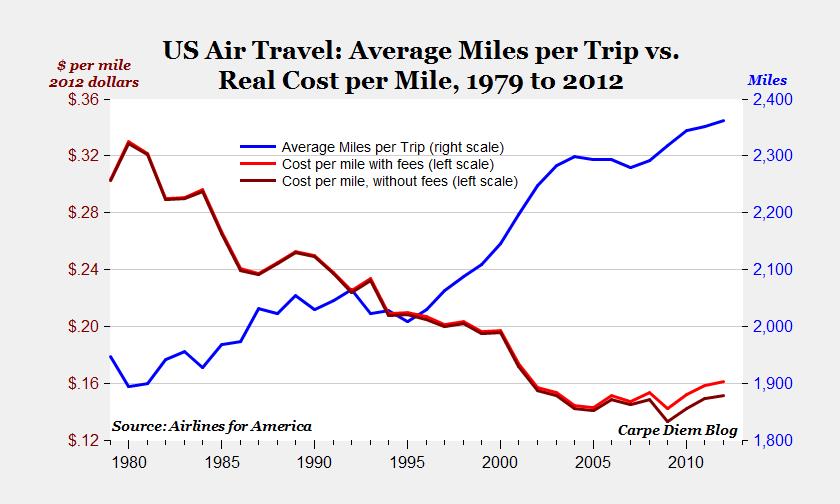
Derek Thompson notes that the cost of flying has plummeted:

Why don’t we appreciate this heyday in bargain flying? The first, and obvious, answer is that flying through the air in a big machine powered by a scarce resource will always cost a big number, and your average family expends very little energy adjusting big numbers for inflation. If you buy a round-trip ticket from New York to Columbus for $280 every year between 1986 and 2010, would you suddenly realize, after 24 years, that the real price of your ticket had dropped by exactly 50 percent? Probably not. You’d probably think, correctly, “I guess flying to Ohio costs $280.”

(Chart from Mark Perry)

A Degree In DIY

Lori Rotenberk reports growing interest in the folk school movement, which is “drawing young do-it-yourself homesteaders and restless baby boomers to the woods to learn about everything from organic farming to electric cars”:

People enrolling in folk schools range in age from 18 to 70. Enrollment is growing among high school graduates taking a gap year before starting college. College grads are opting to spend gap years at folk school, too, in some cases using the opportunity to rethink their careers. Some students in their late 20s and mid-30s come to learn a trade or craft for a second income. Add to the mix boomers who’ve been laid off, have difficulty finding work, and are hoping to start a small business, and others who have chosen to leave careers in pursuit of a long-ignored passion, and you have a recipe for dramatic growth.

Addicted To Arguing

Judith E. Glaser reveals the brain chemistry at work when you argue:

In situations of high stress, fear or distrust, the hormone and neurotransmitter cortisol floods the brain. Executive functions that help us with advanced thought processes like strategy, trust building, and compassion shut down. And the amygdala, our instinctive brain, takes over. The body makes a chemical choice about how best to protect itself — in this case from the shame and loss of power associated with being wrong — and as a result is unable to regulate its emotions or handle the gaps between expectations and reality.

This “chemical choice” can lead to problems:

When you argue and win, your brain floods with different hormones: adrenaline and dopamine, which makes you feel good, dominant, even invincible. It’s a the feeling any of us would want to replicate. So the next time we’re in a tense situation, we fight again. We get addicted to being right.

When Evangelicals Go Digging

Dylan Bergeson examines the “biblical archaeology” of the West Bank, funded by American churches and administered by Israel:

At first blush, [Texas Pastor Randall] Price seems like an unlikely candidate to head excavations amid one of the bitterest land disputes in the modern world. Though he never actually received a degree in archaeology, he built a global network around his brand of Near East biblical scholarship with an apocalyptic bent. He has written extensively for the website RaptureReady.com, given lectures suggesting that Iran is fulfilling the role of Antichrist, and has openly called for the United States to declare war on Islam.

They are getting lots of false positives:

[Prominent Israeli archaeologist Raphael] Greenberg estimates the majority of funding for excavations in Israel and Palestine comes from religious sources. As a result, he said, researchers are plagued by financial pressure to produce religiously significant discoveries. Recent years have seen multiple claims of finding Noah’s Ark, the secret location of the Ark of the Covenant, and most recently, a fraudulent ossuary that was claimed to contain the bones of Jesus’ family.