And Emerson Wept

The Atlantic‘s new sponsored prose:

Just as the current marketing environment is driving a culture of customer centricity and personalized interaction, a cultural shift is required inside the organization as well. Closing the gap between marketing requirements and IT capabilities requires a culture of collaboration in which the CMO and CIO work towards a set of agreed-upon goals that factor in both marketing and IT interests.

The Fog Of Gun Violence

Maggie Koerth-Baker tries to untangle some very incomplete data sets:

People may or may not call the cops to report domestic violence or an assault by someone they know. If the cops are called, the situation may or may not be taken seriously enough that it’s logged in any meaningful way. And if the violent incident in question isn’t technically a crime – shooting yourself in the foot, for instance, or drunkenly blowing a hole in your mother-in-law’s garage on the 4th of July – there’s no reason why that information would be reported to the FBI’s Uniform Crime Report, to begin with.

All those things matter very much to the people who are trying to figure out how guns are used in our society and how gun use changes over time. But there’s not really a solid, nation-wide, uniform way of tracking any of it. So what we say we know about gun violence is almost always just a synonym for what we know about gun murders.

On a related note, This American Life recently aired Part Two of a series on gun violence in one Chicago high school. Kottke conveys the situation there:

Here are some of the rules students live by at Harper High School in Chicago: Know your geography (whether you join a gang or not, you’re in one). Never walk by yourself. Never walk with someone else. If someone shoots, don’t run. These are just a few of the exhausting complexities that face the kids at Harper High, where 29 current and former students were shot last year.

The Obama Wave

Obama Campaigns In Richmond And Cleveland On Second Day Of Campaign Tour

Ta-Nehisi sees Obama’s reelection, and the massive turnout among minorities, as evidence of a bigger shift:

The history of black citizenship had, until now, been dominated by violence, terrorism, and legal maneuvering designed to strip African Americans of as many privileges—jury service, gun ownership, land ownership, voting—as possible. Obama’s reelection repudiates that history, and shows the power of a fully vested black citizenry. Martin Luther King Jr. did not create the civil-rights movement any more than Malcolm X created black pride. And the wave that brought Obama to power precedes him: the black-white voting gap narrowed substantially back in 1996, before he was even a state legislator. The narrowing gap is not the work of black messiahs, but of many black individuals.

Person by person. Soul by soul.

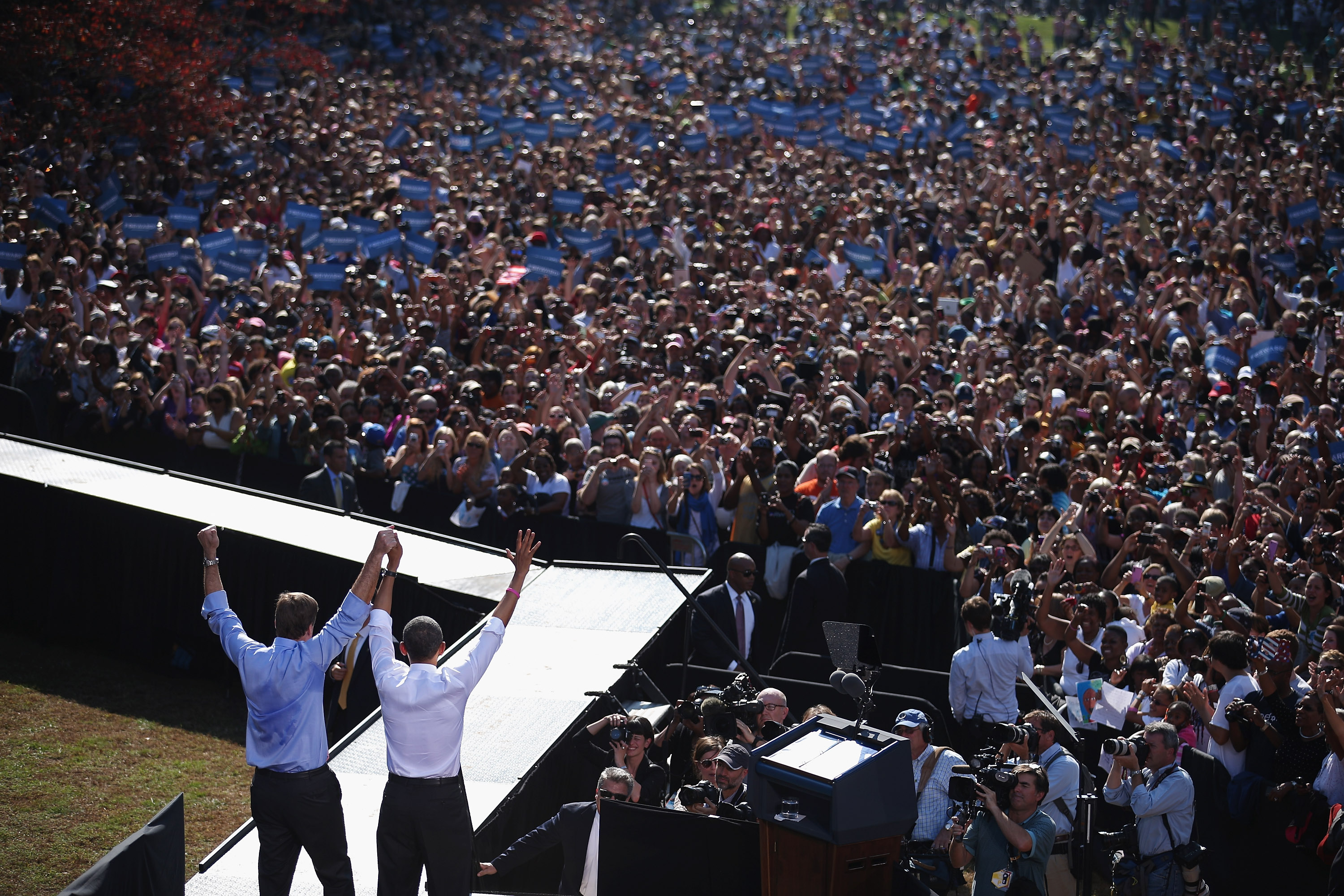
(Photo: U.S. President Barack Obama and Senator Mark Warner (D-VA) wave to a crowd of about 15,000 supporters during a campaign rally at Byrd Park October 25, 2012 in Richmond, Virginia. By Chip Somodevilla/Getty Images)

Chart Of The Day

Marriage_Estimates

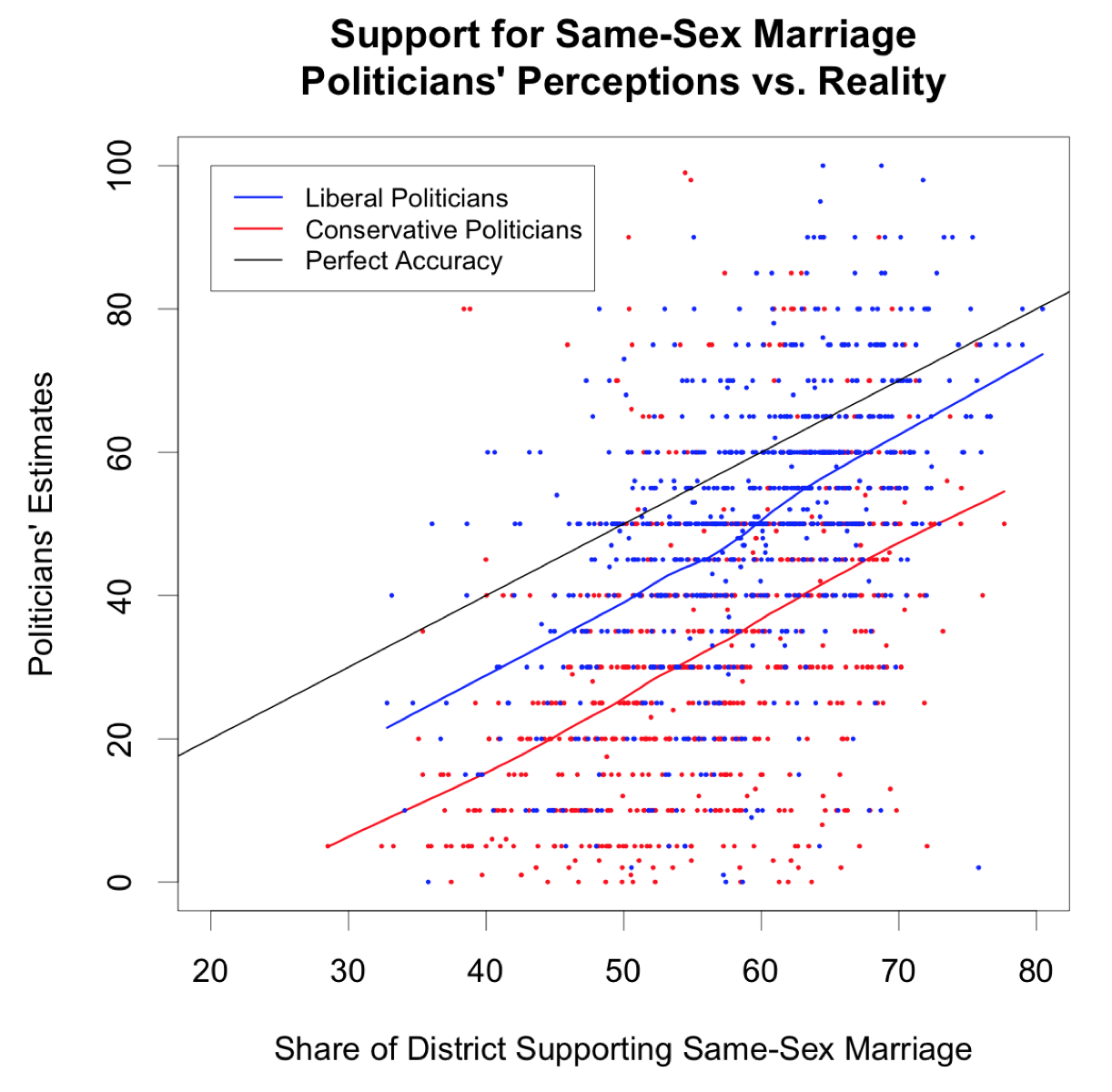
Dylan Matthews flags a new working paper (pdf) by David Broockman and Christopher Skovron:

Broockman and Skovron find that all legislators consistently believe their constituents are more conservative than they actually are. This includes Republicans and Democrats, liberals and conservatives. But conservative legislators generally overestimate the conservatism of their constituents by 20 points. “This difference is so large that nearly half of conservative politicians appear to believe that they represent a district that is more conservative on these issues than is the most conservative district in the entire country,” Broockman and Skovron write. This finding held up across a range of issues.

How Bad Is BPA?

Austin Considine highlights recent studies on disorders possibly connected to Bisphenol A exposure. Why understanding the effects of the chemical is important:

BPA exposure is nearly ubiquitous. In a wide-ranging study conducted by the Centers for Disease Control and Prevention in 2003-2004, researchers found detectable levels of BPA in 93 percent of subjects six years and older. The FDA recognizes something is wrong: It banned BPA from baby bottles and children’s sippy cups just last year.

The Record Button Is Always On

Mark Hurst fears that Google Glass will threaten privacy because it will allow you “to record video of the people, places, and events around you, at all times”:

Remember when people were kind of creeped out by that car Google drove around to take pictures of your house? Most people got over it, because they got a nice StreetView feature in Google Maps as a result.

Google Glass is like one camera car for each of the thousands, possibly millions, of people who will wear the device – every single day, everywhere they go – on sidewalks, into restaurants, up elevators, around your office, into your home. From now on, starting today, anywhere you go within range of a Google Glass device, everything you do could be recorded and uploaded to Google’s cloud, and stored there for the rest of your life. You won’t know if you’re being recorded or not; and even if you do, you’ll have no way to stop it.

And that, my friends, is the experience that Google Glass creates. That is the experience we should be thinking about. The most important Google Glass experience is not the user experience – it’s the experience of everyone else. The experience of being a citizen, in public, is about to change.

Previous Dish on Glass here, here and here.

Mental Health Break

[youtube http://www.youtube.com/watch?feature=player_embedded&v=5HrrbkYJM2M#!]

Kelly Conaboy double-takes:

You see the first baby and you think, “All right, this baby is pretty good. But I still can’t stop thinking about how it’s Monday morning, and about how quickly the weekends race by, and about how this is how it’s going to be for the rest of my life — working my ass off for what seems like only a few moments of repose OH MY GOODNESS, IS THE SECOND BABY EVEN YOUNGER? AND SHE’S EVEN BETTER THAN THE FIRST BABY?! JERRY– CANCEL ALL MY MEETINGS AND GET IN HERE! YA GOTTA SEE THESE BABIES!”

Can The Sequester Be Undone?

Cohn expects it to do real harm:

[T]he sequestration cuts are likely to damage the economy even if Congress ends up repealing them outright. In fact, they are probably damaging the economy already. Furlough notices started going out to some federal workers on Friday, according to news accounts. People who get them are going to react. Some will take the threat more seriously than others, obviously, but given the uncertainty—not to mention the real possibility that some cuts stay in place—some people are likely to change their financial behavior. Maybe they’ll rethink a major purchase or delay maintenance that can wait a few more weeks. And what’s true of individuals is even truer of large organizations, including those in government and those outside.

Cassidy doesn’t foresee a deal any time soon: 

How likely do you think it is that, between now and March 31st, the Republicans will soften their stance on raising taxes by eliminating some loopholes and deductions? And if they stick to their hardline position, how likely do you think President Obama is to drop his calls for a “balanced” approach to replacing the sequester, and to agree to a package of spending cuts without any revenue increases? In my view, the only plausible answers to these questions range from “not very likely” to “not a snowball’s chance in hell.”

How Stan Collender understands the sequester fight:

It was never about cutting spending or reducing the deficit; the fight always was about keeping or winning control of the House of Representatives in the next election. It wasn’t about dueling economic philosophies and it definitely wasn’t about the deficit.

Rummaging For A Living

After watching Redemption, an Oscar-nominated HBO documentary on New York’s “canners,” Nicola Twilley considers state cash incentives for recycling, known as Bottle Bills:

Various studies have shown that they do increase recycling rates dramatically: the United States’ overall beverage container recycling rate is estimated at thirty-three percent, while states with container deposit laws have an average rate of seventy percent. As watching a documentary like Redemption makes clear, however, a lot of this extra recycling and sorting is not being done by the consumers of canned or bottled beverages; instead, the state has outsourced its acts of environmental virtue, at far below minimum wage ($2.50 an hour at best, by my rough calculations), to some of its most marginalised populations.

Financial incentives to recycle bottles and cans don’t always work this way: in Germany, my friends and hosts have always been religious about returning bottles to the shop to claim their Pfand,” and I, who have never pursued a single cent of redemption value in California or New York, have happily followed their lead. Of course, in Germany, the standard deposit amount is €0.25, which is quite a bit more than a nickel.

Finn Arne Jørgensen notes how little has changed in the US:

 As early as 1953, Vermont introduced a bottle bill banning non-refillable bottles, but the law lasted only four years due to heavy lobbying from the beer industry. In 1971, Oregon implemented the first bottle bill requiring a deposit. This deposit was five cents, just like it is today. How many other prices have remained the same over 42 years? Vermont followed in 1973, and Connecticut, Delaware, Iowa, Massachusetts, Maine, Michigan, and New York had followed by the early 1980s. A number of proposed bottle bills in other states had been struck down by industry opposition. The beverage industry fought the new bottle bills tooth and claw, seeing them as a “direct and politically motivated infringement on the free market and a threat to profits,” as geographer Matthew Gandy wrote in Recycling and the Politics of Urban Waste.

Co-director Jon Alpert reveals what he learned from following canners around – upending his expectations:

I think some of the stereotypes that were upturned for me, and are upturned in the film, is that I thought most people collecting bottles and cans were going to homeless, wrestling with mental illness or drug addiction, or that kind of archetype of a bum. But the truth and the reality, is that in this economy these are working New Yorkers. They’re the marginalized working poor. There’s a lot of ink being spilled and breath being spent on the middle class, in political conversations right now and in newspaper columns, but nobody is talking about the large population below the middle class. These are the people who are living on the absolute edge of society. What impressed me was that they’re not asking for a hand out and they’re not looking for anybody to give them anything. They want to work.