Finding Meaning In Fewer Words

Brad Leithauser celebrates concise writing, which “in its broadest spirit encompasses far more than a stripping of verbiage,” but rather “clarifies the contours, it revels in the sleek and streamlined”:

[P]oetry remains the domain where concision consistently burns brightest. (Someone told me that Marilyn Monroe once remarked that she enjoyed reading poetry “because it saves time.” I like this quotation so much that I’ve never dared to confirm it; I’d feel disenchanted to learn it was bogus.) My little cabinet includes two six-line poems whose psychological richness surely couldn’t be duplicated in a full page of poetic prose. The first is W. H. Auden’s “Epitaph on a Tyrant”:

Perfection of a kind was what he was after,
And the poetry he invented was easy to understand;
He knew human folly like the back of his hand,
And was greatly interested in armies and fleets;
When he laughed, respectable senators burst with laughter,
And when he cried the little children died in the streets.

We have here some Nazi monster listening to Schubert lieder at the end of a workday devoted to the Final Solution. Or Henry VIII admiring a Holbein portrait right before ordering another innocent to the executioner’s axe. Or Caligula attending a lighthearted masque on the heels of a highly productive brainstorming session with his court torturer. Here is, ultimately, the whole haunting, ever-repeating saga of the good ship Civilization foundering when a madman somehow seizes its helm.

Mental Health Break

The short film “The Me Bird” is a free interpretation of the homonym poem by Pablo Neruda. The inspiration in the strata stencil technique helps conceptualize the repetition of layers as the past of our movements and actions. The frames depicted as jail and the past as a burden serve as the background for the story of a ballerina on a journey towards freedom.

Catching The Ephemeral

Rose Tremain reveals how a smell inspired her to be a writer:

One evening, lagging behind the other tennis players, with a June sun beginning to go down, I stopped still on the path, inhaling something new and impossibly seductive in the air. During my two-hour game of tennis, the hayfield had been cut. I experienced the scent of the new-mown hay as something so perfect, so life-affirming, that the idea of its inevitable transience (it was, after all, only the frail and final outbreath of a fallen crop) felt crushing. I stood very still and wondered if there existed, in me, any magic by which I could hold onto it for as long as I remained alive. And it was in that moment that the idea of becoming a writer took shape in my mind. I couldn’t capture the smell; what I could capture was the power of my experience of the smell in words.

When the scent of new-mown hay comes to me now, I see how my fear of the ephemeral lessened in an instant. Writers give ephemeral things multiple existences: they understand how a single childhood experience may one day inform countless different stories. And so I saw the direction of my life set out before me across the field.

A Well Hung Museum

Ferris Jabr visited the Icelandic Phallological Museum in Reykjavik, home to “the world’s largest collection of penises and related artifacts”:

In a refreshing contrast to many museums, the Icelandic Phallological Museum completely lacks any pretense or stuffiness. The museum is honest about its purpose: this is a place to come and marvel at a great many penises of different shapes and sizes. Compared to most natural history museums, however, it’s a little light on information. All the specimens are paired with pieces of paper listing the Latin and common names of the relevant animal, and the museum’s website has a thorough catalogue recording the provenance of all the penises in the collection. One of three nooks toward the back of the museum houses a small library. Beyond that, however, there are no panels, videos or exhibits to further stimulate guests. You must be your own guide through this wonderland of phalluses.

Sendak’s Sexuality

Ellen Handler Spitz believes it might help us decipher the meaning of the writer’s work, including his posthumously published My Brother’s Book:

Is it possible that the isolation and belligerence of Sendak’s characters may have been fueled by some of his own aggression toward a world that could not accept him as he was? There is Pierre from The Nutshell Library, rebellious and eaten by a lion; Max from Where the Wild Things Are, destructive, banished, and resentful; angry Mickey from In the Night Kitchen, baked in the oven; Ida’s baby sister from Outside Over There, kidnapped by goblins. In My Brother’s Book, aggression emerges when an enormous polar bear reminiscent of Sendak’s wild things both hugs and threatens Guy and begins to eat him “bite by bite.” Even the title of this latest work contains shades of latent violence: After “My Brother’s” comes the instant association “Keeper,” covertly summoning Cain and Abel. In Sendak, however, primal fraternal hostility is displaced from the relationship itself on to cosmic forces and animal savagery.

Eerily, by means of an oblique classical reference, the homoerotic theme and aggression come together in Sendak’s last work. The devouring bear transforms itself into stars and assumes the form of the constellation Ursa Major. Ursa Major, so the myth goes, was created when Jupiter (in the form of Diana) rapes a chaste nymph named Callisto. Juno, to punish her husband Jupiter, turns Callisto into a bear; taking pity, Jupiter then wrings another change, turning the bear into Ursa Major. Throughout centuries, painters have used this story to titillate, showing one “woman” making love to another woman.

Illustrating With Words Alone

Sam Sacks details the turn against illustrated stories and novels among early 20th century writers, including Henry James and Virginia Woolf, who were suspicious of what visuals did to the integrity of their art:

So writers somewhat defensively cleaved to this division: pictures were about superficial titillation; prose was about essences. And over time the opinion hardened that the old custom of accompanying illustration was a form of aesthetic corruption. There were many great twentieth-century exceptions, naturally—Reginald Marsh’s vivid sketches for Dos Passos’s “U.S.A.,” Noel Sickles’s splendid drawings for Hemingway’s “The Old Man and the Sea” in Life magazine (though not the published book), the entire magnificent run of the Limited Editions Club—but these usually had an air of nostalgia and collectibility about them.

Increasingly, drawn portraits of characters appeared only in the pulps. Literary fiction, even on its dust covers, turned to images of static objects or abstract symbols or, sometimes, of nothing at all. Such ideological stringency reached its apogee when J. D. Salinger designed the paperback edition of “The Catcher in the Rye,” eschewing the lively drawing of a carousel horse that had adorned the hardcover for the starkly imageless “maroon-colored edifice” (in his biographer’s words), which immediately became iconic among high-schoolers and serial killers alike.

Sacks’ conclusion? Writers who stick to this dichotomy are missing out, especially in the age of e-readers that “allow you to read text, look at pictures, and watch videos on the same device.”

A Nasty New World

800px-1622_massacre_jamestown_de_Bry

Ron Rosenbaum reviews Bernard Bailyn The Barbarous Years, which details the “little-remembered” brutality of life in the American colonies during the 17th century:

Bailyn has not painted a pretty picture. Little wonder he calls it The Barbarous Years and spares us no details of the terror, desperation, degradation and widespread torture—do you really know what being “flayed alive” means? (The skin is torn from the face and head and the prisoner is disemboweled while still alive.)

And yet somehow amid the merciless massacres were elements that gave birth to the rudiments of civilization—or in Bailyn’s evocative phrase, the fragile “integument of civility”—that would evolve 100 years later into a virtual Renaissance culture, a bustling string of self-governing, self-sufficient, defiantly expansionist colonies alive with an increasingly sophisticated and literate political and intellectual culture that would coalesce into the rationale for the birth of American independence. All the while shaping, and sometimes misshaping, the American character. It’s a grand drama in which the glimmers of enlightenment barely survive the savagery, what Yeats called “the blood-dimmed tide,” the brutal establishment of slavery, the race wars with the original inhabitants that Bailyn is not afraid to call “genocidal,” the full, horrifying details of which have virtually been erased.

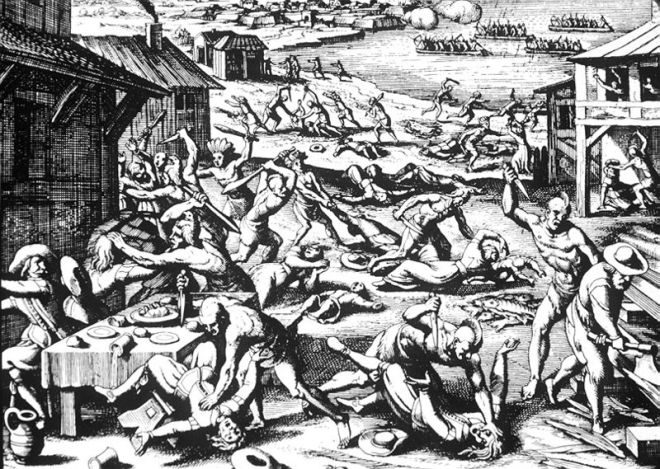
Above image from the Wiki entry for the Indian Massacre of 1622:

Captain John Smith, though he had not been in Virginia since 1609 and was thus not a firsthand eyewitness, related in his History of Virginia that braves of the Powhatan Confederacy “came unarmed into our houses with deer, turkeys, fish, fruits, and other provisions to sell us”. Suddenly the Powhatan grabbed any tools or weapons available to them and killed any English settlers who were in sight, including men, women and children of all ages. Chief Opechancanough led a coordinated series of surprise attacks of the Powhatan Confederacy that killed 347 people, a quarter of the English population of Jamestown.

Update from a historian in Virginia:

I want to provide a bit more context for your readers about the so-called Indian Massacre of 1622. If, as the reviewer of Bailyn’s book suggests, the details of this period “have virtually been erased,” the image and accompanying Wikipedia information you provide doesn’t much help the effort to un-erase it.

Of course, the 1622 attack was a massacre only from the perspective of the English settlers, who had, in previous years, razed Indian towns, looted religious temples, and stolen or destroyed whole fields of maze. Many of the English military men had fought in Ireland and happily repurposed for Virginia the terror tactics developed in those wars. For instance, according to an account by George Percy, English soldiers captured an Indian chief’s wife and two children and confined them aboard ship. This was in the spring of 1610. Annoyed that their superior, Percy, might show the Indians mercy, the soldiers instead threw the children overboard and shot “owtt their Braynes in the water.” The chief’s wife was later put to the sword.

The “Powhatan Confederacy,” meanwhile, was not a voluntary alliance as the word “confederacy,” used in the Wikipedia entry, suggests. In 1608, for instance, the paramount chief Powhatan surrounded and attacked a member group, the Piankatank Indians. For all intents and purposes, he wiped them out and moved another group of Indians into their newly emptied town. According to William Strachey, Powhatan then collected the dead warriors’ scalps and hung them on a line between two trees – in full view of English visitors, Strachey among them.

The attack of 1622 killed about a quarter of Virginia’s English settlers and a report drawn up for the Virginia Company of London suggested that the “Viperous” and “wicked” Indians, rather than be Christianized and civilized, ought now to be completely destroyed: “by force, by surprize, by famine.” “Conquering them is much more easie then of civilizing them by faire meanes,” the writer concluded, “for they are a rude, barbarous, and naked people.”

And yet what’s interesting is that the deaths caused by Opechancanough‘s attack were a drop in the bucket compared to deaths caused by disease and by what some investors in the Virginia Company described as mismanagement. One such investor was Samuel Wrote. In the wake of the attack he decided to crunch some numbers. He estimated that Virginia’s population in 1619, when the company’s current leadership had taken over, was 700. Another 3,570 men, women, and children had entered Virginia in the subsequent three years, adding up to a population of 4,270. But after Opechancanough’s attacks, and the deaths of 347 colonists, only 1,240 settlers remained. What had happened, Wrote demanded, to the other 2,683?

The barbarous years, in other words, involved much more than war, scalps, and flaying. But so also was it more complicated than a conflict between—as one Virginia history textbook puts it—the “obnoxious” John Smith and Powhatan, “a ruler of great spiritual, mental, and physical strength.”

A Poem For Saturday

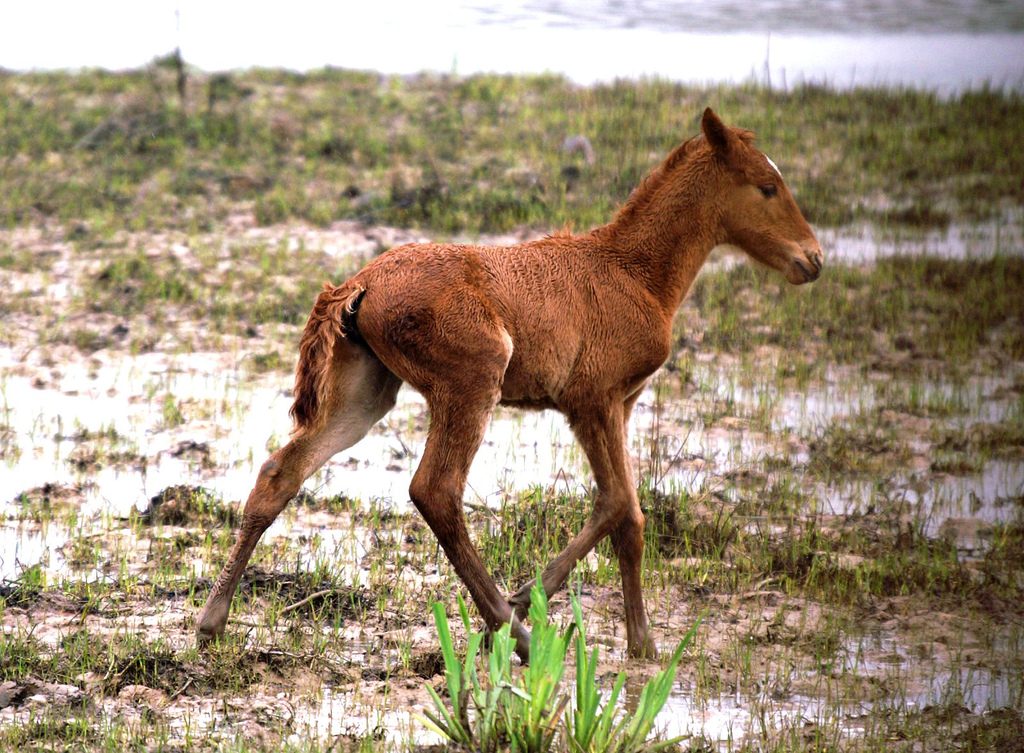
younghorse

“Gus Speaks” by Maxine Kumin

I was the last of my line,
farm-raised, chesty, and bold.
Not one of your flawless show-world
forty-five pound Dalmatians.
I ran with the horses, my darlings.

I loped at their heels, mile
for mile, swam rivers they forded
wet to the belly. I guarded
them grazing, haloed in flies.
Their smell became my smell.

Joyous I ate their manure.
Its undigested oats
still sweet, kept me fit.
I slept curled at the flank
of the fiercest bloodmare.

We lay, a study in snores
ear flicks and farts in her stall
until she came to the brink,
the birth hour of her foal.
Then, she shunned me cruelly.

Spring and fall I erred over
and over. Skunks were my folly.
Then, I was nobody’s lover.
I rolled in dung and sand.
When my heart burst in the pond,

my body sank and then rose
like a birch log, a blaze
of white against spring green.
Now I lie under the grasses
they crop, my own swift horses

who start up and spook in the rain
without me, the warm summer rain

(From Where I Live: New & Selected Poems 1990-2010 by Maxine Kumin © Maxine Kumin. Used by permission of W.W.Norton & Company. Photo by Flickr user ferran pestaña)

The View From Your Window Contest

vfyw-contest_3-2

You have until noon on Tuesday to guess it. City and/or state first, then country. Please put the location in the subject heading, along with any description within the email. If no one guesses the exact location, proximity counts.  Be sure to email entries to contest@andrewsullivan.com (the old address still works as well). Winner gets a free The View From Your Window book. Have at it.