Escalating The War On Whistleblowers

Supporters Of Army Pfc Bradley Manning Rally At State Department

Yochai Benkler fears the possible long-term consequences of the Bradley Manning case:

Secrecy is necessary and justified in many cases. But as hard-earned experience has shown us time and again, it can be—and often is—used to cover up failure, avarice, or actions that simply will not survive that best of disinfectants, sunlight.

That’s where whistleblowers come in. They offer a pressure valve, constrained by the personal risk whistleblowers take, and fueled by whatever moral courage they can muster. Manning’s statement in court yesterday showed that, at least in his motives, he was part of that long-respected tradition.  But that’s also where the Manning prosecution comes in, too. The prosecution case seems designed, quite simply, to terrorize future national security whistleblowers. The charges against Manning are different from those that have been brought against other whistleblowers. “Aiding the enemy” is punishable by death. And although the prosecutors in this case are not seeking the death penalty against Manning, the precedent they are seeking to establish does not depend on the penalty. It establishes the act as a capital offense, regardless of whether prosecutors in their discretion decide to seek the death penalty in any particular case.

(Photo: Code Pink for Peace demonstrator Tighe Barry chants in front of the U.S. State Department to protest the resignation of State Department spokesman P.J. Crowley and the detention of U.S. Army Private Bradley Manning March 14, 2011 in Washington, DC. Two days after saying the treatment of the accused WikiLeaker was ‘ridiculous and counterproductive and stupid,’ Crowley resigned. The demonstrators stripped their clothing off to protest against the treatment of Manning, who has been allegedly held naked in a Marine Corps base in Virginia. By Chip Somodevilla/Getty Images)

The Number One App

Megan Garber praises the potential of uChek, a new app that helps you conduct self-urinalysis:

And, no, the app does not require you to pee on your smartphone. It does, however, require you to pee into a cup with a chemical strip attached to it. The app, Wired explains, then analyzes those strips “by first taking photos with your phone at predetermined times and comparing the results that appear on the pee-soaked strip to a color-coded map.” The app then offers a breakdown of the elements present in the user’s urine, comparing levels of things like glucose, ketones, leukocytes, nitrites, and proteins — much like a urine test conducted at a medical lab would do, only without the trip to the lab. The app then presents the results to the user, offering visual breakdowns that indicate normal versus abnormal levels of each compound.

From the Wired piece:

[uChek creator Myshkin] Ingawale’s own father-in-law, who is diabetic, has been an early tester of the Uchek app and system. “My wife is the one who wants the information,” Ingawale says. “She wants to make sure he’s taking care of himself. He just takes the test and e-mails her the results.” … [T]here is a pattern to what Ingawale is creating and bringing to market through his startup Biosense Technologies. “The medical device industry operates on proprietary, closed hardware and a recurring revenue business model,” Ingawale says. “I am trying to democratize healthcare.”

The Sanitation Worker Closet

This embed is invalid


Tim Heffernan sits down with Robin Nagle, whose book Picking Up describes her time in the NYC department of sanitation:

Central among Nagle’s themes is the paradox—she would call it the injustice—of sanitation work. It is absolutely vital to any modern society. It is also largely invisible. …

Nagle discovered the job’s invisibility during a parade, as she warned sandal-clad spectators to move out of the way of her broom’s coarse bristles. Nobody heard her. “It’s not that they were ignoring me,” she writes. “I was never part of their awareness.” That attitude goes along with the perception that the work is demeaning. Even san men themselves aren’t immune to the idea. Nagle recalls trying to convince a coworker that his work was important: “‘Aw, bullshit,’ he’d say, dismissing me with a wave of his hand. Even after decades on the job, he still hasn’t told the neighbors what he does for a living. His wife is happier that way.”

(Above scene from “The Mighty Boosh“)

Obama’s Israel Trip

Beinart suspects that it has little to do with the peace process:

[W]hy is Obama going at all? The likeliest explanation is that he wants to delay Israeli military action, and thus buy himself some time for a diplomatic push with Iran, he wants to enlist Israel’s help in a push to end the Syrian civil war, and he wants to end Republican snickering that he hasn’t visited the Jewish state. Kerry’s current trip suggests as much. After initially announcing that he was visiting Israel in advance of Obama, Kerry abruptly canceled on the grounds that he doesn’t want to interfere in coalition negotiations. Instead, he’s embarked on a trip that, according to The Washington Post, “is expected to be dominated by discussion of the situation in Syria.” In addition to trying to meet members of the Syrian opposition, Kerry is visiting Turkey, Saudi Arabia, the United Arab Emirates, and Qatar—four countries that are crucial not only for any American push on Syria but for an Iran initiative as well.

Sequestration Day Arrives

http://youtu.be/uj-82AKs-tA

Gleckman sees “the impending government shutdown scheduled for just a month from now” as much more important than the sequester:

If Congress can’t agree on a spending bill by the end of March, nearly all agencies will be shut down and all their employees laid off on April 1, making the sequester’s relatively modest furloughs irrelevant. On the other hand, if Congress and the president do agree on a budget for the rest of fiscal 2013, as they ultimately must, they are likely to make major changes to the sequester—adding money for some agencies, cutting for others, and very likely reducing the overall spending cuts entirely.  Thus, many of those furloughs will never take place.

Stan Collendar expects that “members of Congress that today are saying they are absolutely adamant about letting the sequester stay in place will start to waiver as their constituents become increasingly unhappy about the impact of the spending cuts on their lives.” But he’s not sure we’ll see a repeat of 1995 and 1996:

There are three big difference from the two federal shutdowns that could affect this: (1) the number of safe congressional districts, (2) the tea party, and (3) John Boehner (R-OH) being a much weaker speaker than Newt Gingrich (R-GA). These changes mean both that House members may not care as much about overall approval ratings as they do about the approval of their base voters in their individual districts, and that their leadership may not be able to sell them on any deal even if it wants to make one. If that’s the case, the sequester could stay in place much longer than either of the two shutdowns did individually or cumulatively.

Ezra explains why no deal could be struck to avoid the sequester:

Republicans basically support the sequester because it’s all spending cuts, but they want the cuts allocated more intelligently. The White House opposes the sequester because it hits the economy too hard in 2013 and because it doesn’t include tax increases, and so they want it replaced with a compromise proposal. And so Republicans want to make the sequester a bit better and a lot more permanent while the White House opposes efforts to make the sequester better precisely because it would make it more permanent.

War Isn’t A Winning Issue

Larison forces Syria hawks to face a stubborn fact – that there is little public support for another war. Massie is on the same page:

You may say that Obama has learned the lessons of the last decade too well but, if so, then you need to criticise the American people too. Even if Obama were to favour heavier intervention than that already announced, the administration’s ability to lead public opinion has been diminished by the experience of past interventions. The decreased salience of the Responsibility to Protect doctrine may reasonably be blamed on George W Bush. Whining that it shouldn’t be this way is all very well and good but scarcely changes the fact – uncomfortable perhaps – that it is this way.

Can The South Be Trusted On Voting Rights Yet?

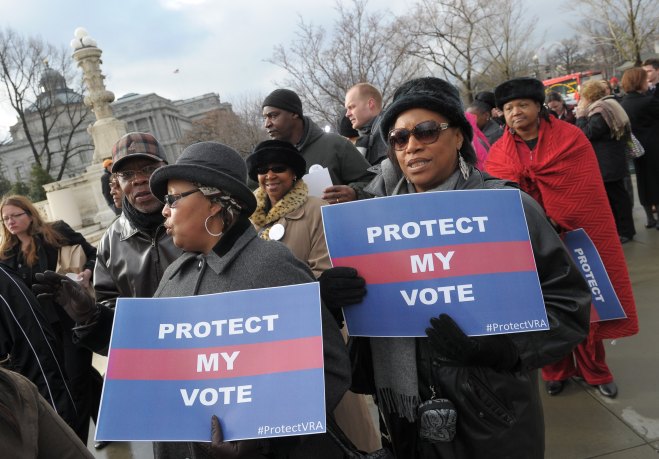
US-VOTE-RIGHTS-JUSTICE

As the Supreme Court this week heard arguments over the Voting Rights Act in Shelby County v Holder, Adam Serwer sets the scene:

Under Section 5 [of the Act], parts of the country with histories of discriminatory election practices have to ask for permission—or “preclearance,” in legal terms—from the Justice Department before making any changes to their voting rules. But [according to Bert Rein, the attorney leading the challenge to the Act,] the South, where most of the covered jurisdictions are, has changed, [and] the law, although once justified, is now unfair and unconstitutional. The five conservative justices on the Supreme Court seemed to agree. “The Marshall Plan was very good too,” argued Justice Anthony Kennedy, “but times change.” … Scalia called Section 5 the “perpetuation of a racial entitlement” that legislators would never have the courage to overturn. “In the House there are practically black districts by law now,” Scalia complained.

Scalia is an asshole, but what Kennedy is saying is not outrageous.

I have to say I am not one of those who thinks that this kind of federal oversight, essential once, must necessarily be essential for ever. And I cannot quite grasp the logic of liberals’ insistence that the bigotry of 1964 is no less a danger today. It’s obviously a much less bigoted society with respect to race than then – in part because of the very Act that liberals are rightly proud of (and that more Republicans as a proportion of their numbers voted for than Democrats). I do think there’s a day in which such supervision may not be necessary as a matter of principle and disagree with Rachel Maddow’s views expressed on last night’s Daily Show that oppression is for ever and that government control of oppression must also be for ever. Societies change. It’s crazy to take no notice of this, and wherever possible the government, in my view, should be race neutral.

But when that change has occurred seems to me to be best left to the legislature – and I thought that was the core conservative position. When last revisited, the Voting Rights Act was passed overwhelmingly. Since when were conservatives the ones asking the courts to strike down laws almost unanimously supported by the representatives of the people?

Serwer argues that SCOTUS shouldn’t even be hearing the case, because jurisdictions can in fact bail out of Section 5 provided they maintain a long-standing record of not having proposed discriminatory voting changes – something Shelby County, Alabama has not done. Jamelle Bouie’s jaw drops at the implication from Scalia and others that racism is a thing of the past. Below he responds to Roberts having asked if it was “the government’s submission that the citizens in the South are more racist than the citizens in the North?”

The answer is a qualified yes. Here is the conclusion of a 2005 study from political scientists Nicholas A. Valentino and David O. Sears:

General Social Survey and National Election Studies data from the 1970s to the present indicate that whites residing in the old Confederacy continue to display more racial antagonism and ideological conservatism than non-Southern whites. Racial conservatism has become linked more closely to presidential voting and party identification over time in the white South, while its impact has remained constant elsewhere.

But Abigail Thernstrom outlines arguments and evidence showing that black voting is vibrant in the Southern state in question:

In Alabama, the number of blacks in the state legislature is proportionate to the black population, Rein replied.  There is also very high black registration and turn-out. The point could have been put more strongly. For many years, those political participation rates have not been especially low in the Deep South. The disparity between black and white registration rates, the Chief Justice pointed out, is greatest in Massachusetts, with Mississippi, where (remarkably) the black registration rate is higher than that for whites, having the third-best rate in the country.

In addition, blacks in the covered jurisdictions have had greater success in winning public office than outside the Deep South “But think about this State that you’re representing, it’s about a quarter black, but Alabama has no black statewide elected officials,” Justice Elena Kagan argued. In reply, Rein might have pointed a finger at the Voting Rights Act.

The insistence on race-conscious districting to maximize the number of safe black legislative seats — built into the enforcement of the Voting Rights Act — is a brake on minority political aspirations.  In majority-black districts, minority candidates tend to consolidate the black vote by making the sort of overt racial appeals that are the staple of invidious identity politics. Very few have any experience building biracial coalitions; they do not acquire the skills to venture into the world of competitive politics in statewide majority-white settings. As a result, max-black districts (the ACLU’s term) seem to have worked to keep most black legislators clustered together and on the sidelines of American political life – precisely the opposite of what the statute intended.

(Photo: Activists hold a pro-voting rights placards outside of the US Supreme Court on February 27, 2013 in Washington, DC as the Court prepares to hear Shelby County vs Holder. The case centers around a key section of the 1965 Voting Rights Act which mandates federal approval for any proposed voting changes in nine states. By Mandel Ngan/AFP/Getty Images)

A Rare Bipartisan Moment

Yesterday, the House finally passed the Violence Against Women Act, which had expired in early 2012. Reauthorization of the law was delayed by the inclusion of measures related to the protection of Native American and LGBT women. Steve Benen points to the significance of the bill’s passing without support from the majority of House Republicans:

[U]nder modern Republican norms, the Speaker only considers legislation that enjoys “majority of the majority” support — if most GOP House members oppose a measure, it won’t even be considered, whether it can pass the chamber or not. The non-binding rule is great for party discipline, but lousy for democracy and governing. For Boehner’s part, the Speaker had long believed in enforcing the “Hastert Rule,” but he’s finding far more flexibility on the issue than we’re accustomed to seeing. When it was time to approve the “fiscal cliff” deal, Boehner ignored the rule to pass a bipartisan Senate plan. When he needed to pass relief aid to Hurricane Sandy victims, he bypassed the rule again. At the time, the Speaker said these were isolated incidents that wouldn’t be repeated, but here we are again — most of Boehner’s caucus opposed the Violence Against Women Act, but he brought it to the floor and passed it anyway.

To reiterate a point from several weeks ago, this may seem like inside baseball, but it’s extremely important. If Boehner, in the name of getting stuff done, is open to bringing important bills to the floor, and passing them with mostly-Democratic support, there’s an opportunity for real governing in the near future.

Amanda Marcotte puts Republicans who voted against the bill in the hot seat:

[A]ll the Republicans who voted against VAWA in the Senate were men—all the female Republican senators voted for it. Then you have the nine Republican congressmen who declared that there was no version of VAWA they would support. Rep. Tom McClintock of California justified his resistance in 2012 by calling VAWA “a feel-good measure” and objecting to how the bill supposedly hamstrings “judges who are attempting to resolve and reconcile highly volatile relationships.” It is true, as I reported at the American Prospect, that VAWA puts an emphasis on separating victims from their abusers instead of trying to patch things up, but that’s because the evidence overwhelmingly suggests that this strategy works better at keeping victims safe. Which is the point.

Alexis Levinson thinks that those who opposed the bill will probably pay a price:

Democrats have gone after Republicans in the past for not supporting the reauthorization of the bill. North Dakota Republican Rep. Rick Berg got an earful last cycle, for example, after he declined to take a position on the bill. His opponent, now-Sen. Heidi Heitkamp, held a number of campaign events on the importance of reauthorizing the bill. Berg ultimately lost [to] Heitkamp, in a state that was expected to lean Republican. Should the House Republicans who opposed the VAWA reauthorization run for Senate, they will likely face withering criticism for being part of what Democrats in 2012 repeatedly called the “war on women.”

The Long Nag, Ctd

An updated chart of readers hitting various levels of readons:

Screen Shot 2013-03-01 at 12.27.33 PM

A reader quotes me:

“…around 5,000 subscribers have yet to log in. (What’s stopping them? We don’t know…)”  I am one of those subscribers. The reason for me is that I have four different devices to read the Dish on: PC at work, PC at home, phone, and a tablet. While I click “read on” fairly frequently, no single device has reached its limit. So I don’t need to sign in. I will keep funding the Dish, as it’s ethical and I want you to succeed. But that’s the only reason I haven’t logged in.

Subscribers can bypass the meter process altogether by clicking the red button in the top-right corner of the Dish. Another subscriber:

I would submit that the cause for some fraction of that 5k is Tinypass’ desire to use a cookie, which means that browsers see a 3rd party site wanting to play with my cookies, and Safari on the iPhone has only all/none/no-3rd-party settings, and I’m not accepting all cookies – eff that. This means that I can’t click your Login button and have it do anything. So what I do is go to dashboard.tinypass.com and login there, then click the “Dish” link in Purchases and that launches me a subscribed-and-logged-in Dish window, allowing me to close the tinypass bootstrap window. Tinypass has helpful paste-in lines for whitelisting them as a valid 3rd party cookie site, but I don’t know how to convince my iPhone of that without opening the cookie floodgates.  So my workaround suffices.

The most common response from readers:

I read your blog through RSS, specifically Google Reader. I rarely if ever visit your site, and have done so recently only to check out the new design (nice work, appreciate the minimalist approach!). I’m guessing that many of the other non-login subscribers come from this group, but perhaps your site analytics could shed light on this.

My feeling is that content consumption strictly through websites will die off as people move to simpler, more customizable mechanisms such as RSS feeds and mobile devices. One of my pet peeves with website feeds is truncated posts that force you to click to a website to read the full post/story. The primary reason I’ve created the feed is to minimize website visits, and the second I’m forced to do so the less likely I will continue to consume your content at all. Serve an ad in my reader, I don’t care, as long as it doesn’t bog down the limited time I have to read the posts I want to read. That is one of the reasons I subscribed to the Dish (besides the great quality of your blog) – as long as you continue to offer full posts in your feed, I will continue to subscribe.

One other note: your “nags” are beginning to feel more like NPR pledge drives – only a nickel a day for honest independent journalism! Not that it’s a bad thing; NPR is great and we all should contribute to the financial stability of the independent media we consume if we can afford it. And hey, I can’t wait for next year’s subscription to come with a free emergency radio or brain power CD.

Obama’s Exquisite Balance On Marriage, Ctd

[youtube http://youtu.be/apQt4xGzvKw ]

The president says rather more dispassionately what I believe. I believe the right to marry is vested in the very Declaration of Independence, and that gay people have as deep a right to it as straights as it is currently composed. But I don’t want that view to be forced, rushed or coerced into action by the Supreme Court, especially when America, and so many states are moving so fast toward equality anyway. Why not keep the judicial decisions limited so as to make the political victories more profound? If there was no way a tiny minority could win th democratic argument, it would be one thing. But in a matter of a decade or so, we have persuaded over half the country and a huge majority of the next generation. Why would I want to give the religious right the satisfaction of saying it was forced on people by unelected judges? Why not get the results of a Roe v Wade without a Roe vs Wade?

Marty Lederman outlines five ways SCOTUS could rule on Prop 8. Part of his analysis focuses on the “eight-state solution,” supported by the Obama DOJ, “which would directly affect only those states (California, Delaware, Hawaii, Illinois, Nevada, New Jersey, Oregon, and Rhode Island) that already treat same-sex couples the same as opposite-sex couples in virtually all ways” but refuse to call their unions “marriage”:

As I noted yesterday, in a rather remarkable development, four of the eight states that provide same-sex couples with virtually all incidents of marriage–Delaware, Illinois and Oregon, in addition to California itself–have filed amicus briefs urging the Court to affirm the judgment of the court of appeals declaring that Proposition 8 is invalid, and making an argument that would, if accepted, appear to seal the fate of their own laws, as well.

The eight-state holding would permit the Court to avoid for now any decision on whether some other states might have a sufficient justification for denying same-sex couples substantial benefits and privileges that they offer to opposite-sex couples.  As Lyle notes, such a holding would of course make it much more difficult for the remaining 33 states to sustain their marriage laws against constitutional challenge.  But the ultimate fate of such statutes would depend on future litigation and/or on political developments.  That is to say, the Court would cast a shadow over the laws of the other thirty-three states, without resolving just yet whether they are constitutional.

Ari Ezra Waldman thinks “there is reason to believe that [the eight state solution] makes strategic sense”:

First, the President knows that Justice Kennedy is the likely swing vote in this case and Justice Kennedy is a cautious, conservative jurist. He has a history of respecting states’ rights above all else and often rejects sweeping policies that reek of overreach. Incremental change, if any change at all, seems to be his mantra, as Professor Kenji Yoshino has argued many times before. The compromise position may be aimed at Justice Kennedy’s cautious nature, giving him room to support gay rights without undermining the driving force of his judicial career.

Second, step-by-step progress may aggravate those of us who want to marry, but can’t, but slow progress denies our opponents fodder to foment backlash.

Mark Tushnet ponders the consequences of such a ruling on future state legislation:

[T]he eight-state solution would force legislators in other states to an all-or-nothing choice. Is that a perverse incentive, or more like holding legislators’ feet to the fire? The eight-state solution tells legislators that, despite what they might prefer, they can’t avoid confronting the issue of marriage equality by adopting something just a bit short of that. (Presumably, even were the eight-state solution to become the law of the land, legislators could avoid enacting full marriage equality by going less far than California and Illinois did in equalizing the rights available to straight and gay/lesbian couples.)