by Matthew Sitman
Gary Gutting explains how he remains a Roman Catholic while also being a philosopher who reveres Enlightenment thought:
The ethics of love I revere as the inspiration for so many (Catholics and others) who have led exemplary moral lives. I don’t say that this ethics is the only exemplary way to live or that we have anything near to an adequate understanding of it. But I know that it has been a powerful force for good. (Like so many Catholics, I do not see how the hierarchy’s rigid strictures on sex and marriage could follow from the ethics of love.) As to the theistic metaphysics, I’m agnostic about it taken literally, but see it as a superb intellectual construction that provides a fruitful context for understanding how our religious and moral experiences are tied to the ethics of love. The historical stories, I maintain, are best taken as parables illustrating moral and metaphysical teachings.
Traditional apologetics has started with metaphysical arguments for God’s existence, then argued from the action of God in the world to the truth of the Church’s teachings as revealed by God and finally justified the ethics of love by appealing to these teachings. I reverse this order, putting first the ethics of love as a teaching that directly captivates our moral sensibility, then taking the history and metaphysics as helpful elucidations of the ethics.
I think this is a very helpful way of putting the matter – it articulates, more or less, inchoate thoughts I’ve been turning over for awhile. Another way of framing Gutting’s arguments is that they are a critique of traditional apologetics, trying to rationally prove the core tenets of a faith. How many people really have been moved by, say, the ontological argument for God’s existence? And its always important to recognize that God is not an object outside ourselves, a being on the same metaphysical plane as other things we might “know.” Whatever knowledge of God we might have, its a very particular kind of knowledge, and to reduce a transcendent, ineffable God to the elements of syllogism not only is a philosophical mistake, it means the God you are describing no longer is recognizable as the God attested to by Christianity.
I would argue it’s far more compelling, when affirming Christianity, to claim, with Francis Spufford, that Christianity “makes emotional sense” – to point to the ways it is a meaningful framework for understanding our suffering and our joy, the gritty realities of what we experience as we move through life. Christianity is not a set of propositions, and it does serious damage to the faith’s credibility in the modern age when it is turned into such propositions. You end up trying to meet modern, rationalist and scientific claims on their own terms, reading the Bible for knowledge about geology and the age of the earth or turning to Revelations as a concrete, literal guide to how human history will unfold. It’s important to remember, as Gutting has, that the central “revelation” of Christianity is not really a sacred text or a creed, but a person – Jesus – who lived a life of self-giving and radical love. Asking how such a life connects with our deepest longings as human beings should be the point of departure for dialogue and conversation, and Gutting eloquently confirms the value, intellectual and otherwise, to such an approach.
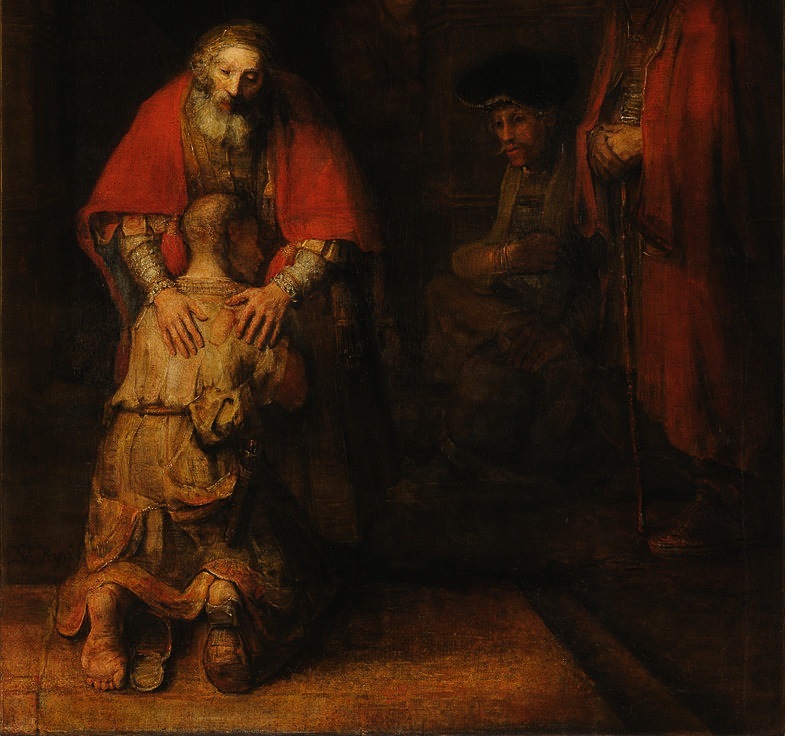
(Detail from Rembrant’s “Return of the Prodigal Son” via Wikimedia Commons)
 The Dish
