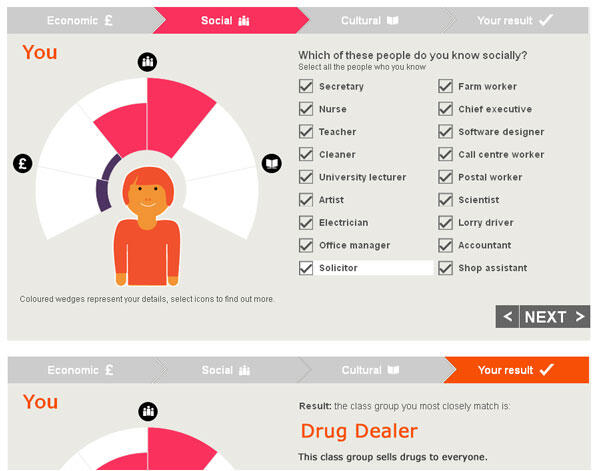
Toby Young reflects on a social class quiz that Manchester University created for the BBC (one of many spoofs is seen above):
One advantage of moving beyond the socio-economic definition of class is that you end up with a less inflammatory portrait of modern Britain. Yes, the social elite are quite numerous, but it’s better to belong to a four million-strong group than be bracketed with the dreaded ‘1 per cent’. … Seven different classes also feels more accurate than the usual three, even allowing for such sub-categories as lower-upper-middle (the class George Orwell said he belonged to). The more there are, the easier it is to move between them and the harder it is to keep track of who is a member of which one. That chimes with the general sense that class has become less important in the past 25 years.
Jenny Diski details how class tests were applied in the past:
You looked, you listened, you sniffed the air. And there it was, at 60 paces. Along, of course, with the telltale signs of arrivisme or decline, everyone with an exquisitely precise social degree of their own as obvious as the nose on their face, the first syllable uttered, the cut of their jacket.
It was as easy to know as it was intricate, the British class system. Provided you were born to it. But those of us who didn’t exactly fit because our parents or grandparents still spoke with foreign accents learned pretty quickly how to spot the finest distinctions. Even an Australian classmate knew, at my boarding school, when I tried to join the drama club, that with the wrong accent, I ‘would only be any good at playing maids’.
Nigeness contemplates “the lost richness of the English class system”:
Once among the glories of our national life, this endlessly complex and subtle system (or rather organism) gave us all our best comedies and most of our best fiction, while also proving a remarkably effective engine – and index – of social mobility, both upward and downward. (‘Was he born,’ inquires Lady Bracknell of Jack Worthing’s father, ‘into what the radical papers call the purple of commerce, or did he rise through the ranks of the aristocracy?’). It also gave us something other than the weather to talk – and even think – about.
 The Dish