Stephen Akey praises the French poet Baudelaire for confronting our failures:
Like a blasphemous Jesus, he took on our worst sins — pride, sloth, envy, lechery — and turned them into art. T.S. Eliot and others have found in him a profound religious yearning beneath the
blasphemy. I, on the contrary, find blasphemy beneath the blasphemy. Baudelaire’s “business” was not, pace Eliot, to “assert the necessity” of Christianity. He asserted, if anything, the necessity of belief in a self that, threatened from forces within and without, might remain whole and integral, if only through the consciousness of its own suffering. Even so, it’s impossible not to be moved by Eliot’s essay on the poet, which concludes not with the expected apportions of praise and censure but, astonishingly, with this prayer: “Baudelaire was man enough for damnation: whether he is damned is, of course, another question, and we are not prevented from praying for his repose.”
Extraordinary as Eliot’s benediction is, Baudelaire didn’t hold out for prayer. He had work to do. Tormented, slothful, and sickly, he managed to produce masterpieces in every genre to which he turned his hand: metrical verse, prose poetry (which he more or less invented), translation, and art criticism. I think of Baudelaire at work much as he depicted his loved and hated city in the last stanza of his magnificent aubade “Twilight: Daybreak” (“Le Crepuscule du Matin”). It’s a Baudelairian dawn. Whores, beggars, the debauched and the dying fitfully awaken to a cold and damp morning — not a promising start to the day. And yet this city will clothe itself in beauty and get to work:
Shivering dawn, in a wisp of pink and green,
Totters slowly across the empty Seine,
and dingy Paris – old drudge rubbing its eyes –
picks up its tools to begin another day.
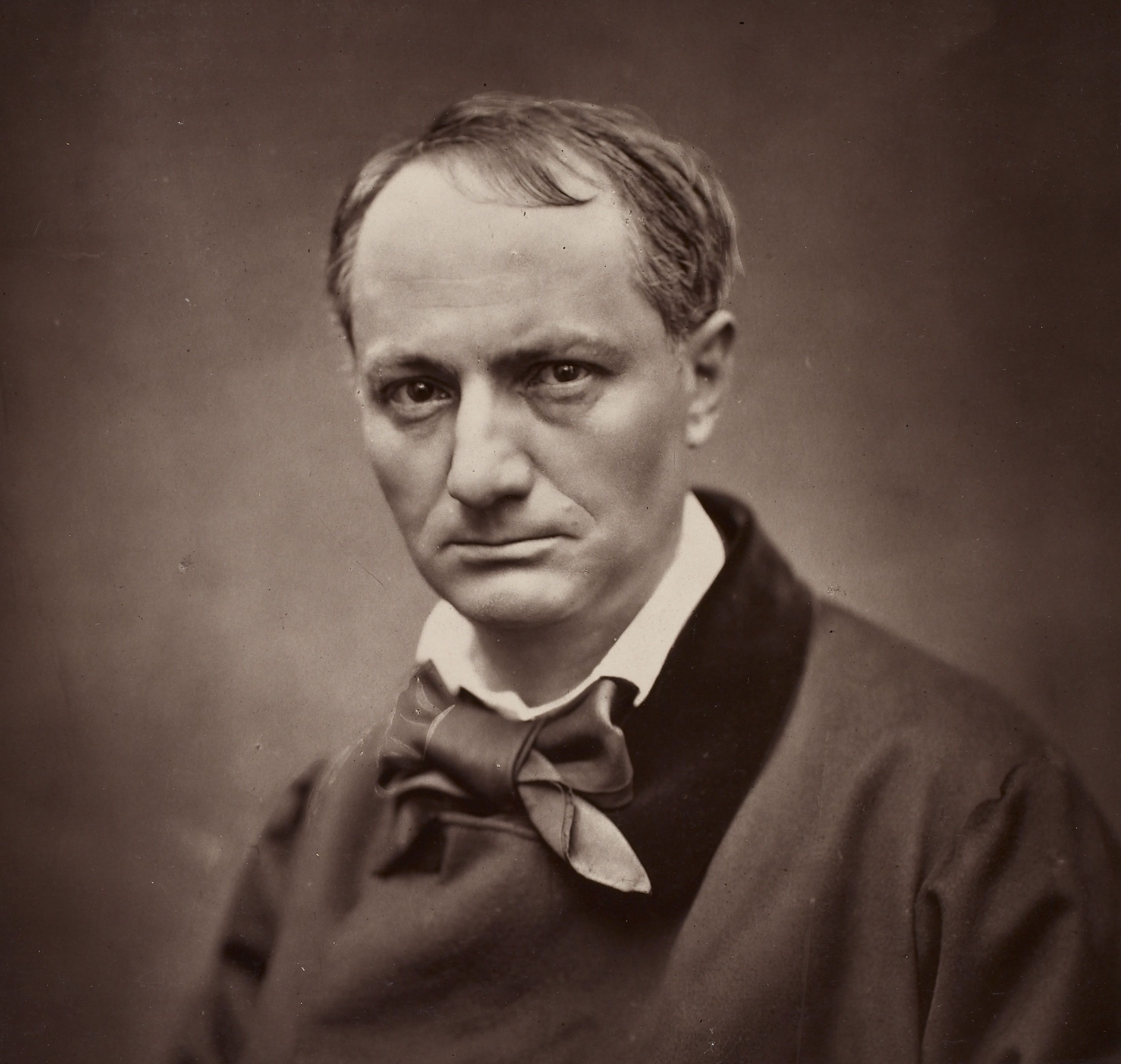
(Photo of Baudelaire by Étienne Carjat via Wikimedia)
 The Dish
