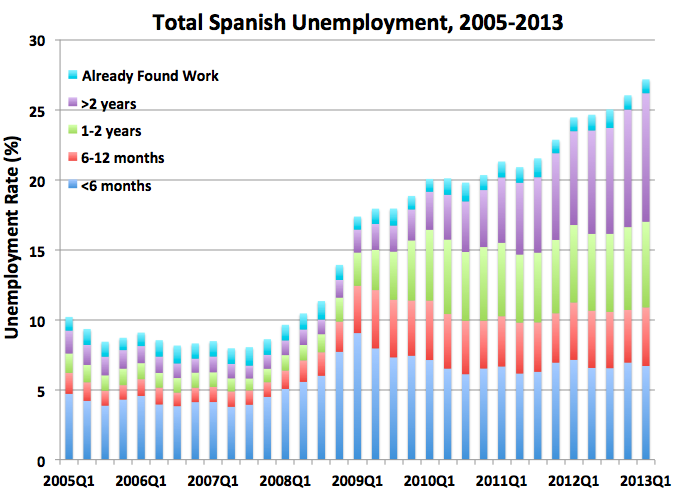
Matthew O’Brien fears that “Spain is beyond doomed”:
Spain’s labor market problems fall into two big buckets: too much regulation, and not enough education. It’s almost impossible for companies to get rid of older workers, which creates a horribly bifurcated labor market. There are permanent workers who can’t be fired, and temporary ones who can — and are. Indeed, as Clive Crook points out, about a third of Spain’s workforce are temporary workers who enjoy few protections and fewer opportunities. Companies go through these younger workers without bothering to invest much in their human capital, because why would they? These temporary workers will be let go at the first sign of economic trouble. Young people get stuck in a never-ending cycle of under-and-unemployment since firms are always hesitant to hire permanent workers who will always be on their books.
But it gets worse. The housing bust hasn’t just cast a shadow over household and bank balance sheets; it’s cast one over young people’s educations too. At its peak, building made up a whopping 19 percent of Spain’s economy, which, as Tobias Buck of the Financial Times points out, lured many young men into dropping out of school for well-paying construction gigs. But now that building has gone into hibernation, all of those young men are left with no work and no education to fall back on. And, again, even if they can find temporary jobs, it’s not as if the companies will spend money to develop their skills.
 The Dish