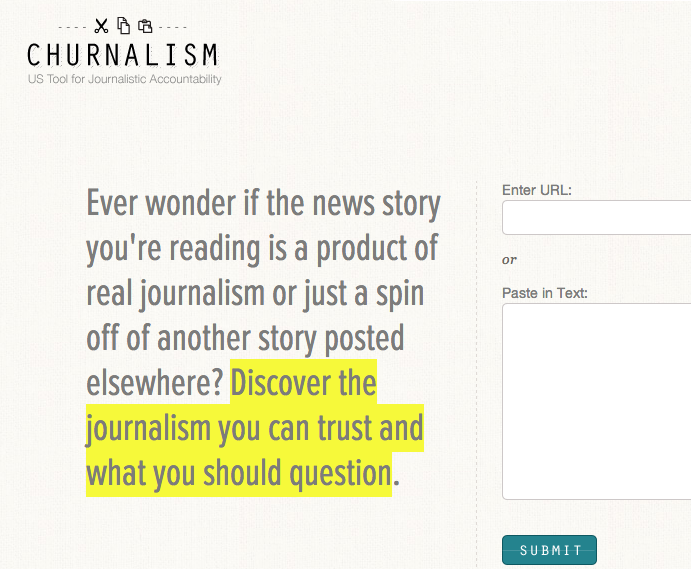
The Sunlight Foundation’s new site, Churnalism, helps hunt it down. Rebecca J. Rosen explains:
“The tool is, essentially, an open-source plagiarism detection engine,” web developer Kaitlin Devine explained to me. It will scan any text (a news article, e.g.) and compare it with a corpus of press releases and Wikipedia entries. If it finds similar language, you’ll get a notification of a detected “churn” and you’ll be able to take a look at the two sources side by side. You can also use it to check Wikipedia entries for information that may have come from corporate press releases.
The worst culprit? Science writing:
In general, according to Devine, “science press releases seem to get more plagiarized than others.” For example, the Sunlight Foundation points to a CBS News article from last fall which shares several phrases — typically information-laced descriptions such as the list “found in hard plastics, linings of canned food, dental sealants” — with a press release from EurekaAlert!, as the Churnalism tool’s results show. Devine speculates that science journalism may run into this problem more frequently because “the language around the findings in those is so specific that it becomes very hard to reinterpret it.”
 The Dish