Technology vs Writing And Thinking

enhanced-buzz-wide-16625-1366757841-21

[Re-posted from earlier today.]

George Saunders ponders the effects of computer technology on his life and work:

I have noticed, over the last few years, the very real (what feels like) neurological effect of the computer and the iPhone and texting and so on – it feels like I’ve re-programmed myself to become discontent with whatever I’m doing faster. So I’m trying to work against this by checking emails less often, etc etc. It’s a little scary, actually, to observe oneself getting more and more skittish, attention-wise. I really don’t know if people are “deep reading” less these days in favour of a quick fix on the internet – I think this is a thing one hears a lot, but when I travel to colleges here in the US there are always people reading Joyce and DFW and debating about literary difficulty and praising William Gaddis and so on.

I do know that I started noticing a change in my own reading habits – I’d get online and look up and 40 minutes would have gone by, and my reading time for the night would have been pissed away, and all I would have learned was that, you know, a certain celebrity had lived in her car awhile, or that a cat had dialed 911. So I had to start watching that more carefully. But it’s interesting because (1) this tendency does seem to alter brain function and (2) through some demonic cause-and-effect, our technology is exactly situated to exploit the crappier angles of our nature: gossip, self-promotion, snarky curiosity. It’s almost as if totalitarianism thought better of the jackboots and decided to go another way: smoother, more flattering – and impossible to resist.

Reading this and watching this riveting Tedx talk on the impact of online porn on young male brains – essentially numbing them to actual sex with real human beings and creating an epidemic of young men with floppy dicks (I refuse to use the term “erectile dysfunction” when simpler English can do) – has woken me up a bit. Writing and editing and producing 50 posts a day – and doing something very similar almost every day since Bill Clinton was president – must be affecting my brain. It’s not as powerful as the effect on the younger, developing brain, but, yes, skittishness, dissatisfaction, and constant stress have doubtless changed my entire mindset. And I can see the point about online porn making physical sex more difficult – especially if you spent your most formative sexual adolescence under the spell of constant, dizzying varieties of sexual imagery and video. How can one woman or one man even begin to replace that cornucopia of dopamine?

Our brains were designed to be turned on. But not this often, this instantly, this pleasurably and without any consequences at all. Once again, our frontal cortex is getting way ahead of our primate DNA. And the Tower of Babel grows ever taller.

Previous Dish on Saunders here, here and here.

(Image: Outside ad of a mouse-shaped prison via Copyranter)

The Daily Wrap

Today on the Dish, Andrew laid out the case for treating AIPAC like the NRA and joined Alec McGillis in questioning Bret Stephens’ Pulitzer prize. He answered more reader criticism of his take on the Boston bombing and jihad, stepped up the conversation with Millman and Dreher, and also noted the fresh case of a religiously motived attack in Canada. Elsewhere, he agreed with Frank Luntz that Republicans are whipped by talk radio ideologues and considered the toll of the hard drive on the sex drive.

In political coverage, Enten fact checked W. Bush’s “comeback” narrative as the curtain went up on Dubya’s presidential library, we kept an eye on the immigration bill and Rubio’s pitch and debated the merits of a bigger Koch presence in media. As the dust began to settle around the details of the Boston attack we recounted Boston’s history of covert jihad networking and connected the industrial tragedies of West, Texas and yesterday’s in Bangladesh. Readers asked Steve Brill how the US can catch up to other nations on health care as we investigated whether Obamacare’s exchanges will work out and Ben Geman noticed Kerry’s squeamishness on Keystone XL.

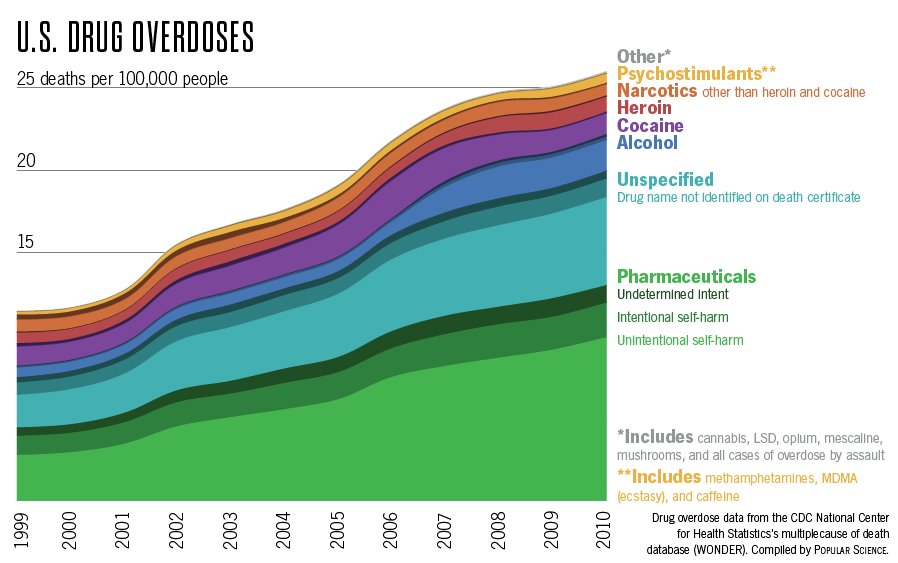
We realized that human rights still aren’t held in high regard the Afghan military as Shaun McCanna focused on its ongoing opium problem. We also witnessed drug overdoses double since 1999, with about half due to pharmaceuticals, blogs recorded the Mexican drug wars in lieu of old media and Shaunacy Ferro discovered the difficulty of studying psychedelics. Later, Mac McClelland observed gentle butchery and we saw an unsavory pro-hijab PSA in the Cool Ad Watch.

In assorted coverage, Dr. Thomas Murphy VII let A.I. play Super Mario Bros, Aaron Ansarov mashed up jellyfish artfully and mapped the world in carpet patterns. Dan Nosowitz spotlighted some anal-retentive drug mules, we surveyed a green skyline and explained why New York keeps its chic cheap. We looked out at Petaluma, California in the VFYW, glimpsed nature in the Face of the Day and Jimmy McMillan ran for mayor in the MHB.

–B.J.

Afghanistan’s Addicts

Shaun McCanna examines the effects of the country’s ever-booming opium industry, which grew over the past ten years from “supplying roughly 50% of Europe’s heroin to over 90% of the world’s”:

The increase in supply of heroin led to a dramatic drop in the domestic price. In Kabul, you can now buy three grams of pure heroin for $5 US. According to the UNODC, there are now over 1 million drug addicts in Afghanistan —roughly 8% of the adult population.

The problem is expected to grow worse as US and NATO troops leave the country:

Currently, foreign funds from US and NATO occupation account for 53% of the country’s Gross Domestic Product; illicit crops account for 26%. With the withdrawal of foreign troops, the amount of cash flowing into the country will dwindle, so illicit crops will become a larger—if not the largest—portion of GDP.

Will ACA’s Exchanges Work?

A new study in Health Affairs has Aaron Carroll worrying about their ability to bring down costs:

This study looked at people in Massachusetts’ health exchange and asked them about the issues they face due to health care costs. They found that 38% of patients reported a “financial burden,” defined as having problems paying medical bills, having to set up a payment plan to pay medical bills, or having trouble paying for things like food, heat, or rent because of medical bills. They also found that 45% of people reported higher-than-expected out-of-pocket costs for health care. This isn’t great news. It means that a significant number of people are still finding health care costs to be a real problem. It gets worse, though. Families with more children had more problems. So did families who make less than 400% of the federal poverty line.

Christine Vestal fears a lack of competition:

Health economists predict that in states that already have robust competition among insurance companies—states such as Colorado, Minnesota and Oregon—the exchanges are likely to stimulate more. But according to Linda Blumberg of the Urban Institute, “There are still going to be states with virtual monopolies.” Currently Alabama, Hawaii, Michigan, Delaware, Alaska, North Dakota, South Carolina, Rhode Island, Wyoming and Nebraska all are dominated by a single insurance company. The advent of the exchanges is unlikely to change that, according to Blumberg. …

[I]t is unclear how many insurance carriers will decide to seek approval for selling their products through these online marketplaces. Insurance companies have been mostly silent about their plans, with some citing uncertainty about federal and state rules as a reason for holding back.

Kerry, Keystone, And The Climate

Ben Geman reports on John Kerry’s reluctance to get involved in the battle over the Keystone XL pipeline:

“I am staying as far away from that as I can now so that when the appropriate time comes to me, I am not getting information from any place I shouldn’t be, and I am not getting engaged in the debate at a time that I shouldn’t be,” Kerry told the House Foreign Affairs Committee … Kerry noted the decision would ultimately come to him, but that until then the various steps of the review process aren’t complete. “It is not ripe,” he said. Kerry spoke in response to a question from Rep. Matt Salmon (R-Ariz.) about State’s years-long review of the Keystone project, which would bring oil from Alberta’s oil sands over the border and down to Gulf Coast refineries. …

Salmon and other advocates of the project were buoyed by the draft State Department review, which found that approving it would not have much effect on the rate of expansion of oil sands development, dealing a blow to critics.

Joe Romm worries about the State Department report’s blind spots:

Right now, Kerry has the State Department’s Draft Supplemental Environmental Impact Statement, but if that is all he information he relies on, he won’t get the full picture. While he will see that the project will only bring 35 permanent jobs, which is true, he would also see almost no discussion of the pipeline’s impact on the climate. (Oddly, he will be able to read an extended discussion of climate change’s projected impacts on the construction and maintenance of the proposed pipeline.)

Romm says Kerry should read the new report out from Oil Change International, which argues that the idea the the tar sands will be developed without Keystone is “simply incorrect”:

The Keystone XL tar sands pipeline is a project that will carry and emit at least 181 million metric tons of carbon dioxide equivalent (CO2e) each year. This is a conservative figure, based on industry analysis of the carbon emissions associated with current tar sands production. … [This] is equivalent to the tailpipe emissions from more than 37.7 million cars. This is more cars than are currently registered on the entire West Coast (California, Washington, and Oregon), plus Florida, Michigan, and New York – combined.

Between 2015 and 2050, the pipeline alone would result in emissions of 6.34 billion metric tons of CO2e. This is greater than the 2011 total annual carbon dioxide emissions of the United States.

David Biello summarizes the EPA’s comments [pdf] on the study:

[State Department A]nalysts assumed the tar sands oil would find a way out with or without the new pipeline. The U.S. Environmental Protection Agency does not agree. Keystone XL’s ability to carry an additional 830,000 barrels of tar sands oil per day is vital to expanded production of the tarry crude in Alberta. The EPA contends that the analysis by State got the economics all wrong. In particular the consultants were too optimistic about the ease with which the oil could be moved by railroad—an alternative already in use. But such tar sands oil transportation alternatives can more than triple the cost of moving crude. State’s report also neglected to consider the potential for congestion on the railroads with an uptick in oil transport, EPA contends. Of course, from a greenhouse gas perspective, transport by pipeline results in fewer emissions than transport by rail, truck or barge.

Could The FBI Have Prevented The Marathon Bombing? Ctd

Watch List Diagram

Philip Bump explains the significance of the reports that the government had Tamerlan on its terrorist watch-list:

The terror watch list, as it’s known, isn’t really a watch list. For one thing, it isn’t regularly watched. For another, it’s not one list. It’s more of a set of hierarchical, integrated databases which are checked under various circumstances, most notably when individuals want to travel. According to Reuters, after he was interviewed by the FBI in 2011, Tsarnaev was added to the Terrorist Identities Datamart Environment, or TIDE, which is compiled by the National Counterterrorism Center. It’s a list that comprises over half a million names. “Because of its huge size,” Reuters reports, “U.S. investigators do not routinely monitor everyone registered there, said U.S. officials familiar with the database.”

In other words, there’s a sort of pyramid of terror investigation. At the bottom of the pyramid are hundreds of thousands of people who’ve come to the government’s attention for some reason. As the FBI and other agencies look into behavior and patterns, people can move up the pyramid — fewer people evincing more suspicious behavior — winnowing to a point once held by Osama bin Laden. Or, after a determined time, people can drop out of the pyramid entirely if they don’t behave in a way that raises suspicion. That’s the track Tsarnaev was on.

Previous Dish on the information that the government had on the bombers here.

(Chart from John Hudson)

Chart Of The Day

drug_overdose

As part of Popular Science’s “Drug Week” coverage, Katie Peek parses the data on drug overdoses, which have more than doubled since 1999:

About half of those additional deaths are in the pharmaceuticals category, which the CDC has written about before. Nearly three-quarters of the pharmaceuticals deaths are opioid analgesics—prescription painkillers like OxyContin and Vicodin. And while cocaine, heroin and alcohol are all responsible for enough deaths to warrant their own stripes on the chart, many popular illegal drugs—including marijuana and LSD—are such a tiny blip as to be invisible.

Boston’s Jihadi Underground

J.M. Berger chronicles the history of CARE International, a Jihadi fundraising and recruiting network that operated in Boston throughout the ’90s (not to be confused with the humanitarian agency also called CARE):

Telling the IRS it was a non-political charity, CARE applied for and received a tax exemption, but its operations continued as before — supporting jihad overseas with money and men. Although it was heavily focused on the ongoing conflicts in Bosnia and Chechnya, its interests reached around the globe to anywhere mujahideen were fighting. As one associate of the group put it in a phone call recorded by the FBI, “As long as there is slaughtering, we’re with them. If there’s no slaughtering, there’s none, that’s it. Buzz off.”

In addition to hosting events at local mosques and universities, the group held fundraising “phonathons” and published a newsletter “stuffed with short, informative news items from various fronts in the global jihad,” mostly Bosnia.  After 9/11 came the crackdown, which led to arrests of many core members on a variety of charges:

Some of the group’s other associates, linked to al Qaeda, were convicted of conspiracy to commit murder overseas. But many involved in CARE’s operations at various levels were never arrested. In some cases, people who were involved in supporting jihadist activity abroad came to realize after 9/11 that their often well-intentioned support had been used to support terrorism against civilians and against the United States, and stopped participating in the scene. Others were simply not implicated adequately to prosecute, although they may have played important roles. Not everyone involved with CARE went to jail, but the organization itself had shut down when the IRS and FBI began investigating it aggressively in 2003, and almost no one involved completely escaped scrutiny.

From West, Texas To Bangladesh

BANGLADESH-BUILDING-DISASTER-TEXTILE

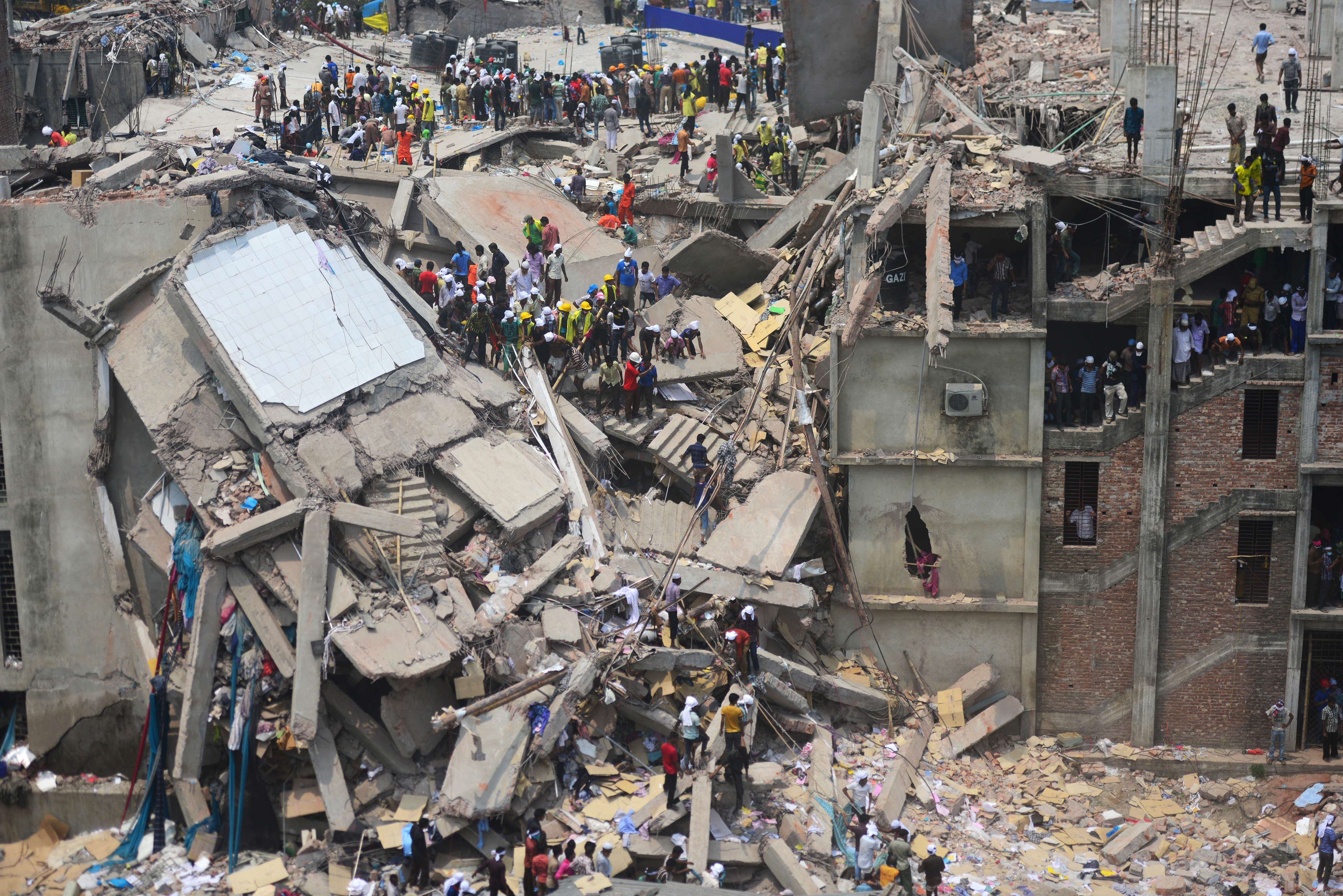
Erik Loomis argues that the reason we don’t see more tragedies like West, Texas is because the US has outsourced industries to places like Bangladesh, where a decrepit, eight-story clothing factory collapsed this week, killing at least 218 people. Loomis wants our labor laws to apply abroad:

In my mind, this is the only way to fight the outsourcing epidemic that provides a cover for irresponsible corporate policies. The injured workers and the families of the dead deserve financial compensation. The American corporations who buy the clothes produced by this factory should be required to pay American rates of workers compensation. Ultimately, we need international standards for factory safety, guaranteed through an international agency that includes vigorous inspections and real financial punishments.

Yglesias pushes back, arguing that “it’s entirely appropriate for Bangladesh to have different—and, indeed, lower—workplace safety standards than the United States”:

Bangladesh is a lot poorer than the United States, and there are very good reasons for Bangladeshi people to make different choices in this regard than Americans. That’s true whether you’re talking about an individual calculus or a collective calculus. Safety rules that are appropriate for the United States would be unnecessarily immiserating in much poorer Bangladesh. Rules that are appropriate in Bangladesh would be far too flimsy for the richer and more risk-averse United States. Split the difference and you’ll get rules that are appropriate for nobody. The current system of letting different countries have different rules is working fine. American jobs have gotten much safer over the past 20 years, and Bangladesh has gotten a lot richer.

Kimberly Ann Elliott sees the situation differently:

[C]ore standards like freedom of association, nondiscrimination, child labor, or forced labor are both fundamental rights, and they’re also framework rights in terms of having a well-functioning rule of law system in place for your economy. Those rights they can vary in the details but, and this is what the 1998 ILO declaration said, all countries, regardless of level of development, should respect these core rights.

Then you have all these other standards like health and safety, like wages, that will necessarily differ by a country’s level of development and, as Matt Yglesias says, by their choices. I wouldn’t go so far as Yglesias to say that therefore it’s only up to them. In a lot of these cases the workers aren’t making a fully informed choice to take these risks. They don’t know the chemicals are toxic. They don’t know that the building’s unsafe.

(Photo: Bangladeshi volunteers and rescue workers assist in rescue operations after an eight-storey building collapsed in Savar, on the outskirts of Dhaka, on April 25, 2013. Survivors cried out to rescuers April 25 from the rubble of a block of garment factories in Bangladesh that collapsed killing 175 people, sparking criticism of their Western clients. By Munir uz Zaman/AFP/Getty Images)