Alec McGillis wonders what Tom Friedman, Eugene Robinson and Steve Coll were thinking in honoring Bret Stephens in the wake of his disgusting campaign against the nomination of Chuck Hagel for SecDef.
Month: April 2013
The Immigration Reform Calculus, Ctd
Rubio’s immigration reform pitch:
Sean Trende finds reason to believe the bill is in the GOP’s best interest:
Softening its tone on immigration could help the GOP with moderate white voters, just as outreach efforts to African-Americans are frequently targeted more at this vote source.
But the obvious potential source of additional votes would be among moderate or conservative Hispanics. In fact, it is safe to say that this is what Republicans are really playing for here. Remember, the name of the game for the party isn’t to win Hispanics by the same share that they win whites, or even to win them outright. Republicans wouldn’t mind that, but it is unlikely to happen, given that Hispanics tend to be poorer and less conservative than their white counterparts.
Instead, what Republicans are trying to do is narrow the gap between Hispanics and whites among ideological and income groups. If moderate and conservative Hispanics had voted like moderate and conservative whites in 2008, John McCain would have lost the Hispanic vote by just two points.
Chait remains bullish on immigration reform’s chances:
There’s something ritualistic about the conservative objections Rubio is getting. It’s not a real revolt. They’re going through the motions to prove to their audience that they have kept their purity, but conservative talk-show hosts and other activist types are not, for the most part, actually doing what it would take to kill the bill.
Earlier Dish on the politics of immigration reform here and here.
The Gun Lobby, The Israel Lobby, And Double Standards

The last few weeks have been a fascinating insight into the language used to describe a powerful lobby in Washington. I’m not talking about the extremes here; I’m talking about mainstream left-of-center media. Let’s focus for a minute on the New York Times. Here are a handful of quotes from the paper’s recent editorial comments on the NRA, in chronological order:
“Americans puzzled by the growing gap between popular support for gun controls and Washington lawmakers’ obeisance to the gun lobby should know about the Congressional Sportsmen’s Foundation … This charity shows how deeply rooted the influence of the gun industry is on Capitol Hill and why getting sensible gun measures out of Congress is so hard, even after young children are massacred in their classrooms,” – NYT editorial, March 13.
“President Obama is being shouted down by the gun lobby … the president has been unable to break through the blockade set up by one of the most powerful and relentless lobbies in Washington… Polls show that more than 80 percent of Americans support universal background checks, but where are those Americans in this debate? The best-organized voices that officials have heard are those thwarting common sense on guns, forcing lawmakers to curl up and cower,” – NYT, April 4.
“South Dakota is currently leading the race to the bottom by arming teachers in their classrooms, but just wait; the pandering to the gun lobby is ferociously competitive,” – Bill Keller, March 24.
“Enactment of much-needed gun control legislation is being suffocated by thralldom to the gun lobby,” – a NYT letter, March 30.
“These senators made their decision based on political fear and on cold calculations about the money of special interests like the National Rifle Association, which in the last election cycle spent around $25 million on contributions, lobbying and outside spending,” – Gabby Giffords, NYT, April 17, in an op-ed called “A Senate In The Gun Lobby’s Grip.”
Pay attention to the rhetoric: the gun lobby holds the Senate in “thralldom”; senators fear its power to wreak revenge on them electorally or through advertisements – they are forced to “curl up and cower”; they exhibit “obeisance” to this small but intense lobby; they are in the lobby’s “grip.” The gun lobby is regarded as the reason there is a gap between public opinion broadly and the Senate’s voting patterns.
This is all Chuck Hagel ever said about the Israel lobby. The chief smear artist, Greater Israel fanatic Bret Stephens, called use of the word “intimidates” with respect to the Israeli Lobby as “ripe” with the “odor of prejudice”. In Stephens’ words:
The word “intimidates” ascribes to the so-called Jewish lobby powers that are at once vast, invisible and malevolent; and because it suggests that legislators who adopt positions friendly to that lobby are doing so not from political conviction but out of personal fear.
But that theme is exactly what has been ubiquitous in the NYT for the last few months – with respect to the NRA. Take Gabby Giffords’ words:
These senators made their decision based on political fear and on cold calculations about the money of special interests …
And yet no one has accused her of bigotry. Has it occurred to Stephens et al that she wasn’t being bigoted about the power of the NRA over Senators, and that “fear” of the NRA’s ability to destroy political careers is salient here. It is just as salient with AIPAC or creepier groups like Bill Kristol’s ludicrously titled “Emergency Committee for Israel,” – more so, in fact, given that almost every AIPAC initiative gets close to 100 percent support. Note, for example, how, during Israel’s pulverization of Gaza’s people and infrastructure in 2009, the American public was evenly divided. Not the Congress. As Glenn Greenwald noted at the time:
Not only does Rasmussen find that Americans generally “are closely divided over whether the Jewish state should be taking military action against militants in the Gaza Strip” (44-41%, with 15% undecided), but Democratic voters overwhelmingly oppose the Israeli offensive — by a 24-point margin (31-55%). By stark constrast, Republicans, as one would expect (in light of their history of supporting virtually any proposed attack on Arabs and Muslims), overwhelmingly support the Israeli bombing campaign (62-27%).
And remember that Rasmussen over-polls white older Republicans. So how did the US Congress react?
It unanimously passed by a voice vote a resolution backing Israel’s right to self-defense which Glenn described as a “completely one-sided, non-binding resolution that expresses unequivocal support for the Israeli war, and heaps all the blame for the conflict on Hamas and none of it on Israel.” AIPAC subsequently bragged about it.
My point is simply that talking about the Israel lobby in exactly the same way that everyone talks about the gun lobby is not and never has been ipso facto anti-Semitism. It is simply using very familiar rhetoric to bemoan the overweening influence of special interest groups in distorting public policy. The gun debate, it seems to me, proves this definitively, revealing the cynical, calculated wolf-crying behind the usual charges of anti-Semitism.
Imagine an op-ed in the New York Times which used exactly the same language about AIPAC as used about the NRA. Let’s look at those examples again.
“Americans are puzzled by the growing gap between popular opposition to West Bank settlements and Washington lawmakers’ obeisance to the Israel lobby …” “The pandering to the Israel lobby is ferociously competitive” … “Freezing Israeli settlement growth is being suffocated by thralldom to the Israel lobby” … “Polls show that Americans support an end to the West Bank settlements by 2 – 1 … but where are those Americans in this debate? The best-organized voices that officials have heard are those thwarting common sense, forcing lawmakers to curl up and cower” … “A Senate In The Israel Lobby’s Grip.”
Bret Stephens would find all this self-evidently anti-Semitic. The truth is that it is simply anti-special interest group. Yes, language describing nefarious lobbies behind the scenes pulling strings to get their way has been used in the past by anti-Semites. But if that kind of language is barred with sole respect to the Greater Israel Lobby, then the debate is effectively crippled – which is, of course, the point. For so long, the anti-Semitism card has been disgracefully, cynically played so that we can be stopped from debating the undemocratic distortion of our politics by special interest groups – in this case arguing for a foreign country’s brutal pounding of a de facto refugee camp.
Mercifully, the blogosphere has begun to break this double standard. Better late than never. One simple word of advice to bloggers writing about this: do not be bullied by threats. You will be smeared as a bigot, as I have been many times. But that says a whole lot more about them than it does about you.
(Photo: The American Israel Public Affairs Committee lobbyist line up outside of Russell Senate Office Building in Washington, D.C. on March 5, 2013. By Douglas Graham/CQ Roll Call/via Getty.)
Face Of The Day

This is the winning entry in the Society of German Nature Photographers‘ annual contest. It’s by Herman Hirsch. This slideshow is a bit of a marvel. There are shots where you marvel at the high-def precision and mastery of the camera; and others that look more like a Monet or an abstract piece of art.
Dissents Of The Day
The in-tray is still inundated with readers upset over the ongoing Dish debate over Jihad:
Dude, please pay attention to every word in the excerpt you’re trying to refute here. Words like
“compounded” and “linked to changing behaviors,” and even “depression.” For someone who’s been on the case regarding brain injuries in the NFL and some of the tragedies those injuries may have helped set the stage for, you seem rather inconsistent to label even considering this angle as “parody.” Even if you don’t want to stray to far from focusing on the religious aspects of this attack, wouldn’t finding similar damage to Tamerlan’s brain at least help advance awareness in the debate about sports in America?
Yes, maybe. But my mockery was not about CTE, which is a serious condition (but not often found on those as young as Tamerlan). It was about some ideological liberals’ desperation to find some kind of way to blame this on anything but Jihad. Why?
Another reader:
What is up with you this week? “liberal wish-mongering” “liberal bullshit” “high-minded nonsense”. Is this how you shore up your conservative bona fides these days?
It is dispiriting to read a usually articulate and considered writer flailing about, knocking down strawmen for what seems like no purpose. Are you getting lots of hate mail? It’s worth noting that your moral compass with regard to terrorism does not work very well, as you highlighted a couple months ago during the 10th anniversary of the Iraq invasion. You have admitted to a form of post-9/11 PTSD. Perhaps it’s worth taking a step back and remembering that “to see what’s in front of one’s nose needs a constant struggle.”
I am not a blogger who tries to shore up my liberal or conservative “bona fides”. I have offended both sides just as much over the years, depending on events and issues. I write what I think is true. I think a desperate search for something other than religious motivation for the terrorism is a form of denialism. Another reader:
For a guy who over reacted rather shamefully after 9/11 (“fifth column”, support of the Iraq war) maybe you want to tone down the utter confidence in your understanding of what has just taken place, a confidence that is producing rather routine snide dismissals of anyone who wants explore the issue in directions you disagree with, or simply want to say “we don’t know yet”. You may be entirely right in your assessment of what took place, but there is going to be a lot more information to come out. Neither your finest, nor more interesting moment. Frankly, rather brutish and bullying.
The most original reaction:
Your smug knee-jerk rejection really crottles my chitlins.
Knee-jerk rejection? When I explicitly wrote: “Yes, we can explore every angle.” One angle a little more fruitful might be a check on his testosterone levels. He looks a little juiced to me in the photos we have. And that could exacerbate his religiously-inspired violence. CTE seems much larger a stretch.
Unfiltered feedback from readers on our Facebook page here and here.
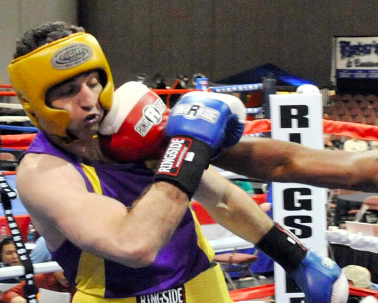
(Photo: Tamerlan Tsarnaev (L) fights Lamar Fenner (R) during the 201-pound division boxing match during the 2009 Golden Gloves National Tournament of Champions May 4, 2009 in Salt Lake City, Utah. By Glenn DePriest/Getty Images)
Ask Brill Anything: Overpaying For Worse Care
Steven lets us know how poorly the US healthcare system ranks compared to other developed nations, with a follow-up regarding which free market-based reforms we should pursue to help remedy that:
Brill recently debated this same topic on Fareed Zakaria GPS. Yesterday, Steven explained how hospitals have become so profitable. Before that, he gave us an overview of why US healthcare is so expensive. You can also go here, here and here to read our coverage of his stunningly good Time cover-story, “Bitter Pill: Why Medical Bills Are Killing Us”. A reader chimes in:
Have been enjoying your Ask Anything videos with Steven Brill so much so that I bought the Time Magazine issue containing his article. This all reminds me of reading T.R. Reid’s, Healing of America a few years ago. For the book, Reid, a longtime journalist and foreign correspondent for several news organizations, took his bum shoulder for treatment in a multitude of healthcare systems around the world. He looked at all kinds of health system schemes and lists and compared the kudos and flaws in each. He also showed the US reader the areas of socialized medicine we have in America that are working well and, in fact, are taken for granted by us as US citizens. (More praise and a more complete review of Reid’s book here.)
When we met Mr. Reid at a lecture in Portland, OR, in 2007, he noted that the medical system he would personally choose, as a parent, would be the British system where everything is free and an aggressive system for preventative health care is in place to keep the populace in a generally healthy state most of the time. For myself, after reading his book, I felt envious of the French with their little medical ID card carrying all their medical info wherever they went. Any doctor a patient consults can have up-to-date personal information without keeping mounds of paperwork in his back room or needing to employ several people to sit for hours a day transcribing medical codes into what an insurance company with or will not pay for.
Ask Anything archive here.
Limbaugh, Levin And The Future Of The GOP
Frank Luntz tried to keep the following statement a secret at a recent University of Pennsylvania talk. But nothing is secret when everyone has a smart phone. Money quote:
“And [Rush Limbaugh and Mark Levin] get great ratings, and they drive the message, and it’s really problematic. And this is not on the Democratic side. It’s only on the Republican side…[inaudible]. [Democrats have] got every other source of news on their side. And so that is a lot of what’s driving it. If you take — Marco Rubio’s getting his ass kicked. Who’s my Rubio fan here? We talked about it. He’s getting destroyed! By Mark Levin, by Rush Limbaugh, and a few others. He’s trying to find a legitimate, long-term effective solution to immigration that isn’t the traditional Republican approach, and talk radio is killing him. That’s what’s causing this thing underneath. And too many politicians in Washington are playing coy.”
Coy? I’d say simply too scared to speak. But Luntz is right. The GOP leadership, if it still exists, needs to disown these two fanatics and haters if it is to stand a chance of becoming more than white, old, male and angry.
How Humane Can Slaughter Get?
Mac McClelland visits “one of the first ranches to … to gain Certified Humane Raised and Handled approval”:
The next cow, the cow I watch die, is quiet. It is black. It comes casually down a walkway. It steps into a squeeze chute, the metal hugging cage that closes in on the cows’ sides to calm them. Scott Towne, the guy in charge of the killing, hits it with a CASH Knocker, a blank shell shooting from a metal apparatus at the end of the long, wooden-handled device and into the front of the head above the eyes, denting the skull but not penetrating its brain, rendering the animal insensible. Instantly the cow’s eyes close. Its neck is lax and its mouth open, easy as a child asleep at the dinner table, or a businessman asleep on a plane.
Stopping at a bar on the way home to bourbon-gargle the lingering deathiness and nausea from the back of my throat, I ponder the cow’s existence. Whether or not farmers should torture animals, or keep them in disgusting and overcrowded and shit-filled conditions, or murder them slowly, are not even questions. Prather’s Northern California grass-munching herd is obviously as well treated as any in natural life, but “good” death is not so easily codified.
“Can you make a slaughterhouse perfect?” Grandin asked in Iowa. “No, nothing in this world that’s a practical thing can be made perfect. That’s just impossible.”
For those who kill animals for a living, making peace with those imperfections is a daily affair.
Creepy Ad Watch

Prohibition In The Lab
Shaunacy Ferro reveals the dizzying red tape that surrounds scientific research on psychedelics:
Currently, according to the DEA, it takes about 9 months to get FDA and DEA approval for a license to research Schedule I substances, though researchers are a little more skeptical. “The DEA’s not in a hurry to grant these licenses,” according to [David Nichols, one of the founders of the Heffter Research Institute to study psychedelics].
Only 349 scientists have them, and that number is on the downswing: Three years ago, there were 550 licenses in the U.S. Nichols suggests that this could be a result of the DEA cracking down on researchers with extraneous licenses. In the past, Schedule I licenses had been renewed on a yearly basis without much fuss, but in recent years the agency has required Nichols to submit his current protocol and justify why he still needs the license.
The free market hasn’t stepped up because “no pharmaceutical company needs or wants to get involved”:
There’s no money in it for them. Though drugs like LSD and psilocybin are relatively easy to make in the lab, as [ Multidisciplinary Association for Psychedelic Studies] founder Rick Doblin pointed out in a 2012 interview, “psychedelics are off-patent, can’t be monopolized, and compete with other psychiatric medications that people take daily.”
“My colleagues say to me, in these days of nanotechology and targeted therapy, what are you doing?” says Donald Abrams, a professor of medicine at the University of California, San Francisco who has done research on medical marijuana. “We live in the 21st century. Studying plants as medicine is not where most investigators are putting their money.” And without the outside funding to continue researching, a scientist’s career goes nowhere, so even fewer scientists want to get involved.
 The Dish