The sting from a Portuguese man-of-war hurts like hell, so most people avoid the jellyfish-like creatures. Not Aaron Ansarov — he and his wife don rubber gloves and collect them when they wash up on the beach near their home in Delray Beach, Florida. They take the creatures back to their house and Ansarov photographs them on a makeshift light table and then mirrors the image in Photoshop. He shot dozens of them this past winter and the result is a unique, psychedelic portfolio.
Dan Nosowitz unpacks the biology of drug mules smuggling large amounts of drugs inside their rectum, a practice known as “booty bumping”:
The problem I kept running into in trying to figure out how much cocaine you could fit in your butthole is that, well, there isn’t really an upper limit. It’s all about conditioning and practice. That said, let’s take that 800 mL as an example upper limit. Given the density of cocaine hydrochloride, that converts to about 0.97 kilograms of cocaine, or very nearly the size of one of those big bricks you see confiscated on the news. And that 800 mL isn’t unheard-of; it’s probably on the low end for someone who performs a lot of rectal stretching activities.
Update from a reader:
Booty bumping is taking drugs via the anus, where they’re easily absorbed. It’s a real problem in the gay community here in San Francisco since lots of drugs are corrosive and can leave wide-open opportunities for infections to take hold, thus increasing the odds of any given STI.
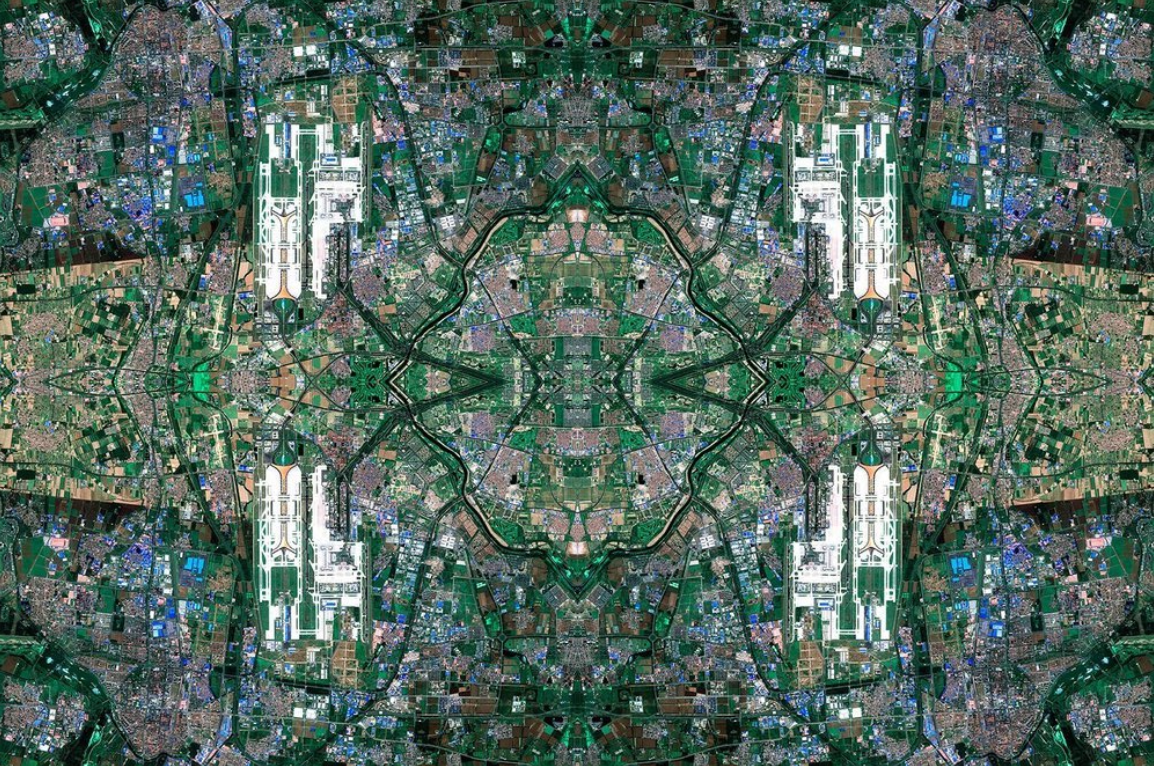
Irish artist David Thomas Smith borrows age-old designs from Persian rugs and repatterns them with screengrabs from Google Maps. From an interview with Smith:
Aesthetically, the initial influence came from Afghan war rugs, I really liked the idea of the rug being used as a document, and this in turn led me to the more decorative Persian motifs as a source of inspiration…. The use of Google Maps (was an obvious candidate, the image quality is by far the best) came about because as [Lev] Manovich said most things are already photographs. For me, a great deal of documentary photography is becoming more and more about the re-contextualization of the image. It’s about taking existing images and giving them new meaning.
(Image: Beijing International Airport, Beijing, People’s Republic of China, 2009-10)
Upscale items and services are generally cheaper in NYC:
In a high-income city like New York, grocery costs are 20 percent lower for high-income people than they are in a low-income city like New Orleans (whereas costs are about 20 percent higher for low-income people in the rich city than the poor city). That’s because there’s a very high concentration of highly skilled people here, so there are a lot of vendors competing for the business of those high-income people, effectively lowering costs and increasing the variety of products that appeal to this consumer group.
Professor Handbury looked specifically at food, but she said that for most things you buy, there are probably positive externalities that come from living around a lot of people who have tastes similar to yours.
Catherine Rampell’s NYT magazine article goes into more detail:
Part of the reason high-income residents get good deals, Handbury explains, results from a particular economic system. Highly educated, high-income New Yorkers are surrounded by equally well-educated and well-paid people with similar tastes. More vendors compete for their business, which effectively lowers prices and provides variety. There’s also a high fixed cost to distributing a niche product to an area; if there’s more demand for that product, then the fixed cost can be spread across more customers, which will justify bringing the product to the market in the first place. That’s why companies go through the expensive hassle of distributing, say, St. Dalfour French fruit spreads in rich cities but not in poor ones and why New York can support institutions like the Metropolitan Opera.
Today on the Dish, Andrew fired back at Greenwald in debating the Boston bombers and jihadism, expounded on his view of Islam and modern terror, agreed with Beinart on the takeaway of the Tsarnaevs’ Caucasian identity and rolled his eyes at ongoing attempts to sidestep the religious explanation. Elsewhere, he unleashed further on Bill Keller’s editorial line on torture, and reflected on the changing significance of the question, “are you gay?” and happily noted that good content means good business.
In political coverage, we dovedeep into the politics of immigration reform, revisited the Gulf oil spill and asked whether the FBI dropped the ball in Boston. On the eve of his presidential library opening, we took stock of George Bush’s apparent PR recovery and sensed some love lost between Dubya and his Vice. Barro set the record straight on workplace mortality, readers asked Steve Brill how hospitals turned into profit mills, we debated the politicization of the sequester. Finally, we considered whether citizenship should be up for bidding as Millennials turned out to be a generation in the passenger seat.
In miscellanea, readers responded to the masturbatory debate, we glimpsed a Matrix-esque rehab program, and Dish met Phish. Matt Honan grasped for a solution to misinformation on Twitter, Virginia Heffernan praised the Internet’s new language of looking, and Adam Alter illuminated the clout of color over our minds. Lisa Margonelli proved the eco-friendliness of living mobile as we tasted a stiff glass of enviro-whiskey.
We followed the longstanding blowback of bullying, Amy Benfer took apart love in The Little Prince, and Tom Junod dispensed wise words on how to sustain a marriage. Lastly we welcomed spring back with a beat in the MHB, spent a moment at a Muslim vigil in Boston for the Faces of the Day and peeked out at the Upper West Side in the VFYW.
A reader points out that the caption on the picture of Stylianos Kyriakides posted earlier undersells “arguably the most significant Boston Marathon victory of all time”:
That’s the best you can do? I don’t think you could have understated Stylianos Kyriakides victory any more. Kyriakides’ victory in the Boston Marathon in 1946 changed the world. There’s a very, very inspirational story behind the picture. Do you know what it is?
William Lambers summarizes Kyriakides’ achievement:
His mission was to bring attention to famine and suffering in his homeland. During World War II the German Army left Greece practically in ruins and short on food. Aid was desperately needed. April 1946 was a pivotal time in world history; hunger then was the World War II enemy that had yet to be defeated. …
For Kyriakides, the Boston Marathon offered an opportunity to shine the spotlight on the hunger in his homeland. He faced a tough challenge. There was the defending champion Johnny Kelley and other great runners to contend with. Kyriakides also had to overcome years of living in the harsh occupation conditions with below-average nutrition. His life had been spared by German troops because he was a marathoner and had competed in the 1936 Berlin Olympics.
Kyriakides overcame the odds, overcame the great Johnny Kelley, and sprinted to victory in the marathon. When he crossed the finish line he shouted “For Greece!” for he knew what this victory would mean in telling the world of his country’s plight. His mission was not over even after he crossed the finish line, though. Next was touring the country to raise donations for Greek relief.
The NoFap “movement” is much more about Internet porn than it is about fapping, whether the participants are aware of this or not. It’s not that frequent masturbating in itself is detrimental to sexual performance; it’s that frequent masturbation to online pornography is detrimental to sexual performance. For the first time in human history, a male can view more sexually arousing females in one hour than our ancestors did in a lifetime. The ubiquitous nature of Internet porn has provided a level of sexual novelty that our brains have not evolved to handle. The key here is dopamine and the brain’s reward circuitry. It’s one thing if you masturbate to mental images. It’s another if you just look at porn. Combine the two to orgasm, day after day, and you will have very real, very detrimental consequences to sexual performance. And once you do this for years on end, it becomes increasingly difficult to maintain boner-levels of dopamine when you’re with just one, 3-dimensional woman.
There is an epidemic of younger guys who are struggling with erectile dysfunction, seemingly due to the over consumption of Internet porn. Check out Gary Wilson explaining the problem in his TEDx talk [above]. So you get this group of guys who can’t get aroused by a real girl (or guy), maybe throw in some other issues such as depression and social anxiety, and due the psychological and social aspects of masturbation, they misinterpret cause-and-effect and quite “fapping” when they should be quitting porn.
Another confesses:
I can’t even maintain an erection in a condom anymore, and during sex often think about the porn scene I watched the previous (or that same) day. Refraining from porn, deleting our downloaded collections, is an attempt to get some control back in our lives.
Another recommends a website that might help:
The Your Brain on Porn site, for all its pseudoscientific sins, was the first place I found that convinced me that maybe too much porn wasn’t such a good idea. I’d heard that a lot before, but always from people who said it would rot your brain and turn you into a crazed junkie craving your next lolicon bukkake fix, or from people who implied that clearly, a true manly man wouldn’t need such artificial aids for his sexual needs, both of which are viewpoints I reject. After browsing on NoFap, I kind of get how porn and masturbation can be natural and healthy for some people, but just not a good idea for others, especially those who did too much too early and missed a lot of early sexual experience.
Another:
I’m as skeptical as the next guy about the magic bullet properties of nofap. They’ll write it cures depression, inspires motivation, and makes you irresistible to women. This should be taken with a grain of salt. But I can tell you from experience – as a 33-year-old gay man who’s been on Viagra for seven years, who was given my first tablet from a 30-year-old man who was dependent on them, who has a handful of straight and gay friends who “can’t stay hard with condoms”, who knows guys who fight ED in their early 20s, and knows guys who can only come if it’s on someone’s face – there’s something happening to young men these days.
A lot of guys find the forum from the website yourbrainonporn.com. It features Gary Wilson’s TedX talk “The Great Porn Experiment” and Philip Zimbardo’s “The Demise of Guys”. It’s compelling stuff; the idea that Internet porn is not your father’s Playboy collection, that our brains aren’t equipped to handle what we’re putting them through, and the effects of tying dopamine reception to internet porn daily, for years at a time.
I encourage you guys to check out the site. It’s an interesting subject, and it deserves better than what New York magazine and Gawker gave it.
Mat Honan struggles with correcting errors or misinformation on Twitter, like the recent tweet from the AP’s hacked account:
Here’s the problem with the way the current system works. Let’s say you tweet something that turns out to be incorrect to your 100 followers. Let’s say 5 of those retweet it to their 100 followers. At this point, some 595 potential people have seen it. (Or at least spambots, but bear with me.) You realize your error, and issue a correction on your Twitter feed. Your 100 original followers may see the update, but it leaves 495 who do not unless those same five people again retweet you. In short, while the automatic retweet button on Twitter lets people spread information far and wide beyond your followers, there’s no way to makes sure those same people see your attempts to correct it.
His suggestion:
So here’s one way it could work using Twitter’s metadata. Twitter could add a function, similar to a retweet or favorite, that let you edit and correct a tweet after it had been posted. Those tweets then show up in a timeline as having been corrected–again, they could be flagged like favorites or retweets. Click on a tweet marked as edited, and it uses Twitter’s Cards function (the same system that lets tweets embed images, videos, and text) to show the original.
That’s the number of states that will soon have marriage equality, with today’s news from that little state. All of New England now guarantees civil equality. Delaware’s House just passed a bill as well. TP notes:
Rohin Dhar explores the success of the popular jam band, whose revenue from ticket sales over the past four years “handily [surpasses] more well known artists like Radiohead, The Black Keys, and One Direction”:
From 1989 onward, before the band had even been signed to a record label, Phish was profitable from live touring. … Because Phish achieved financial independence before the music industry even recognized them, they more or less could do whatever they wanted.
The took their early profits and started their own management company, Dionysian Productions. They hired a staff of 40+ people that handled their elaborate stage productions and back office operations. They built their own merchandise company so that their shirts and other paraphernalia reflected the band’s artistic sensibilities. They even started a mail order ticket company so that fans could send them money orders and buy tickets directly from the band.
… Perhaps more so than any major musical artist today, the Phish business model is derived from having hard core fans of its live music. When Madonna sells out arenas across the country, she’s selling tickets to her various fans that live everywhere. When Phish sells out arenas or festivals across the country, it’s because the same die-hard fans fly across the country to see the band. In the rare instances where fans don’t make the trek and the shows don’t sell out, the band punishes the no-shows by performing a particularly epic set. In a forum where ardent Phish fans compare how much money they had spent on going to see the band, the answers were in the tens of thousands of dollars.


 The Dish