The Immigration Reform Calculus, Ctd

Alex Engler’s analysis from February looks at how immigration reform could affect the House. He finds that, “while the Republican Party has a great deal to gain from successful bipartisan immigration reform, House Democrats face little benefit and even, paradoxically, the possibility of significant losses.” The main reason why:

Democrats currently control the majority of districts with large Hispanic populations. There are 39 Republican districts that are more than 20 percent Hispanic, and only five that are more than 50 percent Hispanic (compared to Democrats’ 76 and 28 districts, respectively).

This concentration of the Hispanic vote means that “a dramatic shift in Hispanic support toward Democrats would have yielded startlingly small gains in the House”:

Under the 42 percent Hispanic voting scenario, a 10 percentage point shift toward Democrats would net only one additional seat, and a 20 percentage point shift would turn only six seats. Conversely, shifts away from Democrats by Hispanics could be devastating. Under the 42 percent scenario, a 5 percentage point shift toward the GOP would have turned five races into Republican victories. A 10 percentage point shift to the right would have handed Republicans 12 seats, and a 16 percentage point shift would have flipped 21 districts. Using the lower turnout models reduces the number of seats changing hands, but the narrative remains the same.

Drum adds his two cents:

This doesn’t answer the question of which party immigration reform is likely to help. What it does say is that it’s a no-lose proposition for Republicans. Even if it turns out to help Democrats more, Republicans aren’t likely to suffer much because of it.


Quote For The Day II

“If they are going to kill him. I don’t care. My oldest son is killed, so I don’t care. I don’t care if my youngest son is going to be killed today. I want the world to hear this. And, I don’t care if I am going to get killed too. And I will say Allahu Akbar!” – Zubeidat Tsarnaeva, mother of the Boston Marathon bombers.

Eco-Friendly Intoxication

Reduce your carbon footprint with a shot of Scotch:

Helius Energy officially cut the ribbon on its new Scottish biomass power plant in Rothes [last week] at the inauguration of the latest facility capable of turning whisky by-products into energy.

The Helius CoRDe Ltd biomass energy plant and animal feed processing unit in Speyside was formally opened yesterday by HRH The Duke of Rothesay, with promise of delivering clean power to 9,000 homes in the region. The 8.23MW combined heat and power plant has been developed by a joint venture incorporating biomass power developer Helius Energy, Rabo Project Equity BV, and the Combination of Rothes Distillers Limited (CoRD), and will now replace the carbon intensive CoRD plant that has previously been used to process waste biomass produced by the region’s world famous whisky distilleries.

The Deepwater Horizon Legacy

British Petroleum's Oil Spill

Brian Merchant marks the three-year anniversary of the rig explosion by checking in on the damage:

Billy Nungresser, the president of Plaquemines Parish, which covers the part of Louisiana most heavily hit by oil after the initial spill, says that the oily fallout continues to this day. Just yesterday, Nungresser told a local TV news station that “oil is still washing ashore in places like Bay Jimmy.”

Meanwhile, fishermen say their catch is still drastically lower than it was before the spill—and the onslaught of chemical dispersants BP used to try to contain it. “The damage is still ongoing right now. My shrimp is down 40 percent and my oysters are down 93 percent,” George Barisich, president of the United Commercial Fisherman’s Association, recently told Eyewitness News. He believes that the dispersant—a proprietary cocktail called Corexit that is believed to be comprised of butoxyethanol, organic sulfonates, and a small concentration of propylene glycol—interrupted the reproductive cycle of the shellfish in the region.

Mark Hertsgaard focuses in on the controversy surrounding Corexit at the time:

Wilma Subra, a chemist whose work on environmental pollution had won her a “genius grant” from the MacArthur Foundation, told state and federal authorities that she was especially concerned about how dangerous the mixture of crude and Corexit was: “The short-term health symptoms include acute respiratory problems, skin rashes, cardiovascular impacts, gastrointestinal impacts, and short-term loss of memory,” she told GAP investigators. “Long-term impacts include cancer, decreased lung function, liver damage, and kidney damage. (Nineteen months after the Deepwater Horizon explosion, a scientific study published in the peer-reviewed journal Environmental Pollution found that crude oil becomes 52 times more toxic when combined with Corexit.)

BP even rebuffed a direct request from the administrator of the Environmental Protection Agency, Lisa Jackson, who wrote BP a letter on May 19, asking the company to deploy a less toxic dispersant in the cleanup. Jackson could only ask BP to do this; she could not legally require it. … Knowing that EPA lacked the authority to stop it, BP wrote back to Jackson on May 20, declaring that Corexit was safe.

Meanwhile, Shiva Polefka is disappointed by Congress’ inaction since the accident:

[T]he legislative branch has yet to pass a single law strengthening federal oversight of offshore oil and gas development. Congress did enact the RESTORE Act which allocates 80 percent of BP’s civil penalties to the affected Gulf Coast states, so they can apply it directly the environmental restoration and economic recovery. …

[O]ther than the RESTORE Act, Congress has done “nothing about the many other critical issues the Commission identified to improve safety and environmental protection.” A year ago, my colleagues at the Center for American Progress highlighted the need for Congress to raise the absurdly low $75 million limit on spill liability that oil companies currently face. While BP voluntarily excluded itself from the cap, the cleanup cost for Deepwater Horizon to date stands at over $14 billion, demonstrating starkly the fiscal as well as environmental risk to the American public from Congressional inaction. Similarly, Congress has refused to codify any new safety standards for offshore drilling. As a result, the gains made through Obama administration rulemaking, and voluntary industry efforts, could easily be easily lost to the whims of the next administration.

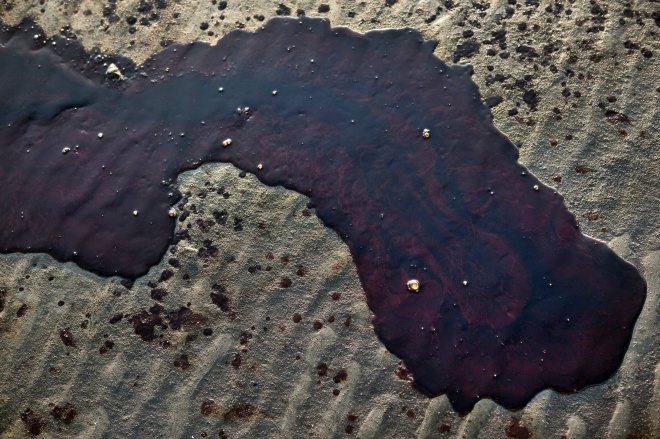
(Photo: Crude oil released following the sinking of the BP Deepwater Horizon drilling rig, washes ashore on June 9, 2010 on Grand Terre Island, Louisiana. By Benjamin Lowy/Edit by Getty Images)


W In The Rearview Mirror

US President George W. Bush (C) delivers

Daniel McCarthy attributes the bump in Bush’s favorability to nostalgia:

Republicans have reason to be a little wistful for the Bush years. And there’s a feeling among centrists that whatever his mistakes, the party Bush led wasn’t as nasty as it has since become.

Larison suspects it’s a function of politics in the present:

If I had to guess, I’d say that Bush’s higher approval mostly comes from people that want to express their disapproval of the current president, and this includes quite a few people who disapproved of Bush while he was in office. One way to do that is to affirm that Bush did a good job. If we look at the results by party identification and ideology, that tells us part of the story. 84% of Republicans and 45% of independents say they approve of how Bush “handled his job as president.” Both figures are much higher than they were in 2008. This reflects the perverse rally effect that causes some people to embrace their disastrous leaders simply because people on the other “side” keep attacking him.

Weigel agrees after speaking to the Tea Party crowd:

In February 2010, a Tennessee lawyer named Judson Phillips put on a miraculously successful National Tea Party Convention, and he became, for a while, a movement spokesman. “The Tea Party movement does not defend George W. Bush,” said Phillips in February 2010, promoting the convention. “George W. Bush is not exactly one of my favorite people.”

Today, Phillips follows the “Obama was worse” line. “The one factor, other than just the passing of time that is helping Bush,” he says, “is the way people remember the economy of the Bush years versus what I like to call the Great Obama Depression. If you compare the Bush economy to the Obama economy, I think a lot of people look back wistfully saying, ‘I was better off 10 years ago than I am today.’ ”

This is just desperate counter-factual denialism. Some were blaming the debt Bush’s wars, spending and Wall Street collapse almost as soon as Obama took office! And that kind of denialism is not a way out of the Republican hole but burrowing deeper into it. Bouie argues that Republicans need to make a clear break with Dubya or perpetually suffer guilt by association:

[T]his is a recipe for failure. The GOP’s losing streak, from the 2006 wave election to Obama’s re-election victory in 2012 (with a brief respite in 2010), has everything to do with George W. Bush, and Iraq in particular. It’s what gave Democrats the House and the Senate in 2006, and it’s a large part of what gave Barack Obama the presidency in 2008. And for as much as election fundamentals could predict the outcome of last year’s election, it’s also true that Democrats got a lot of traction out of tying Republicans to the “failures of the past.” Americans still remember the Bush years, and as long as Republicans are committed to same policies, they’ll still hesitate to give them the reins of state.

Joan Walsh advises the right to keep Bush out of the spotlight:

Bush’s ratings only improved because he went away. His comeback campaign is likely to remind people of the disaster he left in his wake, and backfire on him, his brother and his party.

Recent Dish on George Bush revisionism here.

(Photo: US President George W. Bush delivers remarks 01 May 2006 from the South Lawn of the White House in Washington, DC on the recent trip to Iraq by US Secretary of Defense Donand Rumsfeld and US Secretary of State Condoleezza Rice. Three years after his famous photo-op before a banner hailing ‘Mission Accomplished’ in Iraq, Bush declared that the war-torn country had finally turned a corner in establishing security and democracy. By Paul J. Richards/AFP/Getty Images.)

Bill Keller Won’t Correct An Error Of Fact

The former executive editor of the New York Times recently wrote the following sentence on his blog:

The editors (I was one at the time) argued that what constituted torture was still a matter of debate, that this issue was not just linguistic but legal and had not yet been resolved by a court, and that the word was commonly applied to such a range of practices as to be imprecise.

This is untrue. As I subsequently pointed out, there is a plethora of court cases that deal with the techniques Bush and Cheney authorized, and all of them found them to be torture. None had even the slightest equivocation about it. In fact, the one torture tactic that both former president Bush and former veep Dick Cheney have openly bragged about – waterboarding – has been ruled torture by domestic and international courts for decades. You could argue that there was a debate about some of the techniques, but not waterboarding in any way shape or form. If you were squeamish, you could have used the term “torture and other brutal interrogation techniques” in the NYT to describe the policies of the US government under Bush and Cheney. But Keller didn’t. Even that was too daring for him.

A factual untruth is still sitting on the blog of the former executive editor of the NYT. He has now written a subsequent post without any correction of the previous one, and not responded to the mountain of comments taking him to task. He appears to be compounding his cowardly refusal to use the English language when editing the paper with uncorrected factual untruth on his blog. And people wonder why journalists are held in such low regard.

If the former editor of the NYT doesn’t bother correcting the record, why should anyone else?