Could The FBI Have Prevented The Marathon Bombing?

While members of Congress continue to question whether or not the FBI properly handled its 2011 investigation of Tamerlan, Eli Lake explains Russia’s likely ulterior motives:

Russia’s intelligence service, the FSB, warned the FBI in 2011 about a young Chechen named Tamerlan Tsarnaev, who they believed had become radicalized and was prepared to join an underground organization in Russia. The FBI interviewed the man, searched its databases and found nothing, and closed the case the same year. … But there were good reasons that the tip didn’t trigger a more aggressive American investigation, current and former intelligence and law-enforcement officials tell The Daily Beast.

Those officials pointed to the FSB’s habit of treating much behavior by Chechens as suspicious, and nearly all such behavior as terror-related. The Tsarnaev request, they speculated, was likely triggered by the FSB’s concern that he would participate in or provide support to Chechen insurrectionists in Russia, rather that by any sense of a threat to American interests.

Hunter Walker speaks with a former FBI counterterrorism executive who further details why the US has to be suspicious of such requests from foreign governments:

“Generally speaking, certain foreign governments try to keep track of their expatriates, especially those who are outspoken on human rights issues,” the former [FBI] executive explained. “Countries will submit names to us and will say, you know, this guy’s a bad guy, a terrorist, or a drug trafficker, or whatever. And what you have to be careful about is, you may be being used as a proxy by a foreign government or a foreign intelligence agency to keep track of or to report back on their expatriate community in the United States. Their intent may not be as straightforward as determining whether or not they’re a terrorist or not.”

The Seedy Side Of The Little Prince

little-prince

On the 70th anniversary of the famous children’s book, Amy Benfer criticizes the prince’s understanding of love:

He is driven off his home planet when made half mad over the love of a flower, a rose described as vain, weak, emotionally manipulative, “contradictory,” and given to “silly pretensions,” and who often coughs to hide her lies. “You must never listen to flowers,” confides the prince. “You must look at them and smell them.” This unflattering portrayal of romantic love seems even less appealing when one considers that the prince’s rose is widely considered to be a stand-in for [author Antoine de Saint-Exupéry’s] wife, Consuelo Sunsin, a tempestuous beauty from El Salvador (like the prince’s planet, home to three volcanoes), whom he often left alone during his travels, while he engaged in frequent adultery — the sin so singular to adulthood it shares its name.

Consuelo was no shy flower herself, but the portrait she created of their marriage in her posthumous memoir The Tale of the Rose: The Love Story Behind the Little Prince, published days before the centennial celebration of Exupéry’s birth in 2000, was damning enough to put quite a damper on the festivities.

Despite the devout love it has inspired in generations of impressionable teenagers about to cross over into courtships of their own, Le Petit Prince is not a particularly convincing love story. It is better at describing the platonic friendship between equals that sustain men wandering away from their women: the prince and the fox; the pilot and the prince. The prince protects his rose, shields her behind glass, but never understands her. In a grisly twist, the souvenir he brings back to his planet to commemorate his travels — the sheep in the box — may or may not kill her.

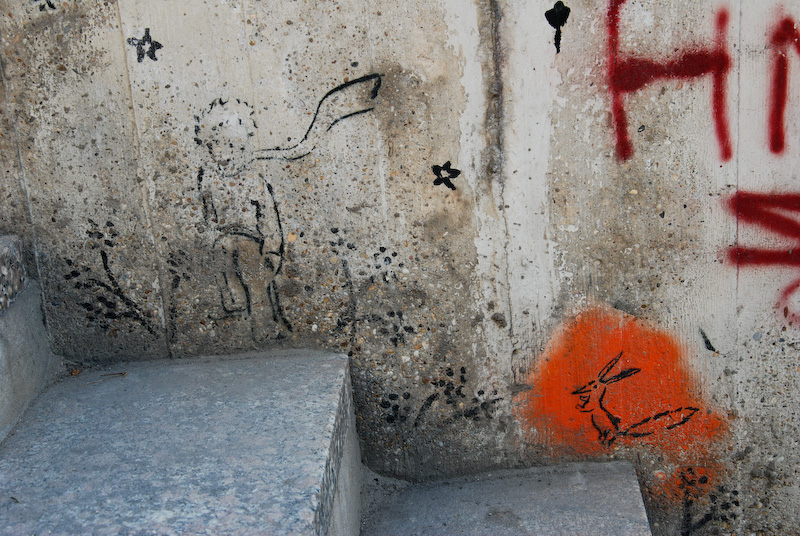
(Photo: Graffiti of the Little Prince in Bratislava by Flickr user bekassine)

The Immigration Reform Calculus

Emily Schuletheis claims that the “immigration proposal pending in Congress would transform the nation’s political landscape for a generation or more — pumping as many as 11 million new Hispanic voters into the electorate a decade from now in ways that, if current trends hold, would produce an electoral bonanza for Democrats and cripple Republican prospects in many states they now win easily.” She imagines what would have happened if illegal immigrants could have voted in 2012:

Key swing states that Obama fought tooth and nail to win — like Florida, Colorado and Nevada — would have been comfortably in his column. And the president would have come very close to winning Arizona.

Republican Mitt Romney, by contrast, would have lost the national popular vote by 7 percentage points, 53 percent to 46 percent, instead of the 4-point margin he lost by in 2012, and would have struggled even to stay competitive in GOP strongholds like Texas, which he won with 57 percent of the vote.

Harry Enten finds these calculations laughable. His analysis:

All told, it would seem that only about 1.7 million new Latino voters would be added if undocumented immigrants were granted citizenship. Nationally, this would be a net of about 775,000 votes. This would increase Obama’s vote margin, but not to 7pt; it would only go up to about 4.4pt – in other words, half a point from where it actually was in November 2012. Even adding in new Asian voters, who vote at a lower rate than even Latinos, and other undocumented immigrants (and controlling for the percentage who apply for citizenship, percentage of citizens who vote, and the percentage who voted for Obama), the margin probably only goes up to, at most, 4.6pt.

The amount this would shift individual states in elections is debatable. Take Nevada, where, at last count, there were 190,000 undocumented immigrants – the highest percentage of any state population. Most of them are Latino. Apply the same math we did above, Obama would have gained about 17,000 votes. It would have increased his state margin of victory by 1.4pt. That’s not nothing, but we’re talking about the state with the largest percentage undocumented immigrants.

Nate Cohn’s math is similar. Bouie’s read on the situation:

Democrats do stand to strengthen their advantage with Latino and Asian American voters. What Republicans gain, on the other hand, is a chance to compete. Which, given their current poor standing, is far better than nothing.

“Are You Gay?” Is A Valid Question

This embed is invalid

Kevin Sessums explains why he has no problem asking closeted celebrities about their sexuality:

In the past I was like, Never out anybody. I was very adamant about that and at some point I sort of switched. I thought, You know what? I’m not going to buy into somebody else’s shame. They can deny it. I don’t give a shit. That’s fine. But I’m not going to be denied the question like it’s something shameful. Also, I’m not asking them what they do in their bedroom. I’m not asking them if they are a top or a bottom or what their sexual proclivities are. If someone is straight, that part of their life infuses all aspects of who they are. They talk about it all the time, and it’s not about being private.

I understand if you’re a movie star, you’re selling an image and people have to be able to project things onto you, especially if you are a romantic lead. I understand all of that in the abstract. But I’m not an adjunct to their career completely. I’m there as someone who’s got a job to do. I’m there to have a conversation. I’m not their agent. I’m not their PR person. That’s not my job. My job is to have conversations with them as people.

I remember the first time I was asked this. It was in the back of a cab filled with former Yalies. Rich Blow (my then house-mate and now called Richard Preston Bradley) was in the passenger seat and looked over his shoulder and asked the question as if it were the equivalent of “are you asthmatic?” It floored me (I think I was around 22).

In a casual conversation, it was jarring – almost thirty years ago. But now, in the context of a consensual interview, it seems to me to be as valid an inquiry as “Are you straight?” It’s not outing someone if it’s a question, asked out of mere curiosity and non-judgment. It’s outing someone if it’s a statement made without their consent, as an act of public shaming.

The Secret To Marriage Is Not Winning

According to Tom Junod:

A fight to the finish is what finishes a marriage. That’s because over the course of married life, people supply their spouses with precisely what’s required to finish them off. The question is not who can win, because anyone can win if they’re willing to go far enough — if they’re willing to win at the cost of love and respect. The question is who can abstain from winning, who can resist the temptation of winning, which, like any other marital temptation, is always there.

But how do you do that? Well, you don’t go to sleep angry, as the old saying goes. And you don’t say what can’t be unsaid. And you don’t fight drunk, because not only will you then say what can’t be unsaid; you will find out what it is.

A very wise man.

Chart Of The Day

Bullying

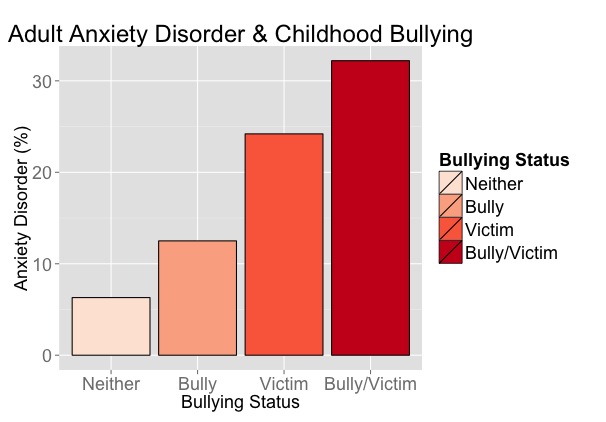
Bullying has long-term consequences:

The first column represents the rate of anxiety disorders in the adults who were neither bullies nor victims in childhood. The second and third are those who were just bullies or just victims, and the last is the rate of disorder among adults who were both bullies and victims of bullying. Although anxiety is a universal experience, an anxiety disorder is a severe and potentially disabling condition. The rate of such disorders is almost four time as high among victims as among those with no experience of bullying, and nearly five times as high among those who were both bullies and victims.

Yes, Of Course It Was Jihad, Ctd

Dreher notes why extremist Islam may be even more susceptible to violent expression than other religions that have proven extremely bloody in the past:

When a Christian murders, as many have done, sometimes with church sanction, he acts in direct contravention of Christ’s example and command. When a Muslim murders, he sometimes carries out Muhammad’s command, which is to say, Allah’s. … Obviously many, many Muslims choose less bloodthirsty interpretations of these verses, and this is the sort of thing that non-Muslims should encourage, for the sake of peace. Nevertheless, the existence of these verses, and the extremely high regard Islam has for its holy book, makes it harder to come against those who wish to kill in the name of Islam.

Millman counters:

If we were to test the proposition, “Islam is inherently more violent than other religions,” we’d need to compare Islamic civilization across time and space to other civilizations (and control properly for other factors). Are Dreher and Sullivan quite sure of what the result of such a comparison would be? Are they quite sure that, say, things like cousin marriage, or a burgeoning population of underemployed males, or the legacy of Cold War-era arms races, or the coincidence of massive oil wealth in the hands of a particularly puritanical sect on the Arabian peninsula, or the intrusion of Zionism, or the demographic decline of Christian Europe (and Russia), or the ructions of modernization meeting a subordination of women that pre-dates Islam, or . . . well, there’s a long list of theories for why Islam’s borders are bloody now. Are we quite sure that those theories are less-correct than the theory, “they are getting their ideas from a bad book?”

But Millman is completely misrepresenting my post, the third sentence of which is the following:

All religion, including Christianity, is susceptible to the violence associated with tribalism and fundamentalism. Christianity’s murderousness through the ages is a matter of historical fact, from the Crusades to the Inquisition and beyond.

That was also the core point of the essay I wrote over a decade ago and linked to this week and stand by:

[Osama bin Laden’s theology has] roots in an extreme and violent strain in Islam that emerged in the 18th century in opposition to what was seen by some Muslims as Ottoman decadence but has gained greater strength in the 20th.

I have long believed that this kind of Internet-based, tradition-free, radical Islam is a creation of modernity – not integral to the faith as lived by countless Muslims for centuries. I have long put it in the historical context of Islam’s long heritage of peaceful governance and human charity. And in many ways, Christianity has more to account for than Islam over the centuries.

After all, it takes a lot more evil to turn a radical non-violent homeless pacifist like Jesus into the cause for a murderous Crusade than it does to select justifications of violence from the Koran and re-enact them. But my reader’s point about the unique challenge modernity poses to religions that claim territory as sacred and that insist that doctrines cannot be altered one iota from texts written centuries ago is a real one. Christianity has reason and clear doctrines of nonviolence to guard against this. But is bombing abortion clinics Christianist terrorism? Abso-fucking-lutely. Freddie reframes the debate:

To me … the question isn’t whether Tamerlan Tsarnaev believed he was waging jihad. The question is, what’s the difference for our next step? How and why would a religious motivation matter? Where the question of Islamic extremism is made relevant is in our perception that there is a larger network of extremists who are eager and able to launch violent attacks against this country. As you know, I’m a skeptic about the size and destructive ability of that network. But it is ancillary to the conversation, because all of our current best evidence suggests that the Tsarnaev brothers worked alone, and had no connection to Al Qaeda or any other anti-American group. The analogy for the Tsarnaev brothers shouldn’t be to the 9/11 hijackers but to the Fort Hood shooter or the DC snipers. Sure: individuals or small groups have the ability to be inspired (in whole or in part) by Islam, along with personal anger and feelings of inadequacy and grievance against American foreign policy and plain old sociopathy. And because of the reality of modern technology, these people have the ability to kill other people. What they do not have, and should not be mistaken for having, is the ability to represent a serious threat to the basic security and prosperity of this or any other country.

On that I am in total agreement. I don’t think there’s much we can do to stop this kind of thing, except constitutional surveillance, public vigilance, and withdrawal of our troops from Muslim countries. The Tsarnaev brothers do not represent a resurgence of al Qaeda; they represent the permanent threat religious fundamentalism poses to modernity, especially if that religion believes itself under siege and has texts that sanction the murder of infidels and apostates. Of course, this threat may be magnified by psychological distortion, personal history, contingent events, and pure chance. But that does not mean it is a chimera. The blood on the streets of Boston was real and red enough.

Original Content Pays Off

For Netflix:

The company added more than 3 million subscribers (2 million in the U.S.) last quarter, which, at $7.99 per subscription, means revenue nearly equaled the full price of the $100 million “House of Cards” series that debuted early this year.

Did “House of Cards” lure 2 million more people, alone? No. We don’t know how many Netflix subscribers watched the series, and we certainly don’t know what share of the new subs joined just specifically because of the Kevin Spacey vehicle.

So what did “House of Cards” really buy? Allegiance. Nearly 90 percent of Netflix subscribers said “House of Cards” made them less likely to cancel, according to a survey by Cowen and Co.

Notice how content matters commercially. People will pay for good stuff – not listicle crack. Zachary M. Seward points out that “Netflix now has 29.2 million people in the US subscribed to its $8-a-month streaming plan, which is, for the first time, greater than HBO’s domestic subscription base of 28.7 million”:

The comparison between Netflix and HBO isn’t perfect, but they increasingly appear to be on similar trajectories. Both started by offering only movies that had long been out of theaters, then ventured into original programming—HBO in 1997 with Oz and Netflix earlier this year with House of Cards. Meanwhile, all of HBO’s customers buy it as an add-on to existing cable TV subscriptions, but HBO Go now offers all of the network’s programming over the internet, like Netflix. At the moment, it’s just a free perk for existing subscribers, but executives at HBO parent Time Warner have been hinting at a future when HBO Go is sold directly to consumers.

“The goal is to become HBO faster than HBO can become us,” Ted Sarandos, Netflix’s chief content officer, put it recently.

(Video: Trailer for the Netflix Original Hemlock Grove, which has gotten bad reviews but appears to be popular with Netflix users.)

Yes, Of Course It Was Jihad, Ctd

Explosions At 117th Boston Marathon

Greenwald goes another round:

The only evidence [Andrew] can point to shows that the older brother, Tamerlan, embraced a radical version of Islam, something I already noted. But – rather obviously – to prove that someone who commits violence is Muslim is not the same as proving that Islam was the prime motive for the violence (just as the aggressive attack by devout evangelical George Bush on Iraq was not proof of a rejuvenation of the Christian crusades, the attack by Timothy McVeigh was not proof of IRA violence, Israeli aggression is not proof that Judaism is the prime motivator of those wars, and the mass murder spree by homosexual Andrew Cunanan was not evidence that homosexuality motivated the violence).

Islam or some related political ideology may have been the motive driving Tamerlan, as I acknowledge, but it also may not have been. You have to produce evidence showing motive. You can’t just assert it and demand that everyone accept it on faith. Specifically, to claim this is terrorism (in a way that those other incidents of mass murder at Aurora, Sandy Hook, Tucson and Columbine were not), you have to identify the “political or social objective” the violence was intended to promote: what was that political or social objective here? Andrew doesn’t have the slightest idea.

I have much more than the slightest idea. I have massive amounts of evidence, outraged testimonies from the family, a horrifying web history, bombs that follow to the letter instructions from an al Qaeda publication, public, extremist spats with his own mosque, and on and on. And this is slippery language:

[T]o prove that someone who commits violence is Muslim is not the same as proving that Islam was the prime motive for the violence …

But Tamerlan was not just a Muslim. He was an extremist, fanatical Muslim who had quite obviously self-radicalized. I have made that distinction repeatedly. If all we had was evidence that he attended a mosque and called himself a Muslim, I’d agree with Glenn. But we have a mountain of evidence that Tamerlan was far more extremist than 99.9 percent of the entire American Muslim population. Why will Glenn not acknowledge this?

His other point is a much more interesting one:

“[T]errorism” does not have any real meaning other than “a Muslim who commits violence against America and its allies”, so as soon as a Muslim commits violence, there is an automatic decree that it is “terrorism” even though no such assumption arises from similar acts committed by non-Muslims. That is precisely my point.

He means, I think, by “terrorism” how terrorism is viewed by the majority in contemporary America. And there is some truth to this point – unfortunately. But does Glenn ever wonder why? Extremist Islam has developed quite a reputation in the last couple of decades, wouldn’t you think? When an al Qaeda enthusiast and religious fanatic decides to bomb the Boston Marathon, is it really outrageous to infer some connection? If he were a Tim McVeigh type, with a web history of black helicopter paranoia, do you think we’d be hemming and hawing about his motives? These terrorist events are designed for maximal media exposure, and they deploy random civilian mass-murder to publicize a cause. They are rational plots.

So to take Glenn’s other examples, they are all hideous killing sprees by gunmen with grudges and fantasies and mental illness. There seemed to be no deeper motive. Fort Hood is a more interesting case – a gun attack on fellow soldiers, while yelling Allah. That seems to me to be clearly at core a terrorist event – but fused with what we can see were workplace issues. He was a Muslim, but the US government continues to describe the attack as an act of workplace violence – not terrorism. I think the evidence points to a confluence of religious radicalism and “going postal.” He attacked his own base and had previously given out cards calling himself a “soldier of Allah.” We have no such workplace frustration to ascribe to Tamerlan: he picked a classic terror target – a televised public event, symbolizing he unity of all people and all faiths in the simple act of running.

Extreme Islamism is a threat to us all. That does not mean we empower it more with Cheney-esque over-reaction or anti-Muslim bigotry (which can create more self-radicalized mass murderers). We can make the distinction between this kind of violent fundamentalism and mainstream Islam, practiced by 99.9 percent of American Muslims. We can stop invading Muslim countries. We can defuse the drama by trying one of the accused in a civilian court. We can ensure that next year’s Boston Marathon is overwhelmed with participants. We should not torture Tsarnaev the way Bush and Cheney did Padilla – on much flimsier grounds. And we can do all this without slipping into the see-no-evil denial that Glenn has, sadly sunk into.

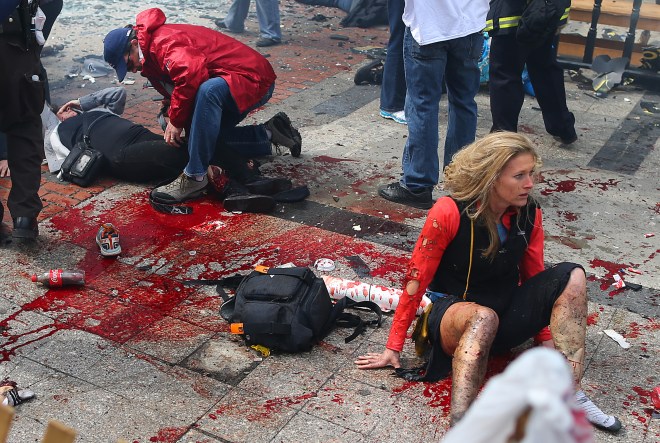
(Photo: Victims are in shock and being treated at the scene of the first explosion that went off near the finish line of the Boston Marathon. By John Tlumacki/The Boston Globe via Getty Images)
The Sequestered Skies

Andrew Stiles, who makes Rush Limbaugh seem bipartisan, wonders if the Obama administration is “trying to maximize the pain of sequestration”:

The FAA has insisted these cutbacks are unavoidable, but the administration has a clear political interest in maximizing the public’s outrage, so critics aren’t buying it. The airline industry has complained that it is caught in the middle of the political fight over sequestration and that the FAA risks interrupting services more than necessary. One industry insider tells National Review Online that the airlines are being used as a “political football” in this debate and suggests that the FAA’s cuts don’t “really have to be done in this way.”

Good try. But wrong

[A]ir traffic control slowdowns were totally predictable. At least 70 percent of FAA’s expenses are personnel-related so it was inevitable that the 5.1 percent across-the-board sequester cut would be felt in everything the agency does including — or especially — in its primary function: managing air traffic. When you set up a system like sequestration that requires an agency or department to cut every program, project, and activity by the same percentage, and when an agency’s spending is mostly for salaries and other compensation-related expenses, it’s not hard to see from the start that there has to be an impact on the number of people doing that agency’s work.

No amount of outraged statements from Senate and House Republicans changes that budget reality.

Recent Dish on the sequester here.