
Decatur, Indiana, 6.48 am
Decatur, Indiana, 6.48 am
Ramesh Ponnuru believes that the immigration bill contains a “terrible flaw”:
The guest-worker program is where they go wrong. For the Republican politicians who have in the past been its main supporters, this provision is like a dessert with no calories: Businesses get the benefit of the temporary workers’ labor and they get to make some money, but the rest of us don’t have to make room for immigrants in our society, and Republicans don’t have to worry how they will vote.
That’s exactly what’s wrong with the idea. One of the worst things about illegal immigration is that it creates a class of people who contribute their labor to this country but aren’t full participants in it and lack the rights and responsibilities of everyone else. A guest-worker program doesn’t solve this problem. It formalizes it.
Grad students and professors at Cornell University are finding order in the chaos of rock concerts:
In a run-of-the-mill mosh pit, [researcher Matthew] Bierbaum said, dancers collide with each other randomly and at a distribution of speeds that resembles particles in a two-dimensional gas. “How these supposedly intelligent beings behave like an ideal gas, I don’t know,” the physicist quipped. Some moshers don’t move completely randomly, however. In circle pits, a subset of mosh pits, dancers collide in a vortexlike pattern. So Bierbaum and the other Cornell physicists described this behavior with a computer simulation based on flocking, a phenomenon that results when particles follow their neighbors…. The Cornell team hopes to use [their model] to study how crowds move in emergency situations such as riots, he said.
A few massive, NSFW circle pits are seen above.
The Cyber Intelligence Sharing and Protection Act (CISPA), aimed at investigating cyber-threats, just passed in the House. Digital-rights activist Mark Jaycox outlines the precise effects of the bill in its current form:
Companies have new rights to monitor user actions and share data – including potentially sensitive user data – with the government without a warrant. Cispa overrides existing privacy law, and grants broad immunities to participating companies.
Andrea Peterson explains the rationale of the bill’s proponents:
[U]nderneath the problems of scope and privacy, the goal of CISPA is to create a functional structure for coordinating information about cybersecurity vulnerabilities and threats so intelligence can be shared. This would allow the government to share information about the tactics of adversaries with victims, or send up a warning flare about an emerging threat. Consider the report released earlier this year by cybersecurity firm Mandiant about a group of hackers engaging in corporate espionage likely affiliated with the Chinese military: It came along with a cache of threat intelligence indicators that could help identify other attacks by the group in the future, such as domain names, IP addresses, encryption certificates, detailed descriptions of over 40 families of malware they use.
The Electronic Frontier Foundation (EFF) is marshalling opposition:
The Fourth Amendment limits the government’s ability to use CISPA powers, but there would still be constitutionally dangerous implications: the government would also be granted broad legal immunity for any “decisions based on” cyber threat information, and CISPA’s “notwithstanding” clause could override government privacy laws like the Privacy Act (which protects personal information in government records) and the Computer Matching and Privacy Protection Act (which limits the use of automated matching of government records).
As it stands, CISPA is dangerously vague, and should not allow for any expansion of government powers through a series of poorly worded definitions. If the drafters intend to give new powers to the government’s already extensive capacity to examine your private information, they should propose clear and specific language so we can have a real debate.
Paul Tassi explains why the Internet hasn’t protested the CISPA the same way it did SOPA:
Pitched as a cybersecurity bill and not an anti-piracy measure, most will think it doesn’t affect them the way SOPA could have. Additionally, there’s probably some level of fatigue from the first protest, as there are probably always going to be bills like these floating around, and major websites can’t really black themselves out multiple times a year in protest.
Dana Liebelson adds that big corporations won’t be coming to the rescue either:
The Obama administration last week declared that it “remains concerned that the bill does not require private entities to take reasonable steps to remove irrelevant personal information when sending cybersecurity data to the government or other private sector entities.” But privacy concerns may not be enough to stop the bill. CISPA supporters spent 140 times more money on lobbying for the bill [than] its opponents, according to the Sunlight Foundation. Big-name companies that openly support CISPA include AT&T, Intel, IBM, Time Warner Cable, and Verizon, and other tech giants are quietly on board, including Google and Facebook[.]
#BREAKING: Boston Police URGE people on Twitter to STOP REPORTING SCANNER TRAFFIC. #watertown
— FOX 4 News (@fox4kc) April 20, 2013
On Friday, millions followed the progress of the Boston manhunt via the BPD scanner. Ambers, a longtime police-scanner junkie, maintains that journalists should never use information from a scanner without a second source and believes that continued misuse, like that seen last week in Boston, will lead to greater encryption of the feeds:
Because authorities have the power to force police agencies to encrypt their channels, and because few will take the time to think about the equities the public and the media have in preserving access to them, I worry that this information commons, as it were, will be regulated too quickly because of the irresponsible actions of a few.
Alex Berezow finds that, “when we consider countries that are similar to the United States, a strong correlation exists between the number of guns per capita and the gun-related homicide rate.” Tom Hartsfield takes issue with Berezow’s analysis:
Gun control might reduce the number of firearm homicides but cause an increase in non-firearm homicides. Countries with gun control might be more developed, safer, and have less violent crime for other reasons, just as countries with high numbers of guns might have more crime due to more guns. Robbery or assault rates might increase without private citizens being able to use a firearm to protect themselves.
Incorporating data on non-homicide violence, Hartsfield finds that “you are no less likely to be a victim of violent crime in a country with fewer guns”:
First, there is no correlation between the number of guns per capita and the overall homicide rate. So people who believe fewer guns will reduce the homicide rate may be wrong.
Second, there is no correlation between the number of guns per capita and the rate of assaults and robberies. So people who believe guns make society safer by reducing overall crime may be wrong, too.
It’s the Sidney Hillman Award for opinion and analysis for yours truly and the Dish as a whole. The awards are given “to journalists whose work highlights important social and economic issues and helps bring about change for the better.” I’m truly honored. The award usually goes to progressives and liberals, so I am a particularly grateful outlier. The citation:
Sullivan’s leadership in the fight for marriage equality is the principal reason he has earned a Hillman Prize. But this is not a single-issue award. Though there are many areas of disagreement between Sullivan and the Hillman judges, we commend, among numerous other things, his fierce condemnations of torture and the impunity granted to its perpetrators, his critique of the cruelties of the failed drug war and the policy of marijuana prohibition, his opposition to all forms
of intolerant religious fundamentalism (including the American variety he correctly calls Christianism), and his campaign for reform and accountability in the hierarchy of his own beloved Catholic Church.
We commend him, too, for the creation and nurturing of a sturdy and consistently innovative journalistic institution—one that has recently embarked on a brave experiment: seeking to sustain itself purely on subscriptions from its devoted readers, without advertising or corporate backing. For those readers, The Dish is a source of almost addictive pleasure as well as a forum for stimulating discussion and a uniquely energetic and intelligent collator of news and opinion.
For courage and constancy in the struggle for marriage equality, for the defense and advocacy of humane values, and for imagination and creativity at the digital cutting edge, we honor Andrew Sullivan and The Dish with the Hillman Prize for Opinion & Analysis Journalism.
So I share this award with everyone else at the Dish (especially Patrick and Chris, my indispensable colleagues for the past few years) and with you, who have made this experiment in self-sustaining new media viable. Thanks.
And if you really want to help us celebrate, [tinypass_offer text=”subscribe!”]
Hackers infiltrated the AP’s account this afternoon and deployed this:
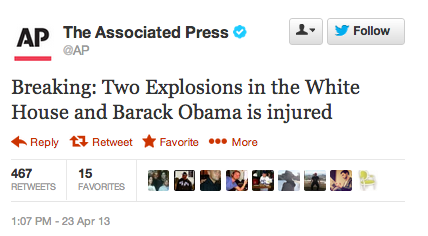
Supporters of the Syrian dictator have claimed responsibility. While no news outlets took the tweet seriously, Wall Street did momentarily:
U.S. stocks and the dollar briefly plunged Tuesday afternoon and U.S. Treasury bonds and gold prices soared, after a tweet from the Associated Press’s Twitter account claimed that there were two explosions in the White House and that President Barack Obama had been injured.
Markets quickly swung back after the Associated Press said on its corporate website that its account had been hacked. The White House confirmed that there had been no incident. The Dow Jones Industrial Average dropped 145 points between 1:08 p.m. EDT and 1:10 p.m., following the erroneous tweet. Stocks soon recovered, regaining broad gains that put the major benchmarks on track for a third day of gains.
Observers said the episode highlights the growing use by players in financial markets of social media such as Twitter and Facebook, FB +0.15% and underscores the dangers of security breaches at a time when many investors are quick to trade on news.
Julianne Pepitone zooms out:
News organizations are a particularly attractive target thanks to their reach and influence.
The Twitter accounts of CBS’ (CBS, Fortune 500) 60 Minutes and 48 Hours were compromised over the weekend. In July 2011, News Corp.’s (NWS) Fox News account — followed by more than 2 million people — was hacked and tweeted that President Obama had been assassinated. That same month, eBay’s (EBAY, Fortune 500) PayPal United Kingdom Twitter feed was hacked, and the profile photo was changed to a pile of excrement. Comcast’s (CMCSA) NBC News account was also compromised two months later, falsely tweeting that a plane had crashed into the Ground Zero area of Manhattan. In February of this year, both the Burger King (BKW) and Jeep Twitter accounts were hacked during the same week. …
After years of hacks that typically involved little more than obscene language, Twitter’s subpar security measures have now caused serious real-world consequences. Many hacks happen when account owners use guessable passwords or access Twitter over public Wi-Fi and shared computers. If one person who tweets from a corporate account loses his or her phone, an entire corporation’s Twitter account could be at risk.
(Chart of today’s Dow from Google)
Jonathan Cohn checks in on the sequester:
The Bipartisan Policy Center has called it a “slow-motion train wreck” that would deprive the economy of about a million jobs over two years. That prediction is broadly consistent with other forecasts, by such independent experts as Macroeconomic Advisers and the experts at the Congressional Budget Office. And it’s not like the recovery is strong enough to absorb such a hit easily.
But will voters link slower growth—and fewer jobs—to the sequester? Will they ask why it’s a better alternative than the budgets President Obama and the Democrats have proposed—budgets that would undo the cuts and make up some of the difference through higher taxes on the wealthy? And will lobbyists for affected industries, from medicine to defense, force Congress to pay attention to them? So far, the answer to all three questions has been “no,” to the surprise of many (including yours truly). That means the sequester cuts going into effect now, for this fiscal year, are likely to stay in place.
Why the political calculus may start to change:
Flights were delayed by up to two hours across the country on Monday, the first weekday that the nation’s air traffic control system operated with 10 percent fewer controllers. Pilots, gate agents and others were quick to blame furloughs caused by mandatory across-the-board budget cuts, but the Federal Aviation Administration said it was too soon to tell.


 The Dish