Ask Brill Anything: “$77 For A Box Of Gauze Pads”

In his first video, Steve explains why US healthcare is so expensive, including a follow-up on what he found most surprising in the course of researching his excellent Time cover-story, “Bitter Pill: Why Medical Bills Are Killing Us”:

Previous Dish on “Bitter Pill” here and here. Relatedly, Trudy Lieberman recently wondered why we don’t try to reduce costs by requiring “drug makers [to] negotiate prices with the government for the drugs used by Medicare beneficiaries” – something other countries do to keep costs down:

Brill estimated that that if drug makers were paid what other countries pay them, Medicare could save some $250 billion over 10 years and, depending on whether that amount is compared with GOP and Democratic deficit reduction proposals, “that’s a third or a half of the Medicare cuts now being talked about.” Liberal economist Dean Baker, co-director of the Center for Economic and Policy Research, crunched numbers from the Organization for Economic Cooperation and Development and came up with similar savings. He found that if seniors paid the same prices as people in Canada, the federal government would save nearly $230 billion over the next decade. States would save about $31 billion and Medicare beneficiaries $48 billion. If the federal government paid the same prices as are paid in Denmark, its savings would be more than $500 billion.

But such numbers are apparently not persuasive when they’re up against the lobbying might of the drug manufacturers. According to Open Secrets.org, drug makers spent $152 million on lobbying in 2012, an amount that has steadily increased since 2002-2003, the time when Congress was debating Medicare’s prescription drug benefit, which handed drug makers the gift of no negotiations over the prices they charge.

Thomas Bollyky highlights another growing issue in international drug prices – patents in developing countries:

Why does Gleevec, a leukemia drug that costs $70,000 per year in the United States, cost just $2,500 in India? It’s seemingly simple. Gleevec is under patent in the U.S., but not in India. Accordingly, Novartis, its Swiss-based manufacturer, may prevent competitors from making and selling lower-cost versions of the drug in the U.S., but not in India.

Last week, India’s highest court rejected an application to patent Gleevec. While the legal issue in the case is important — the patentability of modifications to existing drugs under Indian law — the impact of the decision will likely be broader than just that issue, escalating a long-simmering fight over patented cancer medications in emerging markets.

Indonesia, China and the Phillipines are taking similar measures to amend pharmaceutical patent laws:

The measures that India and other countries have taken — compulsory licensing and adopting strict standards on patentability — are consistent with its international trade commitments, but will be corrosive to the way that pharmaceutical research and development (R&D) is funded internationally. More countries are likely to follow India’s lead. Cancer is not the only NCD on the rise in developing countries, with rates of diabetes, cardiovascular, and chronic respiratory illnesses likewise increasing. U.S. patients will not indefinitely pay a 20-fold increase on the price of medicines that Indian consumers pay.

Yes, Of Course It Was Jihad, Ctd

Drum counters me:

What we know about Tamerlan Tsarnaev is that he was (a) Muslim and (b) enraged about something. Was he enraged, a la Sayyid Qutb, about the sexual libertinism of American culture? Was he enraged about perceived American support for Russia against Chechen rebels? Was he enraged about American wars in Iraq and Afghanistan? Was he acting on orders from a foreign terrorist group?

We don’t know yet. Yes, there’s plainly evidence of his growing Islamic extremism over the past three years. But if there’s anything we’ve learned over the last week, it’s that jumping to conclusions on this stuff is foolish.

This is high-minded nonsense. We know full well that Tamerlan had become a total extremist in his religion. He was thrown out of his own mosque for being a bigot; his family complained about his obsessive religiosity; he berated others for not being sufficiently devout; he had archaic notions of women’s role in society; he gave up his beloved boxing because of Islam. His YouTube account is full of Islamist extremism. And he deployed terrorist violence because of it.

That’s Jihad, Kevin. It’s religion in its most toxic form – as the AP finally acknowledged last night.

It doesn’t need a foreign terror group for it to be Jihad; it’s obviously not Chechen nationalism – because that would mean attacking Russia, not the Boston Marathon, a symbol of co-ed multi-cultural secularism. I think some liberals who have never experienced religious faith find it hard to imagine how faith alone can spur someone to mass murder. They need to get out more.

Friedersdorf writes that, if forced “to bet right now on this case, I’d put my money on the jihadist explanation too.” But he agrees with Drum:

Since 9/11, there have been numerous instances in which jumping to conclusions based on imperfect information caused damage. Think of all the people who confidently insisted on the obviousness of Dr. Steven J. Hatfill’s guilt, or Saddam Hussein’s possession of weapons of mass destruction, or the notion that all Guantanamo Bay prisoners were “the worst of the worst.” Has any harm ever been caused by a War on Terror pundit’s stubborn insistence on delaying judgement?

Yes, the information is imperfect. Yes, if all of this is some kind of set-up, I may have to recant. And I have always said that personal and psychological dynamics are obviously part of the picture, as they are with any crime. But just as silly as jumping to conclusions prematurely is the posture of aloof skepticism when the bleeding obvious is staring right at you. This was religious violence – the most terrifying any can be, because its perpetrators believe that God Almighty is protecting them.

And, to make an obvious but often overlooked point: here is a core difference between diagnosing Jihad and responding to it Cheney-style. You can do one without the other.

Our Collective 9/11 PTSD

Manhunt Underway For Marathon Bombing Suspect

Michael Cohen echoes me on the difference between America’s reactions to events like the marathon bombing and gun violence:

Londoners, who endured IRA terror for years, might be forgiven for thinking that America over-reacted just a tad to the goings-on in Boston. They’re right – and then some. What we saw was a collective freak-out like few that we’ve seen previously in the United States. It was yet another depressing reminder that more than 11 years after 9/11 Americans still allow themselves to be easily and willingly cowed by the “threat” of terrorism. …

If only Americans reacted the same way to the actual threats that exist in their country.

Which is to say that the terrorists succeeded in almost every way possible. The day after the IRA bombing of the hotel in which she was staying, injuring 31 and killing five, Margaret Thatcher gave a speech, on schedule, to her party conference. The IRA suspects were still at large and threatening to kill again:

Today we were unlucky, but remember we only have to be lucky once. You will have to be lucky always.

Norman Geras thinks these arguments miss the point:

The supposed ‘overreaction’ to terrorist attacks isn’t primarily about the extent of risk relative to accidental death, or about fear for one’s own safety. It’s about people taking quite proper exception when, finding it morally outrageous indeed that, individuals moved by some grievance or other and/or the tenets of a murderous ideology, freely choose to put the innocent in peril by random acts of violence.

I wrote about this for my Sunday column. I am second to none in finding these acts morally outrageous, which is why we need to exercise more control in not giving them more power over our psyches than we need to. I think, in many ways, we’re still living with 9/11 collective PTSD:

Last week shows how terrorism works. It terrorizes – and the trauma of that terror lies often buried in the psyche for years, and untreated and un-addressed, it can suddenly return, without perspective or rationality. In some ways, this is understandable. Before 9/11, Americans outside Pearl Harbor, had lived for centuries feeling relatively invulnerable to the terrorism that I grew up with in Britain in the 1970s, or that occurs routinely as a consequence of the US invasion of Iraq (on the day of the Boston marathon, 65 Iraqis were murdered by terrorist bombs). 9/11 was so traumatic, in fact, that it led the US to adopt the torture techniques of totalitarian regimes and to invade and occupy two countries. Americans lost it. And I cannot say I was immune. It changed Americans because we allowed it to traumatize us.

Before 9/11, terrorism didn’t have this kind of power. The first bombing of the World Trade Center did not “change everything”. Last week, the historian Rick Perlstein noted that in Christmastime, 1975, an explosion at a La Guardia baggage claim killed 24 civilians, with severed limbs and heads flying all over the place. No one was ever found responsible – and the city of New York was not under lockdown. It’s different now.

Which means bin Laden succeeded as well – in simply terrorizing Americans. Take this statistic: the National Consortium for the Study of Terrorism and Responses to Terrorism found that the number of terror attacks in the US in the decade before 9/11 was 41 a year. Since 9/11, it has been 19 a year. And yet our terror panic endures – and even grows. It seems we cannot yet simply live with and through occasional terror. We demand its complete absence, in the black-and-white way Americans often do:

We think in absolutes, in terms of avoiding all harms and dismissing potential benefits instead of debating the relative contributions of both. … “Never eat red meat”. “Never let kids watch TV or play video games”. “Never eat soft cheese while pregnant”. “Never fail to screen for disease”. And so on.

Is this a United States thing? Or am I just wired differently? I’m just not sure that the way we react to potential harms is the best approach. This includes, by the way, our response to terrorism.

Previous Dish on Americans’ response to terrorism here.

(Photo: At around 11:45 a.m., April 19, this was the view on Congress Street looking towards Post Office Square as a lockdown-in-place was in effect in Boston during the during the ongoing manhunt for a suspect in the terrorist bombing of the 117th Boston Marathon earlier this week. By Jim Davis/The Boston Globe via Getty Images.)

Don’t Judge A Lover By His Moves

James Wilson, lead singer for the Virginia-based rock band Sons of Bill, compiled “a list of songs for and from the mouths of bad dancers” to accompany their new single, “Bad Dancer.” He comments:

In middle school I remember hearing a friend of my dad’s tell his daughter on her way to a dance, “Remember, the best lovers are the bad dancers.”  I didn’t know exactly what that meant at the time, but the line stuck with me – most likely because I was as awkward as anyone else, feeling trapped on the outskirts, but madly in love with everything like everyone else. You see this same figure recurring in so many coming-of-age stories:  Holden Caulfield, Quentin Compson, every John Cusack movie, etc. I’d been listening to a lot of older pop music at the time, and I got the idea to write them an anthem – a rock and roll love song for the awkward lovers. A dance song for the bad dancers.

As I get older I start to see the ways in which some people never really get over that awkward high-school dance feeling – it opens up into broader life questions of loneliness and wonder, desiring to belong but never quite feeling at home in your own skin. I picked these songs because I think they captured that feeling.

Number one on his list? The Smith’s “Stop Me If You’ve Heard This One Before”, seen above.

The Life Spans Of Guns

Nathan Hegedus reflects on his own experience living in Croatia in the 1990s:

[H]ere is why I still worry about guns, even if they are not the root of anything, and this is almost purely grounded in my time in [Pakrac, Croatia]. Guns are not an idea or a prejudice or an emotion. They will not pass like opposition to gay marriage or dangerously moronic views on rape. They are objects, and they will endure. They get stolen, sold, found, and washed into the loneliest, least connected places, where they do the most damage. And at some point, violence has the potential to build beyond murder to something even worse—riots, wars, pogroms—and then I say that a concentration of guns does matter, too much tinder to be ignited by too small a spark.

Dish on this week’s gun control bill here and here.

A Pre-Tenderized Meal

Montana recently made moves to legalize eating roadkill. Nicola Twilley consults the rest of the country’s laws:

Florida is the most permissive: according to Marketplace, “If you hit a deer, it’s legal to take it home and do whatever you want with it. You don’t need permission.” Most states with roadkill bills do require drivers to notify the authorities; for example, in New York state, residents can salvage deer, moose, or bear from the highway, but only if the collision is reported and deemed to be accidental. A handful of other states expressly forbid the collection and consumption of roadkill, including, somewhat counter-intuitively, that well-known home of guns, “freedom,” and feral hogs, Texas. In some rural counties in Alaska and Vermont, you can even add your name and number to roadkill phone trees: the state game warden will give you a call when there’s a fresh moose or deer “that’s not too smooshed.”

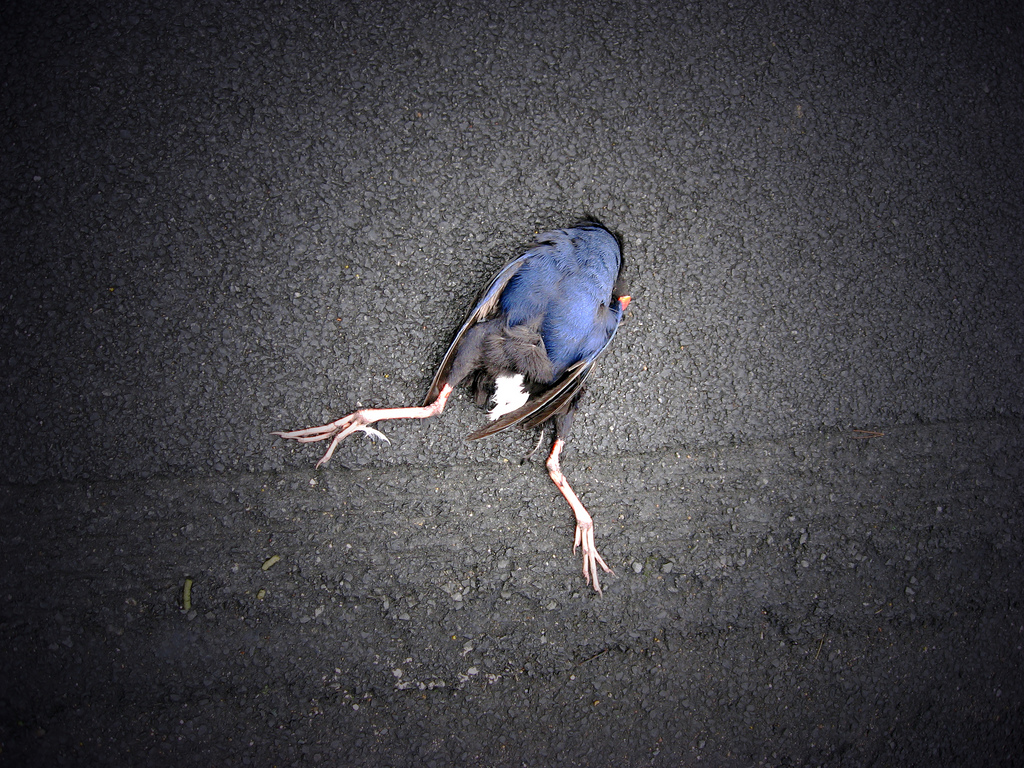
Update from a New Zealand reader, who identifies the above bird and offers advice on eating roadkill:

The bird in your post a Pukeko, a prolific New Zealand waterfowl species that gets run over often. It does not get run over in Montana though.

Roadkill is ok to eat, but it depends on where it is hit. Rabbits and hares that get run over by a wheel are too badly bruised, but those that stick their heads up and get hit by the underside of the grill are fine. Birds can be good, but preferably if they come off the windscreen obliquely, rather than getting hit by the grill. Pheasants usually hit the windscreen and are not too badly damaged.

Pukeko is not regarded as a table bird in New Zealand, as it has suffered from the adage boil it with a rock and throw the pukeko out and eat the rock. It is ok to eat but you don’t get much meat, and it is tough if it is not allowed to settle in a fridge for about two weeks to allow the proteins to break down.

(Photo by Lee Taylor)

Professorial Politics

Chris Mooney unpacks the research of sociologist Neil Gross, who found evidence that the academy indeed leans left, with 50% of professors describing themselves as “left or liberal,” and 8-9% as “far left” or “radical”:

[A]cademia is indeed more liberal than America, just as other professions, such as the clergy and the military, are dens of conservatism. But where conservatives get it wrong, Gross says, is in their simplistic assertions that academia’s leftward lean is a result of bias or discrimination. Rather, he argues, academia is liberal because… it has been attacked for being liberal. Gross’s analysis concludes that the ivory tower’s well-known political reputation has encouraged a kind of self-selection effect, where conservatives gravitate away from it, and liberals towards it.

That would mean it’s precisely backwards to claim that universities discriminate against conservatives in favor of the godless and liberal. Rather, people who are godless and liberal tend to flock to universities—and stay there.

Abandonment Issues And Poker

There appears to be a connection:

People who scored high in attachment anxiety (for example, they agreed with statements like “I worry about being abandoned” and “My desire to be very close sometimes scares people away”) tended to be better at spotting lies and made-up stories….

To see if the lie-detection skills associated with anxious attachment have any benefit in real life, Ein-Dor and Perry recruited 35 semi-professional poker players, assessed their attachment style and then observed their performance in a local poker tournament. Each participant was allocated at random to join in with a group of seven other players at the event. As they predicted, the researchers found that the participants who scored higher in anxious attachment tended to win more money in the tournament (on average, a one-point higher score in anxious attachment was associated with winning an extra 448 chips).

The Budding Of E-Commerce

The first-ever sale over the Internet? A bag of marijuana:

[According to] John Markoff ‘s 2005 book What the Dormouse Said: How the Sixties Counterculture Shaped the Personal Computer Industry … in 1971 or 1972, Stanford students using Arpanet accounts at Stanford University’s Artificial Intelligence Laboratory engaged in a commercial transaction with their counterparts at Massachussetts Institute of Technology. Before Amazon, before eBay, the seminal act of e-commerce was a drug deal. The students used the network to quietly arrange the sale of an undetermined amount of marijuana.

For the first pizza delivery ordered by a computer, see this footage from 1974.

Books As Memory Markers

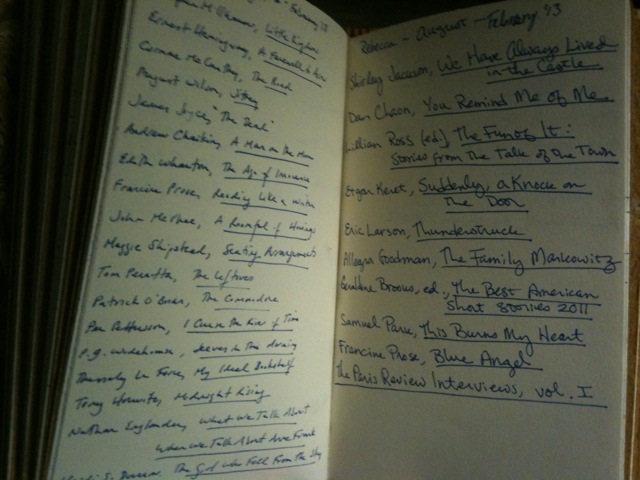
Rebecca Makkai lists the top five books she would save from a fire. One was a blank hand-bound book she received as a wedding gift:

We couldn’t see ourselves asking people to sign it. I wasn’t about to fill it with crappy story drafts or start inside-bookjournaling. So we began writing down every book we read. (Jon gets the left page and I get the right. As you can tell, he’s a much faster reader.) It’s made me more determined to finish things, in the same way my childhood library’s summer reading program once did. It’s also the best diary I could have. If I want to remember December, 2003, I just need to see that I was reading Motherless Brooklyn and it all comes back: pneumonia, hospital, striped sweater, and the last time I ever played tennis.

And it’s also afforded me the greatest insult I could give a book. When a book is so extraordinarily bad that I’d be embarrassed to record it—terrified that my grandchildren, after I’m gone, might pick this one book off the list and read it to see what kind of person I was—I’ll refuse to write it down. It’s a rare punishment, one I’ve only exercised a few times. And therein lies the essay I’ll never write, a companion to this one: The Five Books I’d Consign to the Flames.