A Vatican Spring?

The First Signs Of Spring Are Seen At Kew Gardens

One major piece of disappointment came with Pope Francis’ endorsement of the on-going inquisition of American nuns. I’m not sure entirely what to make of it – is it an early indicator of Francis’ theological conservatism or simply acquiescing to a process already long underway? We will see by the disciplinary actions eventually taken (or not). The nuns would seem to have more in common with the Jesuit Francis, if only because he is aware of the need for outreach among religious orders – even to places and people that discomfort others. That was Jesus’ call, and Saint Francis’ and St Ignatius’. We’ll see what transpires in the end, but, obviously, I hope the Sisters can soon renew their vital work without constantly looking behind their backs.

But three other developments strike me as encouraging. The first – and least sexy – is the establishment of a global council of advisers in the governing of the church. This may seem a trivial reform. It isn’t. It restores the Second Vatican Council’s desire to place the Pope in a less dictatorial position, and to open up areas of authority within the global church as a counter-balance. And so this new governing commission – made up of highly effective cardinals in every continent – is a big shift:

More profound thinkers have read the Pope’s creation of a group of advisers as a bold new step towards fully implementing a model of ecclesial government evoked by the Second Vatican Council – one that is 418W7QTZEEL._SY380_less centralised, more collegial and based on the principles of ­subsidiarity.

“What Pope Francis has announced is the most important step in the history of the Church of the last 10 centuries and in the 50-year period of reception of Vatican II,” said the noted church historian Alberto Melloni. Writing in the Milan daily Corriere della Sera, he said the Pope had “created a synodal organ of bishops that must experiment with the exercise of the consilium”. In other words, shared governance of the Church between the Bishop of Rome and all the world’s bishops.

Detailed proposals for this were put forth in Archbishop Quinn’s book, [“The Reform of the Papacy“] which in 2005 appeared in Spanish. Pope Francis read that work when he was still just a cardinal in Argentina and, at around that time, he reportedly expressed his conviction that at least some of its ideas should be adopted.
More surprising is the support for civil unions for gay couples that seems to be percolating on the margins. The Pope argued for them in Argentina within the Jesuit branch he ran (it was the sole argument he lost in his years in president of the Conference), and earlier this year, some wiggle room for gay couples in civil law was mentioned by Archbishop Vincenzo Paglia, president of the Pontifical Council for the Family. This was only a defensive action against civil marriage rights for gay couples, but it was a concession to reality one cannot imagine Benedict XVI ever making. Now this:

The latest expression of support for civil recognition as an alternative to gay marriage comes from Archbishop Piero Marini, who served for 18 years as Pope John Paul II’s liturgical master of ceremonies. “There are many couples that suffer because their civil rights aren’t recognized,” Marini said.

The third indication of good news is the fact that Pope Francis has unblocked Oscar Romero’s path to beatification:

The Vatican’s Congregation for the Causes of Saints has been studying the Romero case since 1996, after the church in El Salvador formally opened the procedure in 1990. At the end of his 20-minute homily Sunday, Paglia said: “Just today, the day of the death of Don Tonino Bello, the cause of the beatification of Monsignor Romero has been unblocked.” Paglia had been received by Pope Francis on Saturday, and presumably the decision to authorize moving forward with the cause came out of that session.

Romero was shot to death while saying Mass in El Salvador on March 24, 1980. While he is seen as a hero to many because of his solidarity with the poor and his opposition to human rights abuses, his cause has also been viewed with suspicion in some quarters, partly because of Romero’s links to the controversial liberation theology movement.

Know hope.

(Photo: Crocuses in bloom. By Oli Scarff/Getty Images)

Terror And America, Ctd

1946 Boston Marathon

Rafia Zakaria, a columnist for Pakistan’s largest English newspaper, tries to explain the disproportionate coverage of the Boston attacks – compared with, say, 65 terrorist deaths in Iraq on the same day or the West, Texas, catastrophe:

Attacks in America are far more indelible in the world’s memory than attacks in any other country. There may be fewer victims and less blood, but American tragedies somehow seem to occur in a more poignant version of reality, in a way that evokes a more sympathetic response. Within minutes American victims are lifted from the nameless to the remembered; their individual tragedies and the ugly unfairness of their ends are presented in a way that cannot but cause the watching world to cry, to consider them intimates, and to stand in their bloody shoes. Death is always unexpected in America and death by a terrorist attack more so than in any other place.

It is this greater poignancy of attacks in America that begs the question of whether the world’s allocations of sympathy are determined not by the magnitude of a tragedy—the numbers dead and injured—but by the contrast between a society’s normal and the cruel aftermath of a terrorist event. It is in America that the difference between the two is the greatest; the American normal is one of a near-perfect security that is unimaginable in many places, especially in countries at war. The very popularity of the Boston Marathon could be considered an expression of just this. America is so secure and free from suffering that people have the luxury of indulging in deliberate suffering in the form of excruciating physical exertion; this suffering in turn produces well-earned exhilaration, a singular sense of physical achievement and mental fortitude.  The act of running a marathon is supposed to be simple, individual—a victory of the will over the body, celebrated by all and untouched by the complicated questions of who in the world can choose to suffer and who only bears suffering.

(Photo: Stylianos ‘Stelios’ Kyriakides, of Greece, runs up Heartbreak Hill in Newton, Mass. during the 1946 Boston Marathon. He won the race. By Charles Dixon/The Boston Globe via Getty Images.)

Why Did Gun Control Fail?

David Karol provides some answers:

[G]un control supporters have no shared social activities, no common identity and no companies that cater to them. Their jobs don’t bring them together. Unlike gun rights advocates’ they don’t find and stay in touch with each other without a conscious and sustained effort to do so. Under these conditions, it is not surprising to find far more effective mobilization of sentiment on the gun rights side. So even if there was significant intensity of feeling on the part of a sizable minority of gun control advocates, (say 10% of the 90% favoring background checks) we should expect them to have greater difficulty in channeling those feelings and building durable political organizations.

Chait explains why Senate Democrats folded:

If you’re picking your battles, background checks are as good an issue as any to lay down. For one thing, as I’ve suggested, guns loom disproportionately large in the political world of red state Democrats. Guns are the way they signal home state cultural affinity, giving themselves a chance to get their economic message heard. Their A rating from the National Rifle Association is powerful shorthand. And yes, the NRA is crazy and partisan, and was opposing a bill it used to support and that most Republicans support. But none of those facts overcomes the blunt reality of the A rating’s political value.

What’s more, this particular gun vote was an especially good time for Democrats to defect. None of them cast the deciding vote; it fell six votes shy of defeating a filibuster. The bill was already a compromise of a compromise, something that would have stopped a tiny fraction of gun crimes. Even if it passed the Senate, it faced steep odds of passing the House, where it probably would have died, been weakened further, or even turned into a law that weakened existing gun laws.

MoDo On Obama

The best response to her “Obama-Is-A-Wimp” meme (now six years’ old) is from Peter Beinart on gun control. Money quote:

Sure, Obama may have made tactical mistakes. Critics claim the White House waited too long before offering concrete proposals, and wasted time pushing an assault weapons ban that had no chance to pass. But this president, who is sometimes called reserved, aloof, and calculating, pursued gun control with a force of mind and soul that was astonishing to behold. “I never saw a president fight so hard,” remarked Sen. Barbara Boxer, “never on any issue.”

A Long Way From Kyrgyzstan

Julia Ioffe, who spent her early childhood in Russia, explores the significance of the Tsarnaev brothers’ struggle to assimilate in the US as Chechens:

If the YouTube channel that is said to be [older brother] Tamerlan’s really is his, you can see him fervently clinging to this torn identity: It is full of Islam and Russian rap, which makes sense given the Soviet policy of Russifying Chechnya. In fact, Chechnya is still part of Russia and Russian, as well as Chechen, is its official language. Dzhokhar, who was either 9 or 11 when the family moved, may have been more assimilated than Tamerlan, but if that VKontakte page is his, it too is telling: VKontakte is the homegrown Russian rip-off of Facebook. The mere fact that he had a page on an exclusively Russian social network shows that the assimilation was not a complete one. Because emigrating at 11, or even 9, is hard, too. (The most revealing image of Dzhokhar is not the one of him hugging an African-American friend at his high school graduation, but the one of him sitting at a kitchen table with his arm around a guy his age who appears to be of Central Asian descent. In front of them is a dish plov, a Central Asian dish of rice and meat, and a bottle of Ranch dressing.)

When Jihad Meets Columbine

How Olivier Roy understands Western-bred Jihadists:

The main motivation is not religious. Most of the guys, they were normal, they were not especially religious. One of them who went to Tehran became religious. It is not the process of Islamicization, through going to mosque, through studying the Koran. They go for action, they take the al Qaeda thing because if you do that in name of Al Qaeda, you will have a far hotter act than if you do that in the name of something else. They are disconnected in fact from the Muslim community. Many security officials thought the best way to spot these guys was to use the local Muslim communities to control the radical mosques, to engage mainstream imams to ask for help. And most of them comply with that, they want to help but they can’t comply because they guys are not part of these communities. They are loners.

With the Western ones, there may be some strange fusion of loner Internet Jihadism with simple fame-seeking testosterone. But the idea that religious zeal is not behind this seems to me perversely blind.

Roy’s second point, however, is a vital one. This is not about mainstream Islam. It is not about tradition or Muslim communities as we have long known them, especially in America. It is about the fusion of the most extreme and violent versions of Islam (a religion whose founder committed violence), with global Internet culture, and the lost, desperate souls of modernity.

With such an easily available, literally explosive combination, it amazes me, in many ways, that we have not seen more of this before.

Face Of The Day

Gay-man-severely-beaten-by-Muslims-in-Paris

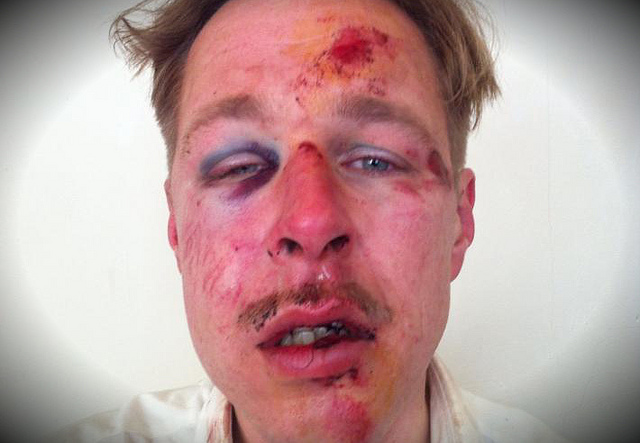
Wilfred de Bruijn, a Dutch man living in France for 10 years, after a brutal homophobic attack in Paris:

According to de Bruijn, he was attacked with his boyfriend in the 19th arrondissement of Paris on Saturday night simply because they were gay. France’s gay rights groups say the savage beating comes as homophobic incidents are on the rise.

They blame the increasingly radical and stubborn anti-gay marriage movement.

Hours after being subjected to the beating, De Bruijn put the photo on his Facebook page. It has since been shared thousands of times across social media.

“Sorry to show you this,” the victim wrote. “It’s the face of homophobia. Last night 19th arrondissement, Paris, Olivier and I were badly beaten just for walking arm in arm.

“I woke up in an ambulance covered in blood, missing tooth and broken bones around the eye.

“I’m home now. Very sad.”

Marriage equality will come to France in a matter of weeks.

Ask Dreher Anything: Conservatives And France

Rod shares why he thinks American conservatives have such a problem with the French:

Even in March 2003, at the onset of the Iraq War, Rod was defending French culture in the pages of National Review:

I think there’s a conservative point to be made here. The French are an old country, and the love they have for their culinary traditions, and its unparalleled excellence, come from a profound respect for tradition and culture, for civilization. When they make fools of themselves beating up the neighborhood McDonald’s, I find it hard to condemn them, because we all live in a world that doesn’t ask What is beautiful? What is delicious? What is worthy; we live in a world that asks only, What is quick and easy? Many of the French resist this modern, very American impulse. They do it in bad, stupid ways sometimes, but their instinct is right. As someone who grew up in a disposable culture, the effort the French put into aesthetic excellence never fails to move me, and makes me want to learn from them. …

… I can’t hate France, and when this ugly time passes, I’ll be back. I’ve got a little boy of my own now, and rather than just tell him about the wonders of France, as Aunt Lois and Aunt Hilda did for me, I’m planning to take him there one day and show him. I want him to see the cathedral at Chartres, the experience of which first stirred me to seek Christian faith (wondering what kind of religion would inspire men to build something so magnificent to the glory of God). I want him to see the castles of the Loire Valley, the vineyards of Bordeaux, and the graveyard at Normandy, where so many of his countrymen died to make France free. I want him to see Paris, the world’s most beautiful city, and the bridge over the Seine where his father kissed his mother one warm spring evening when they were first in love, and to walk over to Berthillon on the Ile St-Louis to taste the best ice cream in the world. France is for him to love too, and not even the perfidious pomposities of Dominique de Villepin can take that from him.

His previous Ask Anything videos are here. Be sure to check out his new book, The Little Way of Ruthie Leming: A Southern Girl, a Small Town, and the Secret of a Good LifeAsk Anything archive here.

Should Tsarnaev Be Read His Rights?

Emily Bazelon worries because he hasn’t been Mirandaized:

[T]he next time you read about an abusive interrogation, or a wrongful conviction that resulted from a false confession, think about why we have Miranda in the first place. It’s to stop law enforcement authorities from committing abuses. Because when they can make their own rules, sometime, somewhere, they inevitably will.

Jason Mazzone counters:

A newsflash: Miranda does not in any way require the police to warn suspects taken into custody that they don’t have to answer questions or that they have a right to have an attorney present. All that Miranda says suspect-number-2is that if the interrogators don’t give the warnings, then (barring an exception), the government won’t be able to introduce into evidence at trial statements the unwarned suspect makes (or the fruits of those statements). Accordingly, there is nothing remotely unusual about the Tsarnaev situation. Millions of criminal suspects are questioned every year by the police (and other law enforcement officials) without ever being advised of their rights under Miranda. Police officers I know tell me they hardly ever Mirandize individuals they arrest because cases in which the arrestee’s statements are relevant to securing a conviction (especially in a world of plea bargaining) are quite unusual.

Sandy Levinson disagrees with Mazzone’s dismissal of Bazelon and considers Tsarnaev’s individual case:

As a practical matter, as Marty Lederman has suggested elsewhere, it is quite unlikely that Dzhokhar Tsarnaev is unaware that he has a right to remain silent, either because of his knowledge of American culture or because his alleged terrorism-masters in Chechnya would surely have had the wit to say (something like) “if you’re captured, remember that those wimp Americans will accord you a right to remain silent.” Also, as Marty has suggested, it is almost certainly the fact that a smart defense lawyer would not necessarily advise taking the fifth, precisely because there is so much evidence against him and the smart thing to do would be to strike a deal for, say, life imprisonment in return for singing like a canary (and verifying what he says by tracking down his leads).

As a practical matter, I don’t object. As a symbolic matter, I fear it reeks of post-9/11 panic. I’m just relieved we do not have a Romney administration or this American citizen would be getting prepped for being tortured, just as Jose Padilla was. Orin Kerr is on the same page as Mazzone:

[T]he government is still free to question Tsarnaev outside Miranda as long as the government accepts the uncertainty of whether those statements would be admissible in a criminal case against him.

Assuming that the evidence against Tsarnaev’s many different crimes over the last week is likely to be overwhelming, agents may not need any statements from him for a criminal case. They may simply want whatever intelligence he can provide for use in broader antiterrorism efforts, and Miranda is no impediment in that case. The agents are free to question Tsarnaev outside Miranda to gather intellligence as long as they don’t cross the line into coercing statements from him.

Freddie DeBoer has a different view:

Timothy McVeigh: killed 168 people. Injured over 800 more. Was motivated by political convictions. He was arrested, Mirandized, charged, appointed with legal counsel, and tried in a civilian court. Ted Kaczynski: killed three people. Injured 23 more. Was motivated by political convictions. He was arrested, Mirandized, charged, appointed with legal counsel, and processed through a civilian court. Eric Rudolph: killed two people. Injured at least 150 more. Was motivated by political convictions. He was arrested, Mirandized, charged, appointed with legal counsel, and processed through a civilian court.

If you recognize that the results of these legal cases were consonant with our system of jurisprudence and with justice, you cannot ask for a separate status for Dzhokhar Tsarnaev without supporting legal discrimination based on ethnicity and religion.

Scott Lemieux adds:

The local authorities that relied on coercive interrogations and didn’t follow professional procedures weren’t more likely to convict criminals, although they were more likely to convict the innocent. Miranda reflected this belief, and the intent of the rule was to inhibit coercive interrogations, because coercive interrogations were both wrong in themselves and produced unreliable information.

To refuse to inform Tsarnaev of his rights — outside of the acknowledged emergency exception to Miranda — sends the opposite message. It’s the message of the previous administration — i.e. that the rule of law and the “war on terror” are incompatible, that slapping the label “terrorist” on a suspect means that professional procedures that respect the rights of the accused can’t work.

Jeffrey Rosen’s related thoughts:

[N]o one has produced evidence showing that non-mirandized investigations, like enhanced interrogation, are necessary to procure valuable intelligence—the administration originally argued that the ordinary criminal justice system was adequate to try even the Guantanamo detainees. “We should use the rules we currently have, because no one has made a convincingly argument that the rules don’t work,” says [Dennis] Kenney, a policing scholar and former cop. “Collectively, you’ll find that the police are pretty comfortable with the rules as they are and if you talk to police leaders, they’re nervous about these kinds of changes.”

And Brian Beutler makes an important final point:

Miranda rights aren’t conferred on a suspect at the moment an officer of the law reads them to him. They’re fundamental. And if Tsarnaev awakes in the hospital aware that he doesn’t have to say anything, and demands an attorney, the FBI ultimately can’t deny him one.