In his new book, The Faithful Executioner, Joel Harrington tells the story of Frantz Schmidt, Nuremberg’s master executioner from 1573-1618, using Schmidt’s own journal. Peter Lewis highlights what made the “pious, reflective, loyal, sober Frantz” such “a rare bird in the world of executioners”:
Schmidt was a professional torturer and punisher as well as executioner. He had to know how far he could go in securing a confession — the best place to turn the screw, how much stretch the shoulder would take in the strappado, the correct tilt of the waterboard (yes, that’s right) — and if the sentence handed down was to sever the tongue, the severer better be handy with medical tools if it was not to become an act of capital punishment. The executioner’s medical knowledge was widely sought, and Schmidt was well considered to have extensive familiarity with herbs and salves (from attending his torture victims) and of setting broken bones (so that the execution might go on). He considered healing to be his calling — for a sensitive soul, it must have been a consolation to his other profession — and he made more money as a healer than an executioner; his patients numbered in the thousands.
There are many nuances to the story of Tamerlan and Dzokhar Tsarnaev – and there is no doubt that, like all human beings their acts were, as my shrink often unhelpfully puts it, “multi-determined.” And there is a huge amount to learn from the stoner kid who got caught up in his brother’s religious fanaticism. But Glenn Greenwald veers into left-liberal self-parody this morning:
The overarching principle here should be that Dzhokhar Tsarnaev is entitled to a presumption of innocence until he is actually proven guilty. As so many cases have proven – from accused (but exonerated) anthrax attacker Stephen Hatfill to accused (but exonerated) Atlanta Olympic bomber Richard Jewell to dozens if not hundreds of Guantanamo detainees accused of being the “worst of the worst” but who were guilty of nothing – people who appear to be guilty based on government accusations and trials-by-media are often completely innocent. Media-presented evidence is no substitute for due process and an adversarial trial.
But beyond that issue, even those assuming the guilt of the Tsarnaev brothers seem to have no basis at all for claiming that this was an act of “terrorism” in a way that would meaningfully distinguish it from Aurora, Sandy Hook, Tuscon and Columbine. All we really know about them in this regard is that they identified as Muslim, and that the older brother allegedly watched extremist YouTube videos and was suspected by the Russian government of religious extremism (by contrast, virtually every person who knew the younger brother has emphatically said that he never evinced political or religious extremism).
Legally, the case for the presumption of innocence is absolutely right. But come on.
One reason the Miranda rights issue is not that salient is that the evidence that this dude bombed innocents, played a role in shooting a cop, shutting down a city, and terrorizing people for a week is overwhelming and on tape. And yes, of course, this decision to commit horrific crimes may be due in part to “some combination of mental illness, societal alienation, or other form of internal instability and rage that is apolitical in nature.” But to dismiss the overwhelming evidence that this was also religiously motivated – a trail that now includes a rant against his own imam for honoring Martin Luther King Jr. because he was not a Muslim – is to be blind to an almost text-book case of Jihadist radicalization, most likely in the US. Tamerlan may have been brimming with testosterone as he found boxing an outlet for his aggression, bragging to his peers of his coolness and machismo and piety, and all of that may have contributed. Who knows if the delay in his citizenship application because he was beating his wife was the proximate cause. But does Glenn wonder why Tamerlan thought it was ok to beat his wife, whom he demanded convert to Islam? Does Glenn see no religious extremism here:
The dramatic confrontation between Tamerlan and his imam began when the 26-year-old interrupted a solemn Friday prayer service three months ago. The imam had just offered up assassinated civil rights icon Martin Luther King Jr. as a fine example of a man to emulate – but this reportedly enraged Tamerlan.
‘You cannot mention this guy because he’s not a Muslim!’ Muhammad recalled Tamerlan shouting, shocking others in attendance according to the LA Times. Kicked out of the mosque for his outrageous behavior, Tamerlan did return to the prayer service after his outburst according to Muhammad.
‘He’s crazy to me,’ said Muhammad. ‘He had an anger inside.… I can’t explain what was in his mind.’
This is from the Daily Mail – which is almost as unreliable as the New York Post – but the sourced quotes from his own imam seem legit. So we see perhaps the core of what is in front of our noses: this was not about Islam or being Muslim as such. Look at Tamerlan’s family and his own imam. They all saw a young man drifting into something far more extremist, fundamentalist and bigoted. His uncle saw it:
‘I was shocked when I heard his words, his phrases, when every other word he starts sticking in words of God. I question what he’s doing for work, (and) he claimed he would just put everything in the will of God.”
We see the sexual puritanism of the neurotically fundamentalist. We have his YouTube page and the comments he made in the photography portfolio. To state today that we really still have no idea what motivated him and that rushing toward the word Jihadist is some form of Islamophobia seems completely bizarre to me.
When will some understand how dangerous religious fundamentalism truly is? And when will they grasp that a religion that does not entirely eschew violence (like the Gospels or Buddhism) will likely produce violence when its extremist loners seek meaning in a bewildering multicultural modern world? This was an act of Jihad. That does not mean we elevate it above crime; it means we understand the nature of the crime. It only makes sense in the context of immediate Paradise, combined with worldly fame. And those convinced of the glories of martyrdom – of going out with a bang – are the hardest of all to stop.
(Video: Introductory clip from the YouTube account of Tamerlan Tsarnaev)
Update from a reader:
In your recent post about the issue of religious extremism and the alleged acts of terror by the Tsarnaev brothers, you said: “But does Glenn wonder why Tamerlan thought it was ok to beat his wife, whom he demanded convert to Islam?” Just a quick fact-check query. The coverage I seemed to recall reading and hearing indicated that although the elder brother, Tamerlan, was charged in some kind of domestic violence incident, as I understand the facts, it was for something he did to a former girlfriend who is NOT his current wife. And separately, as I understand the reporting, he did in fact push and convince his current wife to convert to Islam when they married, but it appears that that was not concurrent with domestic violence against her.
Glad to see this subject make it on your blog. You have been fairly consistent in talking about a lot of these issues that don’t get reported on a ton in other media venues. I just want to jump in though and speak a bit about my own experiences – if nothing else, just for the catharsis of it. This country’s nonsupport of their veterans is borderline criminal. Whether it’s the stigma that gets attached to PTSD thanks to the machismo mentality of the military or the constant stereotyping of veterans with PTSD by Hollywood, or the out-and-out hostility of the VA towards the veterans who they are supposed to help.
I returned from Iraq in 2003 and left the service in 2004. For the next three years, I fought tooth and nail to get help from the VA for PTSD. Every chance they had they denied that any of the symptoms I was suffering from were related to combat; they hilariously told me that they were pre-existing conditions and that they wouldn’t cover it. I spiraled down in those years, drinking myself to sleep pretty much every night and somehow staying in school.
I finally got serious about seeking help after friends of mine sat me down, after a violent outburst followed by some cutting, and helped set me straight. Since then it’s been a constant battle with myself and many times with the VA. Pretty much every day is a struggle and yet the organization that is supposed to be on my side seems to excel at antagonizing and obstructing. For years, my only recourse was the VA because I didn’t have health insurance, and it’s only recently since I’ve gotten an actual job with insurance that I’ve been able to really start addressing these issues.
This story is replayed every single day, thousands of times across the country. Instead of seeking help, veterans will often commit suicide because there is no one there for them. Yet the VA is continuing to repeat the same mistakes. Instead of confronting the issues head-on, they are working actively to downplay the suicide numbers. It’s only recently in the last few years, with the help of veterans organizations, that the totality of the problem is coming out. (There are a lot of great organizations out there who are doing great work; Give An Hour has been a huge help to me.)
Unfortunately, nothing will happen until people start being held accountable and start losing their jobs or elections over this issue. The only way that will happen, as hard as it can be, is for those of us that are struggling with this to start a conversation with our friends, loved ones, and strangers. Only then can the totality of this issue be realized by people who have no connection to these wars and there effects. A clumsy way of saying it is that we need to come out. We need to show that yeah, we may have issues, but we’re not broken. We did our part and held up our end of the bargain – now it’s time for you to fulfill yours.
My grandfather landed on Normandy Beach and never talked about it and struggled with it his whole life. My father was in Vietnam and came back the same way. It’s time for us in this war and generation to be more open and talk about these issues and seek help. Only then can we force the country and our leaders to keep their promises to us.
Another:
I am the forty-one year old adult child of a Vietnam veteran diagnosed with PTSD. In my own experience, the effects of “secondary PTSD” can feel almost as debilitating as actual PTSD itself. As a child, my father was loving and engaged at times, but also unpredictable, swinging from violently abusive to depressed and withdrawn, as he attempted to come to grips with what he saw and did in Vietnam. He also struggled with a host of substance abuse issues – another common symptom of PTSD sufferers.
It took me a number of years to finally connect my own free-floating anxiety, guilt and depression (not to mention my own struggle with drugs and alcohol) with my father’s war experiences. I make no excuses now – trauma affects everyone differently and my father and I both remain responsible for our actions. But to think that the effects of combat (and the costs of our wars) end when our soldiers return home is naïve at best. We are still paying for Vietnam 40 years later and I suspect we will be paying for our current wars for years to come, in one of the currencies that is most valuable to us: the well-being of our families. The trauma of war is now inextricably interwoven in the fabric of my family, and I suspect even filters down into the lives of my own children.
We work hard to heal, and my father and I are both much different now after so many years have passed, but the wound is real, and sometimes still raw. There is great honor in the service and sacrifice our soldiers provide and I remain proud of what my father did in Vietnam, just as I am proud of soldiers today who risk much. But it is a real sacrifice, both for themselves and their families. When we calculate the costs of war, we would do well to remember how long those costs linger.
Most devices don’t have one, according to Andrew Johnston, curator of the new Air and Space Museum exhibit, “Time and Navigation.” He believes that will have to change considering that “GPS is shockingly easy to interfere with”:
One of the famous examples was at Newark Airport. The FAA was experimenting with a positioning system there and every so often, the GPS would stop working briefly. It kept happening over and over again. They finally figured out that what was going on was that right next to the airport was the New Jersey turnpike and the trucks were driving by with GPS jammers. And they’re inexpensive. You plug it into the cigarette lighter power adapter and GPS doesn’t work for the vehicle. The problem is that the zone that it affects is much bigger than a truck. The signal bleeds out, in this case, into the grounds of the airport.
(“The Astronaut Who Captured a Satellite” from NASA)
Kas Thomas debunks the scientific-sounding claims that food rich in antioxidants fight aging and disease:
[A]fter 60 years of intensive research into antioxidants, with billions of dollars spent looking for nutrients that can retard cell aging, not a single antioxidant compound has been found that can extend human life. In fact, in a shocking number of human trials, antioxidants (beta carotene, Vitamin E, Vitamin A) have actually increased all-cause mortality. The Free Radical/Oxidative Stress Theory (like Ancient Astronaut Theory) is founded on correlation, supposition, and a nice-sounding story—and not much else. Its core assumption, namely that the buildup of Reactive Oxygen Species in normal tissues is the main driver of aging, is contradicted by the findings of Pérez et al.and many others. At this point the theory can and should be considered discredited. If research into aging has proven one thing, it’s that in order to live longer, your best strategy isn’t to eat more antioxidants. It’s to eat less—of everything.
Ben Marks highlights a disturbing anecdote, told to him by sword maker Francis Boyd, about antique swords:
“You can tell it’s blood,” he says matter-of-factly, “because ordinary rust turns the grinding water brown. If it’s blood rust it bleeds, it looks like blood in the water. Even 2,000 years old, it bleeds. And it smells like a steak cooking, like cooked meat. I’ve encountered this before with Japanese swords from World War II. If there’s blood on the sword and you start polishing it, the sword bleeds. It comes with the territory.”
Blood rust: I hadn’t thought of that. I guess it would turn water red, but the steak comment is kind of creeping me out, as is the growing realization that if these swords could talk, I couldn’t stomach half the tales they’d have to tell.
Sixty years ago in his “Chance for Peace” speech, Eisenhower listed what we could be buying with the ballooning defense budget. A sample:
Every gun that is made, every warship launched, every rocket fired signifies, in the final sense, a theft from those who hunger and are not fed, those who are cold and are not clothed. This world in arms is not spending money alone. … We pay for a single fighter plane with a half-million bushels of wheat. We pay for a single destroyer with new homes that could have housed more than 8,000 people.
According to the National Association of Realtors, the national median price for a single family home (each houses four people) is $173,600, as of February 2013. Building enough of them to house 8,000 people would cost $347,200,000. Or put a different way, about a quarter of the cost of the Navy’s current Flight IIA DDG-51 Arleigh Burke-class destroyer. The money spent on a single DDG, roughly $1.5 billion, would put durable roofs over the heads of more than 34,000 Americans. The proposed “Flight III” Burkes have an estimated delivery cost of $3 billion to $4 billion apiece. Or another way, it is enough to rebuild all the homes in New Jersey damaged by Hurricane Sandy.
This weekend on the Dish, we took a break from covering Boston, pausing only to praise the city’s medical teams, while Andrew and Hitch continued their late night conversation about religion.
We also provided our usual mix of religious, books, and cultural coverage. In matters of faith, doubt, and philosophy, David Foster Wallace saw perfectionism as paralysis, George Scialabba remembered Camus’s brilliance, and Tom Jokinen considered the finer points of failure. Kaya Oakes found her religion again through Bach, Theo Hobson profiled the new new atheists, and David Sessions speculated about the future of evangelicals and same-sex marriage. Richard Brody pondered the religious themes in Malick’s To the Wonder, Tom Bartlett unpacked the complex faith of Christian Wiman, and William Hurlbut used the example of St. Francis of Assisi to question our biotechnological ambitions. Rachel Shukert tracked the rise of Jewish characters in Mad Men, Edward J. Blum examined depictions of Jesus’ race throughout the ages, Rod Dreher and Damon Linker debated the geography of the good life, and Carl Sagan divulged his highdeas.
In literary and arts coverage, James Wood revealed why he goes easy on first-time novelists, James Baldwin ruminated on the risk of writing, and Geoffrey Pullum elaborated on his critique of George Orwell. Jenni Diski explored the role of “just deserts” in literature and film, Ferris Jabr went through the research suggesting the downside to e-reading, and William Deresiewicz pointed out that the distortion of the English language often starts with the elite. Glen Weldon chronicled the various incarnations of Superman, J. Bryan Lowder walked us through this year’s avant garde winner of the Pulitzer Prize for music, and Damien Ober spotted a fascinating detail about Lincoln’s rise to national prominence. Read Saturday’s poem here and Sunday’s here.
In assorted news and views, Mark Mazzeti narrated the story of an enigmatic West Virginian entrepreneur, Aaron David Miller found the political consequences of America’s unique geography, and Max Fisher highlighted a study debunking some assumptions about which Europeans start drinking at a young age. Nate Cohn went another round debating if Obama’s race cost him votes, Craig Hubert interviewed Sebastian Junger about the allure of war, and Lauren Markham described the rise of a new type of refugee. Michael Pollan asked why we cook, Maria Popova dug up a 1949 guide to dating, and Emily McManus spotted an entertaining academic study of Facebook. Hathos Alert here, MHBs here and here, FOTDs here and here, VFYWs here and here, and the latest window contest here.
– M.S.
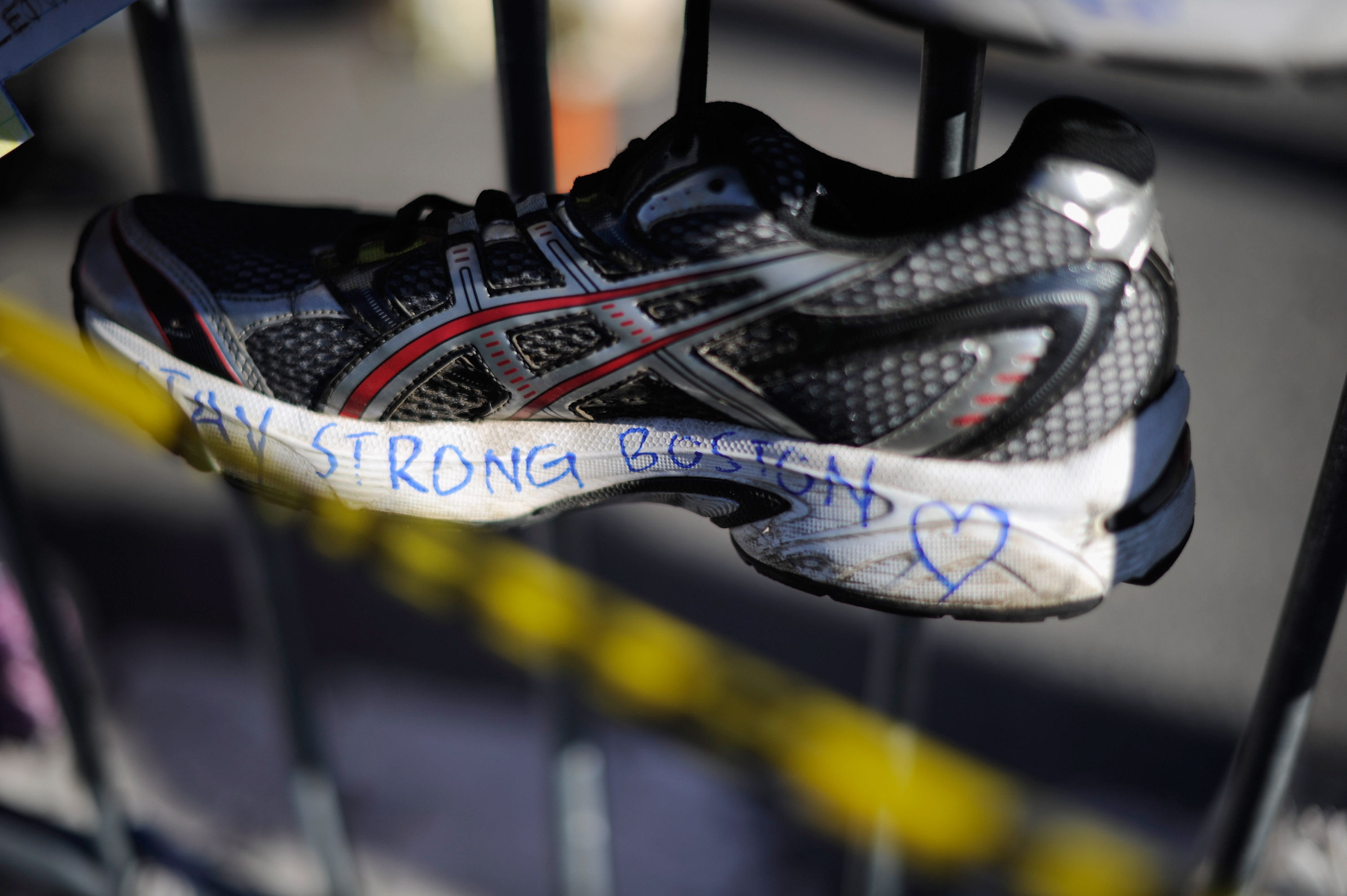
(Photo: Running shoes are placed at a makeshift memorial for victims near the finish line of the Boston Marathon bombings at the intersection of Newbury Street and Darthmouth Street two days after the second suspect was captured on April 21, 2013 in Boston, Massachusetts. By Kevork Djansezian/Getty Images.)
Paul Rivot’s grandmother is 90 years old. She lived through the Great Depression, World War II, and the advents of AM/FM radio, television, and the internet. In the above video, she tries out the extraordinarily powerful Oculus Rift virtual reality headset for the first time, and it is positively heartwarming.
Back in January, Glenn Derene described his own experience test-driving the headset:
With the goggles on my head, I was in a digital representation of a medieval village in the midst of a light snowfall. There were no rapid-fire guns or enemies to fight, just a highly detailed world to “walk” through. [Joseph Chen, the company’s senior product manager] encouraged me to look around and look up to see the snow falling down and the cathedral steeple rising up into the night sky. “Rotate your head and look behind you,” he said. I look in the direction of Chen’s voice and find nothing but a lonely street. A walk into the cloistered entryway of the cathedral felt claustrophobic, but a few steps more and the cathedral opened up to a sprawling interior with arched ceilings.
After a few minutes of this, Chen asked me to stand up, and I was struck by how difficult this task suddenly seemed. “Don’t worry,” he said, “I’ll put my hand on your shoulder to make sure you don’t bump into anything.” He had me turn around and I could feel myself being guided through two different worlds at the same time: The real world, where Chen was making sure I didn’t bump my shins into my chair, and the virtual world, where I was looking through the falling snow at a bridge in the distance.
In March, Paul Waldman wondered if videogames will save future seniors from the despair of getting old:
Considering how much more complex, immersive, and graphically and narratively rich today’s games are compared to those of a few decades ago, just think what they’re going to be like 40 or 50 years from now. Frankly, by the time my ungrateful kids shunt me off to the home, I’m going to be pretty pissed if we don’t have full-on holodecks, where I can play a set against Roger Federer at Wimbledon, chat with Richard Feynman about the nature of the universe while sipping coffee at a Left Bank cafe, then blast some alien invaders, all in the same afternoon and with an almost perfect level of realism. And of course, in the holodeck I will be unburdened by my decaying meatsack, and will do all these wonderfully stimulating things while in the body of a particularly healthy 20-year-old. It’s almost enough to make you believe growing old won’t be so bad after all. Almost.



 The Dish