God’s Instruments

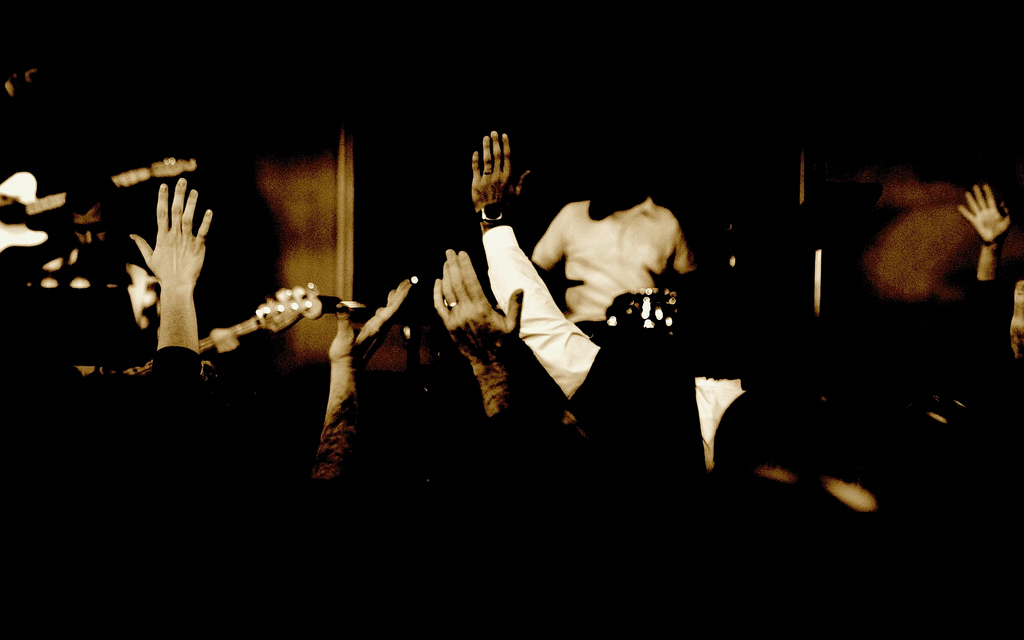
Kaya Oakes found her religion again, in Bach:

I hadn’t touched a cello in 15 years when I discovered the Mass in B Minor, by which time I was deeply into my thirties, married to a musician, my hands permanently bent and hurting from arthritis, and struggling to reconcile with the Catholic church, a protracted battle that continues to consume a rather large chunk of my days. One night when I was killing time before heading off to a catechism class, I found a copy of it at Amoeba Records and stuck it into my car CD slot. The Mass in B Minor begins with a burst from the chorus and orchestra together, the Kyrie: Lord, Have Mercy. Even sitting in the driver’s seat, it was like being knocked to the ground.

The thing about rock music, in all of the forms that I’ve worshipped, is that it’s not about thinking. You have your cerebral performers, but rock music is about the body: the corporeal sensations of fucking, moving, imbibing, ejecting. It is not about the caverns of the mind. And those caverns are where Bach spent his lifetime chasing the intricacies of forms, twisting the ideas of what music can do, wedding it to mathematical possibilities, but never forgetting that, as Keats wheezed, Beauty is Truth. Beauty is the best thing we can point at in order to say “God.”

Blowing Justice To Pieces

George Scialabba reviews the first English translation of Albert Camus’s Algerian Chronicles, finding the French theorist’s reflections on the conflict proof of his profundity:

At a press conference in Stockholm after the Nobel ceremony, Camus made a statement widely misreported as “I believe in justice, but I will defend my mother before justice.” Goldhammer and Alice Kaplan—in her introduction to this edition—perform a considerable service in pointing out that Camus said nothing so simplistic. What he said was: “People are now planting bombs in the tramways of Algiers. My mother might be on one of those tramways. If that is justice, then I prefer my mother.” He was not sentimentally exalting his mother above justice; he was rejecting the equation of justice with revolutionary terrorism.

The Sacrament Of Experience

Richard Brody describes Terrence Malick’s To the Wonder as a film in which “Catholic iconography and Protestant ideals tangle in the American heartland,” summarizing the heart of Malick’s religious vision this way:

For Malick, sacrament isn’t pageantry, isn’t style or theatre; it’s experience. The rigid mediation of such ostensibly Catholic filmmaking is the antithesis of his notion, his literal vision, of a cinema informed by the divine. Malick finds his vaulting spans in immediate vision: he films in a quasi-documentary manner, mixing his world-renowned stars with local residents and filming them on location with a devout attention to the natural landscape and modest, everyday, even banal settings (strip malls, tract housing, offices and stores, laundromats and restaurants of small-town streets).

Malick’s camera is neither weighed down by dogma nor by abstemiousness, neither by renunciation nor by ritual. His fluid, agile, impressionistic, ecstatic, awe-filled and joyful, yet essentially modest and intimate images suggest a transcendentally-guided trip through the world—a wandering that’s tethered to the light, a light that, seemingly beamed from the cathedral, lends a virtual architectural form to the inchoate open spaces of the landscape, and that seemingly guides bodies through it, weightlessly, transforming ordinary strolling into a sort of—well, a sort of ballet. The dancer herself, self-consciously dancing, is—despite her profane emotional voracity—a step closer to the divine than anyone in the movie, including the priest (who, however, graces those in his flock with a reflection of light that nonetheless hardly shines on him).

Josh Larsen, calling To the Wonder Malick’s “most earnest search for God and the film of his in which God is hardest to find,” further details the film’s religious themes here.

Previous Dish on To the Wonder here, here and here.

Why Cook?

In an excerpt from his new book, Cooked: A Natural History of TransformationMichael Pollan laments that economic specialization “neatly hides our implication in all that is done on our behalf by unknown other specialists half a world away”:

Perhaps what most commends cooking to me is that it offers a powerful corrective to this way of being in the world — a corrective that is still available to all of us. To butcher a pork shoulder is to be forcibly reminded that this is the shoulder of a large mammal, made up of distinct groups of muscles with a purpose quite apart from feeding me. The work itself gives me a keener interest in the story of the hog: where it came from and how it found its way to my kitchen. In my hands its flesh feels a little less like the product of industry than of nature; indeed, less like a product at all. Likewise, to grow the greens I’m serving with this pork, greens that in late spring seem to grow back almost as fast as I can cut them, is a daily reminder of nature’s abundance, the everyday miracle by which photons of light are turned into delicious things to eat.

For more, check out Pollan’s interview with Adam Platt. A highlight:

I think it’s interesting that this strikingly powerful interest in all things having to do with food coincides with a progressively more mediated, digitized life. We spend our time in front of screens. We don’t exercise our other senses very much. And food is this complete sensory experience. It engages all five senses. It’s a sensual pleasure. And it is also—and I think this is a very important part of the food movement—really a communitarian movement. What’s driving people to food in many, many places is the kind of experience you can have at a farmers’ market. It’s really a new public square.

(Photo by Steve Evans)

Quote For The Day

GertrudeStein

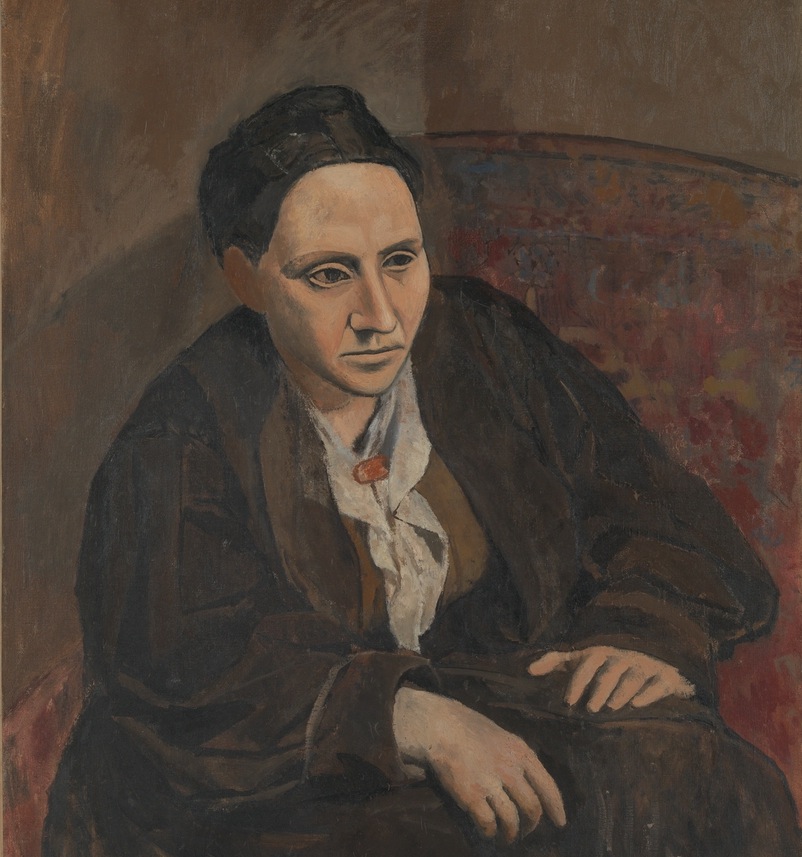
“I don’t try to be prophetic, as I don’t sit down to write literature. It is simply this: a writer has to take all the risks of putting down what he sees. No one can tell him about that. No one can control that reality. It reminds me of something Pablo Picasso was supposed to have said to Gertrude Stein while he was painting her portrait. Gertrude said, ‘I don’t look like that.’ And Picasso replied, ‘You will.’ And he was right.” – James Baldwin.

(Picasso’s portrait of Stein, via Wiki)

Disfiguring Nature

William Hurlbut uses the example of St. Francis of Assisi to question our biotechnological ambitions:

St. Francis’s attentive and appreciative disposition toward the multiplicity of natural forms, even the tiniest and seemingly insignificant, expresses an understanding of the universe as an ordered and intricately interrelated whole. … Recognition of the fragile interdependence of living nature urges us to be cautious — lest we disrupt the basic balance of being and thereby drain the created order of its beauty, vitality, spiritual significance, and moral meaning. We have no license for an attitude of arrogance as masters and possessors of nature. Plants and animals may be used, not as mere raw materials, but with tenderness, compassion, and genuine gratitude. Genetically engineered featherless chickens for cheaper pot pies and leaner pigs with severe arthritis are a violation of basic kindness and courtesy — of the concern that Francis extended to even the lowliest of creatures.

Mad Men’s Melting Pot

Rachel Shukert tracks the rise of Jewish characters in Mad Men as a portrait of cultural assimilation:

[I]t wasn’t until last season that we got Michael Ginsburg, the whiz-kid copywriter. With his thick “regional” accent, Yiddish-accented Old Country father who likes farmers’ cheese and has a dimly remembered tragic early childhood in a concentration camp, Ginsburg is the first Jewish character on Mad Men who isn’t, on some level, trying to hide it. Roger Sterling, ever the gentleman, may have taken it upon himself last season to make sure their client Mohawk Airlines could deal with “working with a Jew,” but the times, they are a changin.’

A Kinder, Gentler Atheism

Theo Hobson profiles the “new new atheists,” who he claims are more nuanced, diplomatic, and “admirably refuse to lapse into a comfortably sweeping ideology that claims the moral high ground for unbelief”:

Crucially, atheism’s younger advocates are reluctant to compete for the role of Dawkins’s disciple. They are more likely to bemoan the new atheist approach and call for large injections of nuance. A good example is the pop-philosopher Julian Baggini. He is a stalwart atheist who likes a bit of a scrap with believers, but he’s also able to admit that religion has its virtues, that humanism needs to learn from it. For example, he has observed that a sense of gratitude is problematically lacking in secular culture, and suggested that humanists should consider ritual practices such as fasting. This is also the approach of the pop-philosopher king, Alain de Botton. His recent book Religion for Atheists rejects the ‘boring’ question of religion’s truth or falsity, and calls for ‘a selective reverence for religious rituals and concepts’. If you can take his faux-earnest prose style, he has some interesting insights into religion’s basis in community, practice, habit.

Justin Hawkins thinks Christians should applaud:

Christians ought to welcome this new development, and not because it signals a softening of opposition to theism. In some ways, this signals an intellectual danger for Christianity. Brash, exhaustive, generalized statements about the nature of reality of the kind perfected by the New Atheists (e.g., “Religion poisons everything”) are always more easily defeated than relatively nuanced, careful positions of the variety advanced by the Newer Atheists. Therefore it is this newer atheism, with its measured and non-dogmatic anti-theism, that poses the larger intellectual challenge to theistic belief.

Nevertheless, the shift away from Dawkins-ism is a welcome one for Christians because it signals a steady and perhaps increasing global interest in religion.

Evangelicalism’s Silent Majority

evangsm

David Sessions speculates about how evangelical Christians under 30 will respond to increasing support for same-sex marriage. He expects the emergence of “something like a bell curve: a large loop of silence and relative apathy with tails of committed support and opposition trailing off each side.” About that middle part of the curve:

The large, complex middle tells the story of the past 15 years. There are lots of different stripes of people who make up this center: some silently supportive of gay marriage, some privately opposed. Probably the largest group is those who feel a unsettled mix of apathy and indecision: their theology is relatively conservative, but the proximity of their gay friends and co-workers and the radical shift in the surrounding culture’s attitude has done its work. Most of all, the legacy of the religious right still haunts; it’s difficult to overstate just how deeply the rejection of the politicized fundamentalism of the past three decades has shaped them. Even if they remain theologically opposed to gay marriage, they are likely to be aware the battle is lost and unsure it’s all that big a deal. I suspect we’ll hear—are already hearing—excuses like, “the government shouldn’t be involved in marriage anyway” or “divorce is worse for marriage than the gays” or “we should focus on religious freedom.” Because of how deep the rejection of and apathy about politics goes among this group, there will be virtually no civic participation in any direction; they’re likely to mostly lay low until this is such a non-issue that no one really talks about it anymore.

(Photo by Brian Petersen)