A Poem For Saturday

bearpoem

“To Be Called a Bear” by Robert Graves:

Bears gash the forest trees
To mark the bounds
Of their own hunting grounds;
They follow the wild bees
Point by point home
For love of honeycomb;
They browse on blueberries.

Then should I stare
If I am called a bear,
And is it not the truth?
Unkept and surly with a sweet tooth
I tilt my muzzle toward the stary hub
Where Queen Callisto guards her cub,

But envy those that here
All winter breathing slow
Sleep warm under the snow,
That yawn awake when the skies clear,
And lank with longing grow
No more than one brief month a year.

(Used with the kind permission of The Robert Graves Copyright Trust. Photo by Flickr user Marshmallow)

Giving The Kid A Bottle

Max Fisher points to a study by UNICEF debunking some assumptions about which Europeans start drinking at a young age:

Despite the strong wine cultures in Italy, France and Spain – or maybe because of them, given the degree to which it cultivates drinking “to enjoy,” as I’ve heard many French say – children in those countries are among the least likely to get drunk.

Kids appear to be much more likely to get drunk in former Soviet states, particularly the Baltic states and Finland, the latter of which might be a surprise given that its kids otherwise score among the highest well-being in the Western world. That may be a partial legacy of Soviet bloc drinking culture, which have the highest alcohol consumption rates in the world and tend to be plagued by alcoholism.

The US ranks last in the surveyed countries.

Face Of The Day

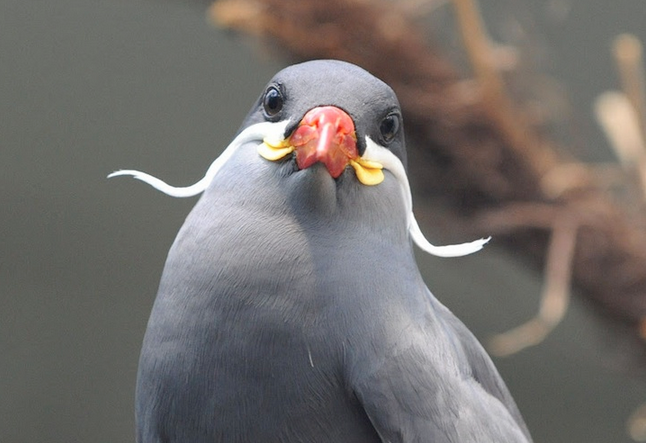
If Dalí were a bird, he’d be an Inca Tern:

Found along the rocky Pacific coastline, from northern Peru south to central Chile, the uniquely plumaged bird is easily recognizable for its dark grey body, its red-orange beak and feet and, of course, that curling white mustache. Sadly, its population has decreased at a rapid rate due to the loss of suitable nesting areas. They’re only an estimated 150,000 left, classifying them as near threatened.

(Photo by Maks Rozenbaum)

Bourgeois Babbling

William Deresiewicz points out that the distortion of the English language often starts with the elite:

There is a lesson here. Idiomatic mistakes, at least the ones that stick, are not produced by the hoi polloi. They happen when people try to sound educated—or to be precise, when educated people try to sound more educated than they actually are. A little learning is a dangerous thing. You hear a word like vagariesor misnomer, you think it sounds impressive, you think you know what it means, and you deploy it the next chance you get. And then somebody who has less cultural capital than you, and who looks to you as an authority, picks it up and uses it in turn.

Comprehending E-text

Ferris Jabr goes through the research suggesting that e-reading may come up short when it comes to comprehension and memory:

[E]vidence from laboratory experiments, polls and consumer reports indicates that modern screens and e-readers fail to adequately recreate certain tactile experiences of reading on paper that many people miss and, more importantly, prevent people from navigating long texts in an intuitive and satisfying way. In turn, such navigational difficulties may subtly inhibit reading comprehension. Compared with paper, screens may also drain more of our mental resources while we are reading and make it a little harder to remember what we read when we are done. A parallel line of research focuses on people’s attitudes toward different kinds of media. Whether they realize it or not, many people approach computers and tablets with a state of mind less conducive to learning than the one they bring to paper.

The Finer Points Of Failure

Tom Jokinen isn’t afraid of falling short:

Making friends with failure is different than squinching your eyes shut and hoping it will go away. The latter is called the Oprah Law of Cause and Effect, which says that bad luck is always just a prelude to success. Think positive, visualize, seize the day, listen to Adult Contemporary music and ride out the bad, because the good always comes… always! The genius of the Law is that you can’t prove it wrong: you can fail all your life, but there’s still tomorrow. This is the logic of slot machines. Keep feeding it twenty dollar bills, like a reverse-ATM, and if it won’t pay out that only means it’s hot. Only an idiot would quit while he’s behind.

Gambling is rational. It’s an act of pure potential. Believing in failure as a necessary condition of life, on the other hand, is not rational, it’s mystical and counter-intuitive, until you make friends with it—not to encourage failure but to keep it from surprising you. Which is what artists and some veteran ball players are able to understand: misfortune is always there, we can manage it or ignore it, but if we ignore it the inevitable bite is that much deeper. In his short novel Seize The Day, Saul Bellow runs his hero Tommy Wilhelm through an existential wringer like God hammering Job, not as a moral lesson but to say: this is how it is. Not only does shit happen but for most of us it never goes away.

Bellow, in Seize The Day:

… since there were depths in Wilhelm not unsuspected by himself, he received a suggestion from some remote element in his thoughts that the business of life, the real business–to carry his particular burden, to feel shame and impotence, to taste the quelled tears–the only important business, the highest business was being done. Maybe the making of mistakes expressed the very purpose of his life and the essence of his being here.

All’s Fair In Fiction?

Jenni Diski considers the role of “just deserts” in literature and film:

Like Kafka and Poe, Hitchcock repeatedly returns to the individual who is singled out, wrongly accused, an innocent suffering an injustice. Yet consider Montgomery Clift’s priest in I Confess, Henry Fonda in The Wrong Man, Blaney, the real killer’s friend played by Jon Finch in Frenzy, James Stewart in The Man Who Knew Too Much and Cary Grant in North by Northwest; none of them is – or could be according to Hitchcock’s Catholic upbringing – truly innocent of everything, and often their moral failings give some cause for the suspicion that falls on them. There is always a faint tang of consequence about their troubles.

We worry about people not getting what they deserve, but, due to religion or some essential guilt we carry with us, we are also concerned that there might be a deeper, less obvious basis for guilt that our everyday, human sense of justice doesn’t take into account. In Victorian fiction, Dickens and Hardy are masters of just and unjust deserts, as innocents such as Oliver Twist, David Copperfield, Tess of the D’Urbervilles and Jude the Obscure become engulfed by persecutory institutions and struggle, only sometimes with success, to find the life they ought, in a fair world, to have.

Blaspheming Against Orwell

Geoffrey Pullum continues his assault on George Orwell’s famous essay “Politics and the English Language”:

Orwell may have thought that phrases like a not unjustifiable assumption should be shunned because they needlessly and redundantly use double negation, but if so, he was wrong. Dropping the two negators from a not unjustifiable assumption yields a justifiable assumption; but that does not have anything like the same meaning. Calling an assumption justifiable suggests one can readily justify it; using “not unjustifiable” is much weaker, and merely suggests that you cannot rule out the possibility of its being justified.

In the same way, Jane is intelligent speaks positively of Jane’s intellect, placing her perhaps in the top quartile of the intelligence range. Jane is not unintelligent, by contrast, is faint praise indeed. It says she does not fall in the range picked out by unintelligent (say, roughly the bottom quartile), but it doesn’t say much more than that.

I take Pullum’s point, but there is a kind of weak ambivalence about the double-negative construction. Why not write that Jane is moderately intelligent. You can get nuance without the clumsiness of very English under-statement. He takes issue with this sentence in particular:

One can cure oneself of the not un- formation by memorizing this sentence: A not unblack dog was chasing a not unsmall rabbit across a not ungreen field.

Let me explain what is so astonishingly dishonest about that footnote. The adjective-negating prefix un- is fairly productive, but by no means universally so. For example, it doesn’t occur with the most basic adjectives of approbation and disapprobation (*ungood, *unbad, *unright, *unwrong). And relevantly here, it never occurs with color adjectives (*unred, *unorange, *unyellow, *ungreen, *unblue, *unindigo, *unviolet), and it never occurs with size adjectives (*unbig, *unlarge, *unhuge, *unvast, *unlittle, *unsmall, *untiny). What this means is that Orwell’s example has nothing to do with the not un- construction that he is supposed to be addressing.

It’s also obviously a little joke. But, hey, blaspheming is something Orwell believed in. So have at him.