Remembering The Fourth Victim

Students have set up a tumblr for memories of Sean Collier:

He knew I was watching the marathon on Monday and was one of the first people to text me to make sure I was okay. Last night, he texted me at 10:30 to see if I’d be bartending at the Thirsty Ear that night — he was thinking about stopping by after his shift ended and hanging out with the students at our weekly karaoke night. He never responded to my text back hoping that he was safe.

Keep the MIT police in your thoughts. They are a kind, dedicated, hardworking part of our community. The extent to which they care about the well-being of the students and every faculty and staff member is inspiring and stems from a deep and genuine love of the Massachusetts Institute of Technology.

Meanwhile, a quick update at the other major disaster this week:

On Friday, a spokesman for the [Texas] State Department of Public Safety estimated that of the 12 confirmed dead so far, 11 of them were first responders. That’s roughly half of West’s volunteer firefighter force—all of whom were well known in town.

(Hat tip: Summer Anne Burton)
How The Suspects Became Citizens

It’s hard to see how tighter immigration laws could have stopped the Tsarnaevs from entering the country:

At the time that the Tsarnaevs applied for asylum, Tamerlan and Dzhokhar were very young. There was almost certainly nothing in their background that would have raised any red flags; apparently, there was nothing in the father’s either. Here, [David Leopold of Leopold and Associates, an immigration attorney who’s been practicing law in Cleveland since the early 1990s,] made a key point: “You can’t predict future behavior.” For any democratic country that wants to participate in international society, Leopold pointed out, you have to assume some level of risk. Despite that, “the systems they have in place,” meaning those security screenings, are “doing the job.”

Terror In America

Manhunt Underway For Marathon Bombing Suspect

Rick Perlstein’s take:

As ghastly, evil, overwhelming, tragic, as the events this week in Boston, Texas, the Capitol mail rooms, have been, it’s easy to forget, in our oh-so-American narcissism, enveloped in the wall-to-wall coverage that makes our present catastrophe feel like the most important events in the universe, how safe and secure Americans truly are by any rational standard. Terror shatters us here precisely because ours is not a terrifying place compared to so much of the rest of the world. And also not really an objectively terrifying time, compared other periods in the American past: for instance, Christmastime, 1975, when an explosion equivalent to twenty-five sticks of dynamite exploded in a baggage claim area, leaving severed heads and other body parts scattered among some two dozen corpses; no one ever claimed responsibility; no one ever was caught; but pretty much, the event was forgotten, life went on, and no one anywhere said “everything changed.”

A less narcissistic time, perhaps. Not now. Now, we let trauma consume us. Now, our desperate longing to know—to find easy, immediate answers—confines us, makes us frantic, reduces us to our basest cognitive instincts.

On an average day in America, 85 people are shot dead. There are now five dead in Boston, including one of the suspected bombers – over the course of five days. I’d say our reaction is less about narcissism than a collective form of PTSD stemming from 9/11.

Nonetheless, we don’t yet know whether others could be involved, or the scale of this terror plot. And authorities have to weigh excruciating risks – between over-reaction and under-reaction – in a fog of fact and fiction. They deserve a break. What we do know is that the bombers had another pressure-cooker bomb with them as they sped toward Watertown. They could have terrorized again.

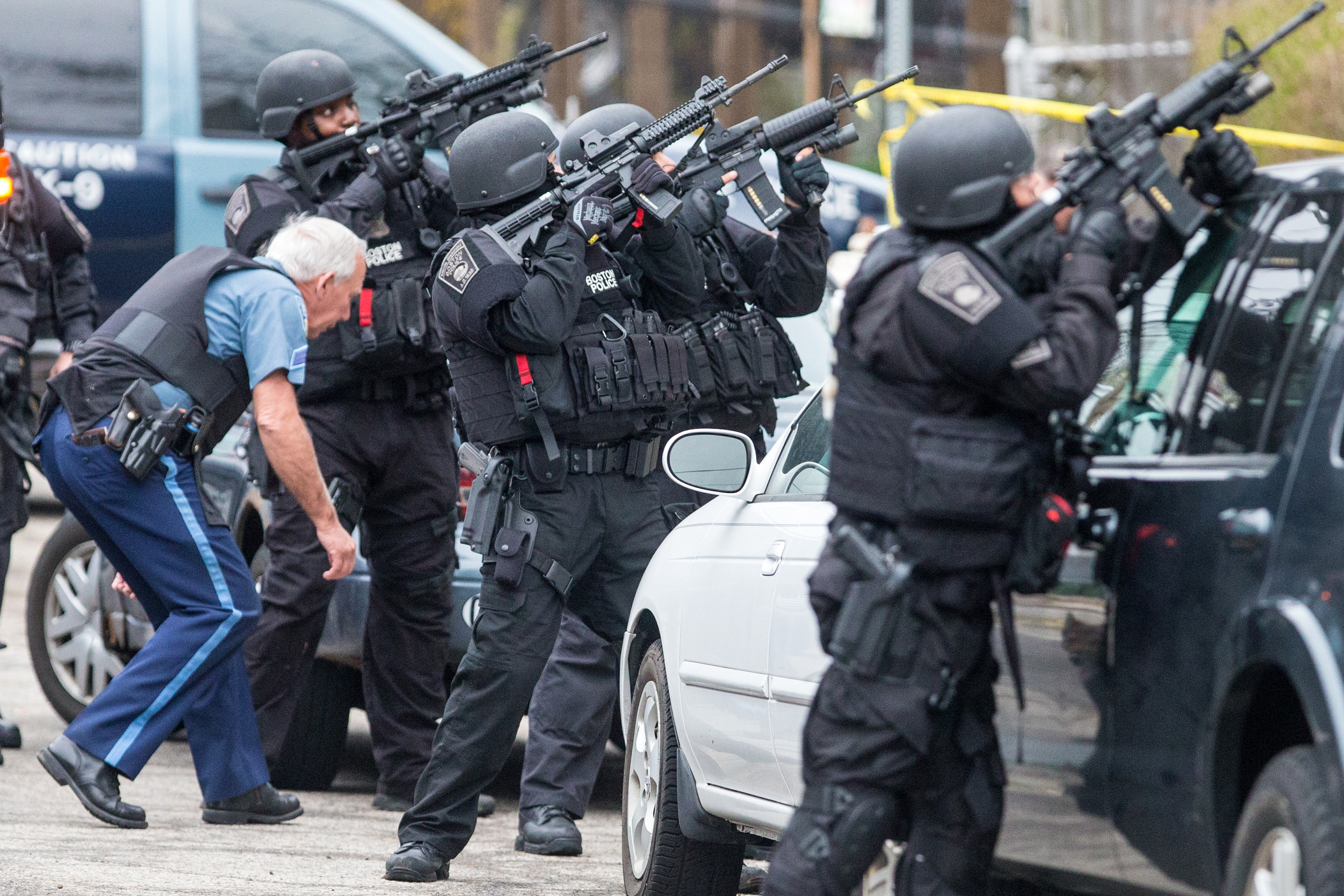
(Photo: SWAT teams moved into position at the intersection of Nichols Avenue and Melendy Avenue in Watertown while searching for one of the two marathon bombing suspects. By Aram Boghosian for The Boston Globe via Getty Images)

Looking The Killer In The Eyes

Dramatic details are still emerging from Monday’s bombing:

Just before 3 p.m. on April 15, Bauman was waiting among the crowd for his girlfriend to cross the finish line at the Boston Marathon. A man wearing a cap, sunglasses and a black jacket over a hooded sweatshirt looked at Jeff, 27, and dropped a bag at his feet, his brother, Chris Bauman, said in an interview. Two and a half minutes later, the bag exploded, tearing Jeff’s legs apart. A picture of him in a wheelchair, bloodied and ashen, was broadcast around the world as he was rushed to Boston Medical Center. He lost both legs below the knee. “He woke up under so much drugs, asked for a paper and pen and wrote, ‘bag, saw the guy, looked right at me,’” Chris Bauman said yesterday in an interview.

Will Immigration Reform Take A Hit?

Kevin Drum fears so:

A few days ago, someone asked: Who are you secretly hoping the bombers turn out to be? My answer was, whatever kind of person is least likely to have any effect whatsoever on public policy. Chechnyans with a grudge of some kind actually fit this bill fairly well, and since the immigration debate is focused mostly on Mexico it might not even have too much impact there. Still, it will have some effect. I don’t know if today’s news will kill immigration reform, but a bill that was on a knife edge already doesn’t need any further setbacks. This is going to hurt its chances.

Matt Steinglass nods:

[R]ationally or not, terrorism involving foreigners in America has always been linked to immigration politics.

The first push to restrict immigration in the 20th century got started after anarchist Leon Czolgosz assassinated President William McKinley; he wasn’t even an immigrant himself, his parents were, but it was enough to prompt Teddy Roosevelt to ask congress to bar “the coming to this country of anarchists or persons professing principles hostile to all government”. The resulting Anarchist Exclusion Act of 1903, and the Immigration Act of 1918 which expanded its authority, didn’t end up actually kicking out more than a few dozen people. And the 1924 Immigration Act, which really did lead to a drastic cutback in immigration, was based on quotas by race and country of origin rather than ideology.

But the political discourse supporting immigration restrictions has always leaned heavily on supposed threats of violence, both criminal and ideological. A couple of immigrant ideological terrorists, running around Massachusetts killing people—the last time the media got hold of a story like this, Sacco and Vanzetti … were sentenced to death, and four years later immigration to America was cut to a trickle.

Earlier Dish on the subject here.

The Shutting Down Of Boston, Ctd

enhanced-buzz-wide-16968-1366386309-10

A reader responds to me and this reader:

Here’s the counter point: If you do something like this, if you fuck with us, we will shut down a major city, stop everything, and hunt you down.

Not sure which one is correct.

Me neither. But if your goal is to gain attention, it worked.

(Image: From a collection of before-and-after shots in Boston)

Where Did The Brothers Get Their Weapons?

Christopher Dickey, Eli Lake and Daniel Klaidman review what we know. On possible ties to al Qaeda, given their firepower:

The trail of the Tsarnaevs seems, for the moment, to remain one of lone wolves. But counterterror operatives see details that suggest a wider organization may yet be discovered. Most telling: the sheer firepower the Tsarnaevs were able to bring to bear in their shootout with police. They appeared to have several unused bombs. And because terrorists learn from each other’s actions, some counterterror analysts are speculating that they may have planned a bigger operation at the marathon, or perhaps to come. One possible example is the bloody Mumbai attack in 2008, carried out by a handful of men, which killed 164 people.

“These are ‘wise guys,’” said one veteran counterterror official. “These are intelligent individuals who thought they could outsmart everybody and get away with it. They didn’t want to die. But they prepared a lot of stuff.”

Why these types of individuals are so hard to stop:

These sorts of lone wolves—whether inspired by al Qaeda or a domestic agenda—are in many ways the toughest cases for law enforcement. “Mobile homegrown types are difficult to stop and to find,” says Rep. Michael McCaul, the Republican chairman of the House Homeland Security Committee. “There is not a conspiracy ring to penetrate. It’s very difficult to stop them and find them.”

“The toughest risk to address is the motivated individual with no known connection to groups, who takes it upon himself to do something,” says Roger Cressey, who worked on counterterrorism in both the Clinton and George W. Bush administrations. “The best example of that is Eric Rudolph.”

This Is A Religious War, Ctd

A reader backs me up against the dissenter:

I think your reader who pointed out the relatively small number of Muslims worldwide actively involved with terrorism is deliberately missing the forest for the trees when it comes to Islamic extremism. The real issue it seems to me is not that the Muslim faith in the abstract is any more or less violent or oppressive than Christianity or any other religion, but rather that in the modern world, the only examples of theocratic government currently being sustained happen to be built upon Islam rather than anything else.

When a religious doctrine and a polity become one and the same, the kind of horrifyingly oppressive regimes we see around the world that foment and legitimize the fundamentalism of these latest terrorists is almost guaranteed. I remember reading something on this blog before about how fatwas against cartoonists who depict Mohammad are justified by some in part because of a lack of understanding of free speech, that Muslims under theocratic rule assume that if those cartoonists weren’t speaking for our government, than our government would silence them. It’s just an example of how these two governing philosophies, ours and that of say Saudi Arabia or Iran, can’t coexist peacefully.

Regardless of whether or not these particular terrorists were tied to any larger group or just influenced by the same rhetoric, this kind of violence will continue for as long as the separation of church and state is a foreign concept to so much of the world.

That’s what I mean by a religious war. It’s war between the extremes of fundamentalist Islam and the free, secular West. That war can exist inside the mind of a single young fanatic who, merely with access to the web and guns and pressure cookers, can stop the world in its tracks. Or it can take the form of sectarian violence in Iraq.

My reader is correct that this is not reducible to Islam in all its breadth and complexity and history. But it cannot be understood at all without grasping the fundamentalist Jihadist mindset. The uncle of the two Jihadists could not be more emphatic that he as a Muslim feels utterly violated and offended by what these losers did. He says he feels ashamed. He is a Muslim as well. And he is an American through and through.

We have to make a simple distinction: between being a Muslim and being an apocalyptic self-proclaimed Jihadist. But the latter exist, are very real, and are inspired by a toxic distortion of Islam.