The Safety Of Marathons

Lydia DePillis argues that marathons are impossible to secure completely. Alyssa thinks tight security “would fundamentally change the nature of marathoning for both participants and spectators”:

As Erin Gloria Ryan wrote for Jezebel, much of the value of these events is in the interaction between large numbers of runners and large numbers of viewers in close proximity to them. “The spectators — people who show up and cheer with noisemakers and high fives and encouraging cheers and magic-markered tagboard signs that read “YOU ALL ARE CRAZY! KEEP RUNNING!”— are the people who matter most to runners,” she explained. ” Without those people, a marathon would just be an exercise in self-abuse from a large group of crazies. But there is meaning in marathoning: the people who watch.”

Russell Saunders zooms out and observes “the ironic failure of terrorism”:

It shouldn’t be an act of courage to dine out in Tel Aviv. It’s shouldn’t be an act of courage to buy groceries in Baghdad. It shouldn’t be an act of courage to earn your paycheck in a skyscraper in Manhattan.

And then it becomes one.

Which is the ironic failure of terrorism. Because of course people will continue to dine out in Tel Aviv and go to market in Baghdad and step on the elevator in New York City. Where previously they did so without thinking, now they do so in a quietly defiant way. Because people will refuse to obey the dictates of the depraved and craven, and will go on living their lives. They will locate the courage within themselves. They will keep running marathons.

Bruce Schneier’s words of advice:

The damage from terrorism is primarily emotional. To the extent this terrorist attack succeeds has very little do with the attack itself. It’s all about our reaction. We must refuse to be terrorized. Imagine if the bombs were found and moved at the last second, and no one died, but everyone was just as scared. The terrorists would have succeeded anyway. If you are scared, they win. If you refuse to be scared, they lose, no matter how much carnage they commit.
A Path-Breaking Pulitzer

This year’s prize for National Reporting was awarded to an unlikely recipient:

InsideClimate News reporters Elizabeth McGowan, Lisa Song and David Hasemyer are the winners of this year’s Pulitzer Prize for national reporting. The trio took top honors in the category for their work on “The Dilbit Disaster: Inside the Biggest Oil Spill You’ve Never Heard Of,” a project that began with a seven-month investigation into the million-gallon spill of Canadian tar sands oil into the Kalamazoo River in 2010. It broadened into an examination of national pipeline safety issues, and how unprepared the nation is for the impending flood of imports of a more corrosive and more dangerous form of oil.

This reach-out to the new brood of lean, small reporting web outfits is really, really gratifying. Their total budget? $550,000. They have no office. Sound familiar? There are only three of them on the Pulitzer team. Dan Nguyen puts the award in further context:

At just 5 years old and with only 7 full-time reporters, InsideClimate News is likely the smallest news organization ever to win in the National Reporting category …

Here’s another size measurement: According to the AP, InsideClimate had about 200,000 page views last month. The winner of last year’s National Reporting Pulitzer, the Huffington Post, is also an online-only news site. But it reportedly racks up a a billion page views a month: i.e., 5,000 times the page views at InsideClimate.

Numbers may seem like a superficial metric, but there’s a reason why big papers dominate every Pulitzer category (except for maybe Public Service) – big investigations require big resources. InsideClimate’s investigation occupied 3 of their reporters for 7 months, a major commitment for a news organization still struggling to draw a daily readership. Even more impressive: InsideClimate is based in Brooklyn, but they invested time and money (i.e. a travel budget) for a story several states away.

Crowd-Sourcing Police Work

4Chan_Image

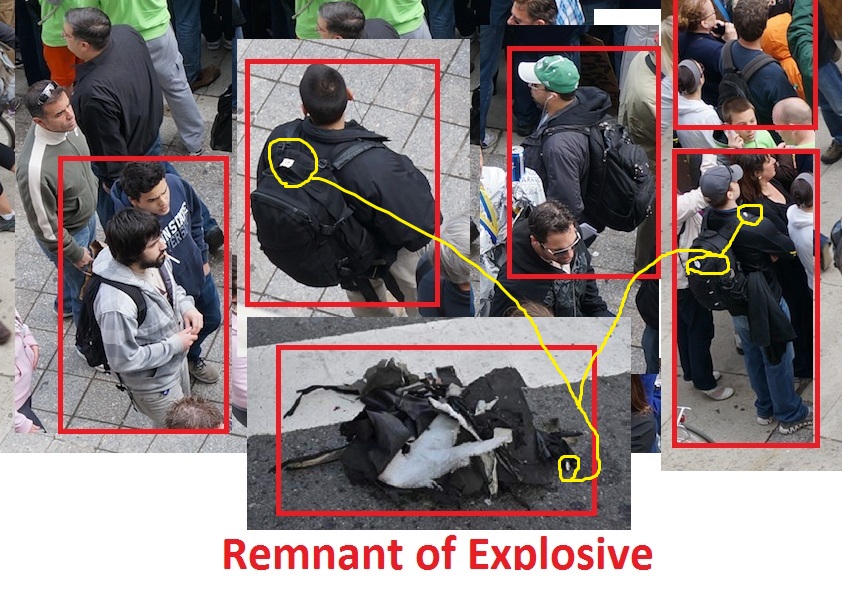
Reddit has a thread dedicated to finding the Boston marathon bomber(s). 4Chan is also on the case. Alexis begs them to stop:

Investigating these bombings is just not a job for “the crowd,” even if technology makes such collaboration possible. Even if we were to admit that Reddit was “more efficient” in processing the influx of media around the bombing, which would be a completely baseless speculation/stretch/defense, it still wouldn’t make sense to create a lawless space in which self-appointed citizens decide which other citizens have committed crimes. This would be at the top of any BuzzFeed list of the tried-and-true lessons of modern civilization. We have a legal system for a reason.

(Image from 4Chan’s round-up of Boston photographs)

Tweet Of The Day

There are conflicting reports and confusion all over cable news and Twitter this afternoon, so we will stay calm and blog on for now, until we spot something conclusive. Update: The FBI just issued a scathing statement:

Contrary to widespread reporting, there have been no arrests made in connection with the Boston Marathon attack. Over the past day and a half, there have been a number of press reports based on information from unofficial sources that has been inaccurate. Since these stories often have unintended consequences, we ask the media, particularly at this early stage of the investigation, to exercise caution and attempt to verify information through appropriate official channels before reporting.

Ellie Hall chronicles the clusterfuck.

“It Was All Just Supposed To Be Symbolic”

557949_10151600344921322_1462963247_n

Some “Tough Ruck 2013” soldiers ran the Boston Marathon with “a military backpack weighing about 40 pounds. The rucks were filled with Camelbacks of water, extra uniforms, Gatorade, changes of socks—and first-aid and trauma kits.” They ran it in honor of their fallen comrades and those now committing suicide in record numbers under the weight of PTSD. The first-aid and trauma kits came in handy.

By the way, that dude in the cowboy hat who rescued the guy with the blasted-off lower leg? He’d lost one son in Iraq and another son to suicide because of his brother’s death. He was carrying pictures of both of them that day.

But suddenly he had a stranger’s life to save. So he did. Maybe we should start remembering him instead of fixating on whatever sick mind for whatever sick purpose planted those devices.

The Immigration Bill Emerges

This embed is invalid


For those with time to spare, the full bill is above. Dylan Matthews goes over the basics. What the pathway to citizenship looks like:

If you’re an undocumented immigrant who arrived in the United States before Dec. 31, 2011, haven’t committed a felony (or three misdemeanors), hold a job, and pay a $500 fine and back taxes, then you will immediately gain the status of “registered provisional,” allowing an individual to legally stay in the United States without risk of deportation. Registered provisionals wouldn’t be able to get any means-tested public benefits. If you’ve already been deported, you’re eligible to apply to re-enter if your parent or child is a citizen or permanent resident, or if you are DREAMer and were deported as a minor …

After six years, you’d have to renew the status, which is dependent on maintaining a steady work history, having a clean criminal record, and paying another $500 fine.

Four years after that (10 years after initially attaining “registered provisional” status), you could apply for permanent residency (aka a Green Card). That step requires showing constant work history, constant presence in the United States, continuous tax payments, clean criminal record, and knowledge of English and civics, as well as paying another $1,000 fine.

Three years after that you’d be eligible to become a citizen. So the recognition-to-citizenship process takes a total of 13 years and requires $2,000 in fines from each adult affected.

Judis worries that immigration will be a boon for businesses but not low-wage workers:

The overall effect of the reforms—which would establish a new labor status for most of the undocumented workers and speed the grant of green cards to a backlog of applicants—will inevitably increase the supply of labor at a time when many Americans are unemployed. Of course, the 11 million undocumented workers are already here, and will no longer be subject to the most egregious kind of exploitation, but they will also no longer be segregated into specialized parts of the labor force and will instead be thrust into the mainstream labor market, where they will compete with native-born workers.

Among Frum’s observations:

Republicans want to postpone voting rights for illegal immigrants as long as possible. Unlike some of the more gullible right-wing pundits, congressional Republicans hold few illusions about how the present-day illegals will vote. Under the deal, voting rights wouldn’t begin to arrive until 2027.

Rubio has put out an FAQ on the bill. One part worth highlighting:

Q: Does this provide any special recognition for the LGBT community.

No. This bill contains no special provisions for the LGBT community.

Paradoxically, I think the DOMA cases hurt us here. Some Democrats are leery of backing immigration equality for the foreign spouses of married gay Americans because they argue that if DOMA falls, then the fight is over. But DOMA may not fall; and gay couples are living apart and in fear and distress and in a diaspora right now. There’s a chance it could emerge in the Amendment process, as Senator Leahy has pledged. But it’s particularly dismaying to see Chuck Schumer let us down on this. He knows the cruelty and pain this causes – and yet still chooses to punt.

“A Tiny Moment’s Respite From The Worst Moment Of Their Lives”

A reader writes:

I finished the Boston Marathon on Monday and was nearby when the bombings happened.  I was never near any danger and witnessed only a few secondary effects of the bombings (people splattered with others’ blood, etc.), but the memory that sticks out is one that I thought you might be interested in for your Cannabis Closet series.  Just a little glimpse into life.   Feel free to post it if you want – I’m always happy to contribute to the Dish family:

At one point, an hour or so after the attack, I was drifting away from the scene and stopped to lean on a sort of cement railing, both to rest my weary body and to just think.  From a stairwell on the other side of the railing, I smelled the distinctive scent of pot.  I looked down and saw two well-dressed women, one white and one black, taking hits from a pipe.  One was holding the lighter and shielding the wind while the other inhaled.  It was a scene of strange intimacy.  The black woman noticed that their smoke was blowing in my direction and said, “Sorry, Marathon Man.”  I said something like, “No worries.  We could all use some relief right now.”

Then they both looked up at me and their words came tumbling out:

“We work at [high-end retail store].  It was right in front of our store.”  “There were legs and feet blown off.”  “There was blood everywhere.”  “People had whole parts of them blown off.”  “I saw someone’s foot.  Just there on the ground.” “People were blown apart.” “There were body parts all over.” “Everyone was covered with blood.”  “And parts of bodies.”

At a certain point, they were finishing each other’s sentences, looking to each other for confirmation that it had actually happened.  I imagined them, being evacuated from work, totally horrified, uncertain about where to go or how to deal with what they just saw, and then one of them inviting the other into this particular stairwell, to share a little secret one of them was carrying in their purse, meant for happier use, now just providing a tiny moment’s respite from the worst moment of their lives.

I did something I almost never do: I reached out and touched them both on the shoulders, gave them a little rub and a squeeze and said, my voice surprising me by cracking, “I’m glad you two are ok,” and I walked away.

Hillary: Stronger Than Ever

Nate Cohn notes that Hillary Clinton currently “commands a staggering 60 percent of the primary vote, an unprecedented figure for a non–vice presidential candidate and one of the highest levels of support of all time”:

Yes, Clinton lost in 2008. But it’s important to note how much stronger her numbers are today than they were in 2007. Back then, only 35-40 percent of Democratic voters offered their support. With a few additional gains, Clinton was able to expand to nearly 50 percent of the vote, despite getting only a sliver of the African American vote. Polls indicate that Clinton has won back much of their support, giving her the broad coalition she possess today.

The true Clinton skill is survival. How those two ever got through the primaries in 1992 still amazes me. Lying very well helped. But it’s clear to me that Clinton has changed, as we all have over the years. There was, for me anyway, a real issue with her path to power – through her husband. But once she had won a Senate seat, and then exhibited remarkable magnanimity at the 2008 Convention, and gained real government experience as secretary of state, she became her own politician. My reservations on that score have evaporated.

Still: did she really make a big impact as secretary of state? Foreign policy was guarded by the president by and large. Maybe some pro-Clinton readers can make the case and persuade me I’m wrong to downplay her substantive record.

Gun Control Gets Shot To Pieces

The background checks bill doesn’t have the votes. Jacob Sullum is skeptical that it would have done any good:

Forcing private sellers at gun shows to arrange background checks with the help of licensed dealers is relatively straightforward. But in that 2004 inmate survey, less than 2 percent of respondents said they had bought weapons at gun shows or flea markets. Three sources accounted for almost nine out of 10 crime guns: “friends or family” (40 percent), “the street” (38 percent), and theft (10 percent). It is hard to see how any notional background check requirement, even one applying to all private transfers, can reasonably be expected to have a significant impact on these sources.

Never under-estimate the power of the major lobby groups in DC: from the NRA to AIPAC and the AARP and the Cuba lobby, they are all designed prevent change. Even if that change is trivial.

It’s enough to make the average voter a little cynical, don’t you think? And I find myself feeling the futility of marshaling any arguments against them. They will all have their way. They are the real actors on the political stage – and the president is reduced to a bystander.

A Breakthrough In Boston?

The cops think they have clear video of a suspect planting the bombs. It could be a “game-changer” in the investigation. Follow more breaking tweets here.