Face Of The Day

CZECH-EXPLOSION-GAS

A police officer and paramedic wrap a thermo foil around a woman injured by a powerful gas blast on April 29, 2013 in Prague’s historic center. The blast injured up to 20 people, four seriously, rescuers said, adding that it was possible some people were buried in the rubble. By Michal Cizek/AFP/Getty Images.

Out In The NBA: Reax


Jon Wertheim tells the story behind Jason Collins’ decision to come out:

Collins didn’t do this to make a political statement, much less to satisfy a sponsor. To his great relief, he didn’t do it under duress; that is, he wasn’t outed or “caught” by the smartphone paparazzi … Collins had simply grown tired. Tired of being alone; tired of coming home to an empty house; tired of relying on Shadow, his German shepherd, for company; tired of watching friends and family members find spouses and become parents; tired of telling lies and half-truths — “cover stories like a CIA spy,” he says with his distinctive cackle — to conceal that he’s gay. He was also tired of … being tired. For most of his life, he’s had trouble sleeping, which he attributes to struggles with his sexuality.

Collins’ twin brother Jarron, who played ten seasons in the NBA, further explains Jason’s motivation for the announcement:

What does Jason want out of this? He wants to live his life. He wants a relationship, he wants a family, he wants to settle down. He wants to move forward with his personal life while maintaining his life as a professional basketball player. That’s all, really.

Marc Tracy compares Collins to Jackie Robinson:

I can’t help feeling that Collins is equally as brave as Robinson was. It is true that Robinson accepted more risks, including to his physical security. The stakes were higher for Robinson. But so were the rewards. Robinson was offered the chance to be a superhero, and he took it, and he is now, indeed, a superhero. More than that, he is one of the most important American figures of the 20th century—not only in sports, but in everything. By contrast, what incentive did Collins have? It was already unclear whether he was going to get another payday, and his coming out could plausibly make his signing by an NBA team less likely. (Horrible, but true.)

Shaun Powell looks ahead:

Had he kept his private life to himself, he’d be a last-minute addition to any team, not a free agent in big demand this summer. But now, will his announcement affect his chances, good or bad, of seeing a 15th season? General managers can’t speak on the record about Collins, but one scout said: “It’ll have no effect whatsoever. If someone needs him, someone will sign him.” It’s very possible that an organization will need Collins for his ability and also want him because of his announcement. He’s a solid presence in the locker room, a quiet leader with an intelligent voice and can still defend big centers. And he’s not expensive. … Any team looking for a veteran backup center who brings more than just basketball ability could do a lot worse than Jason Collins. Expect to see him this fall.

June Thomas wants to see Collins play:

As a free agent, he’s currently on the job market, and I hope a front-office bean counter somewhere in the league realizes the business opportunity Collins has just opened up.

I’ve never been to an NBA game, though I’ve twice lived within walking distance of an arena. If someone signs Collins next season, I’ll gladly head down to the Barclays Center and slap down an outrageous sum to cheer on a pioneer—a guy who can take a charge and knows gay history. I’ll even buy a T-shirt.

Nate Silver finds that 61 percent of pro-basketball players around Collins’ age with comparable stats have gone on to play another year:

My concern is that if no team signs Mr. Collins, it may incorrectly be deemed as a referendum on whether the league is willing to employ an openly gay player — when players in Mr. Collins’s position see their N.B.A. careers end fairly often for all sorts of reasons. Alternatively, if a team does sign him, it may be incorrectly dismissed as a publicity stunt — when 7-footers who can provide some rebounding and defense off the bench often play well into their thirties.

Josh Barro urges more pro-atheletes to come out:

[Collins] says he waited out of “loyalty to his team” and not wanting his homosexuality to become “a distraction.” In other words, he was concerned about impacts on his career. Those concerns were probably reasonable. But civil rights causes, including gay rights, don’t advance without personal sacrifices on the part of pioneers. Gay athletes will expose themselves to career risk by coming out. They ought to do it anyway because of the broader positive effects they can create.

Will Leitch happily notes the widespread support Collins’ announcement has received:

Like a lot of people, I combed through Twitter to look for any sort of negativity, and while there were a few cretins (Twitter being Twitter), I couldn’t find a single “respectable” person doing anything other than being unequivocally supportive. The NBA basically pushed its playoffs coverage down its Website to splash out the news, Kobe Bryant tweeted that he was “proud” of Collins and even Bill Clinton weighed in positively. NBA players, across the board, came out on Collins’ side, as if there is such a “side” to take in someone simply saying who he is. And that was about it. By 1 p.m., ESPN was back to Tim Tebow, and everyone on Twitter was back to self-promotion again. It was fantastic.

Cyd Zeigler applauds:

We knew this day would come. We didn’t know if it would be this week or next year. But now that it has, I get the feeling that, unlike David Kopay 40 years ago, this may open the door to many more in the near future when everyone sees it worked out just fine for Collins. He did it in the perfect way: In his own words. The column he wrote was strong, and it sends a clear message: I’m OK with who I am.

We’ve said for years that the best timing for this announcement would be early in the offseason. Just two weeks after his regular season ended, and six months before the season starts, it couldn’t be a better time to do this. The media will get the story out its system before tip-off of the next season.

And Brian Phillips urges everyone to just “be happy” for Collins:

[I]t’s good news; it’s an occasion for simple happiness, and God knows there aren’t enough of those. But we of the Internet have all become such sophisticated consumers of media that it takes only about five minutes for any cultural conversation to become confused. We have a tendency, or anyway I do, to skip past the important part of any given issue, which we usually grasp right away, and stake out positions on some knowing or contrarian periphery. … [W]hatever your angle vis-à-vis complex media metanarratives, Jason Collins is a person, and he just did something that was hard for him to do, and that thing will help other people. That’s what matters here. That’s what happened.

Stay-At-Home Healthcare

Ezra Klein worries that Medicare is missing a big opportunity by discontinuing support for Health Quality Partners, which provides chronically-ill Medicare patients with regular home visits from a professional nurse and has dramatically reduced those patients’ hospitalizations and Medicare costs:

I asked a half-dozen seniors what difference Health Quality Partners made in their lives. Every one of them began the same way: They could ask their nurse questions, they said with evident relief. They could get help understanding and navigating their doctor’s orders. They didn’t feel like they were being a burden if they needed to ask one more thing, or have their medications explained to them again.

Ezra zooms in on importance of the 33% reduction in hospitalizations among Health Quality Partners patient pool:

If there is a secret to the success of Health Quality Partners at preventing hospitalizations, it’s this: No one else is checking in with [elderly couples like] the Bradfields or the Allens every week. Medical technology — from pills to devices to surgical procedures — is so advanced and so competitive that making further gains requires enormous investment and rarely brings high returns. But the exciting field of knocking-on-the-Bradfield’s-farmhouse-door is almost totally empty. Medicine has been so focused on what doctors can do in the hospital that it has barely even begun to figure out what can be done in the home. But the home is where elderly patients spend most of their time. It’s where they take their medicine and eat their meals, and it’s where they fall into funks and trip over the corner of the carpet. It’s where a trained medical professional can see a bad turn before it turns into a catastrophe. Medicine, however, has been reluctant to intrude into homes.

For the most part, the medical system treats the old very much like it treats the young. It cares for them when they’re sick and ignores them when they’re well. Coburn’s basic insight is a discomfiting one. He doesn’t really believe in “better,” at least not for elderly, chronically ill patients. He wants someone going over frequently to see if they’re depressed, if their color is good, if they understand their medications, if there’s anything they need. This isn’t medicine so much as it’s supervision.

Flagging Flagella

Male fertility is on the decline. Some startling statistics:

In 1992, Danish scientists published a meta-analysis of 61 studies on semen quality from around the world, concluding that the average sperm concentration had declined by nearly 50 percent over a 50-year period, from 113 million to 66 million sperm per milliliter. “Every man sitting in this room today is half the man his grandfather was,” reproductive biologist Lou Guillette told Congress in 1993. “Are our children going to be half the men we are?” …

In 2000, American researchers not only confirmed results from the original Danish semen quality study, they found sperm density in the United States and Europe to be falling at an even faster clip: by 1.5 to 3 percent per year. And last summer, an Israeli study noted a steady decline in semen quality at one local bank over the past 15 years. A full 38 percent of all sperm-donation applicants are now rejected, up from one-third prior to 2004. That year, the bank lowered its minimum sperm count for acceptance to widen its net for donors. Under those more stringent standards, 88 percent of contemporary samples would have been rejected.

Sperm-bank rejects aren’t necessarily infertile. But if the downward trend continues, by 2030 the researchers predict that even above-average men will reach “subfertility” levels. Globally, an average of 15 percent of men are considered infertile, up from 10 percent 20 years ago.

Neologism Watch

Anne Curzan spots a growing trend among her undergrads:

[S]ome students are also using slash to introduce an afterthought that is also a topic shift, captured in this sample text from a student:

12. JUST SAW ALEX! Slash I just chubbed on oatmeal raisin cookies at north quad and i miss you

This innovative conjunction (or conjunctive adverb, depending on how you want to interpret it) occurs, students tell me, even more commonly in speech than in writing. And in writing, it is often getting written out as slash, even in electronically mediated communication, where one might expect the quicker punctuation mark (/) rather than the five-letter word slash.

Slash is clearly a word to watch. Slash I do mean word, not punctuation mark. The emergence of a new conjunction/conjunctive adverb (let alone one stemming from a punctuation mark) is like a rare-bird sighting in the world of linguistics: an innovation in the slang of young people embedding itself as a function word in the language. This use of slash is so commonplace for students in my class that they almost forgot to mention it as a new slang word this term.

John McWhorter also discussed the rise of “slash” while unpacking the linguistics of texting.

Not Your Father’s Cannabis

Marijuana Potency

Gavin McInnes tried some high-potency pot, had a bad trip, and wrote an article about it while baked. The conclusion:

I have always been pro-legalization, but what I just endured has made me reconsider the whole discussion. When they talked about legalization in the 80s and 90s, they kept saying it was just like having a few beers and it was. Today, while advocates push the medicinal angle, the benign drug they’re defending has morphed into a heavy drug. It’s been an hour and a half since I looked death in the face and cried. I am obviously still incredibly high. I’m so high, in fact, that I no longer see legalization of marijuana as such a no brainer. The debate has shifted to, “Should we legalize a really, really heavy drug?”

It’s never a good idea to write and publish something while stoned. Mike Riggs rolls his eyes:

I can’t bring myself to feel bad for McInnes. He hadn’t used marijuana in years, and yet he intentionally chose “a very strong strain” and to consume it by taking a “big rip off a bong,” not in spite of his colleagues telling him pot is stronger than it used to be, but because they told him that. If he just wanted to take this new marijuana for a spin, he could’ve nibbled a bit of edible, taken a modest pull off a vaporizer, or bought a milder strain. Instead, he chose the equivalent of butt-chugging two shots of Bacardi 151, and then turned that bad decision into a disjointed screed against legalization, when really it’s just a cautionary tale about over-doing it.

(Chart from a White House fact-sheet (pdf) on marijuana)

Yes The Internet Enables Democracy

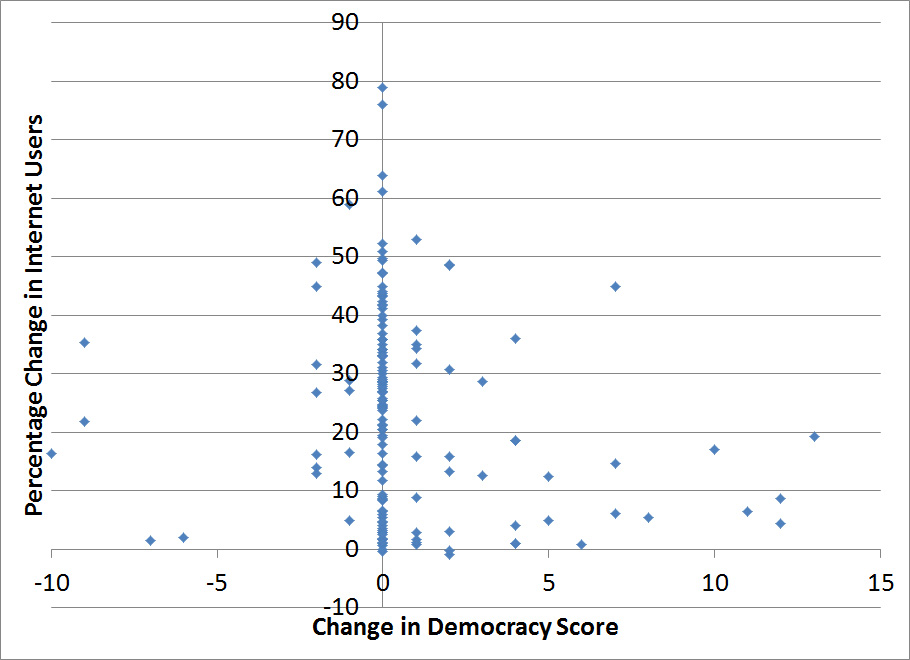
Internet_Democracy

Leon Wieseltier’s favorite curmudgeon/sock-puppet, Evgeny Morozov, demanded a graph showing that web interaction undermines autocracy. Philip N. Howard obliges (see above). The bottom line:

There are still no good examples of countries with rapidly growing internet populations and increasingly authoritarian governments.

A thought experiment for what it’s worth. The core truth about the Internet is that, unlike previous media, it truly rewards non-zero-sum interaction.

When I ran a dead-tree magazine, I was always aware of the competition, feared it, tried to beat it, saw its interests and ours (The New Republic back in the day) as opposed. With the Dish, every other website is a way to find new interesting material, direct more eyeballs toward it, and thereby encourage readers to use the Dish as a hub for other material. And that, in turn, helps us.

It’s even more salient now we’re independent and not even reliant on a parent media company’s home-page. Our major sources of new readers? Today: search engines, reddit, Twitter, Facebook and Google are our top five referrers. We need them the way they need us. Linking to other sites is essential to making your own part of the conversation. It’s a little thing – but it has definitely shifted my own psyche to more non-zero-sum interactions. Which is a fancy way of saying generosity and sense of our interconnectedness. I can see why the spread of that mindset – remember how many hours a day we now spending existing and communicating virtually – might help democratic civic culture.