The Plight Of The Long-Term Unemployed

Matthew O’Brien warns that businesses are discriminating against long-term unemployed:

As long as you’ve been out of work for less than six months, you can get called back even if you don’t have experience. But after you’ve been out of work for six months, it doesn’t matter what experience you have. Quite literally. There’s only a 2.12 percentage point difference in callback rates for the long-term unemployed with or without industry experience. That’s compared to a 7.13 and 8.95 percentage point difference for the short-and-medium-term unemployed. This is what screening out the long-term unemployed looks like. In other words, the first thing employers look at is how long you’ve been out of work, and that’s the only thing they look at if it’s been six months or longer.

Drum doubts that this is a new development, writing that hiring managers “have always been suspicious of applicants who have been out of work for a long period.” Yglesias wonders what long-term unemployment really indicates:

It’d be interesting to know whether this kind of discrimination is grounded purely in irrational bias, or if it reflects a sound satisficing strategy in which long-term unemployment really is a statistically reliable indicator of some unobserved quality.

Previous Dish on long-term unemployment here and its lasting effects here.

It’s So Personal: Hydrocephalus

A reader adds another horrific and heartbreaking medical condition to this collection:

As someone who last year chose to terminate two pregnancies for massive hydrocephalus (all brain structures blown away by the pressure of the fluid), I find it very frustrating that the foetus-insetdiscussion of North Dakota’s law banning abortions for genetic defects largely centers on children with mild cases of Down’s Syndrome.  Because the conversation focus is on a trisomy, a case of improperly separated chromosomes that might happen to any couple, but almost certainly only once, it misses the truly spectacular cruelty of this law.

We don’t have a diagnosis, but my husband and I must have a recessive gene that combines to cause hydrocephalus. For every pregnancy, we have a 1 in 4 chance of this happening.

There are lots of diseases like that.  Tay-Sachs is another fatal example. Because of this, I spend a lot of time chatting on an Internet forum with other women in my situation.  They approach their pregnancies in few ways.  Some absolutely know that they will carry to term, with the hope of spending a few moments with their baby while it lives.  Some are so terrified that they use every kind of expensive fertility technology to avoid carrying a baby that carries a fatal flaw.  Those cost tens of thousands of dollars, with no guarantee that the pregnancy will take.  Some women choose to terminate their pregnancies if the genetic test come back wrong or it shows on the anatomy scan.  But they want living children.  They pin their hopes on a 3 in 4 chance of a healthy baby.

One of the women waiting on the genetic test results has a three year old at home on hospice care.  She is terrified of losing another and will terminate if the tests come back wrong.  She can’t watch another die at age three.  One woman had a baby boy who lived to be nearly one before he died.  Her second baby boy died at eight months.  Then she got a diagnosis and was able to test during her third pregnancy – another boy. It had the disease.  She chose to terminate.

The thing I cannot believe is the unbelievable, astounding cruelty of anyone who would dictate her choice in this.  Force her to birth and care for another dying baby?  She knows what that means!  She chose not to!  How can anyone be so cruel that he would tell her she must go through pregnancy, birth, months-long death of her baby before she can try again to have a living child?

Trisomies are one thing, and they are most often fatal.  They do not usually lead to living children that can interact socially. Mostly healthy Down Syndrome children are the exception – not a good example for policy-making. But for almost all couples who come up against that tragedy, a trisomy is a one-off.  The people who face the dilemma of a recessive gene that kills their children, at different paces and with different amounts of pain – those are the people who know what it means to choose to go through with or terminate a pregnancy for genetic reasons.  How dare anyone else tell them which they should do?  Who would give them additional burdens if they get the awful diagnosis?  Who would do that?

The Iron Lady’s Spiritual Side

The Coffin of Former Prime Minister Margaret Thatcher Is Transferred To The Chapel Of Mary Undercroft Ahead Of Her Funeral

The Economist‘s religion blog remembers the faith of Margaret Thatcher:

In religion, as in so much else, Mrs (later Lady) Thatcher was a bundle of paradoxes. She was the last British prime minister openly and emphatically to acknowledge the influence of Christianity on her thinking, in particular terms not fuzzy ones. Her fellow Tories, John Major and David Cameron, have presented themselves as loyal but lukewarm Anglicans. “I don’t pretend to understand all the complex parts of Christian theology,” Mr (later Sir John) Major once said, reassuringly. As for Labour’s leaders, Gordon Brown inherited the ethos but not the zeal of his father, a Presbyterian minister. Tony Blair is passionately religious but was famously discouraged by his advisers from “doing God” in public because of the fear that he might sound nutty.

(Photo: The coffin of former British prime minister Margaret Thatcher rests in the Crypt Chapel of St Mary Undercroft beneath the Houses of Parliament on the eve of her funeral on April 16, 2013 in London, England. Dignitaries from around the world will join Queen Elizabeth II and Prince Philip, Duke of Edinburgh as the United Kingdom pays tribute to former Prime Minister Thatcher Baroness Thatcher during a Ceremonial funeral with military honours at St Pauls Cathedral. Lady Thatcher, who died last week, was the first British female Prime Minister and served from 1979 to 1990. By Leon Neal – WPA Pool/Getty Images)

The View From Your Window Contest: Winner #149

Screen Shot 2013-04-13 at 3.31.10 AM

A reader writes:

The city in the picture has a very East-African vibe to it. My first thought was Khartoum but the greenery is generally lacking in Khartoum’s city center. I also noticed the traffic was left-sided. My gut tells me this is Kampala, Uganda.

Another:

The buildings and the advertising look very familiar (we like to backpack often, usually in Asia) and so I have decided to go with my gut and say Malaysia.  A look online for stadiums suggests a likely candidate is Stadium Merdeka, right in Kuala Lumpur.  While I cannot suggest what window this shot is taken from, my guess is somewhere like the Swiss Inn, on Jalan Sultan.

Another:

Not too much to go on this week. It’s warm, wherever we are, and there’s a language that uses the Roman alphabet, from what I can tell by squinting, and cars are on the “British” side of the road. I’m guessing Indonesia, not Malaysia, because the abundance of flat land reminds me of the east coast of Sumatra, and the haziness in the air reminds me of the smoke that used to blow across the Melaka Straits to Singapore when I lived there. Both Indonesia and Malaysia have a ton of those ads for skin-lightening creams, which is what the sign looks like (a terrible industry that too many Western cosmetic companies get away with participating in). So here’s a vote for Medan, Indonesia. I’m going to throw a dart and say the Tiara Medan Hotel. Someone with more time and better Google-mapping skills will probably beat me, but here’s hoping I’m on the right side of the world.

Another:

My guess this week, with no fancy computer analysis: Cairo, Egypt.

Another:

My initial reaction was that this was somewhere is Asia, but upon further inspection, I think it is southern Europe somewhere. People will undoubtedly try to decipher the ad on the building, but the best clues are beyond the buildings. One of my colleagues noticed that one of the buildings in the background looks like a castle, and off to the left it seems that there are stadium lights and stadium seating. There is also one palm tree that is visible. The air quality looks somewhat like it does here in southern California, and I think it is a fairly large city. But since we discovered these background buildings only a few minutes ago and time is running out, I am going to have to take a wild guess rather than an educated one: Seville, Spain.

Another:

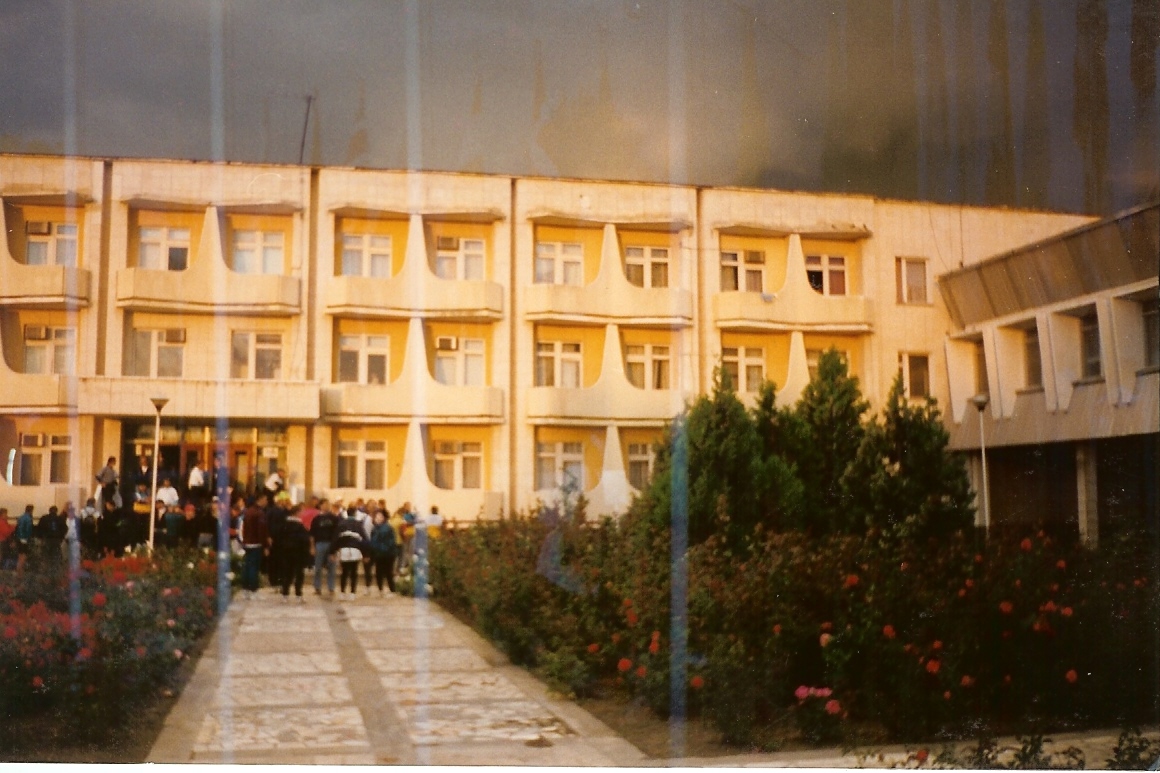
I suspect there is zero chance I’ll get this right, but it looks very much like a town in Russia I visited once on the Black Sea called “Anapa”:

32

However, most Eastern Bloc architecture looks like this.

Another:

Finally!!!  A place I recognize. This has to be India – that is an advert for Dettol soap. The image of a woman, with much lighter skin than the rest of the populace – where else but India!

Another:

Oh now you are just torturing me. Just like that bank branch near the Albania window gave me hope, I was psyched to figure out after a few false starts that the big ad on the side of the building is for Dettol Re-energize soap (“skin so healthy it glows!”). Turns out Dettol soap is sold all over the world, but the particular brand seems to be an Indian thing. So there we have it: India. How hard can that be? Not much help beyond that. There seems to be a stadium in the distance between the buildings with large light stanchions. I can’t spend too much of my like searching for Indian stadiums, and hotels nearby (that building in the foreground sure looks like a hotel). After a desultory look at New Delhi, Mumbai, and just for fun Karachi, I say forget it. I’m sure a Dishhead from India knows it on sight, but let’s just say New Delhi, near Delhi Gate. I look forward to finding out how far off I am.

Another gets the right country:

You must be flooded with Pakistan guesses.  Mine is the equivalent of a dart thrown from across the room. The Ashoka trees (those pointed leafy trees that grow so easily in the tropics) and the architecture all suggested South Asia. And the ad for Dettol soap on the building on the left looks like this one. Lahore is a wild guess. Road, building, etc: no freaking clue, really.

Another gets the right city:

Hmm, looks tropical, Middle-Eastern architecture, perhaps. Yellow plates with black lettering is a good clue … I’d guess this is Karachi, Pakistan.

Another goes into great detail:

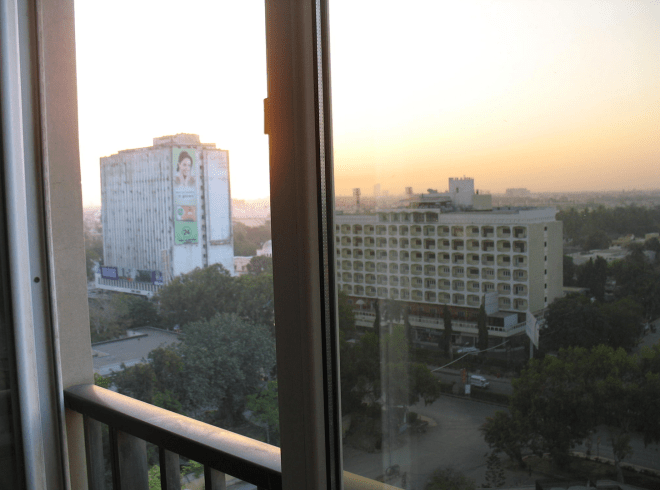
At first glance, this week’s view looked promising – a large city, distinguishable buildings, tree lined VFYW1(2)boulevard, and a stadium in the background. The landscape alone was not enough to determine the region. It looks like places I’ve been in Africa, Southeast Asia, or the Indian subcontinent. The one signage that was clear (but may not be familiar to your American viewers) is the Dettol soap advertisement on the side of the office building. Searching Google for Dettol soap ads, I was able to determine the exact country where this advertisement runs.

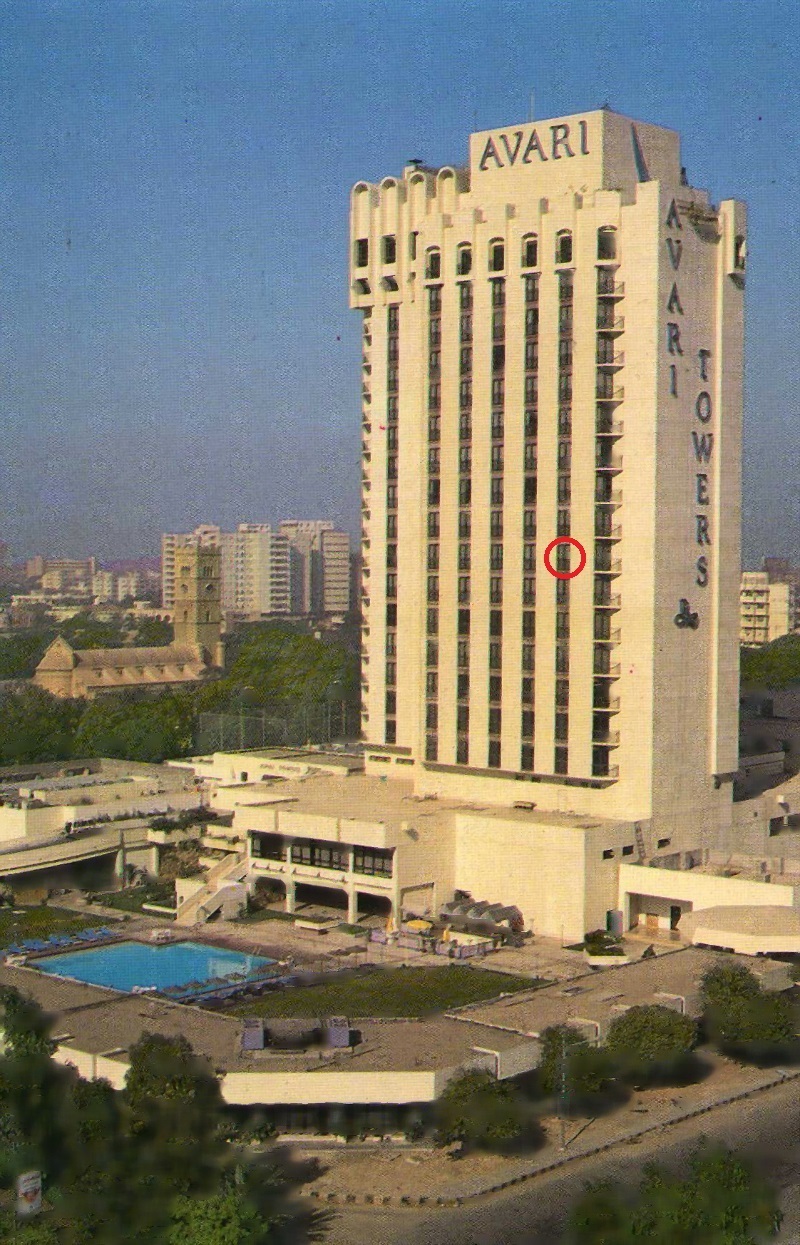
Using the stadium as a landmark, the view was found to be from the Avari Towers Hotel in Karachi, Pakistan. The building on the right side of the view is the Hotel Mehran and the taller commercial building on its left is the Kashif Center. The landmark stadium in the background belongs to the Hockey Complex of Pakistan. My guess is that the view is from the 7th floor, as seen in the photo. Hope I’m right! (or closest).

Another adds:

A Google search of “Skin So Healthy It Glows” leads me to this Tweet by a Pakistani advertising agency identifying the lady in the billboard as actress Sonya Jehan.  A Google image search of “Sonya Jehan billboard” fortuitously – because Google mislabeled the image – leads me to this photo of the Kashif Center in Karachi, the building on which the billboard appears.  Google Satellite view tells me that the VFYW photo was likely taken from the Avari Towers building, 242 Fatima Jinnah Rd, Karachi, Pakistan.  I’ll take a wild guess and say the photo was taken from the 14th floor.

A previous winner writes:

Some contests, like last week’s, are difficult because they provide you with few distinct clues. Contests VFYW Karachi Actual Window Marked2 - Copylike this one, however, are challenging because the abundance of small clues means that a few will be red herrings. Whether you won or lost this week therefore turned on whether you chose the right clues to focus on. Some readers, for example, will have found the region’s architecture via Google and located the city almost immediately. But for those lured in by, say the row of cypress trees, it might have been a long weekend wandering through that tree’s native habitat in the eastern Mediterranean.
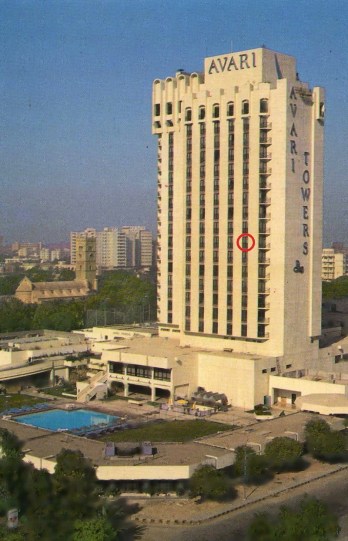
In any case, this week’s view comes from the heart of Karachi, Pakistan. The picture was taken just after dawn by a reader staying on roughly the 9th floor of the Avari Towers located at 242 Fatima Jinnah Road. The photo looks east, southeast towards the balconies of the Hotel Mehran at center frame. Just behind that building and to its left are the light towers of the Karachi Hockey Club’s stadium, whose grandstands are also partially visible. As for that giant billboard with the woman holding her hands to her neck, it’s an ad for an Indian hand soap called Dettol.

Another:

Woohoo! After years of being amazed at the folks who research the Internet to determine the location of your windows, I finally got one using that most wonderful sense – gut instinct!

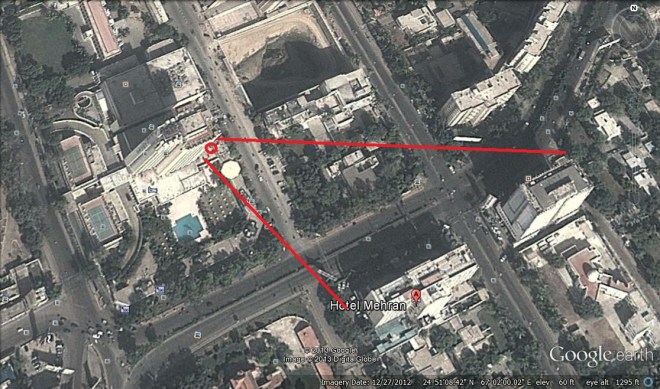
Saw the picture and immediately got the vibe of Karachi, where I lived in the late ’80s and early ’90s. The Suzuki Carry in the image cinched it for me. Showed the picture to my dad who confirmed the building on the right was the Mehran hotel. Google told me the rest! The picture has been taken from the Avari Towers hotel, I’m guessing 10th floor, eastern-most room. I’m attaching a Google map picture:
avari towers

Karachi is a vibrant city that sadly is being torn apart by violence against religious minorities.

I’ve not submitted an entry in the past, so I probably won’t win, but I’ve been meaning to write in for so long this just seemed like a sign too blatant to avoid! My excuse for not writing earlier is that if I wait a day someone almost always says what I want to say before I say it. Anyway, good luck with the subscription model; you had my money on Day 1.

From the submitter:

Delighted again to be part of the contest. Sorry to be late; just back late last night from another trip, this time to exotic Columbus, Ohio.

The room number was 816, obviously facing southeast. Looking at the Bing maps view, if you think of the swimming pool as being south of the tower, the 816 window is the easternmost of five vertical bands of windows, approximately aligned with the east edge of the pool.

Normally I’d make a joke about my two recent submissions – Iran and Pakistan – something about Petraeus having been unavailable … but events today and yesterday lead to other associations: The major earthquake this morning in an area that Pakistan maps as a low seismic risk, felt about 800 miles away in Karachi. And the Boston bombing yesterday – just the sort of nonsense Karachiites have been living with for years.

Btw, I’m just finishing Steve Inskeep’s very good book, Instant City, about the impact of Islamism and ethnic factionalism in general on the development of Karachi as a megacity.

The following entry was the closest to room 816:

Wow, that was almost too easy. I’m a bit giddy at how things just fell into place. The name on the hotel is visible, but not sharp enough to properly read (HOTEL _ _ _RA…?). After a few wild guesses, image-karachiI decided to just do an image search for “Pakistan hotel” and just scan the results. I knew it was a silly stab in the dark, but unbelievably, it took no more than two minutes to come across this image of the hotel in question, Hotel Mehran. Then identifying the submitter’s location as Avari Towers was a simple matter of checking the area on Google Maps and a quick image search to confirm the building on the left is indeed Kashif Center.  No doubt this will will come down to the floor and perhaps even room number, so let’s say 8th floor and … room 807?

This is my first VFYW contest submission, as I usually don’t have much patience, but I might just be hooked now. I’m a Dish subscriber who splits his time between Hong Kong and Taipei. Keep up the great work!

Congrats to our reader on the tough win.  See everyone else on Saturday for the next contest.

(Archive)

When Your City Is Wounded

Boston Deals With Aftermath Of Marathon Explosions

EJ Graff, a Bostonian, tries to process yesterday’s events:

To cripple the city all you’d have to do is take a gasoline tanker and crash it in one of the tunnels built by the Big Dig—you could take down a couple of major arteries and shut down the city for months. On the other hand, if you wanted to strike at our symbolic heart, at what it means to belong to this ludicrously snobby little city built on a harbor that was filled in, if you wanted to grab international headlines on a day when ordinary and extraordinary people from around the world were cramping their legs and exercising their hearts with ordinary and extraordinary joy, if you wanted to make a statement about what it means to be an American, then attacking the Marathon—which belongs to us all—on Patriots’ Day might be just right.

Kornacki, who grew up outside of the city, adds his thoughts:

Between texts and calls to friends and family, I lived on Twitter Monday afternoon, clicking on every link with new information and retweeting anything that seemed useful. It was Twitter at its best. It was also Twitter at its worst, a combination of tasteless tweets from the usual suspects and self-satisfied policing, as if what really mattered was who was saying what on social media. I had no patience for it, or for the speculation about who might have done it and why, or for anyone trying to wring some kind of deeper political or philosophical meaning from any of it. In every picture, I saw home. In every face, I saw an old friend or classmate or teacher colleague or neighbor.  We’ll find out who did this, hopefully soon, and part of me is trying to imagine a punishment harsh enough to fit this crime. The rest of me just wants to cry.

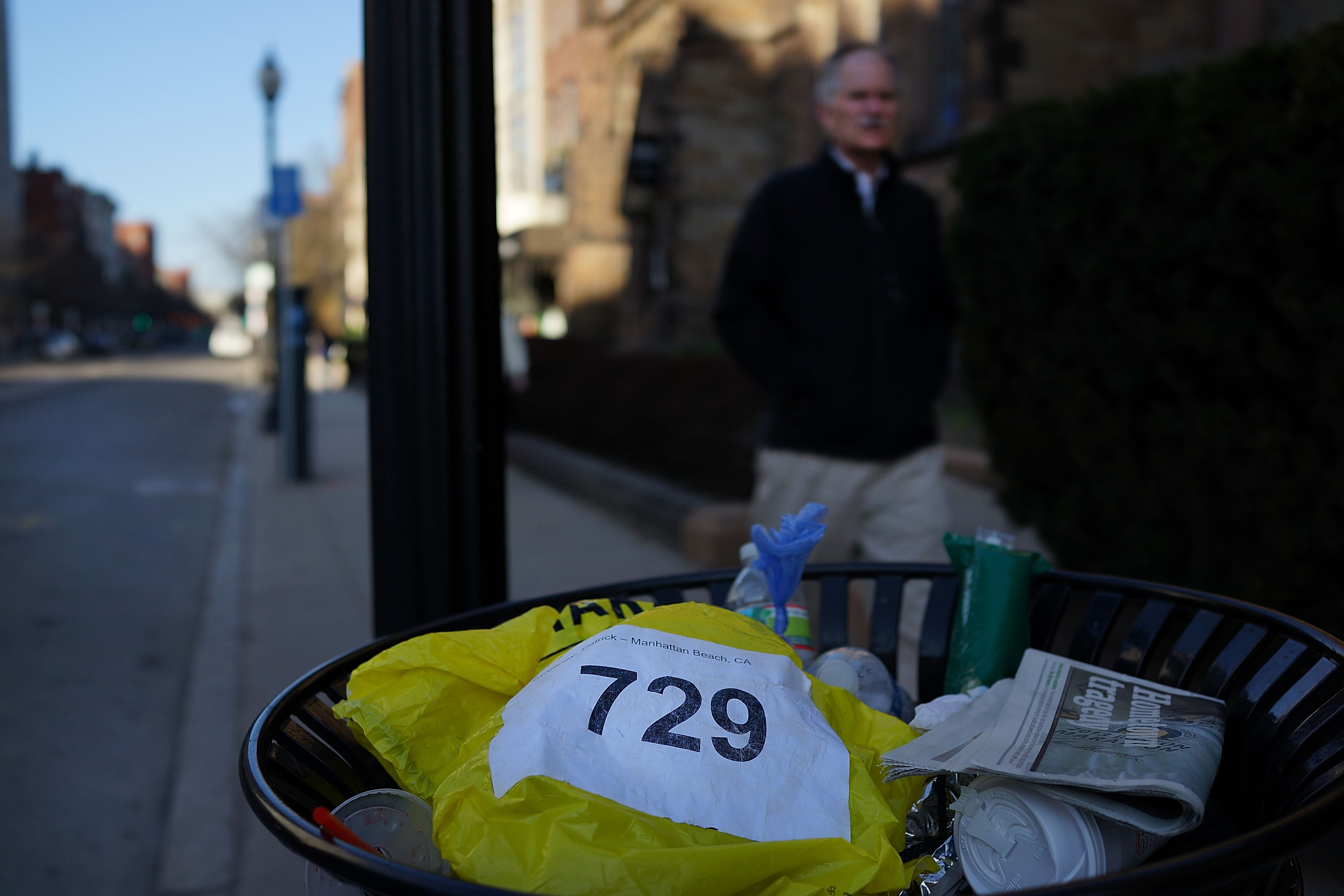
(Photo: A discarded runners bib is viewed near the scene of a twin bombing at the Boston Marathon on April 16, 2013 in Boston, Massachusetts. By Spencer Platt/Getty Images)

The Mormons Punt On Marriage?

Stephanie Mencimer claims that the church “has all but dropped the rope in the public policy tug of war over marriage equality”:

The LGBT community’s best evidence of change within the church is that last year, in the only four states ever to pass marriage-equality laws, the church “did not provide one dime or one volunteer,” [Jim] Dabakis, [the head of the Utah Democratic Party and cofounder of the Utah Pride Center in Salt Lake] says. He adds that in Maryland, when one local Mormon leader tried to organize to oppose a pro-marriage equality initiative, the church shut her down.

(Hat tip: Glazer)

Ask Dreher Anything: Stereotypes About The South

Rod pushes back against the assumption that there has been no racial progress in Dixie:

Yesterday he discussed how people should put down roots wherever they live. Before that, he explained why we should follow the example of his late sister, the subject of his new book, The Little Way of Ruthie Leming: A Southern Girl, a Small Town, and the Secret of a Good Life:

[The book] follows Rod Dreher, a Philadelphia journalist, back to his hometown of St. Francisville, Louisiana (pop. 1,700) in the wake of his younger sister Ruthie’s death. When she was diagnosed at age 40 with a virulent form of cancer in 2010, Dreher was moved by the way the community he had left behind rallied around his dying sister, a schoolteacher. He was also struck by the grace and courage with which his sister dealt with the disease that eventually took her life. In Louisiana for Ruthie’s funeral in the fall of 2011, Dreher began to wonder whether the ordinary life Ruthie led in their country town was in fact a path of hidden grandeur, even spiritual greatness, concealed within the modest life of a mother and teacher. In order to explore this revelation, Dreher and his wife decided to leave Philadelphia, move home to help with family responsibilities and have their three children grow up amidst the rituals that had defined his family for five generations – Mardi Gras, L.S.U. football games, and deer hunting.

Ask Anything archive here.

Terrorism Is Rare

keep-calm-and-love-boston-36

Bruce Schneier calls the Boston bombings “something that almost never happens”:

Remember after 9/11 when people predicted we’d see these sorts of attacks every few months? That never happened, and it wasn’t because the TSA confiscated knives and snow globes at airports. Give the FBI credit for rolling up terrorist networks and interdicting terrorist funding, but we also exaggerated the threat. We get our ideas about how easy it is to blow things up from television and the movies. It turns out that terrorism is much harder than most people think. It’s hard to find willing terrorists, it’s hard to put a plot together, it’s hard to get materials, and it’s hard to execute a workable plan. As a collective group, terrorists are dumb, and they make dumb mistakes; criminal masterminds are another myth from movies and comic books.

Douthat hopes that we will respond rationally:

Today’s attack, on the kind of event that countless cities hold and that even the most omnicompetent police force couldn’t make entirely secure, could easily lead to a further ratchet, a further expansion of preventive (or preventive-seeming) measures, a further intrusion of bureaucratic and paramilitary rituals into the rhythms of everyday life. Or it could be an opportunity to recognize the limits of such measures, the impossibility of achieving perfect security, and the costs of pretending that an extra ring of barriers and inconveniences will suffice to stop a determined evil from finding its way through.

We really do have to adopt a more stoic response to these acts of evil. It is the only long-term thing that deprives them of their power.

Obama’s Gitmo Disgrace

Guantanamo Military Prison Stays Open As Future Status Remains Uncertain

We all know that the Congress is fundamentally responsible for keeping the former torture camp open, by preventing the executive branch from financing the transfer of any prisoners to elsewhere in the US. We also know that some terrorists were captured but with no real proof; and that some have been transferred to other countries. Of those some have taken up arms; some have simply melted back into society.

But we also know that 86 human beings there have not been found guilty of anything and are eligible for transfer – but must remain in prison limbo for the rest of their lives. We also know that there have been prisoner deaths at Gitmo that are extremely hard to explain without a working assumption that they were accidentally tortured to death by suffocation. Now we discover that lawyers for Gitmo prisoners going before the military commissions are subject to surveillance by the government, through secret microphones in cells and extremely sensitive video recording equipment. The farce of the commissions extends to outright violation of the most basic attorney-client privilege.

Seton Hall Law School’s Center for Policy and Research has a new report: “Spying on Lawyers at GTMO? Guantanamo Bay Military Commissions and the Destruction of the Attorney-Client Relationship.” It’s a comprehensive exploration of the legal crapshoot. Take a look. Money quote:

We now know that the government has installed surveillance devices with the capacity to listen even to whispers between attorneys and clients, and to read the Screen shot 2013-04-15 at 10.45.27 PMattorneys’ own notes.
• Of all the facilities in Guantanamo Bay for attorneys to meet with their clients, the military chose Camp Echo, the former CIA interrogation facility
• Listening devices in the attorney- client meeting rooms are disguised as smoke detectors.
• The listening devices are so hypersensitive that they can detect even whispers between attorneys and their clients.
• Cameras in the attorney-client meeting rooms are so powerful that they can read attorneys’ handwritten notes and other confidential documents.
• The camera models can be operated secretly from a location outside of the room.
None of the capacities of the eavesdropping equipment would be necessary for CIA interrogations. Instead, the equipment has been implemented in a practice of multi-layered deception of defense attorneys.

Under those conditions, how can there be even a semblance of a fair trial? And if you were subjected to such a farce, and knew that you were being prevented from ever leaving a prison where you were wrongfully detained in the first place. wouldn’t you go on hunger strike? You’ve been captured by military forces with no charges, taken to a torture camp, hooded and shackled, beaten and tortured, and now – even when found innocent – kept in the same black hole of indefinite detention. Yes, I’d go on hunger strike.

Sure, Obama appended a signing statement, but the 2012 National Defense Authorization Act bars any transfer of prisoners out of Gitmo and president Obama signed it. His administration has defended the US government’s previous positions with respect to the rights of the detainees; and the military commissions are a legal farce of a kind you only find in totalitarian systems of government. And Obama is emphatically not a bystander in this.

Greenwald gets into the details:

Obama’s task force in early 2010 decreed that “48 detainees were determined to be too dangerous to transfer but not feasible for prosecution” and will thus “remain in detention”: i.e. indefinitely imprisoned with no charges. Given these facts, one cannot denounce the disgrace of Guantánamo’s indefinite detention system while pretending that Obama sought to end it, at least not cogently or honestly … In January, 2010, Obama – not Congress, but Obama – announced a moratorium on the release of any Yemeni detainees, even ones cleared for release.

The Yemeni government will take them – and is, in fact, demanding them. But Obama himself has decided he cannot risk letting innocent prisoners go to a country dealing with an Islamist insurgency itself. Many of the hunger strikers are precisely these Yemenis, and, as Greenwald notes, Obama as commander-in-chief has the power to grant a ‘national security waiver’ for the prisoners. He should use it. Is there a danger that these prisoners might turn to Jihad as a form of revenge for a decade of illegal imprisonment? Yes, there is. Is there a danger whenever an actual criminal is released from jail? Yes, there is. But the indefinite imprisonment of individuals cleared of all crimes is simply a violation of basic human rights. It cannot – must not – stand in America.

Obama did not create Gitmo and he wanted to close it. But he cannot have it every which way. By sustaining the prison and former torture camp, by keeping human beings locked up for ever for no reason but his own political fears of looking weak on terror, he is now fully responsible for the deaths that may ensue or the barbaric force-feeding that now appears to be routine. These men are not guilty. For America to imprison them indefinitely in that knowledge and not transfer them to their country of origin is simply a betrayal of core values. That the Obama administration is also spying and videoing confidential attorney-client conversations is also an outrage. Where is the Chicago Law professor when you need him?

We didn’t elect and re-elect Barack Obama to trash American values. We elected and re-elected him to restore them. As Glenn notes, this is not about his or anyone else’s legacy. It’s about the core question of whether in a free society, the government has a right to imprison people without charge, deem them innocent and eligible for release and yet keep them in prison for the rest of their lives.

For those in that haunted torture camp, there really is a fierce urgency of now. Let them go.

(Photo: A detainee stands at an interior fence inside the U.S. military prison for ‘enemy combatants’ on October 27, 2009 in Guantanamo Bay, Cuba. By John Moore/Getty, after Pentagon review.)

Shooting Holes In The First Amendment

Wilkinson asks why we don’t investigate alternatives to gun control:

Perhaps the best way to prevent mass shootings is censorship. For example, it could be made illegal to publish any information at all about mass shooters. No names. No pictures. No probing stories about their fraught home lives. Nothing. Maybe it wouldn’t work, and mass killers would nevertheless go on to achieve through their evil work the glory of infamy. Then again, maybe it would work. Shouldn’t we be willing to at least consider a small abridgement of the first amendment, if doing so would save even one child from a horrific death?

The fact is, most of us would rather lose an abstract kid or two than resort to this sort of censorship. We don’t like to admit that, so we tend to deny that it would work. But nobody actually knows it wouldn’t work.

Adam Gopnik is open to the censorship of violence:

The reason we don’t want our kids—or our teen-agers, or ourselves for that matter—lost in violent imagery, whatever the beauty of the pixelated townscape, is not because of something that they will cause but because of what they are right now. It’s not what they might do it’s who they are in the act of becoming. Fictive or not, violent images increase the sum total of violence in the world. If we believe that we, as Edmund Burke said, should hate violence and love liberty, then we can’t hate violence and still make it part of our idea of pleasure.

There is a third way, of course: for those involved in entertainment and journalism to self-censor, to understand that less is more, and to focus more on the victims of violence rather than the perpetrators of it. But in a free country, that only works if it marks a cultural shift from below, not paternalism from above. Not watching gratuitous, numbing violence is something we need no law to enforce. We can start today.