Choosing A Special Needs Child

RUSSIA-SOCIETY-DISABILITY-CHILDREN

Andrew Solomon is troubled by North Dakota’s new abortion laws, which “criminalize selective abortion, which means that a woman cannot choose to terminate a pregnancy because she knows the fetus has a genetic abnormality, or to select for other characteristics, such as gender.” He is in favor of choice but also the choice to embrace the joy that children with special needs can bring:

I have written in my most recent book, “Far From the Tree,” about the rich experience many parents find in children with conditions against which people often select. I would never propose to anyone—even to myself—that such parents’ rapture constitutes an imperative to bring similar children into the world.

I do see a problem, however, in the speed with which women who have no prior exposure to the conditions in question are expected to make these decisions. Women often terminate a pregnancy without knowing what life would be like with and for an anomalous child. It is worth publicizing the satisfaction that the experience may entail, so that the pro-choice movement becomes the pro-informed-choice movement. Others have already pointed out that if we want people to keep these pregnancies, we might start by providing better services for people with disabilities; our neglect of decent care is a national disgrace, and is ignored in North Dakota’s new statutes.

We’re back to the seamless garment of Catholic teaching.

(Photo: Russian actress Evelina Bledans plays with her son Semyon, a child with Down syndrome, in their country house outside Moscow, on February 8, 2013. Evelina’s decision to keep her little son and recount his life in a blog named after him is often met with incomprehension in Russia, where the majority of children with Down syndrome are abandoned by their parents immediately after birth. By Kirill Kudravtsev/AFP/Getty Images.)

What The Marathon Means To Boston

Erik Malinowski explains the significance of the race:

If you’ve never run in, or even merely attended, the Boston Marathon, there are some unequivocal facts you should know. First, it’s an extremely open event, in the sense that the only thing separating you — well, you and a couple hundred thousand of your fellow spectators — from the planet’s most elite runners is usually nothing. Sometimes, it’s one of those easily moveable steel police barricades, sometimes it’s a piece of race tape, sometimes it’s the stern hand of a volunteer. But sometimes it’s nothing, and people are always running from one side of the course to the other. You have to time it like you’re running across the street in Rome. Runners come by out of nowhere and you don’t want to be the guy who accidentally tripped the lead runner when he was a mile or two from history.

Secondly, it’s more or less a mammoth, citywide party. The Red Sox play their annual Patriots’ Day game at 11:05 am, timed specifically so that three hours later, when the game ends, the crowd might file out to Kenmore Square and see a huge pack of participants run by on tired legs toward Copley Square and the finish line. A lot of people have a few drinks, which often leads to jokes about how easy it would be for any old spectator, to just tackle one of the lead runners at any time. But it never happened, because who would want to mess up the Boston Marathon? It was too much fun. You wouldn’t think standing there and watching people run — I mean, think about how that sounds — could be so much damn fun, but it always was.

Alyssa describes the marathon’s historical importance:

Boston is a city particularly defined by its sports teams and sporting events, and the Boston Marathon is one of the most important of them, even if it doesn’t inspire the same local fervor as the Red Sox or the Patriots, though it does attract 500,000 spectators each year. The Boston Marathon is the oldest continuously-run annual marathon in the world, and the second-oldest footrace, inspired in its first year, 1897, by the marathon at the 1896 Olympics.

Mixed-Faith Marriages

They are increasingly common:

American rates of inter-faith and inter-denominational marriage are rising, to the point where 45% of marriages in the past decade have involved either two religions or Christian doctrines that clash seriously (that rate includes unions spanning the evangelical and mainstream Protestant traditions—when all Protestants are lumped together, the mixed-marriage rate is 36%). Many are models of tolerance and creativity. Naomi Schaefer Riley, author of a new study of such marriages, records a wedding which featured two New Testament readings, the breaking of a glass (recalling the first-century destruction of the Temple in Jerusalem), the reading of a Jewish marriage contract, a transcendentalist poem and an Apache wedding prayer.

But there are some downsides to this development:

Inter-faith marriages are more likely to end in divorce. Half of marriages between evangelical Protestants and non-evangelicals fail, and prominent evangelical pastors warn of the “emotional anguish” of marriage to someone who does not share their strict interpretation of faith.

Who Did It – And Why?

Multiple People Injured After Explosions Near Finish Line at Boston Marathon

The short answer at this point is that we do not know and the Dish has learned not to speculate. We now have a graphic idea of what happened – but no context to make sense of it. Until the full context emerges, we’re not guessing.

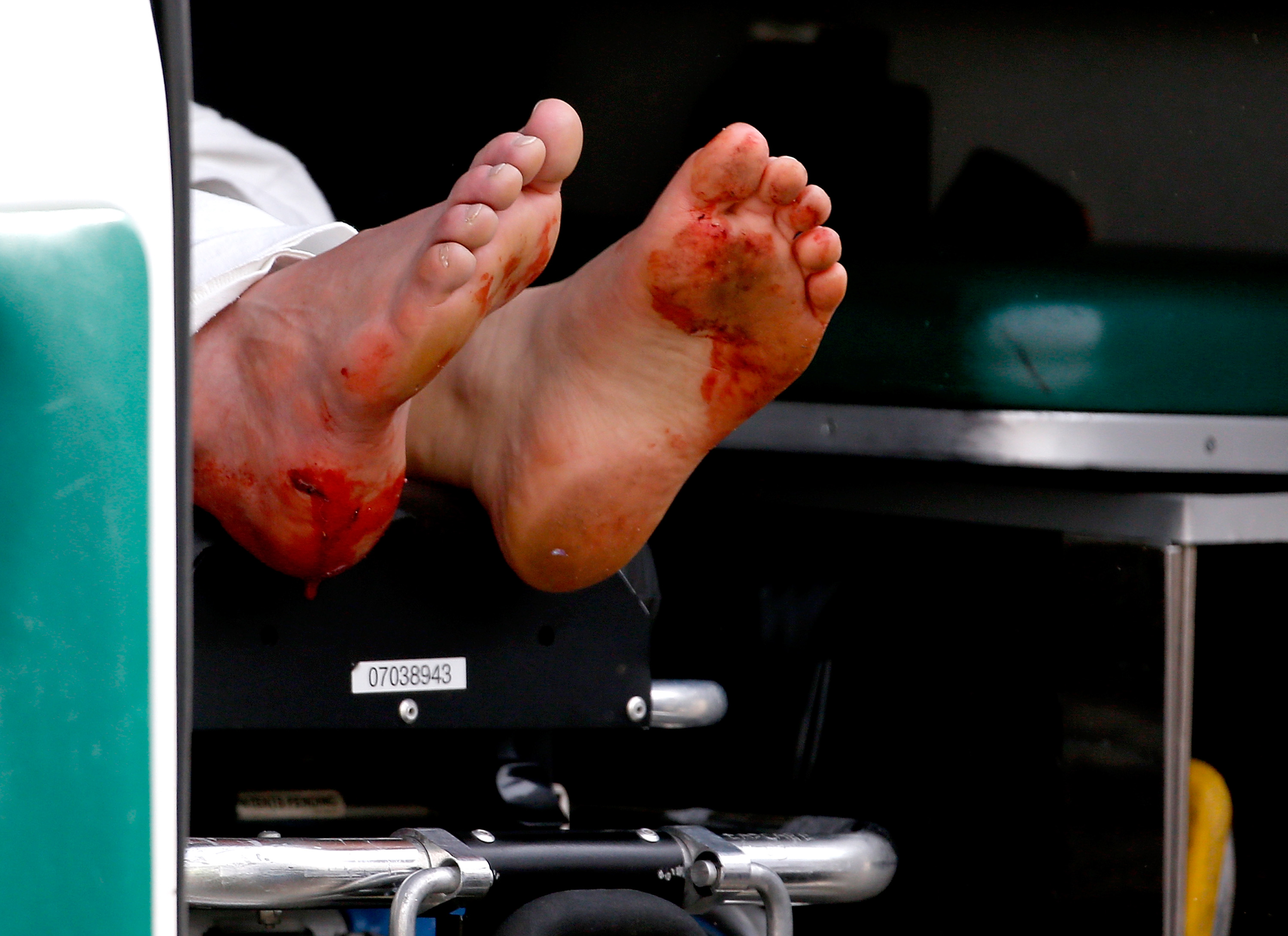
(Photo: Two blood stained feet of a man hangs outside an ambulance outside a medical tent located near the finish of the 117th Boston Marathon after two bombs exploded on the marathon route on April 15, 2013 in Boston, Massachusetts. By Jim Rogash/Getty Images)

Boston Marathon Bombing: Tweet Reax II

[Updated from 4.54 pm to 5.22 pm]

First tweet reax here.

Boston Marathon Bombing: Tweet Reax

[Updated from 3.49 pm to 4.23 pm]

BH6kFLDCQAAcSDO.jpg-large

Mackey is also live-blogging, as is The Guardian. Short clip of the explosion here. Top photo by Bruce Mendelsohn. Deadspin is compiling many more.

Human Hives

Michael Zhang is wowed by Michael Wolf’s photography:

With a population of over 7 million people packed into an area of 426 square miles, Hong Kong is one of the most densely populated places in the world. As with other places where development cannot expand horizontally, apartment buildings tend to get taller and taller in order to provide living space for all the inhabitants. German photographer Michael Wolf decided to capture this population density through a series of photographs studying the architecture of these high rises. The project is titled “Architecture of Density.”

The photographs offer a closeup view, turning the buildings into mesmerizing patterns of edges, windows, balconies, and air conditioning systems. In most of the photographs, the buildings completely fill up the frame, and the repetition is disorienting.

(Photo by Wolf, Architecture of Density)

Another Randian Catholic

Ken Cuccinelli joins Paul Ryan in embracing a total philosophical contradiction:

What book would he write about if he had to write a college-admissions essay? … Ultimately, he picks Ayn Rand’s Atlas Shrugged.

Rand, Cuccinelli says, “captured an awful lot of the battle for our government that’s going on right now” and saw “the natural course of bigger government, [the problem of] relying on it for everything, and the control it takes over everything as it goes down that path.” … Still, he doesn’t consider himself a Randian, because of Rand’s “Objectivist philosophy” and “very selfishly focused” mindset. He notes “the foundation that she appears to be building upon” and finds it to be not “consistent with the Founders’ vision for the country.”

If I were grading a term paper, that would be a D. The profile is a fawning embarrassment – like assigning K-lo to profile Maggie Gallagher.