Germs For Sale

All over your grocery store:

There’s yogurt, of course, but there’s so much else. You can buy pills for your gutcreams for your facetablets for your breath. You can buy blueberry juice with germs, and pizza with germs.

But none of the products are scientifically proven:

While the microbiomes of humans are similar to one another, each of us has a mix of species and strains that’s unique–a mix that also changes from day to day. That variability makes it hard to say that adding in one particular species is going to make a different to anyone who’s sick with a particular disease. Even an exquisitely rare microbe might play a crucial part in the overall ecosystem.

None of these hurdles has blocked the growth of the business of the microbiome. But the $8.7 billion industry has thrived because the microbiome occupies a fuzzy middle ground in the regulatory landscape. Purveyors of germ-loaded products can vaguely hint that their wares will bring you medical benefits. But to the U.S. government, their products are not, officially speaking, medicine. They’re food or cosmetics. It’s possible that the bottle of probiotics you buy in the drug store really will help your digestion, or your immune system, or your bad breath. But it’s also possible that the bacteria you’re buying will get annihilated in the ruthless jungle that is your body.

Update from a reader:

I love the variety of topics on your site. On germs and probiotics, there is a lot of bad science going on out there and a lot of dumb products on the market (I am sick to death of Jamie Lee Curtis discussing her digestive issues on TV). But I have had my own experience with our microscopic hangers-on and I have to give a shout out re: the usefulness of the right probiotic.

I switched toothpaste brands a few years back, after having used a particular brand for a decade or so (the fizzy kind with peroxide in it). Switching to a non-peroxide hippy brand, I started having sores in the corners of my mouth that would not heal. Assumed it was a cold or canker sore, tried all the OTC remedies – no dice. Went to see the doc, who told me I had angular cheilitis – which can be caused by all kinds of things, but often it’s a bacterial or yeast overgrowth. I tried the medicine she prescribed, it sort of worked but the sores kept coming back.

Finally I tried some oral probiotics, meant to aid with breath odor and tooth health, and what do you know. Gone. I assume that the foamy peroxide stuff had been killing off my normal mouth flora for years (good and bad), and once I stopped killing everything, something icky took over. Once I repopulated with some helpful little guys I haven’t had any more problems – my gums look healthier too, my dentist has said. It would seem that probiotics (the right ones, for the right problem) can help.
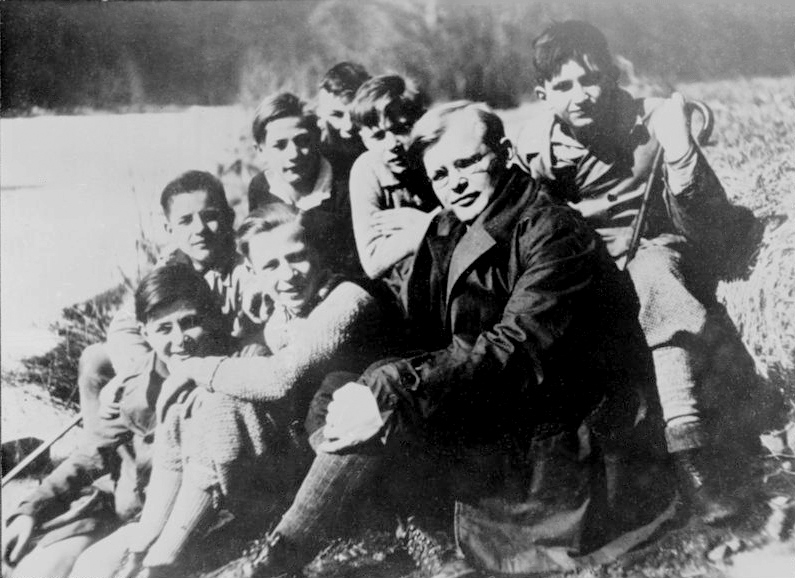

A Modern Martyr

Bundesarchiv_Bild_183-R0211-316,_Dietrich_Bonhoeffer_mit_Schülern

This past week in 1945, the Nazis executed the German pastor and theologian Dietrich Bonhoeffer for his role in a plot to assassinate Hitler. Marilynne Robinson’s essay collection, The Death Of Adam, contains an essay on Bonhoeffer. An excerpt from it:

The day after the failure of the attempt to assassinate Hitler, in which he and his brother and two of his brothers-in-law were deeply involved, Bonhoeffer wrote a letter to [Eberhard] Bethge about “the profound this-worldliness of Christianity.” He said, “By this-worldliness I mean living unreservedly in life’s duties, problems, successes and failures, experiences and perplexities. In so doing we throw ourselves completely into the arms of God, taking seriously not our own sufferings, but those of God in the world — watching with Christ in Gethsemane. … How can success make us arrogant, or failure lead us astray when we share in God’s suffering through a life of this kind?” These would seem to be words of consolation, from himself as pastor to himself as prisoner. But they are also an argument from the authority of one narrative moment. The painful world must be embraced altogether, because Christ went to Gethsemane.

(Bonhoeffer in 1932, via Wikimedia Commons)

Quote For The Day

“[Jesus] has a lot to say about self-righteousness, which he compares, not very tactfully, to a grave that looks neat and well cared for up top but is heaving with ‘corruption’ down below. Maggots, basically. And the point of this repulsive image is not just that the inside and outside of a self-righteous person don’t match, that there’s a hypocritical contradiction between the claim to virtue and the actual content of a human personality: it’s also that, for him, being sure you’re righteous, standing on your own dignity as a virtuous person, comes precious close to being dead. If you won’t hear the bad news about yourself, you can’t know yourself. You condemn yourself to the maintenance of an exhausting illusion, a false front to your self which keeps out doubt and with it hope, change, nourishment, breath, life. If you won’t hear the bad news, you can’t begin to hear the good news about yourself either. And you’ll do harm. You’ll be pumped up with the false confidence of virtue, and you’ll think it gives you a license, and a large share of all the cruelties in the world will follow, for evil done knowingly is rather rare compared to the evil done by people who’re sure that they themselves are good, and that evil is hatefully concentrated in some other person; some other person who makes your flesh creep because they have become exactly as unbearable, as creepy, as disgusting, as you fear the mess would be beneath your own mask of virtue, if you ever dared to look at it,” – Francis Spufford, from his recent book, Unapologetic.

Previous Dish on Spufford here.

A Poem For Sunday

Long shadows cast down a hexagonal tile alley

“Friendship” by Dan Chelotti:

A friend gives a friend
a woodcut that defines
friendship and says that
sometimes the things
that don’t need to be said
are the things that need
to be said. It is true:
look at the woman who
climbs the mountain
with an ironing board
strapped to her back.
What is she after?
Should I bend
with the remover to remove
her hat? Interpret
her skull to reveal
the mystery? Reduce
the world to fact?
Or should I simply
Embrace the woodcut’s
trite smile, and grin
because her linen
is oh so crisp, her head
like a piano on a wire
four stories up.

(From x © 2013 by Dan Chelotti. Reprinted with kind permission of McSweeney’s Poetry Series, San Francisco. Photo by Flickr user Horia Varlan)

Which Historical Figure Would You Spend A Day With?

Leanne Ogasawara answers the timeless cocktail party question:

To meet Proust would have been delicious and the sight of John the Baptist incredible, and yet, in the end, I knew I could not really top the allure of Voltaire. In terms of a day spent, I just have to believe that Voltaire really had what it takes. I mean, he kept Madame du Châtelet happy for decades in her grand chateau, right?

We know at Cirey, the two lovers would spend their days absorbed in the respective studies. Working at opposite ends of the vast chateau, it is said they passed notes constantly during their days spent working apart; liveried butlers would deliver handwritten love-letters on silver platters whenever one of the lovers had something to say to the other. In the evenings, though, Madame and Voltaire would always come together to dine. Oh, can you imagine the sparkling conversations? Those dinners alone make him worthy of a wistful sigh.

I love Voltaire. And, like a favorite landscape, Candide is a book that I seem to return to again and again.

Words That Need To Die

In an interview celebrating the New York Review of Books‘s fiftieth anniversary, the publication’s longtime editor, Robert Silvers, divulges the muddled phrases that drive him crazy:

Framework could rightly refer to the supporting structure of a house, or a wooden construction for holding roses or hollyhocks in a garden, but now the word is used to refer to any system of thought, or any arrangement of ideas. And it really means nothing.

The most heretical thing we do is try to avoid context. Context has an original, useful meaning, now generally lost: the actual language surrounding a particular text—con, meaning “with,” and text—and now it’s used for every set of surrounding circumstances or state of things, and it gets worse with contextualize, sometimes used to mean some sort of justification.

Even more insidious and common is in terms of, a fine phrase if you are talking about mathematical equations or economic functions in which specific “terms” are defined, but it is just loose and woolly when you say things like “in terms of culture,” for which there are simply no clear terms.

Then there is the constant movement of every kind of issue—war, treaty, or political feud—on or off “the table.” The question of an independent Palestinian state is on the table! Or is it off the table? It’s become a way of avoiding a more precise account of just what’s happening.

Into The Great Quiet

Another beautiful meditation on religion and silence from Karen Armstrong:

In the tenth century BC, the priests of India devised the Brahmodya competition, which would become a model of authentic theological discourse. The object was to find a verbal formula to define the Brahman, the ultimate and inexpressible reality beyond human understanding. The idea was to push language as far as it would go, until participants became aware of the ineffable. The challenger, drawing on his immense erudition, began the process by asking an enigmatic question and his opponents had to reply in a way that was apt but equally inscrutable. The winner was the contestant who reduced the others to silence. In that moment of silence, the Brahman was present – not in the ingenious verbal declarations but in the stunning realisation of the impotence of speech. Nearly all religious traditions have devised their own versions of this exercise. It was not a frustrating experience; the finale can, perhaps, be compared to the moment at the end of the symphony, when there is a full and pregnant beat of silence in the concert hall before the applause begins. The aim of good theology is to help the audience to live for a while in that silence.

“A Mystery To Be Lived”

Barry Lenser praises Rod Dreher’s just-released book about his sister’s struggle with cancer, their complicated relationship, and the small-town her illness and death brought him back to:

The Little Way of Ruthie Leming is a book of real pain and real tragedy. Unlike a conventional Hollywood screenplay, the story doesn’t proceed inevitably to a tidy, feel-good conclusion. Here, the stakes are high, and you can’t escape the overwhelming sense of regret and sadness. Imagine having a tortured relationship with someone you love, and then that person dies thinking you were a “fraud” of some kind.

To the benefit of this book, Dreher doesn’t obsess over the question “why”, pursuing a resolution where one can’t be found. Rather, he submits, after some consideration, to the unknown. He describes his and Ruthie’s fallen relationship as “a mystery to be lived”. As with the question of theodicy, which briefly comes up, he doubts that having an explanation would actually ease his mind.

In an age that demands answers and seeks mastery over life’s details, Dreher instead humbled himself before the wonder and uncertainty of the human experience. He didn’t find full peace by acknowledging his powerless position, but it did help him to achieve a measure of clarity. There’s a lesson here to ponder. To embrace what we can’t know isn’t a display of weakness. It’s a recognition of our limited purview.

Yuval Levin’s glowing review, which we noted Friday, deserves a second look:

If, like me, you live very far away from the place you were born, you will at times find this book almost unbearably difficult to read. But only almost, because you will also find in it a moving affirmation of the sense that most of us can only discern rarely and vaguely in the bustle of our daily lives—the sense that beyond our petty vanities and momentary worries, beyond arguments and ambitions, beyond even principles and ideals, there is a kind of gentle, caring warmth that is really what makes life worth living. It is expressed through the words and acts of people who rise above themselves, but it seems to come from somewhere deeper. Maybe it’s divine, maybe it isn’t, but it’s real, and it effortlessly makes a mockery of a lot of what goes by the name of moral and political philosophy, and especially of the radical individualism that is so much a part of both the right and the left today. And it’s responsible for almost everything that is very good in our very good world. If I had to define what conservatism ultimately means for me, it would be the preservation and reinforcement of the preconditions for the emergence of that goodness in a society of highly imperfect human beings.

The book made Justin Green cry – “not watery-eyed man-tears, but unashamed weeping.” It also reminded him of his own Nebraskan upbringing and his love-hate relationship to the small town he left behind:

All of it was for us: the stifling nature, the insistence that everyone should know everything about everyone, that we should all be hyperinvolved in a slew of activities that had little to do with us, the small talk, and the identification of people by family instead of individual personality. That’s all by design, it’s all because of love, and it’s something I’m glad I got to experience. It’s community, and most kids my age will never know what that really means. I don’t like my hometown. But I do love it, because it – in its own infuriating way – taught me the most important lesson in life: you haven’t grown up until you care about someone else more than yourself.