A short but beautiful meditation on what it means to be human by Costica Bradatan:
Month: April 2013
Airplane Evangelism
Reflecting on the difficulties of sharing her faith, Rachel Held Evans shares a cringe-inducing anecdote about a chapel speaker she heard while a student at a Christian college:
Mark suggested we begin a conversation with our seatmate by asking if they knew where they would go spend eternity should there be a catastrophic failure in the plane’s hydraulic system and we all went down in flames. If that doesn’t work, he said, we should drill the person on how many of the Ten Commandments they might have broken, revealing their need for a savior—Ever committed adultery? Ever lied? Ever disobeyed your parents? Ever coveted your neighbor’s things? You know, make a little small talk about idolatry and death and then tell them about Jesus.
She closes the piece by noting a different conversation she recently had on a plane, where she merely listened to and encouraged a woman whose husband was suffering from dementia:
The woman on the plane planted a good seed in my heart, and I hope I planted a good seed in hers. We might not get to watch as the God of rain and soil and sun makes those seeds grow, but we can trust that God is faithful, that God can take even our clumsiest attempts at witnessing and turn them into something good.
Face Of The Day

Details on the portrait above, which is part of a series:
The project, called Eyes as Big as Plates, started off as a play on characters and protagonists from Norwegian folklore, but for Norwegian photographers Karoline Hjorth and Riitta Ikonen the series has become something more about, as they put it, “exploring the mental landscape of their neighborly and pragmatic Finns.”
The models in the photographs are captivating, not only for the strange organic headwear or clothing they wear in the photographs, but equally for the character they project through the images. Who are these quirky and fascinating people who trek across the cold wilderness, willing to dawn strange clothes and convey so much through their expressive eyes? What stories do they tell when not behind the lens? In a sense, the mystery behind the people in the images transforms them back into the folkloric images they were originally intended to be.
More images here. If you’re in New York, check out the exhibit’s closing reception at Recess Redhook, Pioneer Works on April 24th.
(Eyes as Big as Plates # Agnes II, © Karoline Hjorth & Riitta Ikonen.)
How To Love
Vivian Gornick reviews a recent book by Lawrence Friedman on famed psychiatrist Erich Fromm. The way Fromm thought about love:
In the Art of Loving Fromm argued that the phrase “falling in love” was a dangerous misnomer. We did not fall into anything; what we did, once attraction had allowed a relationship to form, was recognize ourselves in the other and then—through affection, respect, and responsibility—work hard to teach ourselves how to honor that recognition. “Once one had discovered how to listen to, appreciate, and indeed love oneself,” Friedman paraphrases The Art of Loving, “it would be possible to love somebody else . . . to fathom the loved one’s inner core as one listened to one’s own core.” In short, the dynamic would induce an emotional generosity that allowed each of us to be ourselves in honor of the other. Once one had achieved this admittedly ideal state, Fromm declared, as he did in every single book he wrote, one could extend that love to all mankind.
The Holiness Of The Ordinary
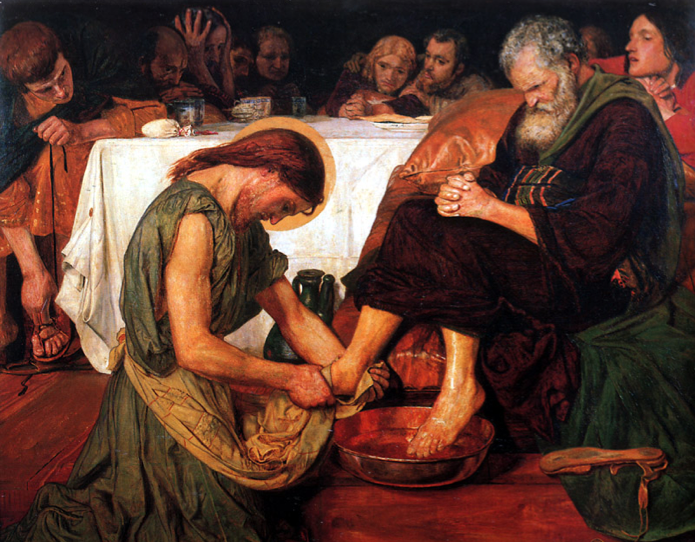
Eve Tushnet went to see the new exhibit of pre-Raphaelite paintings at the National Gallery of Art and came away fascinated by the movement’s controversial emphasis on “the human qualities of Jesus and the saints at the expense of transcendence”:
Ford Madox Brown’s huge Jesus Washing Peter’s Feet originally showed a Christ naked to the waist, but public outcry prompted him to paint in a loosely draped shirt. John Millais’s Christ in the House of His Parents drew controversy (Charles Dickens loathed it) because it seemed to portray the Holy Family as just another carpenter and his clan: ordinary people doing ordinary things.
And Rossetti’s Ecce Ancilla Domini!—his Annunciation—is still shocking today: Mary, a scrawny girl cornered against the wall in a thin nightgown, stares blankly at the angel, who lifts a hand to bless or maybe just to calm her. This is no royal queen of Heaven. The look on her face is the look of a teenager watching the second line darken on her pregnancy test: What does this mean? What on earth do I do now? She’s sallow and almost vampirized, and clearly shaken. This is the moment before she says yes.
Earlier Dish on the exhibit here.
(Image: Ford Madox Brown’s Jesus Washing Peter’s Feet, 1876, via WikiPaintings)
Toward A Less Conventional Poetry
David Yezzi provides a searing critique of what he claims is the shallow optimism of contemporary poetry:
The spectrum of subjects for poetry should be as broad as the spectrum of human emotions, which is not to say that all emotions are equally admirable, only that we exclude consideration of them at our peril.
How did the main effects of poetry ever boil down to these: the genial revelation, the sweetly poignant middle-aged lament, the winsome ode to the suburban soul? The problem is that such poems lie: no one in the suburbs is that bland; no reasonable person reaches middle age with so little outrage at life’s absurdities. What an excruciating world contemporary poetry describes: one in which everyone is either ironic, on the one hand, or enlightened and kind on the other—not to mention selfless, wise, and caring. Even tragic or horrible events provoke only pre-approved feelings.
Poetry of this ilk has a sentimental, idealizing bent; it’s high-minded and “evolved.” Like all utopias, the world it presents exists nowhere. Some might argue that poetry should elevate, showing people at their best, each of us aspiring to forgive foibles with patience and understanding. But that kind of poetry amounts to little more than a fairy tale, a condescending sop to our own vanity.
The View From Your Window

Atlanta, Georgia, 8.36 am
Converting To Atheism
In a recent interview, Susan Jacoby described how and why people become atheists:
[U]nless you’re raised atheist, people become atheists just as I did, by thinking about the same things Augustine thought about. Certainly one of the first things I thought about as a maturing child was “Why is there polio? Why are there diseases?” If there is a good God why are there these things? The answer of the religious person is “God has a plan we don’t understand.” That wasn’t enough for me.
There are people who don’t know anything about science. One of the reasons I recommend Richard Dawkins’s book, The God Delusion, is that basically he explains the relationship between science and atheism. But I don’t think people are really persuaded into atheism by books or by debates or anything like that. I think people become atheists because they think about the world around them. They start to search out books because they ask questions. In general, people don’t become atheists at a late age, in their 50s.
All of the atheists I know became atheists fairly early on. They became atheists in their adolescence or in their 20s because these are the ages at which you’re maturing, your brain is maturing, and you’re beginning to ask questions. If religion doesn’t do it for you, if, in fact, religion, as it does for me, contradicts any rational idea of how to live, then you become an atheist, or whatever you want to call it – an agnostic, a freethinker.
I’m currently working on a book on a history of religious conversion. One conversion narrative is always like Saul on the road to Damascus. A voice appears out of the sky, you fall off your horse, you hit yourself on the head, and when you wake up you know Jesus is the lord. That’s the classic sudden conversion narrative. It doesn’t happen that way with atheism. People don’t wake up one morning and say “Oh God! I’m an atheist.” You don’t fall off a horse and wake up and say “Oh! There’s no God. Ah. Now I know.” No. It’s more a slow questioning, if you were brought up religious, of whether those things make any sense.
Passing Through The Garden

Ashley Makar poignantly reflects on how her cancer diagnosis changed her perspective on the story of Jesus and his disciples in the Garden of Gethsemane:
I used to identify with the disciples in this Bible story. By the time they got to the Garden of Gethsemane, they’d followed Jesus all over Galilee, healing the sick and feeding the hungry, standing up to the Pharisees. They were on the run from the Roman authorities, and they must have been exhausted, collapsed at the feet of the olive trees. But Jesus wouldn’t give his friends a break. Watch and pray with me, he said, demanding vigilance, when I imagine they could hardly keep their eyes open. For years I’ve wanted to talk back to Jesus on behalf of the disciples: Let them have a nap, I’ve wanted to say. And stop making me feel guilty about all the times I’m too tired to be vigilant in the face of others’ pain.
I’m still a sleeping disciple, prone to compassion fatigue, much of the time. But since my cancer diagnosis, I’m beginning to empathize with Jesus at Gethsemane: Just as he’d gotten his life’s work going, just as he was planting the seeds of a new society, just as he was gaining followers willing to give up everything for justice and love, he found out he was probably going to die, at the age of 33. I can imagine Jesus, dashing his knee on the rocky grounds of Gethsemane, the garden it could be—the Kingdom of God on earth—if only he didn’t have to die early.
Just as I’d begun following my vocation to work with refugees, just as I was finding ways to write about God, just as I’d begun living into beloved community, I found out I have incurable cancer, at the age of 33. My life’s work would only be a drop in the bucket of the radical transformation Jesus was trying to make of the world. And I won’t suffer like he did: Cancer is no crucifixion. But sometimes I stomp my feet on the ground of all I feel is being taken from me.
(Image: Agony in the Garden by Andrea Mantegna, 1460, via Wikimedia Commons)
Matter Over Mind
Priscella Long is disturbed by neuropsychologist Benjamin Libet’s experiment on human decision-making:
The decision was to move a hand. Each person was instructed to move his or her hand whenever the desire arose, to report the precise time this wish or intention to move the hand appeared, and then to go ahead and move the hand. Subjects sat in front of a clocklike face with a light going around like a minute hand, only faster, so that milliseconds could be reported.
The results had ominous suggestions for our idea of free will:
The [subjects’] decision to move the hand occurred in the following order. First neurons fired in the premotor cortex (neurons responsible for planning and executing hand motions). These neurons communicated to the motor cortex, which fired, sending instructions to the motor neurons in the spinal cord that make the muscles contract. At this point—and not before—the subject “decided” to move his or her hand. The “decision” to move the hand occurred before but extremely close to the time the hand moved, a long 350-400 milliseconds after the brain began the process of signaling the hand to move.
What are we to make of this? Is it me or my brain that decides things? [Author Christof] Koch writes, “At least in the laboratory, the brain decides well before the mind does; the conscious experience of willing a simple act—the sensation of agency or authorship—is secondary to the actual cause.”
 The Dish
