Bonding Over Booze

Jessica Freeman-Slade reviews Rosie Schaap’s memoir, Drinking with Men:

As a teenager, she’d dress like a Gypsy and offer tarot card readings on the Metro-North New Haven line for free beers; as an adult uncovering her latent spirituality, she’d find refuge in bars between stints as a volunteer chaplain at the foot of ground zero; as a married woman, it took a special bar in Montreal to feel her relationship coming apart. To be a bar regular, she says, is all about “adapting—and about enjoying people’s company not only on one’s own terms, but on others.” We go to bars to find ourselves in other people’s habits, and in finding other people, find ourselves.

Freeman-Slade tested out Schaap’s advice in bars across New York City: 

[Midtown East and West] is where I first started to see what Schaap was drawn to in her favorite bars: the friendships between the patrons, and the warm greetings by the bartenders that recognize them. At the Archive, a little place in Murray Hill where the happy hour red wine was perfectly quaffable, I found a gaggle of midtown lawyers, each clinging to his bar stools and ordering an elaborately named scotch or whiskey of choice. “Can you believe how expensive it is to drink in NY?” asked a red-faced man in a too-tight shirt, leaning across my chair to snatch his vodka-and-soda. “It’s a luxury activity,” I respond, and we clink our happy-hour drinks in solidarity. A frizzy-haired woman to my left swished a diluted cocktail between her teeth as she complained about her work week to the bartender, but even she declined a refill. “I’m going to surprise my husband tonight,” she snickered, and then added, with a low raspy chuckle, “I hope it’s not a bad surprise.”

Such confessionals would be out of place at a fancier bar, but watching people ease out of the workdays can be your first instruction in how to drink like a grown-up. Schaap said, “I’ve come of age in bars,” and perhaps the post-work drink is how you first observe functional adults at play.

The Novelist’s Dream Diary

In a review of La Boutique Obscure, a dream diary by Georges Perec, Tom Jokinen remembers another famous attempt:

Graham Greene also kept a dream diary, which was published after his death in 1991 as A World Of My Own. As Malcolm Bradbury points out in his review for the New York Times, Greene believed in worlds beyond what he called “The Common World” of shared reality: he believed in the mysteries that exist “in the bathroom cupboard, in secret tunnels under the ground, in the labyrinthine world of espionage, in the realm of sexual deceit,” and in dreams. As a Catholic, albeit a Catholic troubled by the arbitrary constraints of the earthly church, he believed too in the world we’re not meant to see except through Revelation. The diary is a stealth autobiography of Greene’s life in the dreamworld. … In an odd way, both A World of My Own and Perec’s La Boutique Obscure are works of non-fiction.

David Auerbach considers Perec’s final dream in the book – “Perec and his father chased, captured, and imprisoned by Nazis in short, punchy scenes”:

Ending the dream journal where and when he did was wise. “I thought I was recording the dreams I was having,” Perec writes in the book’s introduction. “I have realized that it was not long before I began having dreams only in order to write them.” As Perec hints, the dreams recounted in La boutique obscure chart out not just his recurrent obsessions but also a linear narrative about dreaming, telling a story about the journal itself and the pain that went into its composition, a pain that ultimately stems from the author’s loss of both his parents in World War II. By the end of the book, Perec’s dreams are crying out for him to stop writing them down.

You can read some excerpts from Perec’s journals here and Sasha Archibald’s analysis of Perec’s dreams here.

Face Of The Day

A description from Juxtapoz:

[Françoise Nielly]’s colorful portraits, created using thick strokes of oil on canvas, are based off simple black and white photographs. According to her bio, Nielly ‘takes a risk: her painting is sexual, her colors free, exuberant, surprising, even explosive, the cut of her knife incisive, her color pallete dazzling.’

Ending With A Bang

Maureen O’Connor proclaims that “the celebrity sex tape is dead”:

The same day that Ray J’s “diss track” [about his sex-tape encounter with Kim Kardashian] appeared online, porn megastar James Deen confirmed making a “sex tape” with former Teen Mom Farrah Abraham. As Abraham went through the motions of sex tape denial, feigning litigiousness and “shock,” Deen described the “sex tape” as a professional, commercially produced porno: “Definitely not dating. Got tested together on Friday and then saw her on set. That is my only experience with the lady.” As the Awl’s Choire Sicha notes, “This is not a sex tape! This is a good old-fashioned porno. And so we have come full circle.”

Her theory:

Now that homemade celebrity nudity is available for free en masse — from hackers, from social-media-enabled starfuckers, and from social-media-enabled celebrities themselves, sometimes by accident — perhaps the value of the sex tape has diminished, while the betrayal associated with selling one has gone up. To make and save a sex tape, in 2013, requires a level of trust higher than the asking price for most sex tapes.

Tracy Clark-Flory notes a double standard when a starlet makes a sex tape:

It seems there’s an unspoken rule in our culture: As long as you’re an unwitting — or “unwitting” — porn star (i.e., you appear embarrassed and ashamed of your sex tape), you’re allowed to be more than just a porn star. You can sell your own perfume line at Walgreens and Wal-Mart. You can make $10,000 a tweet and broadcast your wedding on E! and star in Super Bowl commercials. It becomes a comeback tale. But if you make the intentional, unabashed choice to expose yourself to the world for profit, you are forever defined by it.

A Poem For Saturday

Bronx_1900

“An Inheritance” by Naomi Replansky, winner of the Poetry Society of America’s 2013 William Carlos Williams Award:

“Five dollars, four dollars, three dollars, two,
One, and none, and what do we do?”

This is the worry that never got said
But ran so often in my mother’s head

And showed so plain in my father’s frown
That to us kids it drifted down.

It drifted down like soot, like snow,
In the dream-tossed Bronx, in the long ago.

I shook it off with a shake of the head.
I bounced my ball. I ate warm bread,

I skated down the steepest hill.
But I must have listened, against my will:

When the world blows wrong, I can hear it today.
Then my mother’s worry stops all play

And, as if in its rightful place,
My father’s frown divides my face.

(Reprinted from Collected Poems © 2012 by Naomi Replansky. Used by kind permission of David R.Godine, Publisher. Photo of Grand Concourse and E 161 street in the Bronx, circa 1900, via Wikimedia Commons)

“Reads Like A Novel”

Jeff Sharlet considers that claim in David Sedaris’ blurb for Katherine Boo’s Behind the Beautiful Forevers, a portrait of the slums of Mumbai:

“It might surprise you how completely enjoyable this book is, as rich and beautifully written as a novel.” Emphasis mine. Cliché Sedaris’s. Should we blame him? He liked the book. He wanted people to read it. And David Sedaris is nothing if not a savvy salesman. He must’ve understood that the promise of “enjoyment,” married to all that is implied, in the context of a book blurb, by “a novel”—characters, plot, resolution, a seamless world—beneath a best-selling writer’s “brand,” would give Behind the Beautiful Forevers a readership far beyond the market share for true tales of relentless filth and poverty. “Reads like a novel”—that’s the elevator pitch. That’s how you sell suffering for $27. …

My own work has on occasion been compared to a novel, and whenever it was, I was delighted. I knew that for a book to be “like a novel” meant that it was safe for mass consumption. It knew that to be “like a novel” meant sales, even though nonfiction outsells fiction. But facts like that are beside the point. For David Sedaris to say that Behind the Beautiful Forevers is like a novel is to reassure the reader that the suffering documented on every page isn’t what matters. It’s the experience. The reader’s, that is. This book will make you feel close to that suffering, but not too close.

Can The Writer Truly Retire?

Ian Crouch wonders:

Critical opinion is not a statistics-based endeavor, and so we don’t have a graphical curve that tells us when a writer is likely to produce his or her best work. Some writers never match their first novels (Ralph Ellison, Joseph Heller). Others reach their peaks in some middle-career moment, when they have fully developed voices and still retain vigor and health and time to put toward the task. (Roth seems to fit this category, although favorites might be found at the beginning and the end).

Yet there are examples of great writers writing splendidly right until the finish—and even the diminished output of older writers is valuable, if only because it matters how great writers absorb and accept and reject the pains and insights of age. Roth has mentioned that he didn’t want to add mediocre books to the world’s library—and there are many, many examples of great writers perpetrating all kinds of lesser crimes in their advanced age. It seems likely that a novel by, say, Hemingway at seventy would have been among his worst, charting the decline of his output. But who wouldn’t want to read what worlds Hemingway might have made out of being seventy? A quote attributed to him goes like this: “Retirement is the ugliest word in the language.” It seems safe to say that dying is uglier.

Suffering In Verse

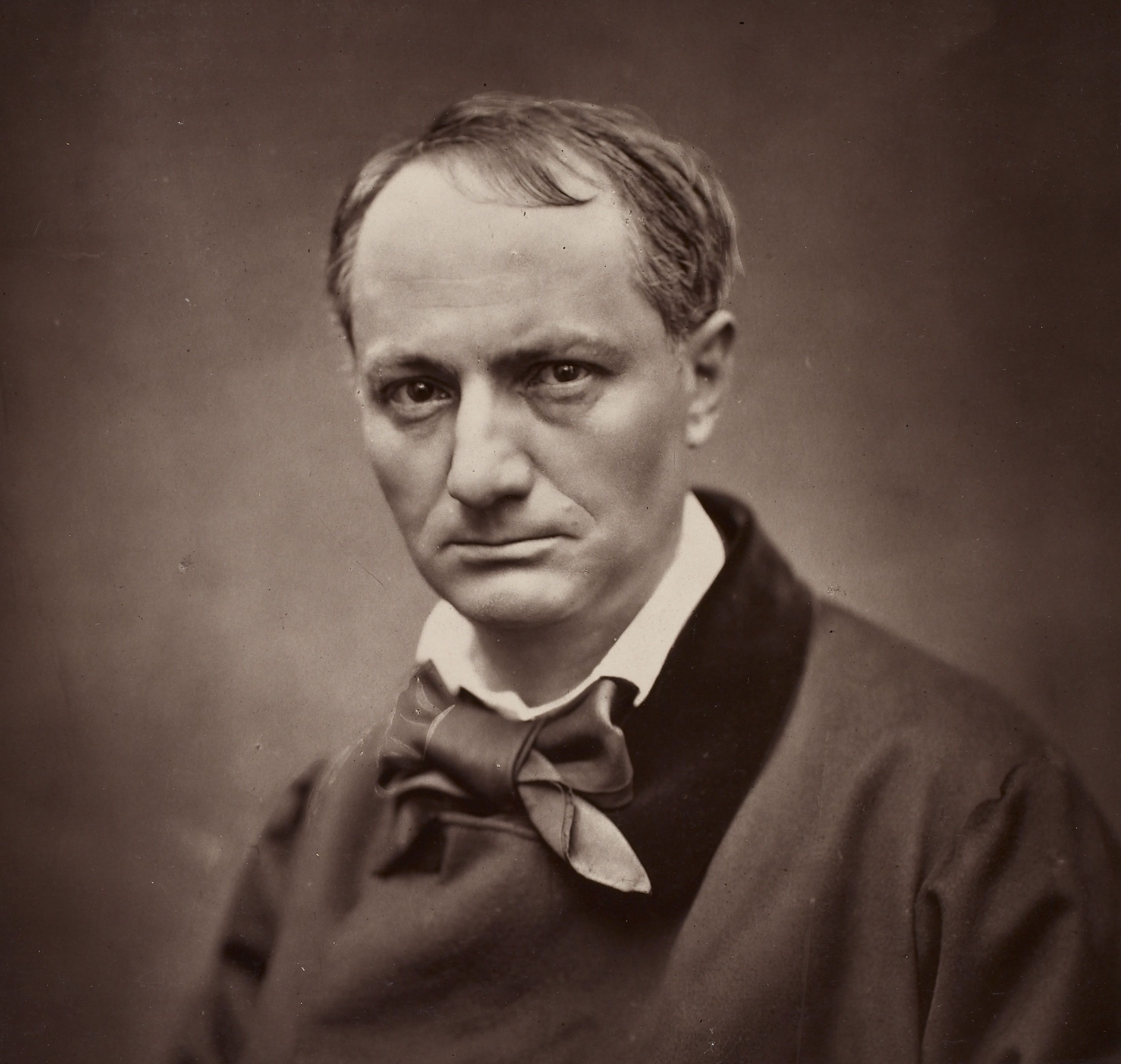
Stephen Akey praises the French poet Baudelaire for confronting our failures:

Like a blasphemous Jesus, he took on our worst sins — pride, sloth, envy, lechery — and turned them into art. T.S. Eliot and others have found in him a profound religious yearning beneath the blasphemy. I, on the contrary, find blasphemy beneath the blasphemy. Baudelaire’s “business” was not, pace Eliot, to “assert the necessity” of Christianity. He asserted, if anything, the necessity of belief in a self that, threatened from forces within and without, might remain whole and integral, if only through the consciousness of its own suffering. Even so, it’s impossible not to be moved by Eliot’s essay on the poet, which concludes not with the expected apportions of praise and censure but, astonishingly, with this prayer: “Baudelaire was man enough for damnation: whether he is damned is, of course, another question, and we are not prevented from praying for his repose.”

Extraordinary as Eliot’s benediction is, Baudelaire didn’t hold out for prayer. He had work to do. Tormented, slothful, and sickly, he managed to produce masterpieces in every genre to which he turned his hand: metrical verse, prose poetry (which he more or less invented), translation, and art criticism. I think of Baudelaire at work much as he depicted his loved and hated city in the last stanza of his magnificent aubade “Twilight: Daybreak” (“Le Crepuscule du Matin”). It’s a Baudelairian dawn. Whores, beggars, the debauched and the dying fitfully awaken to a cold and damp morning — not a promising start to the day. And yet this city will clothe itself in beauty and get to work:

Shivering dawn, in a wisp of pink and green,
Totters slowly across the empty Seine,
and dingy Paris – old drudge rubbing its eyes –
picks up its tools to begin another day.

(Photo of Baudelaire by Étienne Carjat via Wikimedia)