The Last Blood Libel Trial

One hundred years later, David Mikics recounts the last recorded trial of blood libel in the West—Mendel Beilis, falsely accused of draining the blood of a young boy killed by gangsters, in Kiev:

In his trial, Beilis was defiant when he needed to be. He answered one of the judge’s opening questions, “To what religion do you belong?” with, he remembered [in his memoir], “something approaching a shout”: “I am a Jew.” As the trial went on, the prosecution’s case collapsed. The workers that Beilis supervised testified to his honesty; they knew he was incapable of murder. A 10-year-old boy, a friend of the dead [victim] Andrei, had been primed by the Tcheberiak gang to testify that Andrei had often played near the brick factory and had been chased off the factory grounds by Beilis. Instead, the boy stated that Andrei had never gone near the factory. The student who had distributed the anti-Semitic leaflets at Andrei’s funeral fainted when he took the stand. Then, in a moment of high drama, the lamplighter who had originally said that Beilis had chased Andrei from the brickyard recanted his testimony, proclaiming, “I am a Christian and fear God. Why should I ruin an innocent man?”

An Unscientific Ad

A male version of Dove’s latest ad campaign:

Virginia Postrel criticizes Dove’s “social experiment”:

Gil Zamora, the forensic artist, is indeed a well-respected professional who worked for many years doing composite sketches for the San Jose, California, Police Department. But, unlike his interview subjects, he knew the point of the exercise going in.

The “experiment” wasn’t double-blind. Zamora’s knowledge matters because a verbal description of any given feature allows a lot of interpretative leeway, and he could have unconsciously biased his drawings. “This is a social experiment,” he said in an interview, repeating the Dove mantra. “We were trying to show how women are their own worst beauty critics and how they see themselves and how others see them.” Right.

Exacerbating the potential for bias, Zamora deviated from his standard procedure, which includes giving the witness a chance to review the sketch and correct any misinterpretations. There are two possible sources of error in a composite sketch: the witness’s memory of what the person looked like and how that memory gets translated from impression to words to drawing. One witness’s “round face” is fat but oval, another’s is round and not especially fleshy, while another’s is what an artist would call square. Proportions mean different things to different people. And some people simply have limited vocabularies.

Release The Torture Report!

Joe Biden is now on board with getting the most authoritative of the investigations into the Bush-Cheney war crimes out in the open. You’d think the veep and the Senate Intelligence Committee would be enough to over-rule the CIA’s bed-wetting. But the CIA seems to me increasingly a shadow government, immune to the constraints and governance of the real one. We’re going to get the truth about them once we seize it from their cold and bloodied hands.

The Strange Hush Of Freezing To Death

Withstanding bears, frostbite and potential madness, Brian Phillips recently tracked the Iditarod by land and air. At one point his plane, named “Nugget”, froze up on the ground during a visit to the Diomedes Islands, the border between Russian and US territory:

We were stranded out there for three hours. It was the first time I ever understood why freezing to death is sometimes described as peaceful or soothing or just like falling asleep, descriptions that had always Blizzard Blankets Xinjiang In Northwest Chinaseemed to hint at some unfathomable mind-transformation within the freezing person, some power extreme cold had to enchant the brain’s basic mechanisms of homeostasis. It didn’t feel violent, that was the thing. Even with the wind ripping past you. It was like certain parts of your body just accrued this strange hush. Like you were disappearing piece by piece. I thought I’d be warmer outside and walking around than inside Nugget, so I would sort of exaggeratedly move one limb at a time, my left arm or whatever, and while I was concentrating on my left arm my right leg would start to be erased.

More than affecting my sense perceptions, though, the cold seemed to affect the way I thought about my sense perceptions. I’d take my glove off to adjust a zipper and lose feeling in my hand almost immediately and instead of thinking Holy no I need to get my glove back on right this second I’d sort of pause and go My, how interesting that my hand feels as though it’s visibly translucent. Then my brain’s inbox would gently ding. PLEASE DON’T DIE.

A personal anecdote: the priest who gave me my first Holy Communion and Sacrament of Reconciliation, and whom I served as an altar boy, died a couple of years’ ago. He was walking home on a cold night and was discovered the next day dead on the street. He had died of hypothermia. He was one of the gentlest priests I ever knew – a quietly devout and simple fellow – and it seemed horrifying that this man died on a street, alone, perhaps after a fall. But it’s also a relief to think that freezing to death is not as painful and as wretched as one might imagine. One reason I have not given up the faith is because of the kind of humility and sincerity I saw in that first priest. Others were not so lucky. But we shouldn’t let evil obscure the great good so many priests do every day, in ways others will never know about, but that, bit by bit, begin to heal the broken world.

(Photo: A herdsman whose fingers were injured by frost bite lies in a hospital January 9, 2006 in Fuyun County of Altay Prefecture, Xinjiang Uygur Autonomous Region, northwest China. A blizzard that swept in from Siberia and plunging temperatures to as low as 43 degrees below zero centigrade forced the evacuation of almost 100,000 people and stranded a further 220,000 in Xinjiang, according to the National Disaster Reduction Centre. By China Photos/Getty Images)

Spain’s Great Depression

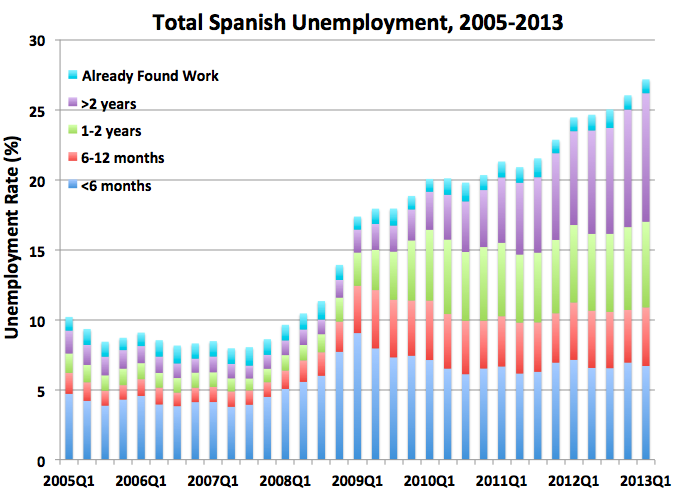
Spanish Unemployment Total

Matthew O’Brien fears that “Spain is beyond doomed”:

Spain’s labor market problems fall into two big buckets: too much regulation, and not enough education. It’s almost impossible for companies to get rid of older workers, which creates a horribly bifurcated labor market. There are permanent workers who can’t be fired, and temporary ones who can — and are. Indeed, as Clive Crook points out, about a third of Spain’s workforce are temporary workers who enjoy few protections and fewer opportunities. Companies go through these younger workers without bothering to invest much in their human capital, because why would they? These temporary workers will be let go at the first sign of economic trouble. Young people get stuck in a never-ending cycle of under-and-unemployment since firms are always hesitant to hire permanent workers who will always be on their books.

But it gets worse. The housing bust hasn’t just cast a shadow over household and bank balance sheets; it’s cast one over young people’s educations too. At its peak, building made up a whopping 19 percent of Spain’s economy, which, as Tobias Buck of the Financial Times points out, lured many young men into dropping out of school for well-paying construction gigs. But now that building has gone into hibernation, all of those young men are left with no work and no education to fall back on. And, again, even if they can find temporary jobs, it’s not as if the companies will spend money to develop their skills.

Are The Fans The Problem?

Before Jason Collins came out, Joel Anderson explained why male pro-atheletes in the most popular American sports have remained closeted:

Mike Freeman of CBSSports.com has reported at least one current NFL player may come out publicly as gay in the next few months. By and large, however, sports figures in major teams sports have stayed in the closet. Why are they waiting? What are the player’s concerns? Not with teammates or the reaction inside the locker room. “America is the greatest place in the world. But America is more homophobic than locker rooms,“ Charles Barkley said recently on The Dan LeBatard Show in Miami. Pro athletes “have played with gay players before. … The crowd is going to be shouting things more than it’s going to be uncomfortable in the locker room.” The particular player Freeman wrote about for CBSSports.com felt the same. “The player fears he will suffer serious harm from homophobic fans, and that is the only thing preventing him from coming out.”

Those big men on the football field cannot take some taunting from the stands? Go watch the Jackie Robinson movie – and grow some.

The Democrats’ Low Pain Tolerance

After the FAA deal, Ezra declares that the “Democrats have lost on sequestration”:

It is worth noting how different the Democrats’ approach to sequestration has been to the GOP’s approach to, well, everything. Over the past five years, Republicans have repeatedly accepted short-term political pain to win the leverage necessary for long-term policy gain. That’s the governing political principle behind their threats to shut down the government, breach the debt ceiling, and, for that matter, accept sequestration. Today, Democrats showed they’re not willing to accept even a bit of short-term pain for leverage on sequestration. They played a game of chicken with the Republicans, and they lost. Badly.

Chait argues that “Obama’s mistake wasn’t the design of sequestration” but, instead, “finding himself in that negotiation to begin with”:

Earlier this year, Obama refused to negotiate over the debt ceiling, and Republicans caved and raised it. If he had done that in 2011, they would probably have done the same thing. Instead, Obama took their demand to reduce the deficit at face value and thought, Hey, I want to reduce the deficit, too — why don’t we use this opportunity to strike a deal? As it happened, Republicans care way, way, way more about low taxes for the rich than low deficits, which made a morally acceptable deal, or even something within hailing distance of a morally acceptable deal, completely impossible.

Weigel identifies a contributing factor:

Intuitively, voters don’t understand that a president might be hamstrung when he’s making decisions about spending. … Call it the Maureen Dowd Paradox — people are so inclined to see the president as powerful that they don’t understand how and why he might be limited legislatively.

Yglesias wonders whether Democrats will cave on the sequester’s defense cuts:

The military cuts would give me a lot of leverage vis-a-vis the GOP because I really think the United States spends wildly too much money on an agenda of global military hegemony. But that’s not what Obama thinks, and it’s certainly not what Obama says. Nor is it a line that red-state Democratic Party senators or folks plotting political strategy for the DCCC are going to want to hold. So far, Republicans keep bailing Democrats out by proposing to rescind military cuts and replace them with cuts in programs for the poor. The different wings of the Democratic Party are comfortable hanging together to oppose that and insist instead on a “balanced” alternative. But what if Republicans proposed to rescind the military cuts and replace them with nothing.

TNC adds:

Sequestration was premised on the abiding belief among Democratic power-brokers–including the president–that Republicans and Democrats were working with equal pain thresholds. They are not. Obama underestimated his enemies, and now we are going to pay for it.

And The Truth Shall Set You Free

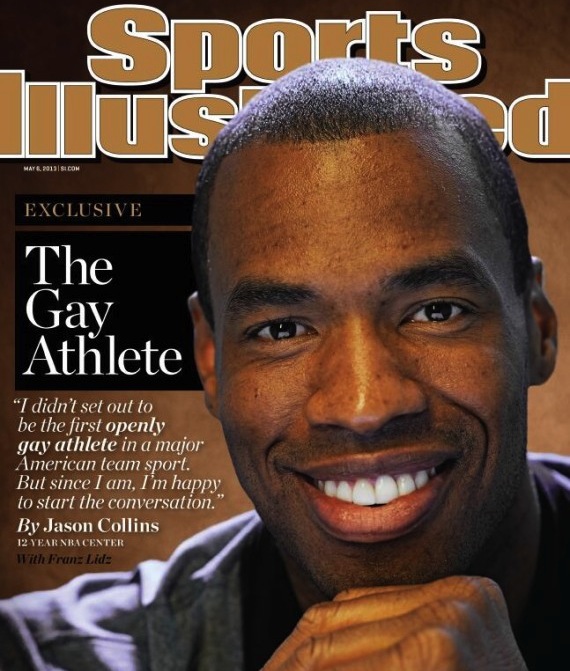
The first NBA player to come out is both African-American and a beautiful writer:

The recent Boston Marathon bombing reinforced the notion that I shouldn’t wait for the circumstances of jason-collins-openly-gay-athlete-570x758my coming out to be perfect. Things can change in an instant, so why not live truthfully? When I told Joe a few weeks ago that I was gay, he was grateful that I trusted him. He asked me to join him in 2013. We’ll be marching on June 8.

No one wants to live in fear. I’ve always been scared of saying the wrong thing. I don’t sleep well. I never have. But each time I tell another person, I feel stronger and sleep a little more soundly.

It takes an enormous amount of energy to guard such a big secret. I’ve endured years of misery and gone to enormous lengths to live a lie. I was certain that my world would fall apart if anyone knew. And yet when I acknowledged my sexuality I felt whole for the first time. I still had the same sense of humor, I still had the same mannerisms and my friends still had my back.

What I found particularly ballsy was his embrace of his Christianity:

I’m from a close-knit family. My parents instilled Christian values in me. They taught Sunday school, and I enjoyed lending a hand. I take the teachings of Jesus seriously, particularly the ones that touch on tolerance and understanding.

And his physical aggression:

I’m not afraid to take on any opponent. I love playing against the best. Though Shaquille O’Neal is a Hall of Famer, I never shirked from the challenge of trying to frustrate the heck out of him. (Note to Shaq: My flopping has nothing to do with being gay.) My mouthpiece is in, and my wrists are taped. Go ahead, take a swing — I’ll get up. I hate to say it, and I’m not proud of it, but I once fouled a player so hard that he had to leave the arena on a stretcher.

I go against the gay stereotype, which is why I think a lot of players will be shocked: That guy is gay? But I’ve always been an aggressive player, even in high school. Am I so physical to prove that being gay doesn’t make you soft? Who knows?

That may be a mind blower for some. But the gay athletes and soldiers and cops I know are some of the toughest motherfuckers out there. And not just the lesbians.

I want to salute Collins for making more space in the world for more people barred by social norms from being fully who they are. He has single-handedly increased the level of oxygen gay athletes can breathe.

We’re all mortal. We all only have now. Why not tell the truth? It’s as liberating as Jesus predicted. And as transformative as the last two decades have been – as the truth has slowly won out over ignorance and prejudice. But it only did so because it was accompanied by its most powerful partner: courage.

Are Chemical Weapons A Game-Changer?

SYRIA-CONFLICT-CHEMICAL

Stephen Walt doesn’t see why they should be:

Does it really matter whether Assad is killing his opponents using 500-pound bombs, mortar shells, cluster munitions, machine guns, icepicks, or chemical weapons? Dead is dead no matter how it is done.

The case against direct U.S. intervention never depended on believing that Assad was anything but a thug; rather, it rested first and foremost on the fear that intervention might make things worse rather than better. Specifically, it has rested on the interrelated concerns that 1) the fall of the Assad regime might unleash an anarchy of competing factions and warlords, 2) the opposition to Assad contained a number of extremist groups whose long-term agendas were worrisome, and 3) pouring more weapons into a society in the midst of a brutal civil war would create another Afghanistan, Iraq, or 1970s-era Lebanon. These prudential concerns still apply, irrespective of the weaponry Assad’s forces have chosen to employ. And if his forces have used chemical weapons, then one might even argue that it raises the risks of intervention and thus strengthens the case against it.

Max Fisher points out that half of Americans can’t identify Syria on a map:

[B]eing able to correctly identify Syria on a map obviously does not preclude an individual from expressing strong views about the country or what Obama should do about it. But it does add a bit more credence to the perception that Syria is not exactly at the center of America’s national attention right now. And that in turn might make some sort of assertive and potentially risky U.S.-led military action in Syria, whatever its merits or downsides, a bit less likely.

What’s striking to me is that even McCain and Butters are reluctant to send in troops. And I agree with Walt that the methods of mass extermination are a little irrelevant to the corpses. Still, the fundamental fear is the following: that intervention is insane; but that letting this conflict run its course could lead to chemical weapons being used by the al Nusri brigade, the major Islamist force now swearing allegiance to al Qaeda. For a chilling update, check out this report in the Telegraph.

The size of the chemical arsenal is perhaps the fourth in the world, hidden all over the country now teetering out of the dictator’s control. Air-strikes would be unlikely to work:

“Airstrikes aren’t reliable because they can just release all the chemical agents into the air,” [Dina Esfandiary, an expert on Syria’s WMD programme with the International Institute for Strategic Studies, the London-based defence and security think-tank] said. “Alternatively, they only do half the job and then render a secure site open to looters.”

Nor, she added, would quick-fire raids by small teams of special forces be an alternative. “You would have to first secure the sites and then do a careful analysis of what was there, followed by controlled explosions. It is, frankly, a labour intensive job, and that is why the Pentagon assessed it as requiring 75,000 men. “Besides, there may be any number of caches hidden all over the place, and even if you could look for them properly – which is difficult with a civil war going on – you would run the risk of some being left behind.”

Recall that the entire rationale for the invasion of Iraq was to prevent chemical, biological or nuclear elements getting into the hands of al Qaeda. Those WMDs did not exist; but Assad’s do. And on a subway train in New York or London, just a small attack could wreak panic and havoc and death on a large scale.

Recent Dish on Syria’s chemical weapons here.

(Photo: A picture taken on April 26, 2013 shows a plastic bottle, coal, cotton, gauze, cola, and cardboard that are used by members of the al-Ezz bin Abdul Salam brigade to assemble homemade gas-masks for protection against chemical weapons, in Syria’s northern Latakia province. By Miguel Medina/AFP/Getty Images)

Quote For The Day

Islamic Society Holds Vigil For Marathon Bombing Victims

“By now we know well the opposing worldviews that characterize our struggle with extremists.  The latter promote the cult of death, whereas we—the mainstream—promote the theology of life.  They believe that only they know the will of God, which they can impose on people, whereas we believe that the will of God is represented by the will of the people.  They believe Sharia is limited to draconian punishments to terrorize people, whereas we believe Sharia is the path to God—one defined by different groups that adhere to justice, mercy and compassion.  They believe grievances are irreversible facts that should be fuel for political violence, whereas we believe grievances can be redressed non-violently, and in partnership with others who, like us, respect human dignity.  They believe that recruiting young people to serve as their warriors will be their unending revitalization, whereas we believe that the mission of Islam is entrusting Muslim youth to be ambassadors of good will and future leaders,” – Salam al-Marayati.

The struggle of our time is not between religions so much as within them. The battle is between fundamentalist certainty and religious humility; between those who see divine truth and seek to live by it, and those who think they see divine truth and want to impose it on others; it is between Islam and Jihadism, between Christianity and Christianism, between the humane ethics of Judaism and the extremist bigotry of many West Bank Settlers. Until these internal struggles are resolved, the external dangers will endure.

(Photo: A crowd gathered during a vigil for the marathon bombing victims held at the Islamic Society of Boston Cultural Center in Boston. By Aram Boghosian for The Boston Globe via Getty Images.)