Facebook For Spies

Robert Beckhausen reports on a 007-worthy addition to the popular photo-sharing platform:

Facebook is a place where you can share pictures of cute animals and fun activities. Now there’s a browser extension that lets you encode those images with secret, hard-to-detect messages. That’s the idea behind Secretbook, a browser extension released this week by 21-year-old Oxford University computer science student and former Google intern Owen-Campbell Moore. With the extension, anyone — you, your sister, a terrorist — could share messages hidden in JPEG images uploaded to Facebook without the prying eyes of the company, the government or anyone else noticing or figuring out what the messages say. The only way to unlock them is through a password you create. …

[It’s] the first time anyone’s managed to figure out how to automate digital steganography — the practice of concealing messages inside computer files — through Facebook, the world’s biggest social media platform. Unlike cryptography, which uses ciphertext to encrypt messages, steganographic messages are simply hidden where no one would think to look.

Thatcher And The Lesbian Widow

Here’s a wonderful little tidbit from Alexander Chancellor in the Spectator’s symposium:

In the middle of dinner on Easter Sunday, she demanded that we all go and stand outside in the cold to see the Hale-Bopp comet as it passed overhead. ‘It reminds me of pheasant,’ she said. ‘Doesn’t it you, Mr Chancellor?’ (It didn’t at all, actually.)

On Easter Monday, a beautiful spring day, Alexander Hesketh brought Margaret and Denis Thatcher over to my house at Stoke Park, where she said another surprising thing to me. Staying there with my late uncle Robin was Jacqueline Hope-Wallace, a great admirer of Margaret Thatcher, having once served under her as a civil servant in the Ministry of Pensions in the early 1960s, who was feeling bereft after the death of her long-term friend C.V. (Veronica) Wedgwood, the historian. I didn’t mention that they had been lovers but must have somehow implied it, for Lady Thatcher grasped the point immediately and said, as a very modern person might, ‘I didn’t realise they were partners.’

When they eventually crossed paths on the lawn, Hope-Wallace started to say, ‘You won’t remember me, but…’ when Lady Thatcher briskly interrupted her: ‘Of course I remember you — you wrote that marvellous report on pension reform…’. She went on to recall the names and personalities of all the other civil servants in that department. She thus made a forlorn old lady very happy.

Doctor Who’s Post-Imperialism

Chris Oates examines the show’s genesis in 1960s England, when the “British empire, like other European empires, was ending”:

In many ways, the show carried on the themes of Victorian youth literature: the Doctor is a fearless traveler; he encounters strange cultures and lands; he is stoic, sophisticated, and not without a few eccentricities. Give him a pith helmet and he could fit in perfectly with the entertainment of the past. Episodic adventure still sold, was still compelling, but with Doctor Who, the creators were confronted with the question of what happens to an empire-builder post-imperially? The question for the show’s creators was how to maintain the lucrative adventure structure of the past without the geopolitical foundation that it had required.

Their answer was to use the traits that were appealing about adventurers and were still permissible in a world where countries are not apportioned on a first-European-come, first-European-served basis. When inviting his companions to join him, he almost always asks if they want to see the universe. The stated mission is travel for its own sake. The Doctor is a tourist.

The GOP’s Demographic Problems Are Very Real

Nate Cohn rebuts various pundits who argue otherwise:

It was frequently observed that a Romney victory would have required a historic performance among white voters, provided that Obama could match his ’08 performance among non-white voters. Bush’s 2004 performance among white voters wouldn’t get it done anymore. In 2016, the math gets even more challenging. If the white share of the electorate declines further, Republicans won’t just need to match their best performance of the last 24 years among white voters, they’ll also need to match their best performance of the last 24 years among non-white voters. If they can’t make the requisite 16-point gain among non-white voters—a tall order, to say the least—then the next Republican candidate will enter truly uncharted territory, potentially needing to win up to 64 percent of the white vote just to break 50 percent of the popular vote.

The Crimefighting Power Of Brown

Ray Fisman dives into research on the effects of Brown v. Board of Education:

A growing body of social science research is now reaching the conclusion that school desegregation should get some direct credit for the drop in black crime. Indeed, as courts have begun overturning these rulings over the past decade, we’ve seen an alarming uptick in crimes by young black men. It turns out that integrating schools wasn’t just a matter of turning them into melting pots or providing equal access to education. It was also an effective way of fighting inner-city crime. …

Berkeley economist Rucker Johnson’s looked at the longer-run effects of desegregation on children of the civil rights era, using a range of methodologies, each of which generates the same set of findings: Desegregation led to higher earnings, better health, and a better chance of staying out of prison for black males. Johnson’s findings on crime echo the results of earlier research, which found that desegregation reduced violent crimes by young (15-24) black men by as much as one-third.

The Bitcoin Bust

Yesterday, the value of the newfangled currency plummeted 61 percent:
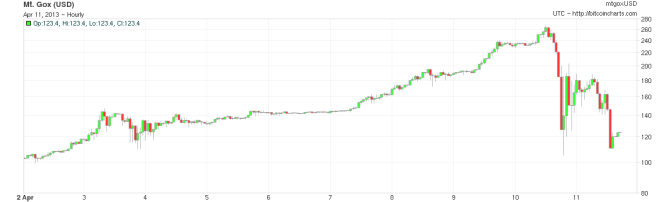
Bitcoin_Chart

Timothy B. Lee points out that Bitcoin has crashed and recovered several times before. Yglesias expects this cycle to continue:

The problem is that if the price of a bitcoin is on a steady upward trajectory, then nobody’s actually going to want to spend a Bitcoin on anything. And if everyone’s hoarding their Bitcoins, then the network is actually useless. Then, since it turns out to be useless, you get a crash. The funny thing is that once the upward spiral comes to an end, then the technological virtues of the Bitcoin platform come to the fore again. If nobody wants to hoard Bitcoins, then Bitcoin-as-platform looks like an attractive alternative to elements of the payment system. But when Bitcoin starts looking attractive again, you should get a renewed hoarding cycle.

Jerry Brito argued recently that Bitcoin’s valuation doesn’t necessarily matter:

Bitcoin will work as a seamless payment system so long as you can get in and out of it quick enough to mitigate volatility. That is largely a technical consideration, but it could also depend on the market’s liquidity, which conceivably could be hurt by speculative hoarding. I haven’t given this much thought yet, but given that bitcoin can be denominated down to eight decimal places, I’m not sure it will be a big problem anytime soon.

Felix Salmon thinks Bitcoin is too volatile to work well for payments:

Currently, it can take an hour for a bitcoin transaction to clear, which means that the value of the transaction when it clears can be radically different from its value at inception. Bitcoin only works for payments if you can be reasonably sure that its value will remain reasonably steady for at least the next hour or so.

McArdle bets that governments will restrict Bitcoin’s growth:

I think that governments can make it so difficult to translate your bitcoins into the real economy that most people simply won’t bother. And the more successful that bitcoins are–the better they become established as an alternate currency–the more likely it is that rich-world governments will swoop in and make it prohibitively difficult to use bitcoins to procure real-world goods in developed countries. At that point you’ve essentially got a novelty currency like greenstamps, which can be exchanged for only a limited supply of goods, and maybe some developing-world travel.

Eric Posner calls the currency a “Ponzi scheme”:

A regular Ponzi scheme collapses when people realize that earlier investors are being paid out of the investments of later investors rather than from the returns on an underlying asset. Bitcoin will collapse when people realize that it can’t survive as a currency because of its built-in deflationary features, or because of the emergence of bytecoins, or both. A real Ponzi scheme takes fraud; bitcoin, by contrast, seems more like a collective delusion.

Rand’s Racial Outreach

Bouie questions the point of Rand Paul’s speech this week at Howard University, a historically black college:

I’m not sure Paul deserves any praise for his performance. It would be one thing if Paul had gone to Howard eager to listen as well as speak. Instead, he condescended with a dishonest and revisionist history of the GOP. “He didn’t say anything I didn’t expect,” said one student, a senior majoring in sociology and economics. I couldn’t agree more.

I have to say the sheer lack of any grace among some liberal commenters on what was an obvious outreach to African-Americans depresses me. Josh Marshall piles on:

Yesterday morning Sen. Rand Paul went over to Howard University. And it didn’t go terribly well. One might say that’s only to be expected in a case like this – perhaps even the whole point – since the aim is to break the ice between communities either antagonistic to each other or thoroughly out of communication. But it’s more an example of what happens when a staunch conservative steps out of the GOP’s tightly-drawn racial nonsense bubble and hits an audience not dying to be convinced that the GOP’s problems with non-whites are the results of boffo misunderstandings about a Republican party that is actually the best thing that ever happened to black people.

That’s too harsh, in my view. But maybe it’s because I’m a libertarian and see some key grounds for coalition politics with the specific victims of the drug war: disproportionately young black men. Weigel gets it right:

No one applauded until Paul got to some actual policy. “I am working with Democratic senators to make sure that kids who make bad decisions such as nonviolent possession of drugs are not imprisoned for lengthy sentences,” said Paul. “I am working to make sure that first time offenders are put into counseling and not imprisoned with hardened criminals.” Barack Obama and George Bush did drugs, after all, and they turned out okay because they got “lucky.” … When he left the campus, past the students still holding the “White Supremacy” banner and conducting interviews, Paul remained the Republican most likely to reform mandatory minimums. He remained the most prominent Republican supporter of drug law reform.

Freddie takes Chris Hayes to task for mocking Paul’s speech and overlooking Paul’s comments on the drug war:

The drug war, of course, is one of the most damaging weapons that is employed in this country’s ongoing war on black people. It’s also one of the few places where I ever feel genuine optimism about our coming to legislative progress on race and class injustice. I can actually imagine a Republican coalition working with progressive legislators to help gradually decelerate our ruinous, racist, cruel drug policy. I can’t see that happening, though, if prominent liberal voices like that of Hayes are so busy chuckling and snarking on national television that they give up every opportunity to find common cause.

Right on.