Today, They’d Call Thatcher An Anti-Semite

There is simply no question that Margaret Thatcher was a great admirer of the Jewish people and promoted and was influenced by Jewish Brits in a way never seen before:

“As half of one percent of the British population, Jews in the Margaret Thatcher era held 5 of 20 cabinet positions. Her high office Jewish contingent included Nigel Lawson (Chancellor, who resigned over the “Westland Affair”), Leon Brittan (Trade and Industry Secretary), David Young (Minister without portfolio, Malcolm Rifkind (Foreign Secretary), and Keith Joseph… “I was born to a Lithuanian father and am of Jewish descent,” noted Minister David Young. “My only brother, Stewart, is chairman of the BBC. My father used to say, ‘One son deputy chairman of the government, another chairman of the BBC — that’s not bad for immigrants.”

The former Tory prime minister, Harold MacMillan, quipped that there were more “old Estonians in her cabinet than old Etonians” – an almost classic trope of an upper-class Tory condescension toward Jews. She shattered that kind of attitude – and was absolutely right to. Which is why the neocons fall all over her. Kirchick’s piece is insightful when it comes to the cultural and religious affinities Thatcher’s Methodism had with what she saw as Jewish virtues (he could have no better source than John O’Sullivan).

But Jamie simply ignores the factual record of her dealings with the Jewish state. If Thatcher were to do to Israel today what she did in her time in office, I have no doubt that Kirchick would be calling her an anti-Semite. Why? She was often infuriated by Israel’s foreign policy and firmly and consistently opposed the project of Greater Israel, which is now the unspoken goal of the Israel Lobby in America. Ali Gharib examines the official records of her actual history with the state of Israel:

Documents released by the British archives reveal Thatcher as a hard-nosed opponent of Israel’s West Bank settlement project. Just weeks after taking the premiership in May 1979, she hosted Begin, the Israeli leader who’d formed the country’s first right-wing government in 1977, at No. 10 Downing Street. The meeting was reportedly tense: Thatcher’s foreign minister railed against the settlements. Thatcher, as many world leaders then did and today do, believed that settlements imperiled a potential deal that could end the Mideast conflict.

Gharib also relays Thatcher’s reaction to Israel’s ’82 invasion of southern Lebanon to root out the PLO:

Late last year, when previously undisclosed papers on the British reaction became public under the U.K.’s thirty-year rule, Jenni Frazer rounded up the Thatcher government’s sentiments: it was “more concerned with maintaining ostensible balance in the Middle East than in recognising Israel’s determination to stamp out terrorism from its northern border.” Frazer goes on:

Overwhelmed with managing the Falklands War, Mrs. Thatcher—though MP for Finchley and Golders Green—drew a comparison with invaded Lebanon in Argentina’s invasion of the Falkland Islands. Francis Pym, Foreign Secretary, made it clear publicly that Britain wholeheartedly condemned Israel’s invasion. In private, the papers confirm, Britain was furious with Israel. A Foreign Office memo states: “It would be odd if we were now to conduct bilateral business with the Israelis as though nothing had happened.” An invitation to Israel to attend the British Army Equipment Exhibition was withdrawn and licences for arms sales were stopped… .

Today, the notion that the U.S. would stop buying weapons for Israel, let alone block their sales, is unthinkable.

Thatcher, unlike the neocons, believed in international law (she opposed the invasions of Grenada, the Falklands and Lebanon alike), as Scott McConnell notes. And she was not afraid to pressure and punish the Jewish state if she viewed its actions as violations of such law and a threat to long-term peace in the Middle East and British interests. That precise position today is regarded as proof of anti-Semitism by the Greater Israel lobby. I believe in suspending all aid to Israel until it stops the settlements. That’s enough to make me a Jew-baiter in today’s America.

Just one request: call Thatcher an anti-Semite too. Show a little fucking consistency.

End Of Gay Culture Watch

The Best Sports Bar in the nation’s capital, as voted for in Washington DC’s City Paper, is this year a gay bar. And it’s called Nellie’s.

In some ways, though, that isn’t a sign of the end of gay culture (perhaps that phase has already passed). Nellie’s – natsnight-gmcw (43)its slogan is “Are You Nellie Enough?” – is a product of the maturation of the gay community as more and more types of gay men – especially those who could and did “pass” for straight in decades past – are able to be who they are. My boyfriend before Aaron, for example, was a sports nut, a Cubs fan, and a stats wonk. All he really wanted to do on a weekend was head to a sports bar and drink beers and watch the game. For a long time, gay culture didn’t give him that option. But the free market is a wonderful thing.

The twist, of course, is in the ironic name. We can’t integrate without some kind of wink. Even when we are fully part of society, I suspect there will always be a tinge of Wildean irony to our identity. This is often not true of the more humorless activists, or smugger, tight-assed liberals. But among regular homos? Yep, they’re nellie enough.

(Photo: Nats Night out, 2009, with the Gay Men’s Chorus of Washington singing the national anthem, Team Nellie from the Aids Walk being honored and more. By Chadwick Cipiti.)

Obama, Deficit Hawk

usgs_line.php

Daniel Gross does the math:

While the national debt mounts, I’ve noted that the primary deficit—the annual mismatch between revenues and expenditures—is melting away. … Through the first six months of this fiscal year, revenues are $1.196 trillion, up 12.5 percent from $1.063 trillion in the first six months of fiscal 2012. Meanwhile, the government has spent $1.797 trillion in the first six months of fiscal 2013, down 2.4 percent compared with the first six months of fiscal 2012. The deficit for the first half of the fiscal year is $600.5 billion, down 22.5 percent from $775 billion in the first half of fiscal 2012.

If the Obama budget were implemented, and if current trends continue, the deficit will have come down by 47 percent in four years. In relation to GDP, it will have declined from “10.1 percent of GDP in 2009 to a projected 6 percent in fiscal 2013 (it’ll probably be less), and 4.4 percent of GDP in fiscal 2014.”

And Obama has managed this while not crippling economic growth, as in Europe, and without a Grand Bargain. If the GOP responds to his new budget by taking yes for an answer, he could do better.

The Sequester Hasn’t Gone Away

The big cuts start to bite this month. What that may mean:

Unemployment checks for people who’ve been without a job for more than 26 weeks are about to get cut by 11 percent. Military contracts are about to get canceled. Medicare patients are being turned away from cancer clinics. Schools will lay off teachers. Infrastructure projects will stop. There will be much more demand for a compromise than there is now. There will be much more political anger than there is now.

This budget sets up that debate. Republicans are, at this point, out of excuses. They can’t say the president isn’t reaching out to them. They can’t say he’s not willing to make painful concessions — or, to rephrase, they can say that, but given all the on-the-record quotes of Republican leaders demanding the White House accept means-testing Medicare and chained-CPI, no one will take them seriously. The White House is calling their bluff. The question is whether, as the pressure mounts, they double down against compromise, or they begin to fold.

Meanwhile, cuts could prompt more government workers to become spies:

Lawmakers and officials who oversee security clearances say the abrupt cut to roughly 20 percent of federal workers’ pay is pushing tens of thousands into the category of financially strapped government workers for whom foreign agents look in recruiting moles and spies. It may sound far-fetched, but those with experience in espionage cases said the threat is genuine.

The Other One Percent: Our Vets

Screen Shot 2013-04-09 at 10.01.28 PM

Mikey Piro, a two-time veteran of Iraq diagnosed with PTSD in 2006, has an excellent little blog called PTSD Survivor Daily through which he processes his post-war struggles. I met him at West Point and chatted late into the night. We hope to be launching a podcast soon, and Mikey will be one of my first guests. A soldier is supposed to be as courageous as this West Point grad from Long Island. But not as gob-smackingly candid about the reality of what we as a nation did to the tiny percentage of us who fought unwinnable wars, while we merely fought about them. Never in the history of human warfare has a nation demanded so much for so long from so few. From a recent post:

In combat we were always provided something to release our emotions or frustrations. Missions and free time let us discharge not only our weapons, but our pent up frustrations. Yelling, shooting, driving, crying, walking and many other releases were all at our disposal.  They were standard issue. In the staccato of combat, a rhythm existed where we could gauge and guess when we needed to pull the release valve.

However, as a civilian, life is so unpredictable by comparison that we as Veterans have a hard time adapting to a continual set of challenges at irregular and less predictable intervals. We miss the neat bookends our tours provided us to bracket the ups and downs combat threw at us. At home the issues build up and we don’t have the markers set to know when to release.

He points to an earlier post about “the pressure that builds from within our core”:

Last week, I met a woman standing in line at a Starbucks.  As I stood waiting for my coffee, I showed her one of my tweets about “#caffeination.”  We got to talking about twitter (@mikeypiro in case you didn’t know) and the conversation led to sitting and talking about our respective professions.  We pulled up a set of chairs in a quiet corner of an outdoor café.  The conversation led down many paths but we talked about the Iraq deployment, job hunting as a new civilian, and my PTSD recovery path.

As I explored the loss of my Soldiers I broke down in the court yard in front of this total stranger.  She was extremely polite and shared a story of her own as I gained my composure.  The conversation for me was very exciting in that this total stranger out of the kindness of her heart was willing to listen.  I felt I could open up to her on a number of topics, so I did not let the previous anxiety of crying get in the way.  Talk about an In Vivo exposure!  Normally, medicine helps me keep those tears in check.  Alas, I was on the tail end of my cycle and I have found that holding tears back is more exhausting than just letting them go.

You can follow his writing here, with posts including “The Myths of #PTSD recovery: A survivors’ perspective” and “Superheroes have issues too: The #Avengers and #PTSD symptoms“.  In this post, he recalls one of many traumatic moments in Iraq:

The first KIA [killed in action] was a little ways up the road.  He had bullet holes from head to toe and was in a large pool of thick red blood.

(Did I mention we didn’t have body bags?  Oh yeah, that.  We ran out a few months back and were forced to use tarps…)

The few ground troops got with the HQ guy, wrapped up the first KIA, and put him on the back of the truck.

The second KIA was a little farther up the road.  He was a big man.  Had to be two hundred and fifty pounds.  He was hunched over and also lying in his own pool of blood.

[Quick Aside]

Under the laws of the Geneva convention (I am paraphrasing here) , once you engage an enemy and they are wounded and you take their weapon, they are now an enemy combatant and subject to medical treatment and POW status.  You own them.

Back to business

We roll the giant man over to get him ready to put on the tarp only instead of being dead, he starts screaming, moaning and gurgling.

Like many times in combat, the initial report was wrong.

He was not going to live.  One third of his head was missing.  The horror is of this realism of war is still with me to this day.

I wanted nothing more than to finish him.  It would be easy, just cap him.

So there I was, new XO, with everyone looking at me.

What did I do?

I turned to the medic and said, “I don’t care if you have to scoop his brains back in his head.  Put a bandage on him; we are taking him the to the aid station.”

It was the beginning of a very long day.

In a very long war.

(Photo from Piro’s Instagram account)

Yglesias Award Nominee

“Margaret Thatcher’s last years were spent coping with dementia, a terrible illness. If, like us, you were disgusted by how she treated the least well off in Britain and around the world, the old line about not wishing something on your worst enemies still applies. We can’t help but think it’s pretty lousy to celebrate or gloat over anyone’s suffering and death and we don’t want anyone else to do it either.

We just want to place front and centre people who had no place in the Thatcherite worldview. And we want to do that in a way that can actually do some good. You can help us by donating to the excellent charities we have chosen to represent a fraction of them – the homeless, miners’ families, gay teenagers, Hillsborough survivors and South African victims of the Apartheid regime,” – a quote from a British liberal group called “Don’t Hate, Donate.”

They’re afraid some of the truly horrible bile directed at Margaret Thatcher since her death may be backfiring. I sure hope so. I have every respect for those who disdain the Thatcher legacy and are now saying so forthrightly. There should be no phony squelching of debate or universal deference when someone of Thatcher’s stature dies. But there are some limits in decency. Death-parties? Misogynist placards? They remind me one reason why I was a Thatcherite in the first place. The ugly extremism of her opposition.

Obama, The GOP And Fiscal Seriousness

Screen shot 2013-04-11 at 12.38.48 PM

A simple question given divided government and the scale of the future fiscal imbalance: which party is prepared to compromise more? The GOP is arguing that their acquiescence to a relatively minor part of the fiscally ruinous Bush tax cuts – four years after they were supposed to be sunsetted – gives them the prize. But Obama’s new budget is in a different universe. He has already kept in place a large swathe of the Bush tax regime, but now has offered some serious, tangible cuts to entitlements, including the chained CPI. On top of his previous squeeze of Medicare and the cost-control provisions in the ACA, he’s open to means-testing more for wealthier Medicare recipients.

The rough balance of his new budget is 2 – 1 spending cuts to revenue increases. The howls from the left – has the Democratic party reverted to pre-Clinton brain-deadness so swiftly – confirm the constructive moderation. One reaction from the right, it seems to me, was so cynical, toxic and foul in its hypocrisy and bad faith … well it had to have happened in Washington. Even the Club for Growth was taken aback:

“Greg Walden doesn’t seriously oppose even the most modest of reforms to social security, right?” said Club for Growth President Chris Chocola in a statement. “With nearly $100 trillion in unfunded liabilities, the last thing Republicans should attack the Democrats for is for making the most minor reforms to our entitlement programs. If anything, President Obama nibbles around the edges of entitlement reform and doesn’t do anything to put entitlements on a permanently sustainable path.”

I have been arguing for Obama to bring forward this kind of budget for a while. Maybe his caution was justified – especially given how he has been lacerated for negotiating with himself in the past and because the GOP is so riddled with purism and partisanship (even after its electoral shellacking), the compromise always seems to be in one direction.

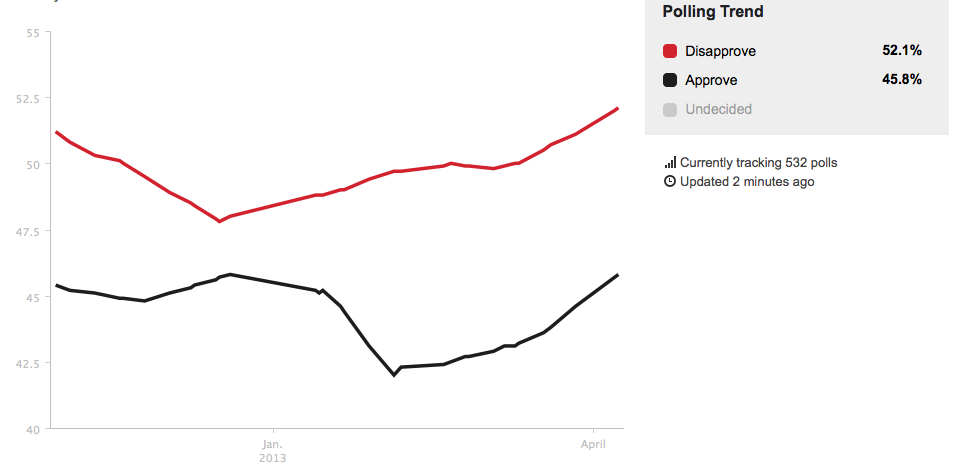
But I think the president has realized his sagging poll numbers on the economy (see above) are directly related to his seeming inability to get even the slightest fiscal compromise in the face of unsustainable long-term debt. He’s the president, after all. In the end, he was elected to get some kind of bargain done, before the debt compounds even further. He’s now taken a clear enough step that even Bill O’Reilly may have to concede that he is serious about entitlement reform – if only to make discretionary spending in any way feasible in the near future.

What Obama needs to do soon is go everywhere and explain his compromise and demand some give in return. Perhaps if gun regulation and immigration reform really do gain traction, some kind of momentum for a deal could emerge. It is entirely to Obama’s advantage if that happens. The Democrats? They’re too smug right now. Obama’s concessionary move is in actuality a shrewd one. Inertia isn’t – if the Dems want to appeal to the center of the country on the economy and its future.

The Other Other White Meat, Ctd

53776601_723864b67c_b

A reader writes:

Your reader’s story about Peru reminded me of my ex-girlfriend.  She was a doctor and spent quite a bit of time volunteering for a poor village in the Andes.  She said that nearly everyone raised guinea pigs at home and they were considered a good dish to serve a special guest.  As a visiting doctor from America providing free medical care, everyone considered her a special guest. Nearly every night some family would invite her over for dinner and they’d all insist on serving her guinea pig.  By the end of her stay, she would spend the better part of each evening begging her host for the night to please serve anything other than guinea pig.  She was a well-traveled woman, not a picky eater in the slightest, but apparently that was one taste she was never able to acquire.  Granted, I was never able to discern if this was due to the taste itself or the notion of eating a common childhood pet.

Another quotes Michael Todd:

[G]uinea pig is good for you, with more protein and less fat than flesh from pigs, cows, sheep, or chickens. Guinea pig is also good for Mother Earth—you don’t need a Ponderosa-sized spread to raise them, and they convert their feed into edible protein twice as efficiently as a cow.

That could be in large part because any animal that is raised for food is raised today in a way that makes it bad for you, and guinea pigs aren’t currently raised for food. If they were raised for food, they would be raised in vast numbers in horrid factory farms.

They would be bred to gain tons of weight and get very fat very fast. They would be virtually immobilized in intense confinement for their entire lives and fed a diet that is not natural for them (all corn and/or soy, including pesticides). They would live in their own waste and every breath would be filled with the ammonia that the waste emits, burning their lungs and eyes as it enters their bodies.

Their food would contain antibiotics. They would likely be given growth hormones. Their flesh would cease even to resemble the flesh of their non-factory-farmed ancestors – just like meat today has very little in common with the meat that used to exist in the wild, and is far less healthful to consume than the meat that used to exist in the wild. Oh, and just like the eggs, meat, and dairy from factory farms today, it would have deceptive “humane myth” labeling such as “Cage-Free”; “Free-Range”; “All Natural”; “Humane Certified” and other such non-defined marketing terms.

Guinea pig flesh would no longer have “more protein and less fat than flesh from pigs, cows, sheep, or chickens.” It would have a far higher fat content than it does today. Further, “twice as efficiently as a cow” is still horribly inefficient compared to plant-based foods. And to the extent their flesh replaced the flesh of larger animals, there would be more suffering in the world because it would take more individuals to produce the same quantity of flesh as larger animals. Everything that industrial agriculture touches gets destroyed.

Another reader:

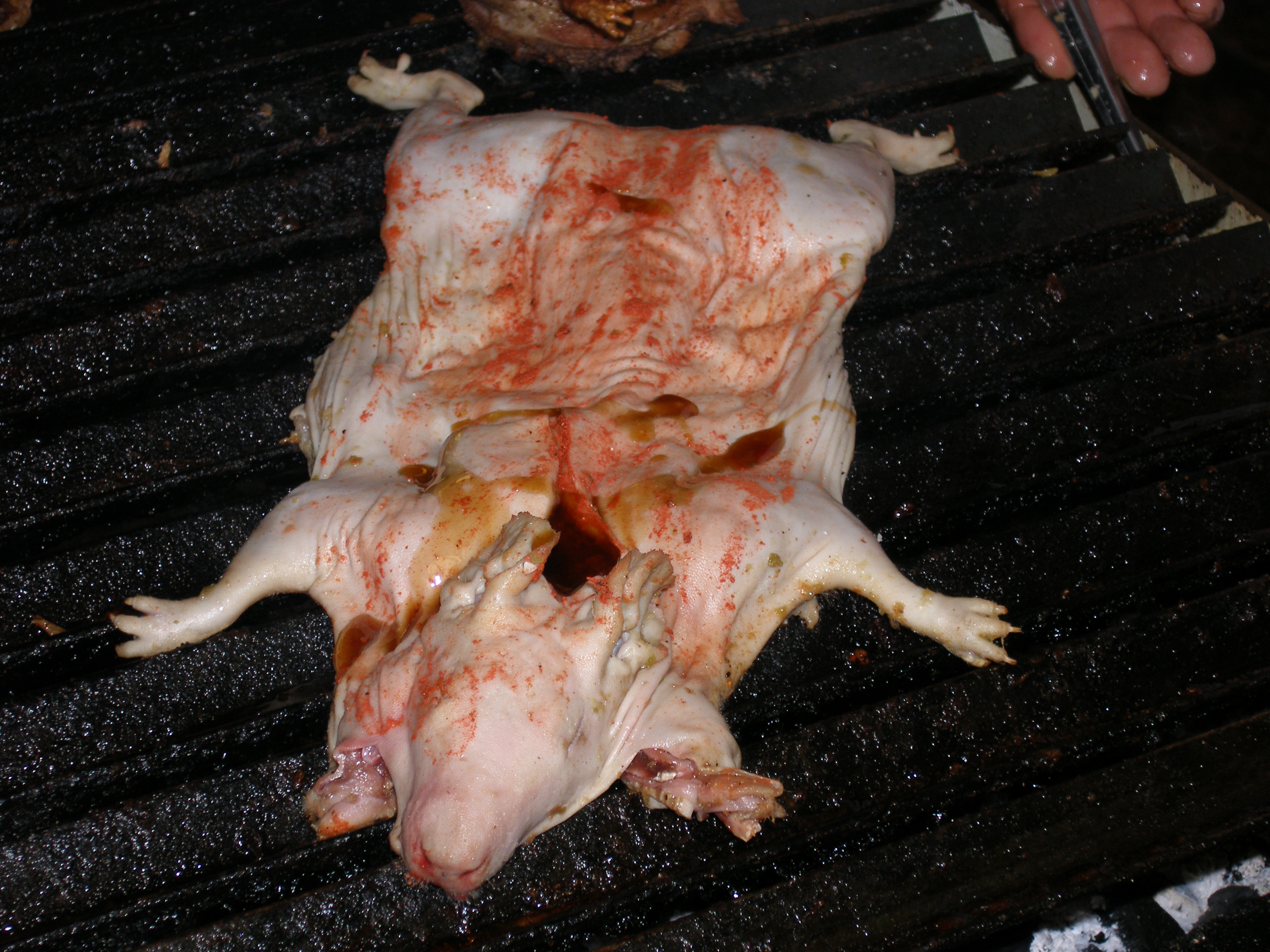
OLYMPUS DIGITAL CAMERAI couldn’t resist sending in the attached photo of a guinea pig roasting on the grill, taken in Otavalo, Ecuador back in 2006.  I tasted some of the finished product, and it wasn’t terrible, more or less like somewhat greasy quail.  We subsequently visited the home of an indigenous family, who had dozens of them running around the dirt floor of the house.  The grandmother would toss them some grain to keep them fed, and I guess would just grab one or more of them up when it was time to make dinner.  As far as I could tell, guinea pigs are very much a rural/Indian thing in Ecuador, as I did not see any on the menu when I was in the capital, Quito.

Aside from the cuteness issue, I can’t really see guinea pig taking off as a food item in lieu of poultry or other meats.  There’s not very much meat on those bones.

Another:

Anecdotal evidence from friends who have visited Peru: if you order guinea pig in a restaurant, be sure to ask that it be served with the head attached, so you can be sure you’re getting guinea pig and not rat.

Another:

I had an odd feeling that I had read about eating guinea pig on your blog previously, and thanks to your highly functional and awesome new search bar, I confirmed my suspicion: “Eating The Family Pet“. Okay, I’m not sure how likely it really is that I remembered this small item from five years ago. I probably read about it somewhere else and this is a coincidence. Still, the new search is awesome!

One more:

At the Cathedral in Cuzco, Peru, there is a wonderful Last Supper with guinea pig as the main course:

181DCFD6-1E02-4FE1-BA2A-3E5C46DEFAE8

(Top photo of “home grown” guinea pigs in Peru by Sam Judson)