Rise and shine with the Norwegian band Real Ones:
Real Ones – Separation Blues from André Chocron // Frokost Film on Vimeo.
Rise and shine with the Norwegian band Real Ones:
Real Ones – Separation Blues from André Chocron // Frokost Film on Vimeo.
New e-textbooks are making it harder for students to skip or skim reading assignments:
A startup named CourseSmart now offers an education package to schools that allows professors to, among other things, monitor what their students read in course textbooks as well as passages they highlight. … [P]rofessors attribute students’ low grades to the CourseSmart-provided proof that the student never, or rarely, opened their books. The engagement index shows not only what, but when, students are reading, so if they opt not to peruse the textbook until the day or night before a test, the professor will know.
Pierre Tristam worries about this “policing by data”:
Reading is one of the few truly private activities left us, depending entirely on the isolation created between book and reader, and the way the reader chooses to engage with that book: reading a page over five times, skipping five pages, underlining five lines, cursing at five others. … How you read a textbook is irrelevant. If you’re performing well in class, that’s all that should matter.
Update from a reader:
Speaking as a professor, I imagine you’d have to be pretty bad at your job to use that data to evaluate students. What I mean by that is that a professor has a lot of responsibilities besides teaching, and every minute spent grading is a minute not spent on something else that’s at least equally important. Why waste time looking at data that can only possibly give you a rough assessment of students, when you have other data (homework, exam, participation) that give you a much more direct assessment? I’d only do that if I didn’t have any other responsibilities – but I’d only not have those other responsibilities if I wasn’t a very good professor in the first place.
A big friggin’ laser:
Ackerman throws cold water:
The Navy won’t say just how many kilowatts of energy the LaWS’ beam is, but it’s probably under the 100 kilowatts generally considered militarily mature. The fact that LaWS can kill a surveillance drone and a fast-attack boat has more to do with the vulnerabilities of those systems than it its own prowess. It cannot stop an anti-ship missile, and its beam, about the circumference of a dime, will do little more than singe a fighter jet. And there remain significant challenges with cooling a shipboard high-energy laser, a necessary safety feature.
But [Adm. Jonathan] Greenert, [Rear Adm. Thomas] Eccles, and [Rear Adm. Matthew] Klunder are confident that the next wave of Navy lasers will be more powerful.
One advantage of the new weapon is that it’s cheap to fire:
Since it runs on electricity, it can fire as long as there is power at a cost of less than $1 dollar per shot.
John McWhorter doubts that replacing the term “illegal immigrant” with “undocumented immigrant” will “improve the public opinion of the people in question”:
The problem is that language dances much more lightly on thought than we often suppose, and in a battle between thought and language, thought has a way of winning out. Words’ meanings, even when crafted to bend away from opinion, drift back to where we didn’t want them to be, like a fly keeps landing on you after you swat it away. This has happened to previous attempts to expunge a term of its negative meaning.
Consider affirmative action, now so conventional we rarely stop to parse what the actual words comprising it mean. “Affirming” what? What kind of “action”? The term was a magnificently artful and gracious construction of the 1960s, giving a constructive, positive air to an always controversial policy.
McWhorter makes related points elsewhere:
Decrying the designation of the people as illegal is like trying to put out a housefire with an eyedropper: language’s record on seriously transforming thought is scanty indeed. Many will recall UC Berkeley’s George Lakoff suggesting back in the Bush era that we call taxes “membership fees.” Clever—but how many think the current impasse between Democrats and Republicans over tax hikes would be any less intransigent today if the President were engaging John Boehner in a debate over membership fees?
Ashley Fetters points out that the real-life history of Madison Avenue doesn’t bode well for Sterling Cooper Draper Pryce if the show heads into the ’70s:
In real life, the relationship between the public and the advertising industry hit the skids in the 1970s. Public opinion turned negative toward consumer marketing, and a widespread crackdown on false and misleading ads ensued. …
[I]n 1969, Ralph Nader published his controversial Nader Report on the Federal Trade Commission, a project in which Nader and seven law-student volunteers exposed the general laziness of the FTC in protecting consumers from false advertisements and fraud. Their report condemned suggestive ads, deceptive or false claims in TV commercials and print ads, and the diversion of attention away from unappealing information (such as the unpleasant side effects of a drug, or the health risks of cigarettes). In order to ensure that consumer deception was exposed, disciplined, and fixed, Nader and his team of “Nader’s Raiders” called for “alert and extensive monitoring operations with pre-screening by expert engineers, doctors, and professionals.”
Waldman asks:
What is it about lists that we find so irresistible? As far as I can tell, no one has tried to figure it out (though it’s possible there are psychologists who have solved the mystery, and I just haven’t seen their work). Maybe it has to do with the promise of something both finite and complete, distilling the world down to something you can manage and then be done with. The world is full of photos of cute corgis, but these 37 are the cutest, and once you’ve seen them not only will your day be a little sweeter but you need search no more for cute corgi photos. It could also be the attraction of something easy to read—because it’s broken into small pieces, you know it won’t require too much work to read, you’ll be able to skim it easily, and if you want to read part of it and then stop, you’ll be able to.
Lawrence Rifkin questions whether “making babies is the meaning of life”:
Do we laud the parents of extremely large Mormon, Hasid, Catholic, and Muslim families as public exemplars of a meaningful life? Do we honor the most popular sperm donor as humankind’s greatest philanthropist? Even if our genes get perpetuated, our genes are not us. After a few generations of genetic mixing and shuffling, there’s unlikely to be anything unique or identifying about us in our offspring. If your great-great-grandchild has your brown eyes and your blood type, but no other personality or physical traits uniquely identifiable to you, how much of “you” has really lived on? Further, if the idea is to perpetuate our genetic lineage, what if we have children, but no grandchildren?
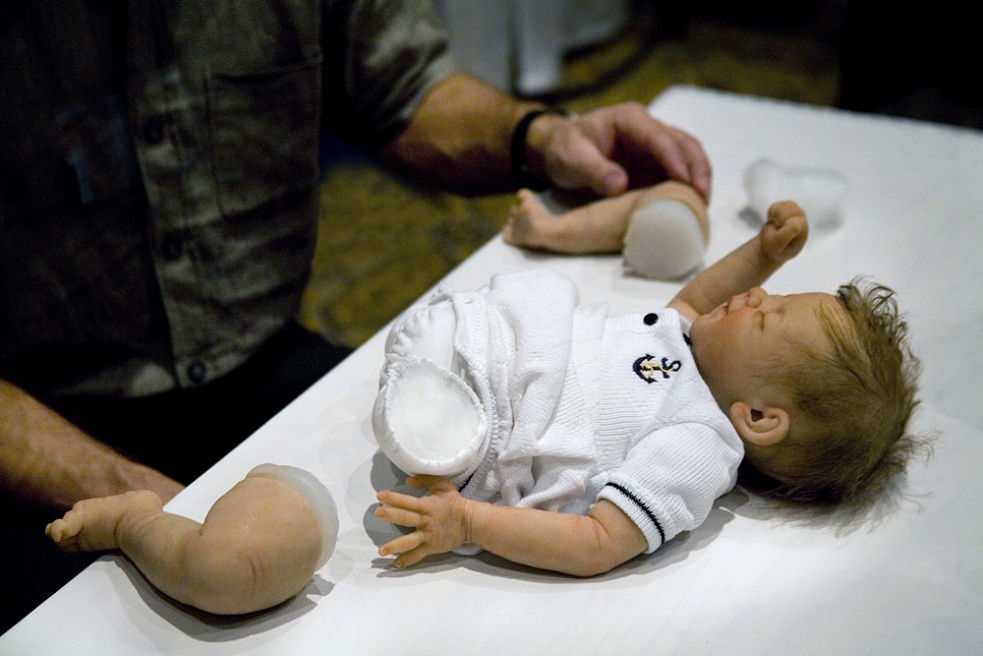
The above photo comes from photographer Rebecca Martinez. A few months ago, James Estrin interviewed Martinez about her submersion into the Reborn subculture, “a growing group, almost exclusively women, who collect shockingly lifelike handmade dolls of newborn babies.”
News Corp COO Chase Carey has threatened to convert Fox to a cable-only channel if they lose their case against online streaming service Aereo, which allows users to stream antenna TV for $8 a month. Rebecca Greenfield analyzes the situation:
While News Corp.’s threat to stop broadcasting is more likely big talk than an actual game plan, Wall Street likes that idea. News Corp.’s announcement sent its stock soaring, even though it would have to wait until after its current NFL deals, which run for another seven years, expire.
But look around and content owners have already started pulling their best, most valuable stuff from the public waves. Sports, for example, have started moving to pay TV. Most regular season baseball, basketball, and hockey games now run on regional sports cable stations. While the really big sport events are still broadcast, that’s showing signs of slipping, too. Starting in 2014 the Final Four of the NCAA Tournament will be on TBS. That would follow Monday Night Football, the staple of ABC for decades, that moved to ESPN, and even the Olympics, which, aside from the primetime packages, was shown live (whether on cable stations or streamed online) only to people who pay for their TV.
Last week we ran an Urtak poll of Dish readers regarding the thread and the questions it raises. Below are the results from the roughly 1,000 readers who responded (blue means yes, orange means no):


But that support dropped a little when it came to graphic images of kids:

And although readers overwhelmingly support the idea of posting graphic images, they seemed to be sensitive to the impact those images have on the small minority of readers who oppose it:

Understandably the aversion to seeing graphic images of kids was higher among readers who have children (22% aversion) compared to those who do not (14% aversion). Review all of the poll results here. Another reader continues the thread:
I am a little surprised that most of your readers either object or insist on war photography by listing similar reasons – confronting the reality of a war that we take part in but don’t generally have to look at. It’s surprising to me that no one is really questioning the idea that the photography is in some way allowing us to access this reality. It’s not. It’s a picture. One of the common complaints in theories about photography is that looking at these images actually desensitize the viewer by making them complicit with the act of photography, which is by its nature an act of non-intervention.
It makes the documenting of the event seem to be more important in some contexts than the event itself. Think of photographs of starving children, where the photographer presumably could feed the child but takes a picture instead, arguing that if the world sees the starving child that more children could be saved than the one day of extra life this photographer could provide by feeding. But it also turns the act of witnessing the photography into a feeling that you have done something important by confronting something horrible – when in fact the viewer hasn’t done anything at all, hasn’t even confronted something horrible, has just looked at a picture.
And then there is the argument that says basically the shock of seeing carnage like this wears off, and any sadness or horror the viewer feels on being confronted with the image takes the place of any action or more critical thought that might be engendered by another way of presenting the facts of war. I can’t for the life of me remember where I read it, but I think it’s true that the magazines that first published starving children photos in the ’80s sparked a lot of donations – but not really many after that. The photograph insists on the grinding reality of what it portrays, which suggests that these horrors always exist in the world with or without our participation while also only asking of its viewers that they look at them. All you have to do is view them and you have done your part about recognizing the horrors of war. Now, pat yourself on the back and be sure you look at tomorrow’s pictures from some other bloody conflict.
I don’t really have an opinion about whether or not you post pictures. They make me sad but they don’t give me nightmares. And reading about the conflicts also make me sad. But this isn’t a simple question of whether or not your readers have a moral obligation to see this stuff. It’s a lot more complicated than that, and being aware of those complications can help your viewers steer clear of those traps.
Kanan Makiya claims that the Iraq War sparked the Arab Spring. Peter Maass counters:
Where’s the proof? The best Makiya can do is note that a number of years after the invasion, uprisings occurred elsewhere. The logical imperfection is audacious. He does not quote any leader of those uprisings as making a connection with Iraq—perhaps because they don’t. Wael Ghonim, one of the online leaders of the Egyptian uprising, has noted, “The war in Iraq killed so many innocent people, and it’s not something that any civilized nation should be proud of.” Makiya cannot drum up support from even Fouad Ajami, another backer of the invasion. “Having supported the Iraq war, I would love to make this connection,” he wrote last year. “But Iraq, contrary to the hopes and assertions of conservative proponents of the war, is not relevant to the Arab Spring.”
 The Dish