Not the Dish but the New York Times Book review, according to Michael Wolff. He’s predicting its post-Tanenhaus demise.
Month: April 2013
Ask Dreher Anything: Cancer As A Part Of God’s Plan
Rod explains how he reconciles his faith with the illness that took his sister’s life:
Be sure to check out his new book, The Little Way of Ruthie Leming: A Southern Girl, a Small Town, and the Secret of a Good Life:
[The book follows Rod] back to his hometown of St. Francisville, Louisiana (pop. 1,700) in the wake of his younger sister Ruthie’s death. When she was diagnosed at age 40 with a virulent form of cancer in 2010, Dreher was moved by the way the community he had left behind rallied around his dying sister, a schoolteacher. He was also struck by the grace and courage with which his sister dealt with the disease that eventually took her life. In Louisiana for Ruthie’s funeral in the fall of 2011, Dreher began to wonder whether the ordinary life Ruthie led in their country town was in fact a path of hidden grandeur, even spiritual greatness, concealed within the modest life of a mother and teacher. In order to explore this revelation, Dreher and his wife decided to leave Philadelphia, move home to help with family responsibilities and have their three children grow up amidst the rituals that had defined his family for five generations – Mardi Gras, L.S.U. football games, and deer hunting.
Ron Paul And Lew Rockwell
The love affair gets re-booted. Ugh.
The Resilient American Upper Class
They get their success the old fashioned way:
Tufts economist Linda Loury suggests that half of all jobs in the U.S. are found through family, friends, or acquaintances.
Canadian economists Miles Corak and Patrizio Piraino look at how often men end up working at the same company where their father worked, finding that as many as 40 percent have done that at some point. The proportion rises to 70 percent among the top 1 percent in income distribution. This helps to explain why the relationship between the earnings of parent and child is even higher at the top end than it is across the population at large, according to Corak. One-third of successions between chief executive officers in publicly listed companies in the U.S. involves an incoming CEO related by blood or marriage to the old CEO, the founder, or a large shareholder. That’s bad news for the share price, according to Francisco Perez-Gonzalez of the NBER, but clearly good news for the newly appointed relative.
Misha Not So Mucha
The ginger Svengali alleged to be the mastermind of Tamerlan Tsarnaev’s conversion to Internet Islam … seems pretty harmless in this NYRB report. But read the comments as well as the short piece. Update from a reader:
It’s funny that you should note the comments on the NYRB article – Catherine Fitzpatrick is a well known “eccentric” in the Russia-watching circles. (And by eccentric I mean nutty and conspiratorial.)
Another:
Long-time reader, early subscriber here. I write to register how offended I was that you would highlight on your blog an ad hominem attack on Catherine Fitzpatrick. (Full disclosure: I knew her in NY in the ’70s and ’80s, but have not been in touch since.) She’s a long-time human rights activist on Russian and Eastern European fronts. In her work with Aryeh Neier at Helsinki Watch in the 1980s she defended, sometimes with distinct personal bravery, more dissidents than you and I ever will. She is a very well-known scholar of Soviet/Russian affairs, and her Russian fluency is so superb that she was a translator of many major books in the 1990s (including Yeltsin’s autobiography). She was an “early adopter” of all things Internet. (Her association with Second Life led, by my reading, to the controversy that led your reader to call her “nutty.”) In short, political perspectives aside, she and you (and I) have a lot in common.
Yglesias Award Nominee
“Sarah Palin is an example of what can happen when a person is consumed by bitterness and grievances. It has a corrosive effect, and over the last several years she has, if anything, become even more brittle and embittered. From a human standpoint it’s a shame. And from a political standpoint it’s precisely the countenance and bearing conservatism and the GOP need to avoid,” – Pete Wehner on Palin’s latest phony outrage at the White House Correspondents’ Dinner, something she eagerly attended not so long ago (because there was a terrifying moment when I nearly ran into her).
No, I didn’t go this year. No media entity wanted me to; and the Dish has no White House correspondent, unless you call me one, and we’d rather spend our money on, well, journalism.
Ending The Gay Ban One Troop At A Time
The Boy Scouts of America recently announced that it plans to end its ban on gay Scouts but keep the ban on gay troop leaders. EJ Graff suggests an alternative:
Instead of accepting the gay-okay-till-21 recommendation, here’s my hope: that the Scout assembly at large will instead find a way to move forward on the earlier trial-balloon policy. A few months back, the Scouts let out the suggestion that perhaps each troop could decide its policy on gay members and leaders for itself. That was, I thought, a brilliant compromise, a kind of federalism that would allow each troop to remain in sync with its community’s attitudes.
Such a policy would make it possible for individuals locally to lobby and educate their neighbors and friends. Mormon-sponsored troops could live by their own strictures, while the Unitarians or some other group could independently sponsor a gay-welcoming troop across town. That policy would allow the Scouts’ ban to fade slowly, along with antigay attitudes, until they were ready to flush it away as an embarrassment. In the meantime, yes, individual gay kids would be marooned in hostile troops as they realize that they might be, you know, like that—but no matter the policy, you know that those troops (and the families that are putting their kids in them) are not yet going to be welcoming, no matter what the Scouts’ official policy might be.
Meditation As Self-Defense
Sam Harris, a practitioner of meditation and Brazilian jiu-jitsu, connects the two:
Almost all our suffering is the product of our thoughts. We spend nearly every moment of our lives lost in thought, and hostage to the character of those thoughts. You can break this spell, but it takes training just like it takes training to defend yourself against a physical assault. You are thinking every moment and not aware of it, and the initial experience of anyone who seriously tries to meditate is one of discovering how incessant this cascade of thoughts is.
Graeme Wood sparred with Sam:
Harris likened training with an expert fighter to “falling into deep water without knowing how to swim.” He sees BJJ as a cycle of mock death and resurrection, wherein an expert may kill you many times per session. “To train in BJJ is to continually drown—or, rather, to be drowned, in sudden and ingenious ways—and to be taught, again and again, how to swim.”
Having read all this, I asked Harris to drown me.
I am several inches taller and several pounds stockier than Harris, who is 5 foot 9 and weighs 165 pounds, and I am undefeated in single combat—though only because I have never been in a fight and flee anytime I see anyone who looks even vaguely threatening. …
I soon found myself in what BJJ practitioners call a “rear naked choke,” which, while less alarming than it sounds, is lethal if applied unmercifully. At one point, I resisted by pushing my jaw between Harris’s elbow and my throat. That didn’t help. “He can choke your whole jaw into your throat,” [instructor Ryron Gracie] said. “It affects the carotid—through the jaw!” He said this with an air of Isn’t that cool? Later, once Harris had let me go, I had to agree: Yes, very cool.
A Lifetime Of Status Updates
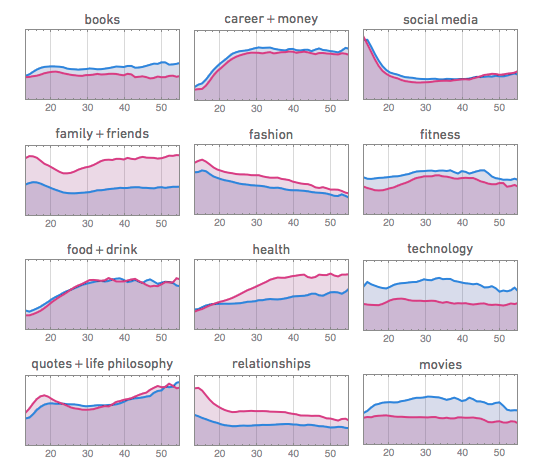
Stephen Wolfram extensively unpacks data from the Wolfram|Alpha Personal Analytics for Facebook, with more than a million submissions. The above charts visualize the popularity of subjects on Facebook, by age and sex:
It’s almost shocking how much this tells us about the evolution of people’s typical interests.
People talk less about video games as they get older, and more about politics and the weather. Men typically talk more about sports and technology than women—and, somewhat surprisingly to me, they also talk more about movies, television and music. Women talk more about pets+animals, family+friends, relationships—and, at least after they reach child-bearing years, health. The peak time for anyone to talk about school+university is (not surprisingly) around age 20. People get less interested in talking about “special occasions” (mostly birthdays) through their teens, but gradually gain interest later. And people get progressively more interested in talking about career+money in their 20s. And so on. And so on.
Some of this is rather depressingly stereotypical. And most of it isn’t terribly surprising to anyone who’s known a reasonable diversity of people of different ages. But what to me is remarkable is how we can see everything laid out in such quantitative detail in the pictures above—kind of a signature of people’s thinking as they go through life.
Optimum Diversity
A recent study found that societies “flourish when their populations have just enough genetic diversity, but not too much”:
Of the 145 nations considered in the 2000 comparison, Bolivia, one of the world’s poorer countries, was the most genetically homogenous. The authors calculated that if Bolivia’s level of genetic diversity were just one percentage point higher, its current per capita income would be 41 percent greater.
Ethiopia, where the first modern humans emerged 150,000 years ago, lies at the other end of the spectrum. There, extreme genetic diversity has led to crippling poverty. A drop in heterozygosity of just one percentage point would result in a 21 percent bump in contemporary income per capita, the authors found. … The nation that came closest to the ideal level of post-industrial genetic diversity? According to Ashraf and Galor’s calculations, it was the United States.
 The Dish