A Route Through The Gridlock?

Ambinder finds “reasons to think that the partisan gridlock that paralyzed Congress for the past several years is beginning to ease”:

The prospects for passing a major overhaul of immigration laws remains high. The media fetishizes the role of Florida Sen. Marco Rubio, positing that somehow, if Rubio bolts or begs off from the task, immigration reform is dead. I think pundits are confusing Republicans rallying around Rubio as a personality who will be a viable presidential candidate with the much different optics and effects of passing an immigration bill. On the news, you might hear something like: “Marco Rubio was seen frowning today, and so immigration reform looks dead.” The next day, Republican and Democratic senators unveil part of their immigration reform bill.

The Other Other White Meat

Cuy Dinner

Guinea pig?

Most recent scientific work looking at guinea pigs and diet mostly concerns what the animals eat (as a proxy for humans), and not having them eaten (by those same humans), but research from the 1980s finds guinea pig is good for you, with more protein and less fat than flesh from pigs, cows, sheep, or chickens. Guinea pig is also good for Mother Earth—you don’t need a Ponderosa-sized spread to raise them, and they convert their feed into edible protein twice as efficiently as a cow.

Update from a reader with insights as to why the meal isn’t more popular in American restaurants:

My father is from Peru and I’ve eaten home-cooked guinea pig while up in the Andes visiting family. Unlike what you can get away with when serving chicken, guinea pig – to taste at the very least “good” – must be cooked to order. This fact would disqualify most restaurants from serving it, I assume. It’s often pan fried whole in a chili paste/sauce in a wok-like vessel and because there is no thick portion of meat. And I would not want to eat a whole guinea pig that had been sitting under a heat lamp for three hours. It’s different with a fried chicken leg or breast, right? This is probably why (at least as of 10 years ago when I last visited) most all restaurants in Peru won’t serve it on menu.

(Image by Flickr user Erin & Camera)

The Trade Deficit Isn’t Dangerous?

Millman ponders a 2005 paper (pdf) downplaying America’s trade deficit:

We know how much we pay to service our debt (public and private) owned by foreign entities, and we know how much we receive on the assets we’ve accumulated abroad. And it turns out that the net income number is positive, relatively stable, and has been rising over a long period of time. What the paper concludes from this information is that the real value of America’s investments abroad has risen faster than our liabilities have accumulated, and that the apparently massive accumulated trade deficit is just an accounting fiction. It’s not that we mortgaged Alaska to buy a Lexus or a Mercedes. It’s that we mortgaged Alaska to buy Eurodisney, with a little money left over to buy a Lexus or a Mercedes; and Eurodisney has proved so profitable that if we sold it we could easily pay off the Alaskan mortgage.

The Bitcoin Bubble? Ctd

A cool primer for those unfamiliar with the futuristic currency:

A reader responds to our previous post:

It seems the main way Bitcoins are used is for the Dark Web, that part of the Web that is unregulated and used by many folks to get unregulated materials. You can buy nearly anything there, from drugs to chemicals or other materials that you can use for good or nefarious ends. Bitcoins are used because they are a legitimate means of commerce that is not easily traced. And pegging the coins to the gold standard is one of the reasons for that. You can store your coins with a bank in Switzerland as an actual lump of gold and get that gold sent to you when you want to cash out. So, in a sense, it’s not like other currency.

I confess to being really curious about this other world of gold and less than legitimate commerce. My fantasies have turned it into something out of a Philip K. Dick novel. You can access this world safely and away from prying eyes – if you have the knowledge about how to do so. But I’m not going to dip my toe in.

The NRA’s Unlikely Role Model, Ctd

A reader writes:

The idea of arms being limited to “well-regulated militias” in the Constitution, as your reader claims his father taught him, shows a complete lack of understanding of both the document and the history of its writing. The (presumably sarcastic) remark that the Court has “let any unstable jerk be a militia, and let him regulate himself” is actually the entire point of the Second Amendment. The right to bear arms was an essential right in 1787 because of the risk of Indian incursion, not as a bulwark against tyranny or a defense against foreign invasion. The concept of a “well-regulated militia” as it concerned pre-Revolutionary America actually would often have been little more than a posse of all available homesteaders organized to defend the area or march on a nearby settlement.

In this context, each individual actually does represent his own militia, because he may be the only one available to defend an isolated farm. The idea that the Founders intended weapons to be limited exclusively to organized military formations is preposterous; with few exceptions, such formal organizations did not exist. In many frontier regions, there would have been no defense available to settlers if the Amendment was read as many now propose.

This absolutely does not mean that gun control is unconstitutional, however. The inclusion of the phrase “well-regulated militias” in the Amendment was not an accident, even if it is frequently misread today.

The Founders intended weapons to be readily available to the extent that Americans would be ABLE to form a “well-regulated militia” to defend against incursion. This is the appropriate reading of the Amendment. Gun control should therefore be based, as it was in 1934 and 1994, on a determination of what constitutes a necessary weapon to enable the formation of a militia. I personally think that hunting rifles and pistols probably constitute an adequate complement of weaponry for a militia (in a country with a standing army), but others may disagree. Tragedies like Newtown should be occasions to reevaluate our definitions.

Instead people on the right defend the right to bear all weapons as a defense against Obamacare or something while people on the left, like your reader, dismiss the right to bear arms entirely on the grounds that militias don’t exist anymore.

Is the Second Amendment outdated? Probably, but I don’t see a sizable movement to repeal it anywhere. Instead of talking past each other we should be debating which types of weapons are defensive and which are not. This is what Obama has tried to do in the past few months, to his credit.

Another reader:

You published correspondence from a reader who wrote: “Well, the NRA finally found a Court that was willing to ignore the word ”militia” and the concept of “well-regulated” – overturning 230 years of jurisprudence. ” This statement is way off-base.  The NRA was not behind either of the cases that went to the Supreme Court resulting in the finding that the Second Amendment protects an individual right.

In fact, the NRA tried every imaginable approach to keep the case that eventually became Heller from going forward.  They filed a copycat suit with other plaintiffs and named additional defendants who brought much more power and influence to the opposing side.  They tried to have their suit consolidated with the original suit, with their attorney named as counsel.  They also tried to get their allies in Congress to enact legislation that would moot the case.  Only after those bringing the suit had prevailed at the appellate level (four years after the original filing) did they finally simply stay quiet while the rest of the litigation proceeded. Similarly, they did not finance or back the McDonald case that incorporated the right established in Heller to state law.

When the Heller case was decided, it brought the Supreme Court’s jurisprudence into line with the consensus of the majority of Constitutional Law scholars, including liberal Constitutional Law scholars.  Your correspondent should read the amicus brief filed by Jack Balkin of Yale Law and others – whom no one could possibly describe as anything other than liberal – in the McDonald case.

The Daily Wrap

Today on the Dish, Andrew responded onscreen to critics of Thatcher, and revealed how foreign the Baroness would have been to the Republican program, from climate change to AIDS. Andrew also implored us not to wait for politicians to spearhead social change, pointed out one such case (of gay rights in Uganda), and considered the Obama administration’s role in the change sweeping America. Elsewhere, Andrew continued to express hope for Pope Francis, gave an interview with Vanity Fair, and daydreamed of a future career as a canna-critic.

In political coverage, we tried to measure what racial animus cost Obama in both elections, located the GOP in the 12-step plan, and explored some new ideas of class in Britain. We discovered most scandals don’t torpedo careers and reassessed animal rights’ victory on horse slaughter as Francesca Mari peeked between the grand moments and figures in history. Reading up on WWII, TNC pushed back on lofty assurances against barbarism, as we granted certain elements of the nanny state a second look.

In miscellanea, Laura Bennet and Willa Paskin panned Vice’s new HBO show, Tom Shone triangulated the elements of good cinema, and we counted music sharing as just one new struggle over intellectual property. We uncovered the history of the suicidal dogs of war and considered whether loneliness is a killer while the world markets craved red hot chili peppers. We came across a Fargo-style self-kidnapping service, looked beyond calories for healthy eating, and studied elite chic.

Later we read David Foster Wallace on Fyodor Dostoevsky, spotted the difference between hardcovers and their paperbacks, and wondered if the art gallery is becoming history. Things got beardy in the MHB, we met the gaze of an anti-Maggie Briton celebrating Thatcher’s death for the Face of the Day, spotted a shadowy VFYW in the East Village, and tracked down Rohrmoos-Untertal, Austria in the results of the latest VFYW contest.

–B.J.

Obama’s Cultural Transformation Of America

Marijuana Crime

[Re-posted from earlier today]

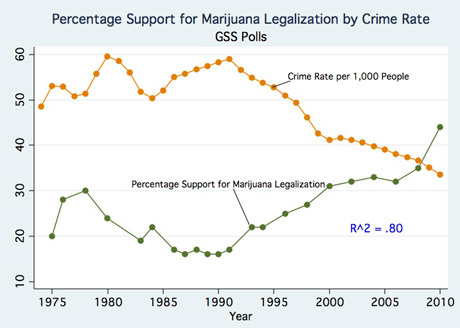
Support for marijuana legalization increases as crime goes down:

Eighty percent of the differences in support for marijuana legalization nationwide since 1975 is explained by the change in the overall crime rate through 2010 (the last year in which we have the crime rate and GSS data). Crime rates are currently at very low levels nationwide, which could explain why we saw the demonstrated upswing of marijuana legalization in all polling during the first decade of this century. If we were to see an increase in the crime rate in the future, there’s a pretty decent chance we’d see a decrease in support for marijuana.

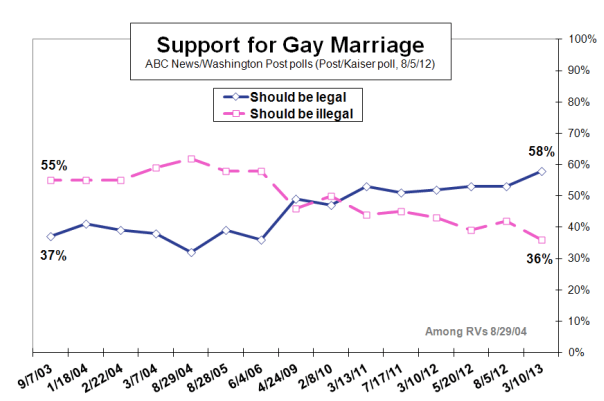
Maybe so. But I’m still impressed by that sharp sudden uptick in the last few years. It looks a lot like the marriage equality graphs:
Screen shot 2013-04-09 at 1.21.32 PM

More and more, as the Obama re-election moves into the rear-view mirror, I think we are wrong to see the current fiscal stalemate or economic situation as the most dispositive aspects of Obama’s presidency.

I think what he may well be remembered for will not be his careful stewardship of a very sick economy back from intensive care. Given the nature of the economic collapse, he was never going to get a Reagan recovery anyway. All he needed was a recovery strong enough to get re-elected, and a winning coalition that remade America as a cultural entity. And that’s what we are now seeing. The 2012 election was a watershed for cultural change – and I suspect the sudden jump in support for marriage equality and marijuana legalization reflects a bandwagon effect in the wake of Obama’s overwhelming cultural victory.

Obama has presided over the moment when white America came to accept that it no longer has the demographic clout to ignore non-white America – a huge symbolic step in national self-understanding, literally epitomized by a multi-racial, multi-cultural president. It looks likely that his presidency will be the most significant one for gay rights in American history. He has established the principle of universal healthcare in America – another huge shift in the cultural identity of the country. He has harnessed the political power of American women to decimate the GOP’s coalition. If he presides over immigration reform, we will be a different country culturally than we were only a decade ago. And he will have ended – perhaps permanently – the entire idea of militarily occupying foreign countries to advance our geo-political goals, and, if the sequester continues, will have cut defense in ways even Clinton couldn’t dare to.

This is a cultural revolution. He did not create it. He organized it. And epitomized it. We are now looking very closely at various political, tactical moments – the budget, entitlement reform, taxes – exacerbated by the new instant and universal media. What we are missing is the strategic cultural revolution that has been occurring all the time, and that he has very carefully guided.

And he is quite happy for us to miss it. Because that stirs up less resistance. But the change goes on …

Quote For The Day

“I think of myself as being particularly baffled on the one hand, by the whole question of God and the relation of This picture taken 21 March 2007 shows ahumans to God, but also, possibly because of lots of empty spaces in my life, open to exploring what that might mean. I have open spaces where I put that question and just see what happens.

Going to church is one such space, though I don’t go with any expectation of fulfillment or illumination. I just go because I have gone, and my mother went and her mother went and there’s something there that happens to all of us. A kind of thinking takes place there that doesn’t take place anywhere else. No matter how unattractive the service—and nowadays the mass is rather unattractive in its modern translation—no matter how brainless the sermon, there is a space in which nothing else is happening so that thinking about God or about the question of God can happen. So I go there and let it happen.

Nothing changes, I don’t become wise about this, I don’t become ethically better or more interesting. I’m just the same person, I’m that person with this space open and I do think that for me, in this life, that’s as far as I’m going to get with spirituality,” – Anne Carson.

(Photo: This picture taken 21 March 2007 shows a a grey-beam coming through a stained-glass window, on every spring and autumn equinoxes, at the Strasbourg cathedral, eastern France. By Frederic Florin/AFP/Getty Images.)

The History Of The Everyday

Francesca Mari zooms in on it:

Microhistory arose largely in Europe and the United States in the 1970s and 1980s in reaction not only to the top-down historical narratives common to political history but also to the increasingly quantitative ones of social history. Microhistorians argued that the generalizations of capital “H” Great Man History distorted the truth of how most individuals actually lower-case lived and therefore advocated telling the stories of what one practitioner called “the normal exception”: the interesting small player who could stand in for the average person and, as a result, offer a unique angle overlooked by elite texts and master narratives. Although at first a European phenomenon—perhaps best exemplified by Carlo Ginzburg’s 1976 The Cheese and the Worms: The Cosmos of a Sixteenth-Century Miller—microhistory also found its advocates on this side of the Atlantic: Robert Darnton’s The Great Cat Massacre and Other Episodes in French Cultural History, for example, and Laurel Ulrich’s Pulitzer Prize–winning A Midwife’s Tale: The Life of Martha Ballard, Based on Her Diary, 1785–1812.

Mari focuses on the work of Jill Lepore:

Although one of her essays shows how a biography won Andrew Jackson the presidency and set a presidential precedent, another shows how Thomas Paine, who motivated the American Revolution with his pamphlet Common Sense, died alone in Greenwich Village shortly after being turned away from the poll booth, his nails curled over his toes like claws. Perhaps such instructives are why Lepore doesn’t primarily write for writing’s sake in the form of finely-crafted fiction. She writes to redeem a set of truths about the past for consumption by the normal exception, an audience of ordinary lives, readers who want history that sounds like them: “Who tells the story,” Lepore says in her preface to The Story of America, “like who writes the laws and who wages the wars, is always part of that struggle”—a struggle over who’s included and who’s excluded, which is to say, over who is empowered.

Kidnappers For Hire

Of a different sort:

[Adam] Thick founded Extreme Kidnapping in 2002 after being inspired by the old David Fincher movie The Game. (SPOILER: It was all a game!) For $500, Adam and his crew will abduct you at gunpoint and hold you hostage for four hours. A thousand bucks gets you ten hours, along with a bit of customized sadism. GQ was curious to see what $1,500 would buy me.

If it strikes you as obscene that people would pay to be kidnapped at a time when it happens routinely to other people for real, the fact is that we live in an age when a normal life simply isn’t enough for many Americans. If you watch enough movies and TV (as I do), you end up yearning for a life that is more cinematic than blissful. Experiences are the newest, hottest luxury items. I looked at it like I was paying for a memory implant, Total Recall-style.