War Porn

Laura Bennett is unimpressed by Vice magazine’s new HBO show of the same name:

“Vice” mostly peddles an aggressive nihilism, an undifferentiated stream of brutal images and events. By the second episode, all the gunshots and explosions have begun to sound as phony and rote as special effects. The thinness of context makes the trauma feel mostly atmospheric, all this highly specific misery and atrocity blending into a single panorama of carnage. War becomes a series of assaultive clips and soundbites, the sum reduced to its parts. So the world is screwed, the government is corrupt, war is a desolate waste. Child soldiers, enslaved sex workers, a cross-dressing basketball star befriending a heinous dictator: It is all sad and mystifying and strange.

Willa Paskin’s view:

Despite showing some very gruesome imagery— a real decapitated head, for example— and having a swaggy, “we’re so hip we send our reporters into dangerous places looking like they just rolled out of bed” self-aggrandizement, “Vice”  is fundamentally earnest: war is terrible, these situations are totally effed up, American foreign policy positions are generally right. The series, according to the voice-over that plays at the beginning, is out to expose the “absurdity of the modern condition,” but it doesn’t really fixate on the “absurdity,” or not much more than any news outlet sending dispatches from dangerous places.

Marah Eakin adds:

Serious journalists had been in Pakistan, Angola, and North Korea for years, so what made Vice think that because it sent some tattooed kids wearing jeans to a war torn area that it was reporting serious news and not just promoting “what the fuck” tourism. With [“Vice”], that question looms large and is never really answered.
Class In The UK

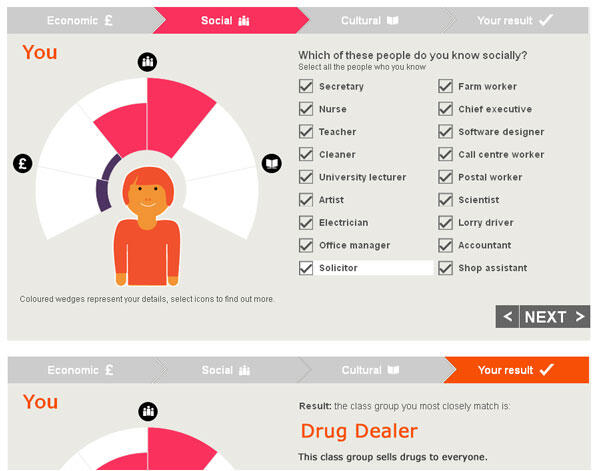
Toby Young reflects on a social class quiz that Manchester University created for the BBC (one of many spoofs is seen above):

One advantage of moving beyond the socio-economic definition of class is that you end up with a less inflammatory portrait of modern Britain. Yes, the social elite are quite numerous, but it’s better to belong to a four million-strong group than be bracketed with the dreaded ‘1 per cent’. … Seven different classes also feels more accurate than the usual three, even allowing for such sub-categories as lower-upper-middle (the class George Orwell said he belonged to). The more there are, the easier it is to move between them and the harder it is to keep track of who is a member of which one. That chimes with the general sense that class has become less important in the past 25 years.

Jenny Diski details how class tests were applied in the past:

You looked, you listened, you sniffed the air. And there it was, at 60 paces. Along, of course, with the telltale signs of arrivisme or decline, everyone with an exquisitely precise social degree of their own as obvious as the nose on their face, the first syllable uttered, the cut of their jacket.

It was as easy to know as it was intricate, the British class system. Provided you were born to it. But those of us who didn’t exactly fit because our parents or grandparents still spoke with foreign accents learned pretty quickly how to spot the finest distinctions. Even an Australian classmate knew, at my boarding school, when I tried to join the drama club, that with the wrong accent, I ‘would only be any good at playing maids’.

Nigeness contemplates “the lost richness of the English class system”:

Once among the glories of our national life, this endlessly complex and subtle system (or rather organism) gave us all our best comedies and most of our best fiction, while also proving a remarkably effective engine – and index – of social mobility, both upward and downward. (‘Was he born,’ inquires Lady Bracknell of Jack Worthing’s father, ‘into what the radical papers call the purple of commerce, or did he rise through the ranks of the aristocracy?’). It also gave us something other than the weather to talk – and even think – about.

Music Piracy Is Nothing New

Noah Berlatsky reviews Alex Sayf Cummings’ Democracy of Sound, a “history of music piracy from the wax cylinders of the 1870s to the present day”:

Music has been compact and easy to reproduce since the days of sheet music. It is, moreover, intensely social: People want to share it with each other, whether by sending a YouTube URL in the 21st century, trading Grateful Dead tapes in the 20th, or copying sheet music for other singers in the church choir in the 19th.

Perhaps even more importantly, music is, and has long been, hard to pin down. A book or a painting is a physical object—but where is a song? Is it notes on paper that tell you how to sing it? Is it a live performance? Is it the recorded notes? Is a singer singing someone else’s song copying that song, or is she making a new artistic work? Turning music into property is, in other words, conceptually complicated—which is why, Cummings, suggests, struggles over intellectual property have often started, or been worked out first, in struggles over ownership of music.

Hollywood’s Holy Trinity

Tom Shone theorizes that “great films arise when there is a triangulation between director, actor and protagonist — when all three share a spiritual umbilicus”:

[T]he Godfather is Coppola’s shadow-King as much as he is Brando’s; “One Flew over The Cuckoo’s Nest” is Milos Forman’s kiss goodbye to soviet Czechoslovakia as much as it is Jack Nicholson’s middle-finger salute to Hollywood. This also explains the airlessness that hangs over “Citizen Kane”, whose star, director and main character are already united in the singular frame of Orson Welles. What was never sundered cannot coalesce.

When Animal Rights Goes Wrong, Ctd

Like Marc Champion,  Steve Chapman argues that the ban on horse slaughterhouses has done more harm than good:

When 17 state veterinarians were polled on horse welfare, all said it’s gotten worse since the slaughter ban. According to the National Association of Counties, the number of abandoned horses has risen — just as opponents warned it would. If an owner can’t sell the horse for a decent sum and lacks the money to have it euthanized, he may leave it somewhere to meet death by starvation, disease or predators. … Rescue operations would be a more congenial answer, but they can’t do enough. They currently care for only about 6,000 horses nationwide, and most are at capacity. They couldn’t possibly accommodate the 166,000 shipped for slaughter each year. Those unwanted animals have to go somewhere.

Update from a reader who discusses a factor brought up during the Dish thread on why Americans don’t eat horse meat:

I am a small animal veterinarian who has been watching the horse slaughter debate since the US facilities were closed. One issue that people never seem to address is that fact that horses in the US are not subject to the same medication restrictions as animals raised for meat.

There are strict limitations on drugs that can be used in cattle, poultry, or small ruminants (i.e. goats) due to the fact that the drug residues in the meat end up being consumed by people. Horses exist in this strange in-between world where they are treated as companion animals while they are being used for riding, racing, etc, but then treated as meat animals when they go for slaughter. If horse slaughter advocates want to pursue re-opening US slaughter facilities, they ought to also advocate strict limitations on what medications horses can be given to protect the humans or zoo animals who eventually eat those horses- which in turn may have huge quality of life impacts on those horses treated as companions. Thanks for bringing attention to the issue!

Voices Of The Abasiyazzi

That’s a slang term for gay or queer in Uganda and the title of a film project about the plight of gays in Uganda, fomented in part by Tim McCarthy, a pathological videographer and fearless gay activist. If you saw “How To Survive A Plague”, you will have seen much of his unforgettable raw footage of the AIDS crisis. He now wants to go to Uganda to join Pepe Onziema and chronicle the grim reality unfolding there. I guess you could call the film, ‘How To Survive A Culture War.” Here’s the project on Kickstarter if you want to help.

Mental Health Break

A catchy and cartoonishly morbid music video from The Beards:

Marty Beckerman interviewed the band recently:

What percentage of your fans are beardless? (Male and female.)

It’s kind of hard to say. I never pay any attention to anyone without a beard, so I couldn’t really tell you how many beardless fans we have. When it comes to women, we like to encourage a practice called “bearding.” It involves tying your hair around the front of your face to replicate a beard. It looks great and it’s really starting to catch on.

High-Brow Racism

After reading Antony Beevor’s The Second World WarTNC grapples with the Holocaust:

It is often said that racism is the result of a lack of education, that it must be defeated by civilization and progress. Nothing points to the silliness of that idea like the Holocaust. “Civilization” is irrelevant to racism. I don’t even know what “civilization” means. When all your great theory, and awesome literature, and philosophy amounts to state bent on genocide, what is it worth? There were groups of hunter-gatherers wandering the Kalahari who were more civilized than Germany in 1943.

The End Of The Gallery Show?

Jerry Saltz recently sounded a death knell:

These days, the art world is large and spread out, happening everywhere at once. A shrinkingfraction of galleries’ business is done when collectors come to a show. Selling happens 2448485410_9b9a77b208_oyear-round,at art fairs, auctions, biennials, and big exhibitions, as well as online via JPEG files and even via collector apps. Gallery shows are now just another cog in the global wheel. Many dealers admit that some of their collectors never set foot in their actual physical spaces.

The beloved linchpin of my viewing life is playing a diminished role in the life of art. And I fear that my knowledge of art—and along with it the self-knowledge that comes from looking at art—is shrinking.

Artists and dealers are as passionate as ever about creating good shows, but fewer and fewer people are actually seeing them. Chelsea galleries used to hum with activity; now they’re often eerily empty. Sometimes I’m nearly alone. Even on some weekends, galleries are quiet, and that’s never been true in my 30 years here. (There are exceptions, such as Gagosian’s current blockbuster Basquiat survey.) Fewer ideas are being exchanged, fewer aesthetic arguments initiated. I can’t turn to the woman next to me and ask what she thinks, because there’s nobody there.

Sarah Nardi nods:

Warhol said that an artist is someone who produces things that people don’t need to have. That’s hard to argue with. I need water. I need to exhale after I inhale. But I don’t need to have a painting on my wall. No one does. But a sense of connection, I believe, is something we all need.

And art serves as a way to form those connections—to ourselves, to each other, and to the world. We need galleries for that. We need thoughtfully curated shows, the juxtaposition of wildly different points of view, and—most importantly—access to living, breathing, working artists. We need to see them standing next to their work, enjoying a well-deserved glass of wine.

So let the champagne crowd toss back their bubbly and move on. And let the faceless collectors appraise pixelated shadows projected on the virtual wall. Galleries serve a larger purpose than sales. Beyond their role as a place where work is sold, they are physical spaces that help foster a culture of real, meaningful connection. They are, as Saltz writes, “social spaces, collective seances, and campfires where anyone can gather.”

(Photo by Celine Nadeau)

A Second Look At The Nanny State

In an excerpt from his new book, Cass Sunstein defends certain forms of paternalism:

Here’s a simple but striking example of the possibility that paternalism can actually increase people’s welfare. We would ordinarily expect people to be worse off if government makes it more expensive for them to purchase goods that they want. If government tells you that you have to spend more to buy a computer, a lamp, or a pair of shoes, your life will hardly be better. But empirical work suggests that there are exceptions. More specifically, cigarettes taxes appear [pdf] to make smokers happier. To the extent that this is so, it is because smokers tend to be less happy because they smoke. When they are taxed, they smoke less and might even quit, and they are better off as a result.

For various reasons, including its addictive nature, smoking is a highly unusual activity. In light of the risks of error and abuse, we have to be careful in generalizing from it. But the broader point is that in some cases, there can be real space between anticipated welfare and actual experience, leaving room for a paternalism that respects people’s ends.