Nuclear Power Saved Lives

Deaths Nuclear Prevented

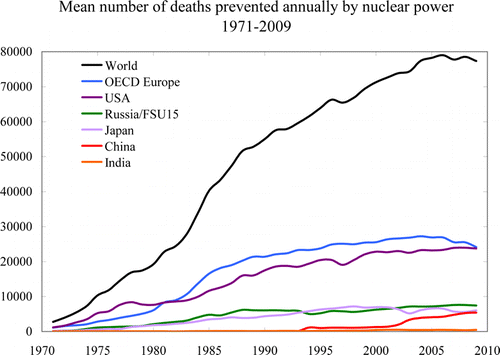
About 1.84 million of them, according to a recent report. Austin Considine summarizes:

Those lives were spared, researchers say, because nuclear power spared the earth’s atmosphere 64 gigatons of CO2-equivalent greenhouse gas emissions. That’s a lot of poison. What’s more, they argue, an additional 80 to 240 gigatons and another 420 million deaths could be prevented by around 2050 if we replace some of our fossil fuels with nuclear power over time.

There’s a big difference between the estimated 1.8 million from the last 40 years and 420 million in the next 40 years. Some of that is attributable to the world’s growing population. But some is because the world is industrializing in places like China, where fossil-fuel pollution is a major problem. As the graph above indicates, estimated rates of annual lives saved by nuclear power has grown steadily for decades.

A Remote Relationship

Aaron Hartzler chronicles being a gay man raised in a fundamentalist Christian home:

[W]hen I finally came out, Mom broke her silence on the subject. “It would be easier to go to your funeral than to know you are going to spend the night with that man.” This was the fevered pitch of the bullying, the loudest it ever became. Since then, the noise has subsided along with any meaningful communication between us, buried beneath the shallow serifs of her email italics — cheerful updates about the weather in places I’ve never lived, and people I’ve never met, at churches I’ll never attend.

Growing up means learning to hold two opposing views about the same thing. It’s not that I’ve stopped loving Mom and Dad — I haven’t. It’s just that I’ve accepted the fact that they may be as powerless as I am to change. Turns out unconditional love is a two-way street, so I protect myself with a few well-placed guardrails — one of which is the relative distance of communicating with Mom mainly by text and email.

Degrees Of Unemployment

Jodan Weissmann parses the varied views on what a college degree is worth right now:

It’s safe to assume that the recent BLS figures have brightened up a bit over the course of our slow but steady jobs recovery. Yet any way you slice it, there are far more jobless college grads around than the United States is used to seeing. In the end, most sophisticated college critics aren’t that worried about unemployment, though. Rather, they’re worried about underemployment. There’s a very loud chorus who believe that droves desperate BA’s are strapping on barista aprons and answering phones as temps just to make ends meet, rather than starting stable professional careers. In the process, goes the argument, they’re tragically pushing high school grads who would ordinarily fill those jobs even further down the economic food chain.

The problem isn’t imaginary. A few days back, the Wall Street Journal’s Ben Casselman reported that 284,000 Americans with a BA or higher were working in jobs that paid minimum wage or less, about double the pre-recession total (as shown in the the paper’s graph above). According to the BLS, the vast majority of those workers were actually in sub-minimum-wage jobs, meaning they were probably working for tips. The number of over-educated waiters and waitresses out there, in other words, has blown up quite a bit.

Matt Brueing underscores how much worse it is for those without a degree:

To my delight, Catherine Ruetschlin and Tamara Draut released a new Demos report yesterday about the job crisis afflicting young Americans, with a specific emphasis on the majority of youth who have no college degree. And those numbers are brutal. People between the ages of 18-24 without a high school degree face an unemployment rate of 27.4% and an underemployment rate of 41.7%. Those in the same age group with only high school degrees face an unemployment rate of 19.7% and an underemployment rate of 34.6%.

In the 25-34 age group, the numbers are somewhat better, but still bad. Those between the ages of 25-34 without a high school degree have an unemployment rate of 15.4% and an underemployment rate of 29.2%. Those with only high school degrees have an unemployment rate of 11.2% and an underemployment rate of 19.9%. In short, it’s terrible to be young in this job market, and really terrible to be in it without a degree.

David

This embed is invalid


Joe Klein remembers his friend:

I spent Easter Sunday with David in hospice. He couldn’t talk and had difficulty swallowing. We held hands for seven hours. He could understand what I was saying and he would squeeze my hand in response to my recollections of our times together—the red convertible, the Bible study, the times he asked me—a man old enough to be his father—for advice, the times, the many times, he gave me comfort and support and inspiration.

David always closed every conversation by saying, “I love you, Joe Klein.” I think he probably said that as often as my wife has. And so I must close this by saying one last time, “I love you, David Kuo.” And I will always love you, and I will always have your enormous heart and spirit to guide me. And I will miss you, and so will the world, especially the least of these. I love you, David Kuo.

I love him too. And I do not deploy this active verb for additional pathos. I believe, as David believed, that David is still here and everywhere, finally resting in the bliss of Jesus.

He and I did not become the kind of friends that Joe and he were. We saw each other occasionally, chatted on the phone, emailed constantly, but spent little time in each other’s physical presence.

And yet I have to say that I felt his presence a great deal in my life. This last Holy Week, he wouldn’t leave me alone. At the Good Friday service, it was as if he were next to me in the pew, enduring his Passion, doubting, fearing, crying out for help. I felt him very powerfully yesterday as I stopped on one of the piers on the Hudson River Park with the dogs and found myself lost in some kind of word-less conversation with him. In Washington or New York or London, in journalism and academia, it is hard to find fellow Christians to simply be with, to be free with. I am not a holy roller of any sort and David was a bit. But the candor of his faith and his total acceptance of mine – and our shared spiritual experience of living posthumously – made all our differences evaporate.

And there was something Jesus-like about David. He soon recovered from any fleeting belief in politics, let alone that fatal dance between the ineffable and the electable. He experienced, as I did, an early premonition of mortality, but unlike me, then had to live the illness in all its brutal, battering humiliation. He walked the Via Dolorosa. And do not believe for a moment that he somehow did that flawlessly. He was no saint in the fantasized sense. He fell time and time again. And he told me about it time and time again. There was no wall there; no guile; just a form of transparency which rested in truth. Which is a form of sanctity. Certainly, I find it hard to believe in a sanctity that is free from sin.

His suffering tore me up. After the last time I hugged him and walked him to my apartment door, I wondered if he could make it down the stairs his shuffling walk was so stilted. Yet he managed to drive home and called me to confirm he was OK. Yes, like a lot of sick people, he somehow seemed to be the care-giver at times. And yes, sometimes I needed his care more than he needed mine.

Maybe it was the way he brought up all those memories of my peers struggling against imminent death at an ungodly age; maybe it was his calm, steady humor and curiosity over our dinners, even as he had been dry-heaving the night before; maybe it was the unexpected sharing, the brutal truth he could impetuously dole out, or his indifference to the tribalisms of the capital city, or his impatience with any nonsense like homophobia. But he did not just make the world less lonely. He made it ever so slightly brighter, the colors more vivid, the love stronger, the urgency greater.

I am so happy for him now.  He is where he always was – in Jesus’ presence. But now with no earthly frustration to get in the way. David can be now. Just be. And what a being he is.

Losing Your Other Half

Heidi Julavits is entranced by Christa Parravani’s memoir, her, about the death of her identical twin Cara:

Briefly their story is this. Until Cara died, she and Christa functioned as a single entity split between two bodies. As children, the twins vowed that if one perished the other would commit suicide. “The unharmed twin would take her life by whatever means she possessed: Drano, phone cord, knife, swan dive from a cliff.” (Parravani cites the following statistic: 50 percent of “identicals” die within two years of the death of their twin.) …

Cara matured into a drug abuser and the less stable of the two; Christa, by comparison, was driven and even-keeled. Then, at the age of twenty-four, Cara was raped and nearly killed while walking her dog in the woods.

What had been transpiring gradually—the twins’ healthy separation into two adult women—was violently hastened. “The moment my sister fell under her rapist’s hand, he untwinned us: the bodies were the same but Cara became lost in hers. My body became a vessel of guilt, reminded us both of the past . . . joyful giving of sex, ripe exposed youth, and the naïve belly that still tickles at touch.” The trauma precipitated a drug-addiction tailspin from which Cara never recovered. The twins’ relationship became untenable. “She hates you for reminding her of what she was,” the author writes. “You fear her for showing you what you could become.” Christa, after trying repeatedly to help Cara get clean, adopted the tough-love approach. Cara’s final angry words to her gauntlet-throwing sister were, more or less, if I die now it will be on you.

And then, as Charlotte Brontë might have it, Cara died. (As Charlotte Brontë would not have it, she died of a heroin overdose, in a bathroom.) But contrary to sisterly suicide pacts and the rules of metaphysics, both sisters, in a sense, lived on. “While she was alive I was vibrant, responsible, steady, and holding her up,” writes Parravani. “I was her opposite. In the wake of Cara’s death, I became her.”

(Photo: “Blizzard” by Christa Parravani, from the series Kindred)

Who’s Hornier? Ctd

Gavin Mcinnes and his tight jockeys settle the question (NSFW):

A reader chimes in:

The article you posted about the social construction of sexual desire is another great example of how the novelty of counterintuitive claims is actually counterproductive in scientific realms. That men have a stronger (even uncontrollable) sex drive is a culturally reinforced stereotype, yes, but one based in fact. At every level of scientific understanding the fact is confirmed. The sex drive is largely regulated by the production of testosterone. Men produce significantly more testosterone than women, and correspondingly have a greater sex drive. Evolutionary biologists and psychologists note that as childbearing has substantially less cost for males as compared to females, it is to their reproductive advantage to engage in more sex and have more offspring.

If it is culture, and specifically Protestantism, that has defined the female sex drive, you might ask why none of the 40% or so of the world that practices non-Abrahamic religions report a particularly ravenous female population. A published psychology article on sex differences in the sex drive notes (pdf) that in India (Hindu) they also find a significantly higher sex drive in men. Men, as opposed to women, will have sex with “Untouchables”, despite the cultural taboo.

That the author can find a few literary references to the contrary I would suggest is the result of two factors:

1) most authors from antiquity were men, who may be projecting their desires or pandering to their audience 2) there is a very old stereotype of women having less control over their passions (i.e., emotions) in general. For much the same time period that the author is drawing upon to support her contention (ancient greece – mid-20th century), “hysteria” (excess emotionality) remained a recognized medical condition suffered (almost exclusively) by women. That sexual desire might be among the domains that the “weaker sex” could not control would fit nicely with this stereotype.

I do not mean to entirely dismiss social construction/social learning theories. They are very relevant for many topics, but in this case they decidedly incorrect. This is a case in which the wealth of evidence actually supports the stereotype.

How China Sees North Korea

Osnos explains:

Over the years, I’ve spoken to many of the American diplomats involved in negotiations with China and North Korea, and their consensus is clear: for all of North Korea’s instability, China still prefers the status quo to a post-Kim North Korea that could very well end up under the control of Seoul or Washington. So China and the U.S. remain far apart. “Our threat assessments are fundamentally misaligned,” a former American negotiator told me.

From China’s perspective, even if Kim is losing control of the situation, he has not lost it yet, and so China considers anything short of that to be alarmist. As long as North Korea is not threatening Beijing, this is a prisoners’ dilemma we will be facing on our own.

To appease China and hasten North Korea’s end, Beinart wants to America “to pledge formally that America will never station troops on what is now North Korean soil”:

Beijing keeps propping up Pyongyang. According to a February article in Foreign Policy by Fudan University’s Shen Dingli, there are three main reasons. The first is that China fears North Korea’s implosion could send tens or even hundreds of thousands of refugees fleeing across the two countries’ 800-mile-long border. The second is that North Korea’s collapse might prompt the millions of ethnic Koreans living on the Chinese side of the border to try to secede and join their kinsmen in a reunified Korea. The third is that if America’s ally South Korea swallows its northern twin, China could suddenly find itself with the U.S. military on its southeastern border.

There’s little the Obama administration can do to allay Beijing’s first two fears. But it can do a lot to allay the third.

Quotes For The Day

All from Margaret Thatcher. The first in many ways sums up everything. She said it at the age of nine, upon receiving a school prize:

“I wasn’t lucky. I deserved it.”

In collectivist, leftist, envy-ridden mediocre Britain, those were words you were not supposed to say. They were revolutionary words. And they carried the added benefit of truth. My other faves:

“It will be years – and not in my time – before a woman will lead the party or become Prime Minister,” – 1974.

“In politics, if you want anything said, ask a man; if you want anything done, ask a woman,” – 1982.

“I am painted as the greatest little dictator, which is ridiculous – you always take some consultations,” – 1983.

“I can trust my husband not to fall asleep on a public platform and he usually claps in the right places,” – 1978.

But I have to say my truly treasured words from her were among her last as prime minister, as she was dispatched by that brutal machine, the British Conservative Party:

“It’s a funny old world.”

It is, innit?

How They Hated Her

If you lived in Britain then or now, the loathing the woman inspired was extraordinary. In her way, she revitalized British pop music, by giving them all an object for their hatred:

Musical responses to Thatcher came in three varieties. There were songs that took a hard look at the country, especially during the early 1980s recession and the Falklands war: the aimless dispossessed of Ghost Town, the conflicted dockworker of Shipbuilding, the struggling poor of A Town Called Malice, the despair-poisoned citizens of the The’s Heartland. There were the character assassinations: Crass’s incandescent Falklands response How Does It Feel to Be the Mother of 1,000 Dead (quoted to the lady herself at Prime Minister’s Question Time), the Blow Monkeys’ somewhat premature (Celebrate) The Day After You, Morrissey‘s Margaret on the Guillotine and Elvis Costello‘s venomous Tramp the Dirt Down.

I could name dozens more but there are hundreds in the third category: whole careers, like that of the Smiths, implicitly underpinned by opposition to Thatcherite values. Look at the long list of people who played benefit gigs for such causes as the miners’ strike or Red Wedge and you’ll find such seemingly unlikely names as Wham! and Spandau Ballet’s Gary Kemp.