Leave Them Kids Alone

Jay Griffiths emphasizes the need for adventure in a risk-averse society:

William Golding’s Lord of the Flies is cited as if it were documentary evidence, as if, without the authority of adults, children will become vicious little monsters. Children are made to read this malignant propaganda against their childhood selves, and its message is beloved by those who believe that the opposite of obedience is disobedience. But these are false opposites. The true opposite of obedience is not disobedience but independence. The true opposite of order is not disorder but freedom. Most profoundly, the true opposite of control is not chaos but self-control. …

For there actually has been a real-life Lord of the Flies incident, and the result was the opposite of what is portrayed in the novel.

One day, in 1977, six boys set out from Tonga on a fishing trip. They left safe harbor, and fate befell them. Badly. Caught in a huge storm, the boys were shipwrecked on a deserted island. What do they do, this little tribe? They made a pact never to quarrel, because they could see that arguing could lead to mutually assured destruction. They promised each other that wherever they went on the island, they would go in twos, in case they got lost or had an accident. They agreed to have a rotation of being on guard, night and day, to watch out for anything that might harm them or anything that might help. And they kept their promises—for a day that became a week, a month, a year. After fifteen months, two boys, on watch as they had agreed, saw a speck of a boat on the horizon. The boys were found and rescued, all of them, grace intact and promises held.

How To Adjust Your Taste Buds

According to Joseph Bennington-Castro, “we don’t just eat foods because we like them, we like them because we eat them”:

After birth, your preferences continue shaping for the next two years. “Up until the age of 2 you will eat anything,” [psychologist Elizabeth Phillips] says. But then you become neophobic — that is, you don’t like new food. So if you hadn’t already been exposed to a certain flavor by the time you hit your terrible twos — whether through amniotic fluid, breast milk or solid food — chances are you won’t like it. At this point, most parents make a big mistake. “They think, ‘Oh my child doesn’t like this,’ but it’s actually anything new that they don’t like,” Philip says. So parents typically stop trying to feed their child that food and the kid ends up apparently hating it for years to come. “They don’t know that if they just keep giving it to their child, they’ll eventually like it.”

The key, then, is to make the food not new. Basically, you’ll like a new or previously hated flavor if you’re repeatedly exposed to it — studies suggest that it takes 10 to 15 exposures. “So if there’s something you don’t like, just eat it over and over and over again,” Philip says.

The Weekend Wrap

tintenfrass03

This weekend on the Dish, we took a break from politics to provide our usual eclectic mix of religious, books, and cultural coverage. In matters of faith, doubt, and philosophy, Gary Greenberg questioned psychiatry’s claims to be scientific, Barry Schwartz told us why we should settle for good enough, and Thomas de Zengotita offered an incisive critique of evolutionary psychology. Anne Kingston examined the mainstreaming of Buddhist mindfulness, Shel Silverstein described what God’s love feels like, and Richard Wolin pondered the dangers of monotheism. Christopher Hutton argued that to doubt is Christian, Vatican doctors gave their stamp of approval to JPII’s second miracle, Jim Holt thought the was universe wasn’t beautiful, and Adam Gopnik reflected on a parent’s love.

In literary coverage, Ernest Hemingway ruminated on the writer’s life, Flannery O’Connor noted why Southern writers love freaks, and Terrence Malick assigned books to his cast and crew. Mary Mann praised the cantankerous writing style of Max Beerbohm, Daniel Matthew Varley compared William Styron and DFW on despair, and wine turned out to be connected to writing in more ways than we realized. Will Glovinsky considered on attitudes toward crowds in literary history and digital modernity, Robert Frost didn’t hit it off with Ezra Pound, and Tony Hoagland suggested changes to the poetry curriculum. Victorian marriages were not something to aspire to, John McWhorter analyzed the linguistics of texting, and Jennifer Szalai investigated the various iterations of Oprah’s book club. Read Sunday’s poem here.

In assorted news and views, Viola Gad chemically-enhanced her dating life, researchers connected attractive voices to what they might indicate about the rest of a person’s body, and Jim Giles appraised Wikipedia’s demographics. Adam Baer reviewed the new Hummingbird music-notation system, Francie Diep reported on a creative way to increase the efficiency and bring down the cost of solar power, the U.S. government hoarded narcotics in the lead-up to WWII, and J. Hoberman saw a new installation at the Metropolitan Museum of Art, Street. MHBs here and here, FOTDs here and here, VFYWs here and here, and the latest window contest here.

– M.S.

(Image by Dr. Manfred Anders, from Wikimedia)

The Scourge Of Wiki-PR-News

The Sunlight Foundation’s new site, Churnalism, helps hunt it down. Rebecca J. Rosen explains:

“The tool is, essentially, an open-source plagiarism detection engine,” web developer Kaitlin Devine explained to me. It will scan any text (a news article, e.g.) and compare it with a corpus of press releases and Wikipedia entries. If it finds similar language, you’ll get a notification of a detected “churn” and you’ll be able to take a look at the two sources side by side. You can also use it to check Wikipedia entries for information that may have come from corporate press releases.

The worst culprit? Science writing:

In general, according to Devine, “science press releases seem to get more plagiarized than others.” For example, the Sunlight Foundation points to a CBS News article from last fall which shares several phrases — typically information-laced descriptions such as the list “found in hard plastics, linings of canned food, dental sealants” — with a press release from EurekaAlert!, as the Churnalism tool’s results show. Devine speculates that science journalism may run into this problem more frequently because “the language around the findings in those is so specific that it becomes very hard to reinterpret it.”

Is Grad School Worth It?

Joshua Rothman reflects on the question:

What does it mean to say that a decade of your life is good or bad? That it was worthwhile, or a waste of time? Barring some Proustian effort of recollection, a long period of years, with its vast range of experiences and incidents, simply can’t be judged all at once. The best we can do is use what psychologists call “heuristics”: mental shortcuts that help us draw conclusions quickly.

One of the more well-understood heuristics is called the “peak-end rule.” We tend to judge long experiences (vacations, say) by averaging, more or less, the most intense moment and the end. So a grad student’s account of grad school might not be truly representative of what went on; it might merely combine the best (or worst) with how it all turned out.

The most wonderful students will be averaged with the grind of the dissertation; that glorious summer spent reading Kant will be balanced against the horrors of the job market. Essentially, peak-end is an algorithm; it grades graduate school in the same way that a software program grades those essays on the S.A.T. Sure, a judgment is produced, but it’s only meaningful in a vague, approximate way. At the same time, it raises an important conceptual question: What makes an experience worthwhile? Is it the quality of the experience as it’s happening, or as it’s remembered? Could the stress and anxiety of grad school fade, leaving only the learning behind? (One hopes that the opposite won’t happen.) Perhaps one might say of graduate school what Aeneas said of his struggles: “A joy it will be one day, perhaps, to remember even this.” Today’s unhappiness might be forgotten later, or judged enriching in other ways.

No Women On The Road, Ctd

A reader writes:

In response to Vanessa Vaselka’s thoughtful essay on the lack of female road narratives, there is, of course, Zora Neale Hurston’s Their Eyes Were Watching God, which is a quest narrative in the long tradition of Western quest narratives that also addresses issues of gender roles and expectations about female sexuality. There are also many travel narratives written by female authors which also raise Vaselka’s concern about rape and violence. While there are many other kinds of exploration based upon careful attention and observation – I’m thinking about Dickinson and Marianne Moore, for example – these writers reinforce Vaselka’s point in other ways. Katherine Anne Porter’s short story “Flowering Judas,” about an American woman active in revolutionary politics in Mexico in the early 1920’s, yet intensely self-protective against male sexual advances and potential sexual assault, also speaks to Vaselka’s concerns.

Another reader suggests:

While it lacks the fame of Huck Finn, there is a really weird and wonderful book about the world’s greatest hitchhiker, a beautiful woman with massive oversized thumbs called Even Cowgirls Get The Blues by Tom Robbins. Sissy meets all sorts of people from a fashion designer to Jack Kerouac to a bunch of Lesbian Cowgirls and the sex guru/hermit that watches over them the hills of the badlands.

The trailer for the film adaptation is seen above.

The Most Caffeinated Countries

The US isn’t one of them:

Lindsey Bolger, director of coffee for Green Mountain Coffee Roasters, says if you measure the amount of coffee consumed per coffee drinker, the world champions live in Nordic countries. “Depending on which country, they’re up to eight cups of coffee per person, per day. In the U.S., we’re at maybe 2 or 2.5 cups of coffee per day,” she says. Americans actually used to drink a lot more coffee. Per person, we drank almost twice as much during World War II.

Quote For The Day

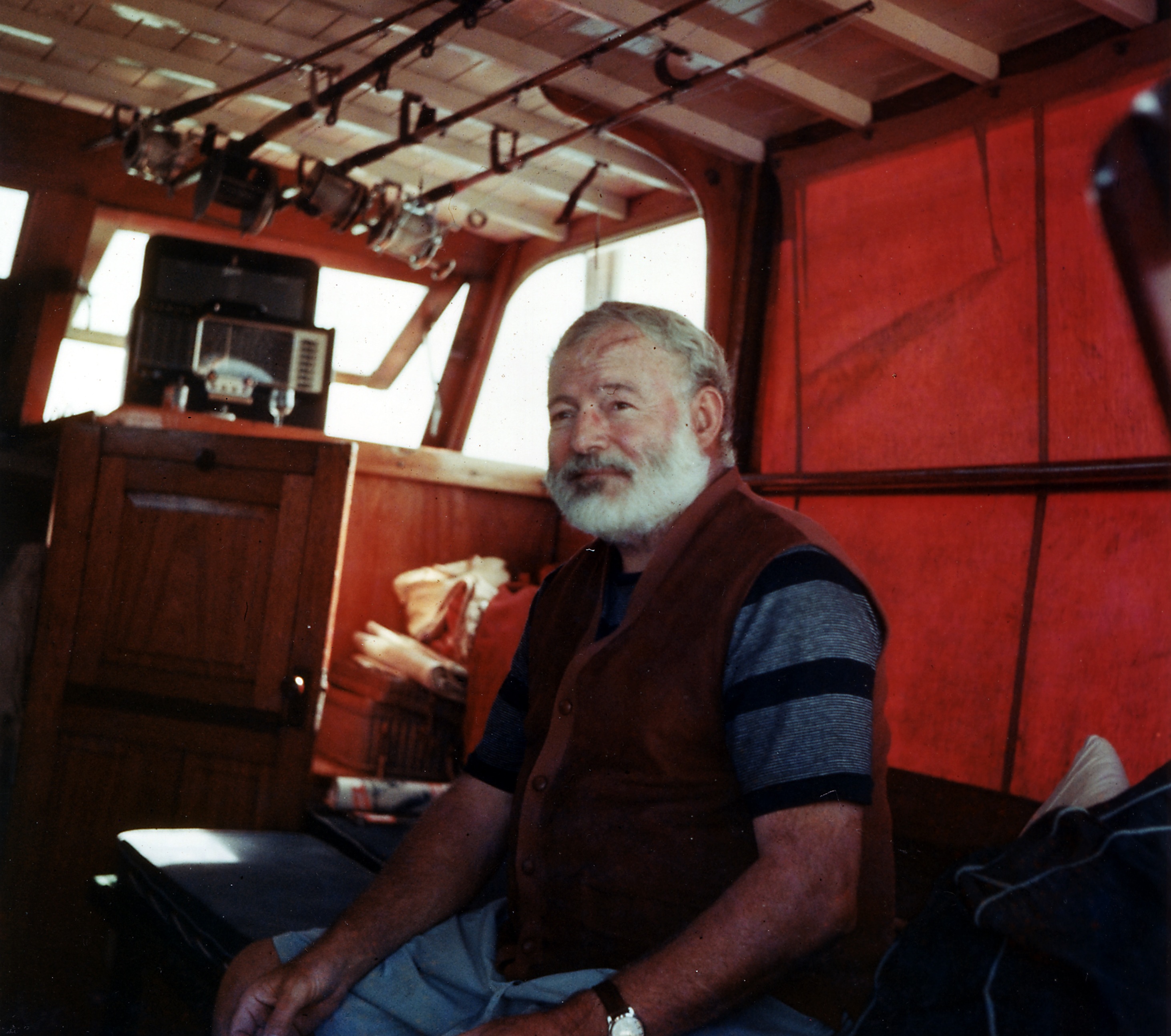
Ernest_Hemingway_1950

“Writing, at its best, is a lonely life. Organizations for writers palliate the writer’s loneliness but I doubt if they improve his writing. He grows in public stature as he sheds his loneliness and often his work deteriorates. For he does his work alone and if he is a good enough writer he must face eternity, or the lack of it, each day.

For a true writer each book should be a new beginning where he tries again for something that is beyond attainment. He should always try for something that has never been done or that others have tried and failed. Then sometimes, with great luck, he will succeed.

How simple the writing of literature would be if it were only necessary to write in another way what has been well written. It is because we have had such great writers in the past that a writer is driven far out past where he can go, out to where no one can help him,” – Ernest Hemingway, 1954 Nobel Prize Speech

(Hemingway circa 1950, via Wikimedia Commons)

The Haunted South

A quote from Flannery O’Connor’s essay, “Some Aspects of the Grotesque in Southern Fiction”

Whenever I’m asked why Southern writers particularly have a penchant for writing about freaks, I say it is because we are still able to recognize one. To be able to recognize a freak, you have to have some conception of the whole man, and in the South the general conception of man is still, in the main, theological. That is a large statement, and it is dangerous to make it, for almost anything you say about Southern belief can be denied in the next breath with equal propriety. But approaching the subject from the standpoint of the writer, I think it is safe to say that while the South is hardly Christ-centered, it is most certainly Christ-haunted. The Southerner, who isn’t convinced of it, is very much afraid that he may have been formed in the image and likeness of God. Ghosts can be very fierce and instructive. They cast strange shadows, particularly in our literature. In any case, it is when the freak can be sensed as a figure for our essential displacement that he attains some depth in literature.

Mike Springer finds audio of O’Connor reading from the same essay.

A Poem For Sunday

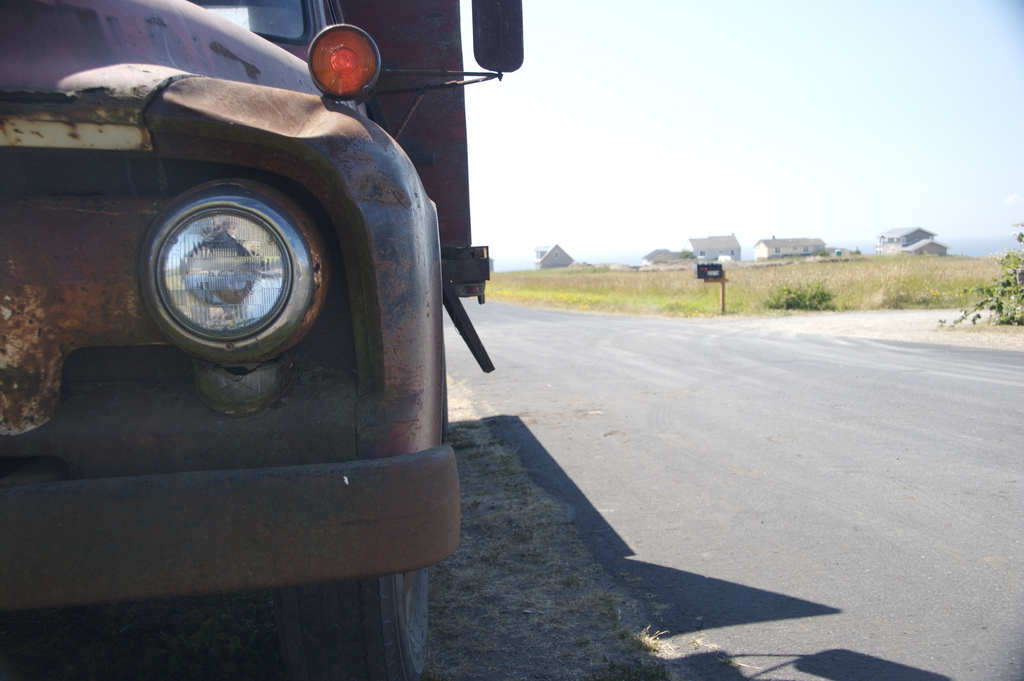
oldtruck

“Twenty-Year Marriage” by Ai:

You keep me waiting in a truck
with its one good wheel stuck in the ditch,
while you piss against the south side of a tree.
Hurry. I’ve got nothing on under my skirt tonight.
That still excites you, but this pickup has no windows
and the seat, one fake leather thigh,
pressed close to mine is cold.
I’m the same size, shape, make as twenty years ago,
but get inside me, start the engine;
you’ll have the strength, the will to move.
I’ll pull, you’ll push, we’ll tear each other in half.
Come on, baby, lay me down on my back.
Pretend you don’t owe me a thing
and maybe we’ll roll out of here,
leaving the past stacked up behind us;
old newspaper’s nobody’s ever got to read again.

(From The Collected Poems Of Ai © 1973 by Ai. Used by permission of W.W. Norton & Company, Inc. Photo by Flickr user Xiong)