The Demand For American Sperm

by Zoe Pollock

This embed is invalid

It’s increasing:

Why is US sperm so popular? It’s not about the superior fitness of American males, exactly. One reason is that the US’s immigration history means lots of ethnic diversity. For some would-be mothers from other parts of the world, this can give US product a leg up over places like Denmark, another sperm exporting powerhouse. Another is all that tracking and testing: the U.S. has some of the world’s highest standards for disease testing and donor screening. The FDA defines sperm as human tissue, and regulates it much as it does the donation of organs.

Paying anonymous donors has also helped:

Unlike many countries, the US allows men to donate anonymously and to be paid for doing so, leading to a comparatively larger donor pool; sperm donations in other countries plummeted following laws prohibiting anonymous donation or payment. After Britain ended anonymity for sperm donors in 2005, the wait for sperm could take years — in part because fewer men agreed to share their sperm with multiple women or with women they didn’t know personally. In Canada, concerns about the commercialization of human reproduction led to a ban on paying donors in 2005; by 2011 a single sperm bank with 35 active donors made up the entire national supply, according to the Toronto magazine The Grid. (In contrast, [Seattle Sperm Bank] alone has more than 140 active donors). Today, more than 90 percent of donor sperm used in Canada is imported from the US.

Your Nasal Wingman

by Doug Allen

According to Colin Lecher, a sense of smell might be your best ally in the dating scene:

Research suggests that men who can’t smell have fewer sex partners than men with fully functioning nostrils. About five times fewer. A team of researchers had already found a correlation between not having a sense of smell and having feelings of insecurity. … A more recent study from the same researchers compared 32 people who couldn’t smell–22 women and 10 men–with a control group, asking both groups about the number of sexual partners they’d had. The question was, if people are insecure because they can’t smell, will that insecurity affect their sex lives, too?

Well, something‘s affecting their sex lives. The men, on average, had way fewer partners than the men in the control group. Curiously, the women without a sense of smell had about the same number of partners as the control group women. But compared with the control group (and the men), the women ranked themselves as more insecure in their current romantic relationship.

Anti-Social Media?

by Doug Allen

James Shakespeare encourages you to stop sharing your experiences on social media:

It’s natural to want to share experiences with the people you care about. After all, the classic postcard greeting is ‘Wish you were here’. But I think our reasons for sharing experiences on IMG_2003social media are more cynical than that. It’s not sharing, it’s bragging. When we log in to Facebook or Twitter we see an infinitely updating stream of people enjoying themselves. It’s not real life, of course, because people overwhelmingly post about the good things whereas all the crappy, dull or deep stuff doesn’t get mentioned. But despite this obvious superficiality, it subconsciously makes us feel like everyone is having a better time than us. We try to compete by curating our own life experiences to make it look like we’re also having non-stop fun and doing important things. It breeds in us a Pavlovian response that means every time something good is happening to us we must broadcast it to as many people as possible. …

The key thing to remember is that you are not enriching your experiences by sharing them online; you’re detracting from them because all your efforts are focused on making them look attractive to other people. Your experience of something, even if similar to the experience of many others, is unique and cannot be reproduced within the constraints of social media. So internalise that experience instead. Think about it. Go home and think about it some more. Write about it in more than 140 characters; on paper even. Paint a picture of it. Talk about it face to face with your friends. Talk about how it made you feel.

I’m always a little put off by sweeping generalizations about people’s motivations for sharing on social media, be it Facebook, Twitter, Instagram, or anything else. Sure, there may be a lot of people who use these services as Shakespeare describes, carefully curating their every post to make their life seem as fulfilling as possible. But there are also myriad other ways to use social media that are not nearly so cynical.

Personally, I choose not to have a big presence on social media, with one notable exception: Instagram.

I don’t like broadcasting the day-to-day details of my life to a wide audience with status posts, or tweeting my possibly deep but probably less-deep-than-I-think thoughts. But I thoroughly enjoy the cleanliness and focus of Instagram, and the way that it gives me a brief window into the lives of my friends. When I post Instagram photos (I’ll confess, the large majority of which are cat-related), I hope that those who follow me see it the same way: not as an attempt to package and reproduce my experience for others, or as a form of bragging, but as a way to share, if only briefly, my experiences with those I think might enjoy the opportunity to share in them. It’s not necessarily a “wish you were here,” nor is it a “look at how cool my life is”; rather, I think of it as “I enjoyed this, maybe you will too.”

(Photo: From my Instagram feed, watching the 2012 Presidential debates with my cat. Personally, I don’t think this makes me look like I’m “having non-stop fun and doing important things.”)

The Kibbutz Goes Kaput

by Zoe Pollock

Rachel Johnson recently revisited the collective she volunteered at during her youth:

The kibbutz was a third of the size it used to be, and there was no communal dining hall. Instead, everyone stayed home at night, watching TV. And the average age of the members was 80.

She reflects on the larger changes in Israeli society:

Sociologists date the beginning of the end of the kibbutz movement to as long ago as the war of 1967. The annexation of the West Bank, Gaza and East Jerusalem meant the end of socialism and the start of messianic, Zionist capitalism. Now signs of the change are everywhere. For example — in one of those tiny changes that symbolises a big shift — sandals, the emblematic item of socialist footwear, almost compulsory on the kibbutz, were banned from the Knesset, Israel’s parliament, in 2007. …

As I left Galilee, I realised that it would be simplistic to say that the changes in the kibbutz movement mirror the changes in politics, the economy, and the population. In Israel, things are always more complicated. But a country that was once socialist, secular, and led by men who’d all been on kibbutzim, like David Ben-Gurion, Moshe Dayan, and Ehud Barak, has turned religious, nationalist and capitalist. There is only one kibbutznik left in the Knesset, but two settler MPs are already ministers.

(Image by Flickr user epiclectic)

The Novelist Exits Stage Left

by Zoe Pollock

Even the greatest writers can fail at applying their talents to the stage, as Rodney Welch learned while reading The Tragedy of Mister Morn, “the latest piece of Nabokov miscellany to find its way into print”:

This convoluted five-act verse 1923 play about the overthrow of an imaginary kingdom is the work of an impassioned young writer who bit off more than he could chew, did not know how to make a complex story look easy, or how to develop cardboard stereotypes into three-dimensional characters. The dialogue is guaranteed to reap little more than confused stares or snorts of derision from the audience. Sometimes, it’s ridiculously expository: “The rain quivers as though in senile drowsiness” or “the moulded whimsy of a frieze on a portico keeps us from recognizing, sometimes, the symmetry of the whole.” Or just ridiculous: “…my face drifts up out of the semi-darkness to meet me, like a murky jellyfish, and the mirror is like black water…” …

On the surface, it seems like he might have succeeded in this career, as his fiction has always had a certain theatricality to it. So many of his characters are lost in plays of their own making, bent on staging their own version of reality. But telling a story in dialogue cramped his style; even in his books, it wasn’t his best means of expression. Like Proust, he was more in his element writing from a deeply interior level, usually through a single tortured consciousness, a single fractured perspective. That’s when his incredibly colorful and comic style took flight, and why he ruled the novel and short story in ways he never could the stage.

For more, check out Christopher Michel’s comprehensive review of Andrea Pitzer’s The Secret History of Vladimir Nabokov.

Notes Of Dankness And Blueberry

by Zoe Pollock

William Breathes, who writes under a pseudonym, reviews dispensaries and their various strains of pot for the alt-weekly Denver Westword and runs its cannabis news blog, Toke Of The Town. The best part of the job? Normalizing the drug:

[Readers] can go to westword.com to get news about the state legislature, or about education, about the prison system—and about marijuana. It’s not the old-school media approach to marijuana, where it’s like, “Let’s see how many pot puns we can cram into the lede and how many jokes we can make at the expense of marijuana smokers.” We definitely make jokes at the expense of marijuana smokers, but we also take news very seriously.

We’ve seen other news outlets come around on that.

The Denver Post—and I’m not trying to pick on another news media outlet—but for the longest time, their pot coverage was shit. It just was. Every time it was just them making fun of the pot smokers. But in the last year, they’ve realized that it’s important, and it’s not just 20-something stoners tuning in to figure out what’s going on. People wanna know because it’s a viable, million-dollar industry. In the sense of the media, that’s been an important role for my job.

But I think the obvious one is that I like to think I’m helping patients find really good places to buy medicine. Whether it’s for price or quality—for some people, as long as it’s clean, that’s fine to them, they just don’t want to go somewhere scuzzy. That’s why I still focus on what the interior of these places look like. I always think about it like this: if my mom was to read this and she had a medical marijuana card, what would she get out of this? ’Cause it’s not just people like me, it’s not just 20-somethings. It’s also baby boomers [and older people, too]. Our average-age patient is 41.

The Grey Lady Goes Zen

by Zoe Pollock

Justin Ellis applauds a new project from the NYT’s James Harris:

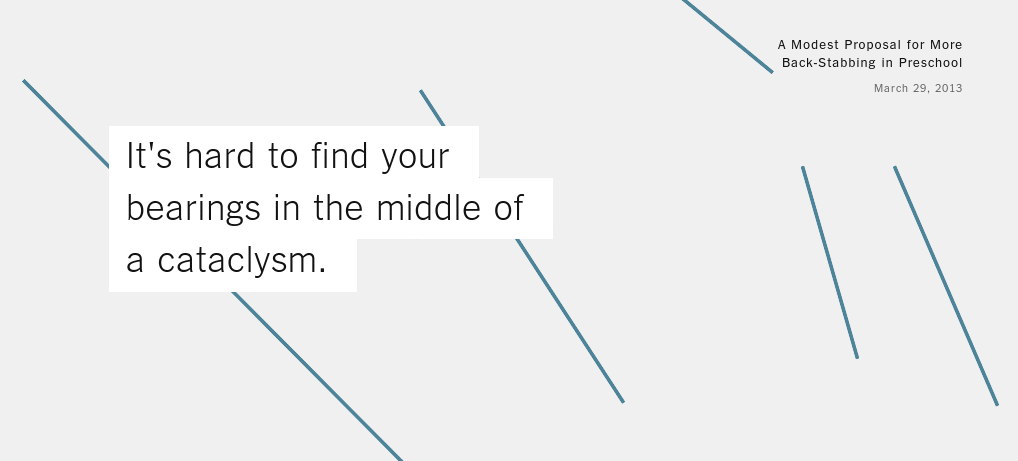
Times Haiku is a collection of what they are calling “serendipitous poetry,” derived from stories that have made the homepage of NYTimes.com. The haiku live on a Tumblr hosted by the Times. Harris built a script that mines stories for haiku-friendly words and then reassembles them into poetry. (For those of you that may have zoned out in class, haiku are comprised of three lines with, in order, five, seven, and five syllables.) The code checks words against an open source pronunciation dictionary, which handily also contains syllable counts.

“Sometimes it can be an ordinary sentence in context, but pulled out of context it has a strange comedy or beauty to it,” Harris said. … The result, much like @nytimes_ebooks, is bizarre, quirky, and kind of zen.

As Harris explains on the About page, it’s not a strict interpretation of the form:

Most of us first encountered haikus in a grade school, when we were taught that they are three-line poems with five syllables on the first line, seven on the second and five on the third. According to the Haiku Society of America, that is not an ironclad rule. A proper haiku should also contain a word that indicates the season, or “kigo,” as well as a juxtaposition of verbal imagery, known as “kireji.” That’s a lot harder to teach an algorithm, though, so we just count syllables like most amateur haiku aficionados do.

But it’s got a solid foundation:

Articles covering sensitive subjects are not scanned for potential haikus, and the bot knows to skip anything with awkward sentence construction. … “Over time we’ve added syllable counts for words like ‘Rihanna‘ or ‘terroir,’” the haiku Tumblr reports. Yesterday, Harris posted on Twitter that he was adding syllable counts for “gewürztraminer, vindaloo, sabermetrics, esoterica, mortarboard, defenestrate, koan, nametag, ceramicist…”

One more cool fact via Ellis: the blue lines behind the haiku are computer generated, based on the meter of the first line of text.

(Image: Times Preschool Haiku)

Faces Of The Day

by Zoe Pollock

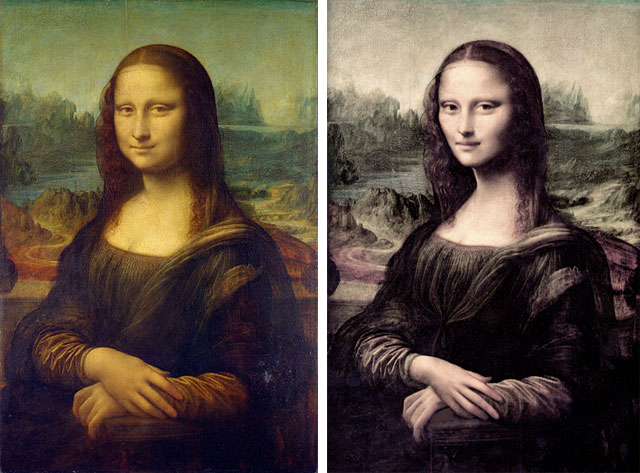
Kottke compares beauty across the ages:

For his Alpha Beauties project, artist Nazareno Crea retouches paintings and sculpture from throughout history, a process which normalizes each period’s ideal of female beauty to that of the present day. That is, much skinnier, with smaller noses, higher cheekbones, and larger breasts.

For a similar eye-opener, check out these webcam workers posing like famous works of art.