Your Creations Can Get You In Trouble

by Patrick Appel

Brendan Koerner profiles Alfred Anaya, who created hi-tech “traps,” hidden compartments in cars. Making traps, in and of itself, is not illegal, but Anaya is serving a more than 24 year sentence because some of his clients used his traps to transport drugs:

A common hacker refrain is that technology is always morally neutral. The culture’s libertarian ethos holds that creators shouldn’t be faulted if someone uses their gadget or hunk of code to cause harm; the people who build things are under no obligation to meddle in the affairs of the adults who consume their wares.

But Alfred Anaya’s case makes clear that the government rejects that permissive worldview. The technically savvy are on notice that they must be very careful about whom they deal with, since calculated ignorance of illegal activity is not an acceptable excuse. But at what point does a failure to be nosy edge into criminal conduct? In light of what happened to Anaya, that question is nearly impossible to answer.
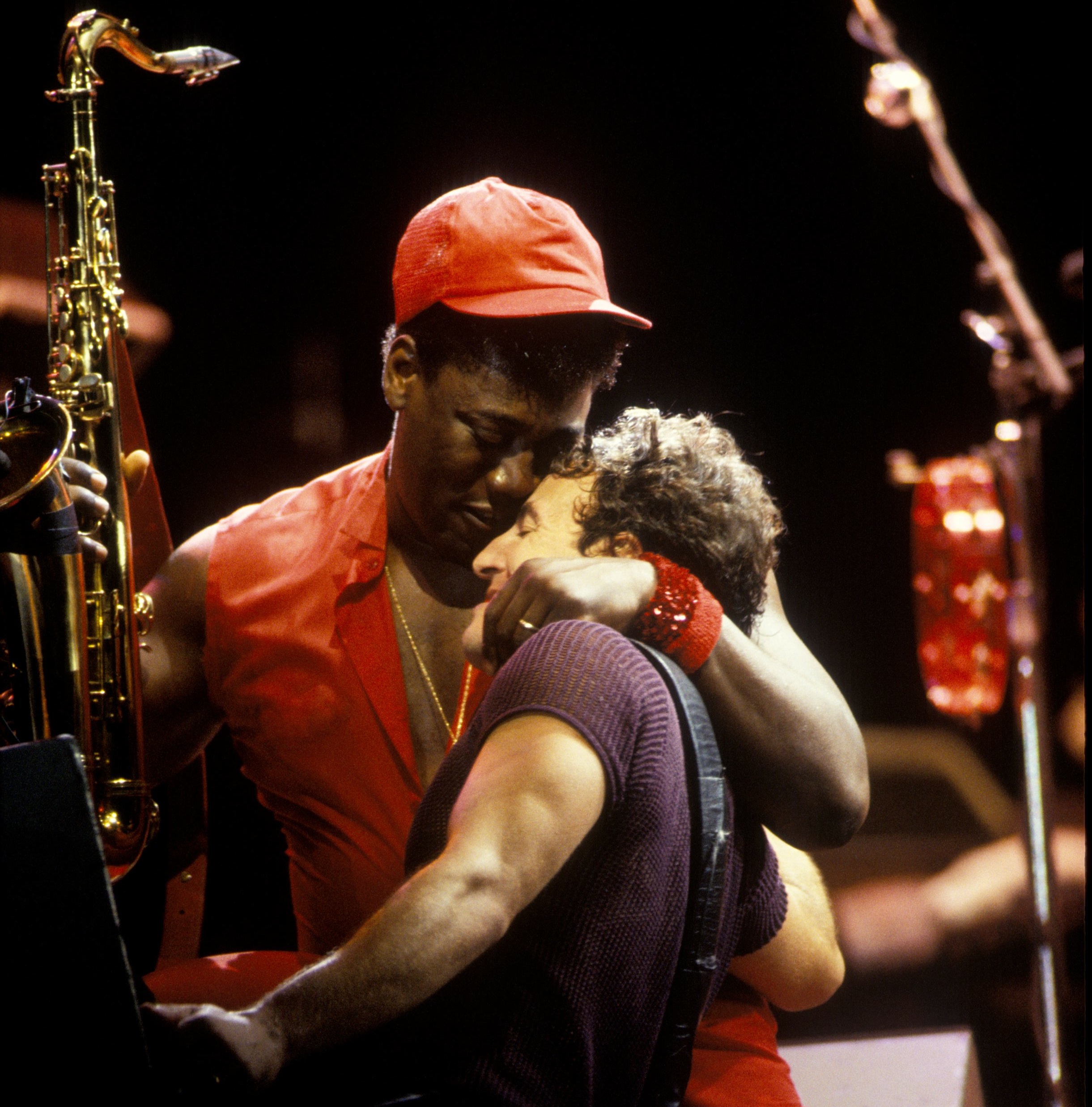

Bruce’s Bromance

by Chris Bodenner

Bruce Springsteen

A reader builds off this post:

Whenever I hear discussions about high-profile men jokingly (or not?) expressing sexual attraction to other men, I’m always curious that no one mentions Bruce Springsteen. To most people, obviously, Bruce is the pure embodiment of unfettered American masculinity. And yet for the 40 years he played beside Clarence Clemons, until Clemons’ death in 2011, the two men had this clearly intense, complicated relationship that was enacted and re-enacted every night onstage – culminating in a long, deep kiss on the mouth – without irony or camp, just pure, exuberant love between two men, without a need to be defined as straight or gay.

See it here, in a series of quite touching and beautiful photos. There’s also a fleeting shot of it live, in the official “Born to Run” video, at about 0:18. (Though note that commenters continue to feel the need to provide the “NOT gay” disclaimer.) Of course, both men married women (multiple times each) and have large families. Who knows and who really cares what their sexuality is? I think it’s sort of beside the point. More interesting to me is the sheer intensity of their love and their fearlessness in expressing it without the need to declare, “Of course we’re both straight!”

To the contrary, when Clemons described the kiss in 2009, he didn’t bother to mention sexual orientation:

It’s the most passion that you have without sex. Two androgynous beings becoming one. It’s love. It’s two men – two strong, very virile men – finding that space in life where they can let go enough of their masculinity to feel the passion of love and respect and trust. Friendships are based on those things, and you seal it with a kiss.

(Photo: Clarence Clemons and Bruce Springsteen of the E Street Band embrace while performing on stage in Los Angeles c.1981. By Richard E. Aaron/Redferns)

Everything You Never Wanted To Know About Digestion

by Patrick Appel

Bee Wilson enjoyed Mary Roach’s new book, Gulp:

If you’ve ever wondered why some people complain of gassiness after beans, while others eat them with impunity, Roach has the answer. If you’ve never wondered, too bad; Roach is going to tell you anyway. Apparently, half of the population lack a certain enzyme in the colon that is needed to break down the complex carbohydrates in legumes. As a result, they are “troubled by beans.” When the colon inflates, releasing gas, it is a “warning system”: “Because stretching can be a prelude to bursting, your brain is highly motivated to let you know what’s happening down there.”

In an interview about her book, Roach sings the praises of saliva:

[I]n saliva there’s these histatins which help wounds heal. So when someone kisses a baby’s booboo, like a scrape, or when a pet licks its wounds, it’s actually – because you think oh, oh, it’s full of bacteria, don’t do that. But there’s these healing elements. Saliva was a home remedy for cuts and scrapes and shankers and things. People would apply the spittle of a – first-thing-in-the-morning spittle of an old man or something would be, like, the remedy. But there’s some medical sense to it.

The Most Harmful Drug, Ctd

by Doug Allen

Tyler Cowen connects alcohol to the gun control debate:

In part our guns problem is an alcohol problem.  According to Mark Kleiman, half the people in prison were drinking when they did whatever they did. … There are connections between alcohol and wife-beating and numerous other social ills, including health issues of course.

It worries me when people focus on “guns” and do not accord an equivalent or indeed greater status to “alcohol” as a social problem.  Many of those people drink lots of alcohol, and would not hesitate to do so in front of their children, although they might regard owning an AK-47, or showing a pistol to the kids, as repugnant.  I believe they are a mix of hypocritical and unaware, even though many of these same individuals have very high IQs and are well schooled in the social sciences.  Perhaps they do not want to see the parallels.

Previous Dish on alcohol as the most harmful drug here.

Small Government Theocons? Ctd

by Brendan James

A reader writes:

Concerning this post, I think you and Ed Kilgore are talking past each other.  Ed’s talking about the Religious Right; you’re talking about “young evangelicals.”  Not exactly the same thing—indeed, the young evangelicals you’re speaking of seem to be moving away from the Right, or at least modifying it to accommodate what is now clearly a cause as lost as keeping evangelicals from divorcing.

But if you focus on, say, the Tea Party, as Ed does, it’s apparent that the persistent efforts of some clueless pundits to characterize it as a “libertarian” movement miss the point.  It’s not the deficit these people are concerned with; after all, where were they in the oughts?  They’re concerned, as ever, with the federal government taking stuff away from deserving folk like themselves and giving it to undeserving folk like the poor, or the uninsured, or parasitic elites in academia, the bureaucracy, etc.

And for them this is a moral cause; that Obama is in the business of taking from the “right” people and giving to the “wrong” ones isn’t a policy disagreement, it’s proof of his moral perfidy.  That they are utterly clueless about the federal budget and the fact that they are major beneficiaries of federal redistribution policies makes it all the easier for them to strike this self-righteous pose; there’s no “libertarianism” for them if it touches “their” Medicare.  It really is the culture war by another means.

I understand this point, that libertarianism and Christianism are not a priori incompatible (even if it requires some slippery semantics) and so a rise in the former need not lead to perestroika. But the fact is that evangelicals are the core of the religious right, and if the next generation is becoming libertarian on social matters like marriage—we could talk about drugs as well—that’s a big problem for the old guard that organizes much of the base around cultural paranoia. If this generational shift continues, how small is the Christian Right’s tent going to shrink before they lack the clout Kilgore and the rest of us are worried about?

The UN’s Deadly Incompetence, Ctd

by Brendan James

A Zimbabwean cholera patient sits in his

Not long ago we posted on the UN’s cover-up of a cholera outbreak in Haiti, sparked by a peacekeeping mission in 2010. It turns out there was another outbreak on their watch, in Zimbabwe, which left 4,000 dead in 2008-09. A whistleblower in the UN tried to warn his superiors about the growing epidemic, but was fired by his chief officer, on behalf of that officer’s friends in Mugabe’s government. It was an election year, after all. Armin Rosen digs deeper:

The UN and [officer Agostinho] Zacarias’s chief responsibility should have been to Zimbawe’s embattled civilian population. Instead, both failed to live up to their obligations — even as they were conspiring against someone who had exceeded them. That campaign even seeped into the tribunal proceedings, as Zacarias and the UN made specious and unsupported claims in court that Tadonki had been accused of sexual harassment while based in Harare. It didn’t work, but the UN’s efforts are continuing even now: the UN has stated that it is appealing its own tribunal’s decision, and according to [lawyer Robert] Amsterdam, the World Body has taken the first procedural steps necessary to retry the case. At a March 6 press conference, a UN spokesperson refused to comment on the case — except to say that “judgments of the UN Dispute Tribunal are not final until they have been confirmed by the UN Appeals Tribunal,” and that “the Organization intends to file an appeal of this judgment.”

(Photo: A Zimbabwean cholera patient sits in his bed on February 27, 2009 at a hospital in Harare. By Desmond Kwande/AFP/Getty Images)

Sully Bait

by Chris Bodenner

Many readers are flagging this news – the formation of a PAC called the Bearded Entrepreneurs for the Advancement of a Responsible Democracy (BEARD). Money quote:

“It’s been 125 years since our last bearded President, Benjamin Harrison, was elected. We’re hoping that with our support, bearded individuals will shrug off over a century of political irrelevance and start running for office again.”

Update from a reader:

The news about the PAC has even more Sully Bait than I expected. If you go to Jonathan Sessions’ web site (he’s the founder of the PAC), and then go to his link about upgrading from IE, you’ll find his 404 page with a lovely picture of beagle puppies. What’s better than that?

Bearded beagle puppies?

How Powerful Is The Bully Pulpit?

by Patrick Appel

Jonathan Bernstein recently argued that Obama should talk more about fighting climate change. Digby is puzzled:

I had thought the bully pulpit is not only useless, but often counter-productive, so this is a surprise to me. Ezra Klein explained it to us all in this New Yorker piece from 2012, wherein he outlined all the political science numbers-crunching that proves public opinion is fairly irrelevant to public policy and presidential rhetoric even more so. Indeed, the thesis says that while the president coming out publicly for a particular policy may be able to harden his own troops’ resolve from time to time, he also hardens the opposition against him, so government basically can only be effective through the use of backroom deals and inside the beltway politicking

Bernstein’s response:

[A]s far as I understand it, the data we have on public opinion and the bully pulpit are mainly about short-term effects, and especially the (non-) effects of attempting to move Congress on specific legislation by changing public opinion. I don’t think we know much, if anything (and I hope someone will correct me if I’m wrong) about long-term effects, if any. I mean, we know that Ronald Reagan didn’t make US voters more conservative during his presidency…but I don’t think we know anything about what, if any, long-term effects he might have had either on specific issues or ideology in general — including effects concentrated within conservatives. Or, to put it the other way: we could have something here similar to campaign effects in which strong professional electioneering tends to cancel out; if one side saw the minimal effects results and decided to not campaign at all, we’re fairly certain that it would create a very large effect. If Democratic presidents preach liberal ideals it might not change any minds, but if they don’t, it might fail to “educate” a generation of Democratic activists.