How Graphic Should War Coverage Be? Ctd

by Chris Bodenner

Add your two cents to our survey:

This embed is invalid

A reader continues the thread:

When I was a journalism student, a visiting professor once told us a story. His editors had sent him to cover a state execution, where he sat with members of the victim’s family and various representatives of the state. He watched this man die and returned to his office with a grisly story full of graphic details. His editor told him there was no way the paper could print something so horrifying, to which the then-reporter asked, “Then why did you send me?”

Another:

Going back even further than WWII, the intensely graphic photos that Matthew Brady and his team took on the matthew_brady_photobattlefields of the Civil War showed civilians, for the very first time, the true horror of war.  These photos are present at nearly every National Historic Battlefield and are an important reminder of what young men on both sides of the Civil War were willing to face for four years.  To my knowledge no one has protested to the NPS to take down the interpretive signs that show these pictures because they are too disturbing or violent.

It is easy to point to the people today who do not want to see modern-day war photos and say that they want to hide their heads in the sand – that they want to deny what is happening halfway around the world.  But there is also a key difference between battlefield photos now and then: Color.
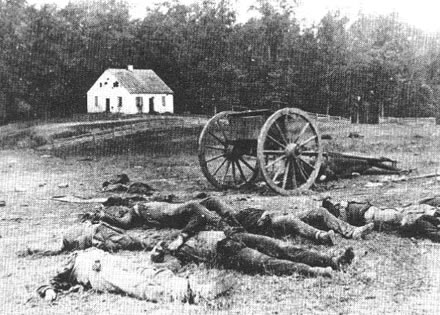
Color photos of a dead soldier are much different than black and white photos.  How much more vivid and horrific would that photo of Kim Phuc been had it been published in color?  It is easy to overlook the blood, gore and trauma of a battlefield injury in black and white.  The mind knows it is there, but the emotions react more to the presence of the person in the photo, empathy and horror that this man or woman was gunned down in the prime of his life.

But color forces a person to see, first and above all else, the blood.  Red will draw the eye immediately.  No longer is the viewer looking at the person’s face and imagining being in that situation or sympathizing with the family left behind.  Rather, like watching a slasher movie, the viewer is simply looking at the grotesqueness of the injury, wherever that injury is.  I would argue that color in fact dehumanizes a battlefield photo so much that it DOES become obscene in a way.  It turns a very human tragedy into a Hollywood set piece.

That is not an excuse not to publish these kinds of photos.  But I do think we need to examine what we want to really show in these photos, what emotions we want to evoke, and whether or not the photos that show intense and graphic war violence in very living color will really accomplish what we’re setting out to do.

(Photo of Antietam by Matthew Brady)
The Risks Of Sharing

by Doug Allen

Richard Nieva sees the insurance industry as the biggest threat to the increasingly popular “sharing economy”:

Airbnb ran into issues when some hosts reported guests ransacking and stealing of their property. And Uber, the black car taxi service — the most successful of auto-related sharing companies — made headlines recently when the company’s contracted drivers staged a protest in San Francisco, partly over outrage that Uber doesn’t own a commercial insurance policy, meaning the drivers themselves are liable for any accidents they might get into.

As the sharing economy burrows its way into people’s everyday lives – or at least out from the realm of absurdity – there’s been a familiar refrain echoing throughout the blogosphere and traditional press: City hall has been getting in the way. Indeed, in many cases, government regulators have taken a hard line against the sharing economy companies. … But even with the long laundry list of attacks by city hall, the trickiest obstacle for sharing economy companies – particularly in the car-sharing space – is the arms length relationship they have with the insurance industry. Early adopters — call them the Napster generation — are happy to break the law within reason. Putting their savings at risk by lending an asset that insurance won’t cover (up to a certain point) may be another matter.

The Stigma Against Cheap Weddings, Ctd

by Patrick Appel

In response to this post, a reader writes:

I am one of 6 children and a member of an even larger Irish-Slovak Catholic extended family.  My wife and I are both college graduates with liberal arts degrees; getting by just fine, but by no means with the disposal income that would be required to throw a nice event for the number of people whom we consider ourselves to be really close to.  Once invites are extended beyond parents and siblings, the number of people we would “need” to invite would immediately jump into the hundreds.  We simply did not have the budget for this (and it was not a matter of choosing not to dip into savings; savings do not exist).  So, with some emotional and brief interpersonal turmoil, we only invited our immediate families and a close personal friend each to stay at 2 beach houses we rented for a weekend in Cannon Beach, Oregon.  Our guest list was 30 people.  We prepared the food ourselves, we bought the beer, wine, and liquor from costco, there was no photographer, or other hired help.  It was a family celebration, as it seems, is the whole idea behind a wedding ceremony, in the first place.

We were able to provide a level of setting/accommodation, food, beverage and activity that we could never have dreamed of if we had to extend invitations beyond the sphere that we did.  But, we were able to host an amazing event for the 30 most important people in our lives, that they all still talk about.  It was an amazing weekend for all involved.  In fact, though we would have liked to share that experience with many, many more people, I think that everyone– us included –enjoyed that experience much more than a rented party facility with standard catered fare, DJ/band, floral centerpieces, etc.  We recognized the importance and significance of making our commitment to each other in front of those who are most important in our lives, and wanted to provide them with an experience that they would always remember.  I think we definitely achieved our goal, and though the cost was definitely in the thousands of dollars, it was much less than half of what the “average” wedding costs today.

Both my wife and I have many friends from the East/West/Midwest young educated class that have chosen to celebrate their nuptials in similar fashion.  I think a nice intimate event shared with those you love most is a much more pleasant and ultimately meaningful celebration than the very expensive cookie cutter fiesta that leaves all involved feeling frazzled and stressed.  If I am going to spend $30k on something, I am going to get a lot more out of it than what I have witnessed siblings, cousins, and friends get out of their rather humdrum, but very expensive weddings.

Another reader:

Maybe I was lucky, but last year when my husband and I decided to abandon our plans for a blow out wedding, and instead opt for a small ceremony at my parents’ house over Christmas with family already in town, no one was quick to judge our financial situation. When we sent out invites, I told everyone “I found out I was going to have to pay $600 for table cloths. That’s not happening.” I don’t care how much money we have — that’s just ludicrous! Instead of the financial judgement, though, we got frequent calls asking “Are you pregnant???” from any family or friends over the age of 50. When we mentioned this to friends closer to our age, it was amazing — each of them said “That hadn’t even crossed my mind!” Either there’s a big generational divide in assumptions here or our friends were lying to our faces.

Anyway, our wedding was amazing and meaningful and perfect, and exceedingly cheap to boot! We even streamed it online for the family and friends we had to cut off the invite list to keep costs down. They were happy to watch, and happier to not have to attend or bring a gift. It was perfect all around! (And I’m still not pregnant, Uncle Jim.)

A final reader makes an important point:

“Average cost” does not necessarily mean “typical cost.”  This is especially true with something like a wedding, where the wealthy spend exorbitant sums and skew the statistic.  If four couples have $9,000 weddings and one couple has a $100,000 wedding, the average wedding cost is $27,000 — but let’s not interpret that to mean that that’s what most people should expect to pay.

A 2007 WSJ article provided better numbers:

For the three surveys, the median wedding cost is closer to $15,000. The median is the middle figure when you line up a set of numbers in order of size. It is a popular choice for social statistics because it is unperturbed by very small or very large numbers.

Debating Debates

by Doug Allen

Howard Kurtz responds to Stuart Stevens’ call for fewer debates in the primaries:

It’s not surprising that Stuart Stevens wants fewer presidential debates, since his candidate Mitt Romney got beat up in so many of them. But his suggestion, in his debut column for The Daily Beast, that the debates be wrenched away from the networks is way off the mark. Maybe he’s suffering from posttraumatic debate syndrome, but these televised extravaganzas actually give the country a good look at how the candidates perform under pressure. … A strong candidate knows how to hit major-league pitching.

Justin Green counters:

I’ll indulge the sports metaphor: having 18 debates before the first actual vote is like asking a pitcher to throw 300 pitches while warming up in the bullpen.

At a certain point, all you’re doing is wearing down your arm. And after, let’s say, four or five debates, a voter will have all the information he or she needs to make an informed choice. The Michele Bachmann screeds about stealth jihad, the Ron Paul demands for a gold standard and Newt’s rambling about Newt-things quickly reach the point of no longer being helpful to the democratic process. …

[W]as there a single moment from the primary debates that added something substantive to the presidential race? Did we really learn how any of the candidates handled themselves under pressure? Were conservative ideas vigorously debated, with differing viewpoints well-represented? Were conservative voters offered a variety of options that gave them a hand in shaping the future of the Republican Party? Did the debates strengthen the GOP? Did they strengthen the general election?

My answer on all counts: no.

The NRA’s Unlikely Role Model, Ctd

by Chris Bodenner

A reader writes:

This Winkler person trying to gin up the idea that the NRA got its ideas about strutting their gun culture in public from the Black Panthers … please. I was politically awake in California at that time.  There was a HUGE cultural backlash, from racist gun-culture-loving whites, against the “nerve” of those Black Panthers appropriating white conservative ideas – which were already long-cooked in the 1960s – of patriotic militias defending their rights against oppressive big governments. The idea that today’s West Coast NRA types who delight in congregating at their local Starbucks, armed up, to rile the local liberals, took this idea in any way from a now-obscure Black Panther model, instead of from their own generations of intense culture-worship of founding fathers with guns, backwoods pioneers with guns, cowboys with guns, American soldiers with guns, and John Wayne (and many others) playing at cowboys-and-soldiers with guns on the silver screen, is truly nonsensical.

Another is on the same page:

The NRA was singing the 2nd amendment tune long before there were Black Panthers.  I went to summer camp in the late 1950s, where we did archery and riflery, each under the banner of a national association, from which we earned kiddy honors, complete with sew-on patches and medals. So I became a junior member of the NRA, and read The American Rifleman, the NRA magazine.  It was full of the same bullshit still put forth: the only thing standing between the upstanding US citizen and government tyranny was the fact that some of the citizens were packing heat.

I proudly repeated this stuff to my father.  I figured he’d appreciate my attention to the Constitution, since he taught Constitutional Law.  He slapped it all down pretty quicky. “Read the amendment, and tell me what a militia is.  If gun control is really unconstitutional, they could get a ruling on that.  But the courts have always read the ‘right’ as related to militias.  It doesn’t work for them, so they just lobby against any laws they don’t like.  That ‘bulwark against tyranny’ line is just John Birch stuff.”

Well, the NRA finally found a Court that was willing to ignore the word “militia” and the concept of “well-regulated” – overturning 230 years of jurisprudence.  It’s a Court that claims to be traditionalist and modest in its reach.  Oh, sure: The Court said, “Let any unstable jerk be a militia, and let him regulate himself.” And the Court saw that it was good.  And the Court said “Let the corporations be people”.  And the Court saw that it was good.  This Court is detached from reality, lost in the swamps of theory, and radical.

The following passage is from the same email by the reader who said he prevented his rape in a hotel room by pulling out a gun:

By the way, your coverage of the ongoing gun debate has been nothing short of terrible and incredibly one-sided.  But I understand different people have different opinions.  And nothing being proposed so far would have impacted my ability to defend myself in that situation, so it’s a bit irrelevant to the gay rape issue.

But it’s worth pointing out.  The Frum quote you posted about the Black Panthers was particularly distressing. Reading his larger piece, he calls hunting an “increasingly marginal” activity, since only 6% of Americans have purchased a license, seemingly indicative of Mr. Frum’s long-term feeling that guns aren’t worthy of constitutional protection.  What then does that mean for Jews like himself, who are a nearly statistically irrelevant 2% of the population.  Or gays, who are likely closer to to 6% than the previously claimed 10%.  Are gays a marginal population?  Six percent of Americans is 20 million people, which doesn’t include all those over 65 or with their own land who generally don’t need a license to hunt. By way of comparison, 7% of Americans (25 million) played golf last year. Does David Frum think golf is an increasingly marginal activity??

Nothing in Winkler’s book should be a surprise to anyone who spent time examining the issue beyond merely reciting the talking points of the Bloomberg activism machine.  In fact, the reaction to the Black Panthers by the establishment (with the NRA’s support) passing onerous gun control laws designed from the outset for enforcement in a discriminatory fashion against blacks is the very reason the NRA’s membership erupted and split. All the Democrats these days pining for the NRA to return to the NRA of old, or Republicans to emulate Ronald Reagan (who oversaw the passage of those and other laws), are really asking for a return to the terrible days when it was considered acceptable to pass laws as long as the intent was only to impact those “other” people.  It’s reprehensible, and indicative of the deep distrust Americans have, for any attack on our rights.

Previous Dish on Winkler’s wonderful 2011 Atlantic piece here. Money quote:

The day of [the Black Panthers’] statehouse protest, lawmakers said the incident would speed enactment of Mulford’s gun-control proposal. Mulford himself pledged to make his bill even tougher, and he added a provision barring anyone but law enforcement from bringing a loaded firearm into the state capitol.

Republicans in California eagerly supported increased gun control. Governor Reagan told reporters that afternoon that he saw “no reason why on the street today a citizen should be carrying loaded weapons.” He called guns a “ridiculous way to solve problems that have to be solved among people of good will.” In a later press conference, Reagan said he didn’t “know of any sportsman who leaves his home with a gun to go out into the field to hunt or for target shooting who carries that gun loaded.” The Mulford Act, he said, “would work no hardship on the honest citizen.”

Yet another example of how Reagan is such a false idol for the contemporary GOP base.

Where There’s Smoke, You’re Fired, Ctd

by Chris Bodenner

A reader writes:

I am an ex-smoker (I quite a three-pack-a-day habit almost 40 years ago), so I have great sympathy for nicotine addicts.  I have worked for a major corporation that had a no-smokers policy (the boss had quit and thought it was a good idea; it was his company).  But I have no space for UPenn’s irrational policy with respect to smokers.

If health and its associated costs are the criteria for hiring, then are they hiring people with high BMIs, high LDL-low HDL, high blood pressure, diabetes, alcoholism or any other health issue?  Likely yes, because the ADA won’t let them discriminate.  Well, I believe there is enough evidence available now to include nicotine addiction under the illness rubric.  I won’t go into serotonin and dopamine reactions, but a quick Google search will yield a lot of information that you would expect PennMed to already possess. It would seem that just because they can discriminate against smokers (and not any of the other health issues), PennMed is discriminating.  That may be good for the bottom line.  It will not do anything for smokers.  And it stinks worse than cigarette haze.

Another also goes after “nanny-state paternalism”:

So are they going to stop hiring obese people as well?

You know, I get that there is an externality on the health care system now that we are all buying in, but they could just pass the premium increase on to the employees. ObamaCare specifically allows insurance companies to charge smokers more, and even though we pay ridiculously huge taxes on our smoking already, I’d be OK with paying double the Pigovian tax rate.  It’s not economically efficient, but it’s ok – a bit of tax-incentive nudging by the government in health policy isn’t the worst thing in the world.  We encourage home-ownership and retirement savings as well, and I think we should tax the hell out of pot too, so fine.

But this is just stupid.  It is not about health.  It is about image and heavy-handed, nanny-state paternalism which is different not just in degree but in kind from small price incentives or public health campaigns (even if these are incentives are larger than the economically “optimal” level).  Somehow it has become OK for people to find pleasure in excessive food or alcohol or risky sexual behavior (all of which induce the same kinds of public health externalities), but not in tobacco.

So here’s my deal: don’t hire smokers, but don’t hire overweight people, drinkers, or anyone who enjoys recreational sex either (or for that matter, anyone who risks their body in expensive ways playing soccer or mountain climbing or doing anything vaguely dangerous and fun).

Update from another:

It seems to me that readers complaining about “nanny-state paternalism” in private companies are trying to have their ideological cake and eat it too. Last I heard, no one was talking about making it illegal to hire smokers – and in fact I imagine that in the end, the nanny-state paternalism of the ADA will strike down no-smoker policies. But for libertarians, why does their right to smoke trump my right to run a company with just the “image” I want?

The GOP’s Green Base

by Doug Allen

Fox News may mock renewables:

But they do not speak for all Republicans. Brian Merchant points to a new survey from the Yale Project on Climate Change Communication, which focused on attitudes toward climate change among self-identified Republicans and Republican-leaning independents:

Republicans still love clean energy. I mean, overwhelmingly love the stuff by epic margins.

Some of the report’s findings:

A large majority of [Republican] respondents (77%) support using renewable energy in America much more or somewhat more than it is used today (51% and 26%, respectively). Among those who support expanded use of renewable energy, the most common preferred timing for taking such action is “immediately” (69%).

A slight majority of all respondents (52%) support using fossil fuels in American much less or somewhat less than it is used today (21% and 31%, respectively). Among those who support reduced use of fossil fuels, the most common preferred timing is “immediately” (52%). By a margin of almost 2 to 1 (64% vs. 35%), respondents say America should take action to reduce our fossil fuel use.

Your Marijuana Resort And Spa

by Brendan James

Matt Brown, one of two guys opening a kind of vineyard tour circuit of Colorado dispensaries, explains why he’s not worried about a visit from the feds:

Colorado has not seen enforcement action like you’ve seen in California, where they’re kicking in the doors of dispensaries. And that’s because Colorado has the most sophisticated medical marijuana regulatory system of anywhere in the world. At this point we have 400 pages of regulations and laws, so it’s very easy to tell if this person is following the rules, and that person’s selling 150 pounds out the back door. But we’re still being cautious. We’re not here to poke our fingers in anybody’s eye or annoy the federal government. We just want to help people and make the process of finding weed more normal.

Normal is what we have in Colorado right now. You buy your weed at a store, and it has hours. I was saying to my friend the other day, “Aw man, it’s 7:30, the weed store’s closed. Oh well, I guess I’ll wait until they open tomorrow morning at 9.” That’s normal. That’s what it should be.

The Daily Wrap

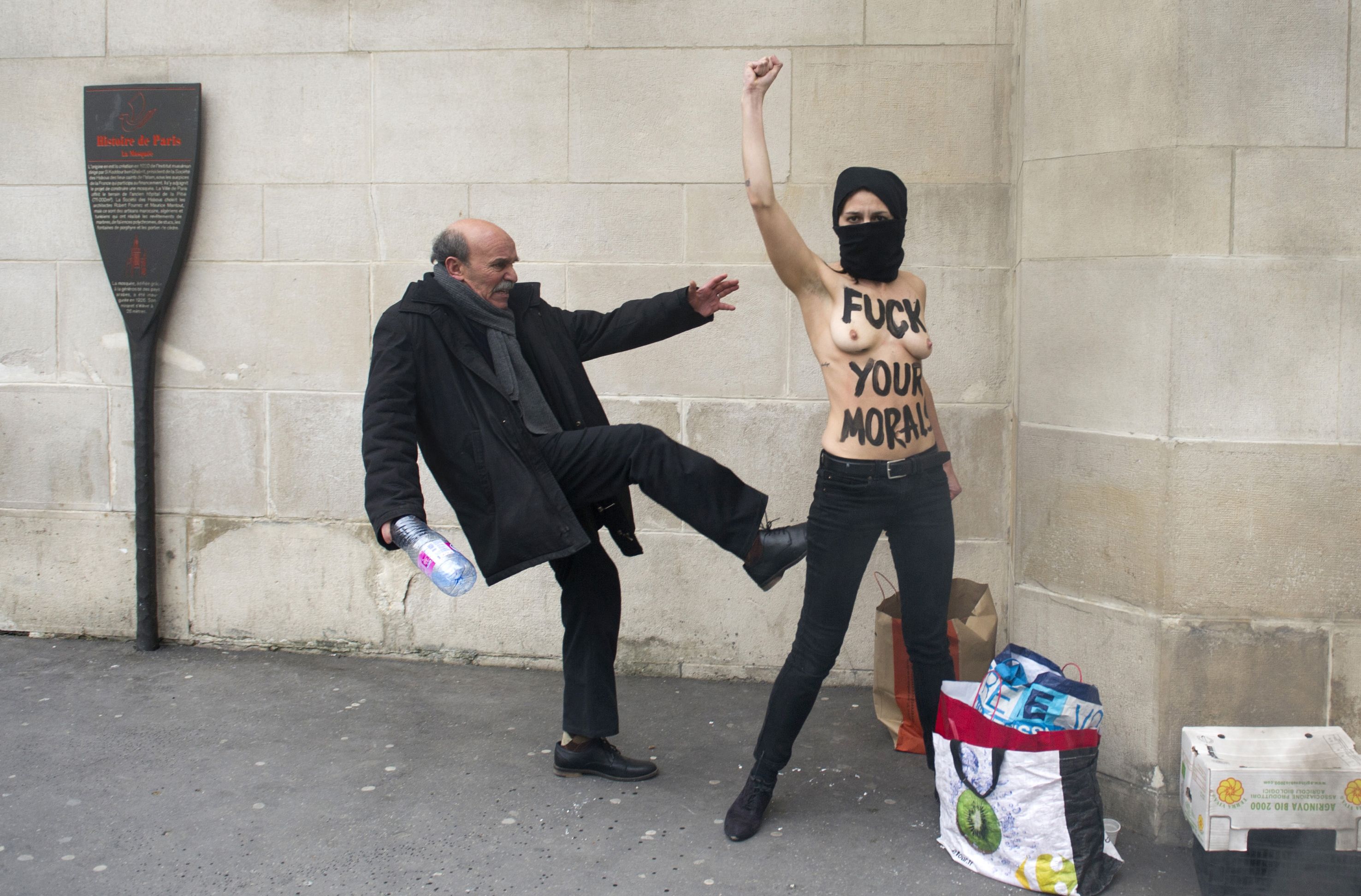
FRANCE-FEMEN-DEMO

Today on the Dish, readers asked Andrew where federalism begins and ends, Nick Beaudrot kicked off a discussion on blogging as a way of life and Matt Sitman looked at Pope Francis as a Jesuit. Suderman caught up with the hiccups in Obamacare, Weigel measured lack of interest in the sequester and Pareene wondered if we’ve seen the last of the Clinton hacks. We discussed the economic reasons of the “decline” of marriage, checked in on the demise of the Euro, and Adam Alter noticed a connection between a hurricane’s name and how much we give for relief.

We caught Americans running drugs on the Mexican border, kept considering the plight of the snitch, and welcomed terrorism back to the silver screen. We pondered the significance of teacher cheating, asked if we’re hardwired for language and toured a lonely, lonely shopping center. Elsewhere, we updated readers on the Dish experiment, unearthed the very first Face of the Day, and readers sounded off on the restaurant EZ pass. Kate Crawford differentiated data and truth, Calvin Trillin extolled the joys of the floating editor, while Zoe carried on the marriage-surname discussion (and announced some exciting news).

Later, Moynihan cringed at his Wikipedia entry, we eyeballed how many of our fellow citizens go for UFOs and trutherism, and readers shared their experience of sensual sneezes. We reckoned with the power of Wagner and revisited Ware’s broken leg as Evan Selinger opened a drawer of old thank you notes. Andy Greenwald said a good word for bulk watching Game of Thrones while Woodman defended the misuse “literally.”

Finally, we looked out on London for the VFYW, spotted tiny tourists beneath a big Face of the Day, took a somber look back at Fraggle Rock for the MHB.

­–B.J.

(Photo: A man kicks a topless activist of the Ukrainian feminist movement Femen as she raises her fist to protest against Islamists in front of the Great Mosque of Paris on April 3, 2013. By Fred Dufour/AFP/Getty Images)

Francis Emerges, Ctd

by Matthew Sitman

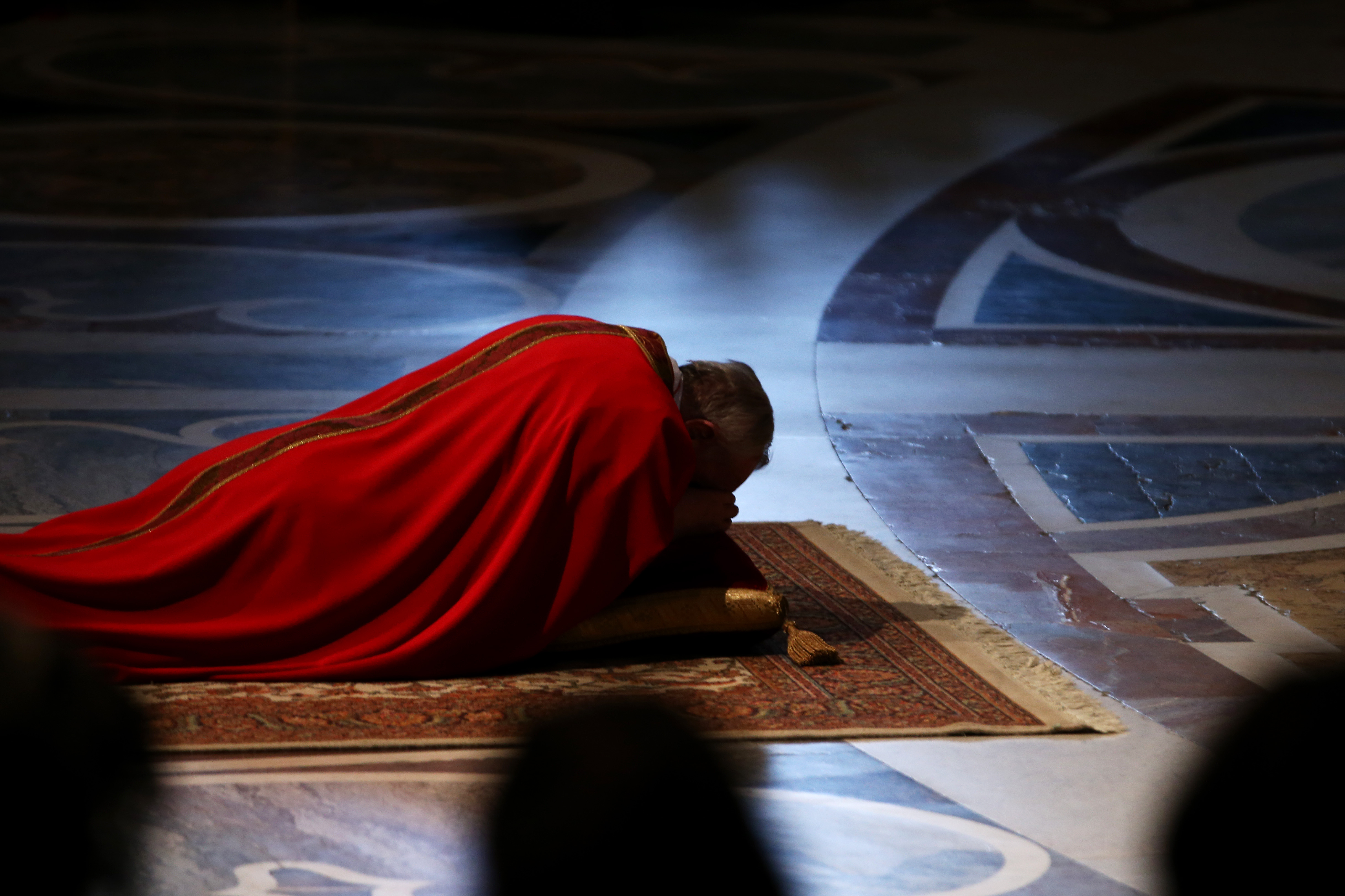
Pope Francis Attends Celebration Of The Lord's Passion in the Vatican Basilica

J. Michelle Molina finds the heart of Jesuit formation – St. Ignatius’s Spiritual Exercises – to be a revealing, but thus far largely neglected, way to understand Pope Francis:

No matter how we stake our political or religious claims, any effort to understand the man ought to include a sense of the Spiritual Exercises, a Jesuit meditative program of spiritual renewal that connects self-reform to transformative action in the world. These meditations offer a framework with which to interpret Francis’s actions because they have provided the key metaphors with which the Jesuit Bergoglio has sought not only to know himself, but also to engage the world.

One point of emphasis in the Exercises:

[The Jesuit] joins the twin goals of contemplation and action in a world understood in both geographical and existential terms. “Jesus knocks from within so that we will let him come out.” These words echo a very Jesuit notion that personal reform is linked, in the words Bergoglio drew upon to inspire the conclave, to an evangelizing church that is “called to come out of herself and to go to the peripheries, not only geographically, but also the existential peripheries: the mystery of sin, of pain, of injustice, of ignorance and indifference to religion, of intellectual currents, and of all misery.” He has eschewed certain liturgical vestments as, quite literally, trappings that would encumber his desire to walk in the world. And this sense of self in the world likely inspires Francis’s controversial symbolics, such as the washing of women prisoner’s feet.

I think this is very perceptive, especially because – as Molina intimates – it allows us to avoid imposing simplistic categories on Francis. Recently we featured a quote from Jody Bottum that made exactly this point, that our usual political labels don’t make much sense when applied to Francis, nor, at its best, historic Christianity more broadly. There’s no reason we should expect a man forged in spiritual practices developed in the 16th century to fit comfortably within any contemporary ideology scheme. And even more, the notion of contemplation joined to action in the world seems particularly fitting when considering Francis, as he appears to be intent on his deeds, from the simplicity of his lifestyle to the washing of a woman’s feet, conveying as much as his words. That style of leadership, that way of living, surely has its roots in the rich tradition of Ignatian spirituality.

There’s one other point worth making here. Molina notes this about Francis’s experiences with the Spiritual Exercises:

Bergoglio has made the full 30-day version of the Spiritual Exercises at least twice and has repeated the shorter, eight-day version every year since he entered the Society of Jesus in 1958.

A 30-day regimen of prayer, meditation, and introspection is an experience most of us probably have trouble fully imagining. One aspect of Ignatian spirituality, as Molina’s article makes clear, is knowing yourself. To overcome or transcend the self one must be acquainted with the darker corners of your soul. The humility and compassion Francis evinces, I suspect, comes at least in part from the rich inner life, the self-critical inward turn, that is a part of the Exercises. A deep awareness of your own faults and failures – a contrite heart – is the precondition for the extension of mercy and love to others. It isn’t surprising, then, that the Jesuit “activism” of Francis has skewed not toward ideological, political ambition, but humble service. Molina’s sketch of the new pope’s Ignatian formation goes as far toward explaining why this is so as any account I have read.

(Photo: Pope Francis prays on the floor as he presides over a Papal Mass with the Celebration of the Lord’s Passion inside St Peter’s Basilica on March 29, 2013 in Vatican City, Vatican. By Dan Kitwood/Getty Images)