London, England, 6.35 pm
London, England, 6.35 pm
Evan Selinger ponders the place of thank-you notes in today’s digitized world:
People like Nick Bilton over at The New York Times Bits blog argue that norms like thank-you messages can cost more in time and efficiency than they are worth. However, such etiquette norms aren’t just about efficiency: They’re actually about building thoughtful and pro-social character.
Take my six-year-old daughter. When she looked at her new iPod Touch (a Chrismukkah gift), she saw it as a divine labor-saving device. Unlike the onerous handwritten thank-you notes she had to do for her birthday, she envisioned instead sending quick thank-you texts to friends and family. Months later, she still doesn’t understand why her parents forbid the shortcut. And she won’t. Not anytime soon.
Why he’s sticking with the paper version:
At stake … is the idea that efficiency is the great equalizer. It turns every problem into a waste-reduction scenario, but its logic has a time and a place. Social relations are fundamentally hierarchical, and the primary way we acknowledge importance is through effort. Sending laconic thank-you texts to family treats them no differently than business associates.
A reader writes:
I was going to save this topic for my own blog but this thread at the Dish has compelled me to write in. Other countries have already solved this “waiting for the cheque” problem years ago and they did it with a very low-tech solution.
In the past five months I’ve traveled to Australia once and the UK twice. One thing I noticed about some of the restaurants / pubs I visited was that they make you pay at the bar. Each food / drink purchase is a discrete transaction. You go to the bar where you give and pay for your order. You then take your drinks right away and if you ordered food they give you a marker and when it’s ready they bring your meal to your table. You repeat the process if you want more.
What I like about this approach is that it scales very well. The bar is optimized for taking orders and the customers transport their own drinks. One or two guys drop off the food and collect the empty glasses. Compare this with back home where servers in most restaurants and pubs will keep track of drink and food orders throughout the evening and give individual cheques when one or all of the patrons are ready to leave. The North American system only works well if it’s a small group where everyone is sitting in a fixed location for the whole evening and everyone has a car to get them home.
I’m the organizer of a social group that meets every Wednesday for a cinq-à-sept (five-to-seven), which is French Canadian for “happy hour” (note to all you Dishheads who think you’ve just improved your foreign language skills: be careful. In France it means something completely different.) On any given week between 30 and 60 people will show up. I’ve organized over a hundred of these evenings at a dozen different pubs / restaurants and I can say without hesitation that a system like they have in the UK / Australia would greatly improve our Pub Night events.
The North American system doesn’t just waste 20 minutes at the end of your evening; it’s the source of a bunch of other problems too. Orders for large groups take much longer and sometimes people forget to pay (intentionally or not). Sometimes customers don’t have enough money (this can’t happen if you have to pay before you order). It’s also hard on the servers who have to keep track of everything. And it breaks the rhythm of the evening if you want to move locations. You can’t just get up and leave; you have to wait for everyone to pay and this can take a long time depending on the size of the group.
Tabbedout looks promising but it only speeds things up if everyone in your party is using it which is unlikely to happen if you’re more than four people. What I would like to see is more restaurants adopt the UK / Australian model.
Another broadens the discussion:
When someone suggests that there’s an app for that, I wish the blog post or article would say how many people have smart phones, how many people have cell phones that aren’t smart phones, and how many people have land lines.
An app won’t help my father-in-law, who doesn’t have a cell phone. He eats out pretty regularly. An app won’t help my mother, because she only has a regular cell phone, not a smart phone. OK, they’re in their 80s. An app wouldn’t have helped one of my kids until recently, because of their phone contract. Thankfully, the contract expired. I’m in my early 60s. I would like to convert my cell phone to a smart phone, but if I do that, the monthly cost will have to come out of my restaurant budget. If I had to use an app to get efficient service, I couldn’t afford to eat out.
I spend too darn much on technology. There’s television, broadband and land line phone bundled into a big package with a big bill, plus a cell phone bill every month for just one person. Being a single person is expensive; I’m a widow, but I am a lot more sympathetic to the comments of single friends these days. I could get rid of the land line phone, but that would save almost nothing. I can’t do without the broadband because I work from home some of the time. I don’t watch much television and don’t get HBO, so I don’t feel I’m being extravagant even though I only spend a few hours a week in front of the set.
If I only had to pay for a phone, I’d have a smart phone. But I need other services, too. They cost money and they don’t seem to be included in consumer price indexes. When I was growing up, television was free and in our geographically difficult area, a good signal was hard to get. My husband grew up in a region with good signals and access to more than one metro area, and he heard a much wider selection of music on the radio and saw more television than I did as a kid – when I got a transistor radio in high school, there was only one station that really came in clearly. Now I have to pay to have things come in clearly, and I also have to pay to have Internet access. I’m dreading the day when a smart phone becomes a necessity, because then my monthly budget will be more expensive even though my income isn’t increasing.
Technology is making our lives very different, but it is a heck of a lot more expensive than writers from the national media acknowledge. Let’s take a sort of Suze Orman moment. Not saving for retirement? How much would you have in that retirement account if you relied on an antenna for television and never got cable? Kids need a college fund? How much could you have saved by not buying computers or paying for broadband? (Yeah, that brings up the issue of how the kids could get into college without access to computers and the Internet, so why aren’t those costs considered part of the market basket of essential expenses?) You know a senior citizen who needs more money for medications or a poor family that needs more cash for medical care? What would Suze say – “Ditch those cell phones and save, people”? Maybe the 47 percent have just had a hard time keeping up with the additional cost of supporting Microsoft, Apple, Verizon, among others, along with the cell phone and cable companies.
While I know it is possible to do without television, I think the time has come to agree that Internet access and basic cell phone service are, well, basic requirements. But a smart phone to pay a restaurant bill quickly is not a basic requirement. Find another way to serve all the credit card customers, not just the ones with pricey phone plans.
I wish I wasn’t turning into a curmudgeon, but money is a dimension often left out of discussions of technological solutions. Figure out the cost of the shiny new app and the equipment it runs on before recommending it to all of us.
Kate Crawford warns against believing “that massive data sets and predictive analytics always reflect objective truth”:
Data and data sets are not objective; they are creations of human design. We give numbers their voice, draw inferences from them, and define their meaning through our interpretations. Hidden biases in both the collection and analysis stages present considerable risks, and are as important to the big-data equation as the numbers themselves.
For example, consider the Twitter data generated by Hurricane Sandy, more than 20 million tweets between October 27 and November 1. … The greatest number of tweets about Sandy came from Manhattan. This makes sense given the city’s high level of smartphone ownership and Twitter use, but it creates the illusion that Manhattan was the hub of the disaster. Very few messages originated from more severely affected locations, such as Breezy Point, Coney Island and Rockaway. As extended power blackouts drained batteries and limited cellular access, even fewer tweets came from the worst hit areas. In fact, there was much more going on outside the privileged, urban experience of Sandy that Twitter data failed to convey, especially in aggregate. We can think of this as a “signal problem”: Data are assumed to accurately reflect the social world, but there are significant gaps, with little or no signal coming from particular communities.
I would only add that these problems are not unique to big data, though they are more likely to be ignored with a larger dataset. In any data analysis, it is important to think about not only the data that you have, but also the data that you don’t have.
PPP recently took the conspiracy-temperature of 1,247 registered voters. An unimpressed Joshua Keating sums up the poll’s more sensational results:
Among the survey’s big findings are that 51 percent of Americans believe JFK was killed by a conspiracy, 21 percent believe a UFO crashed at Roswell, 13 percent believe Barack Obama is the antichrist, 7 percent believe the moon landing was faked, and 4 percent believe “lizard people” control our societies by gaining political power.
He admits that while there are certainly some true believers out there who buy into theories like a global-warming hoax or Saddam Hussein being involved in the 9/11 attacks – he thinks the results are most likely skewed by the suggestible:
The day after April Fool’s Day is a good time to reflect on the fact that many of us are more suggestible than we’d like to admit. We’ve all had friends who have unquestioningly shared fake news stories on Facebook (There’s a whole blog devoted to them) or relatives who’ve forwarded us dubious conspiracy e-mails. The questions asked on the survey are detail-heavy and quite specific. For instance: “Do you believe Paul McCartney actually died in a car crash in 1966 and was secretly replaced by a lookalike so The Beatles could continue, or not?” We might hope that most people would say, no, of course not. If they had even heard of the theory, they would probably know that it was a running joke propagated by the Beatles themselves. But a significant number of people probably just heard all those facts and dates and though, “Huh, well I guess so.”
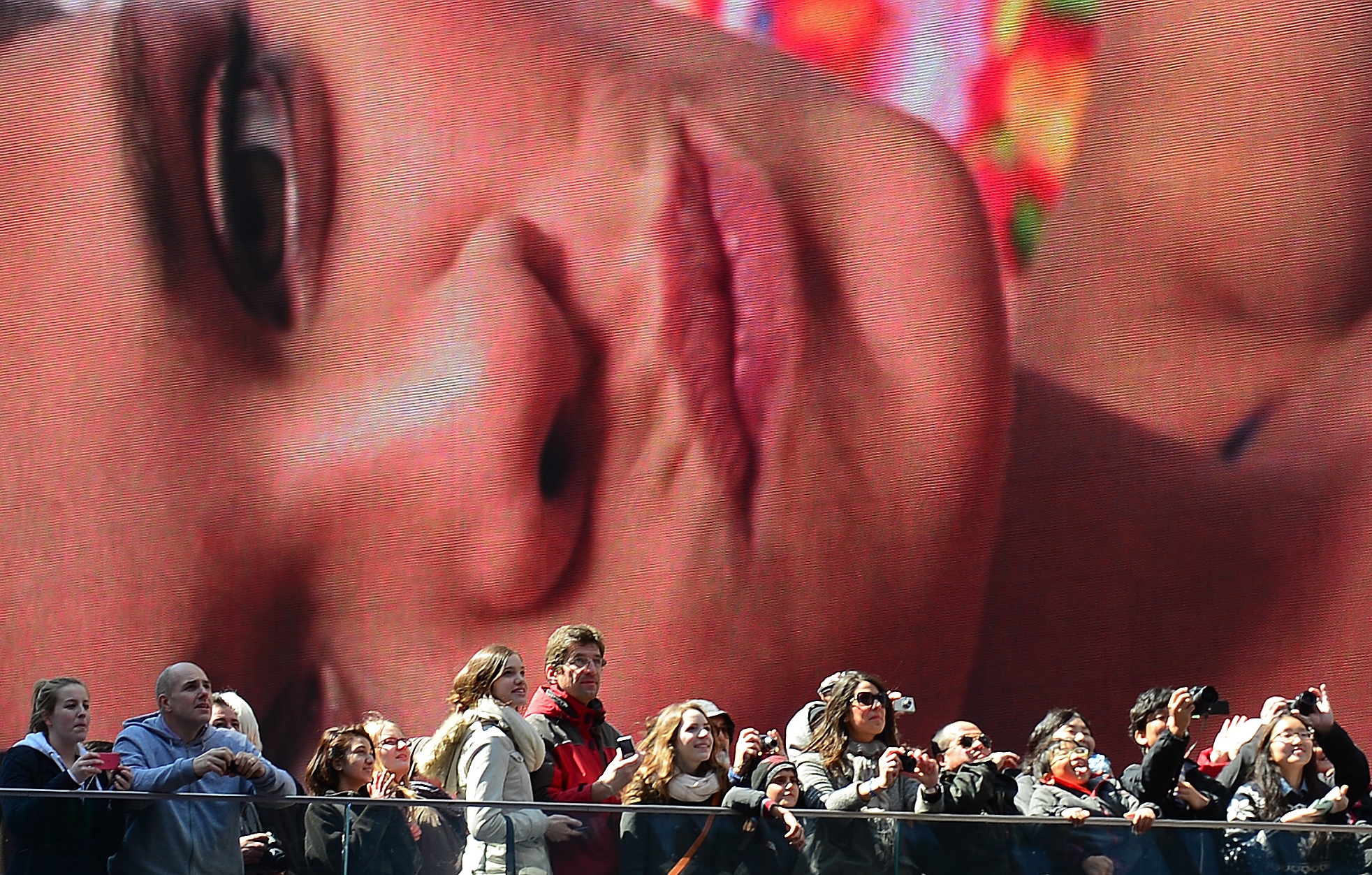
Tourists enjoy the sights while visiting Times Square and its giant advertisement billboards on April 3, 2013. By Emmanuel Dunand/AFP/Getty Images.
Calvin Trillin recalls his early days working at Time magazine. He was a “floater,” an editor “who was brought in to a section when, say, the person who wrote Sport was home with the flu, or when one of the World writers was on vacation”:
There were some enjoyable aspects of being a floater. When I settled into the desk chair of, say, the Education writer, someone who presumably pored through the education quarterlies and lunched with school reformers and kept abreast of the latest disagreements about how best to teach reading, I could feel myself imbued with the authoritative tone favored in those days at Time; I called that “instant omniscience.” I had become adept at using one of the tools employed to assert Time’s authority—what I thought of as the corrective “in fact,” as in “Democrats maintain that the measure would increase unemployment. In fact…” There were no bylines in Time then, so the readers had no way of knowing whether the Art section’s critique of the new Coventry Cathedral had been written by someone steeped in the history of church architecture or by a floater who’d moved in after a short stint in Medicine that had left him with no words in the magazine for two weeks and a more detailed knowledge of loop colostomy procedures than he’d ever hoped to have.
Adam Alter explains:
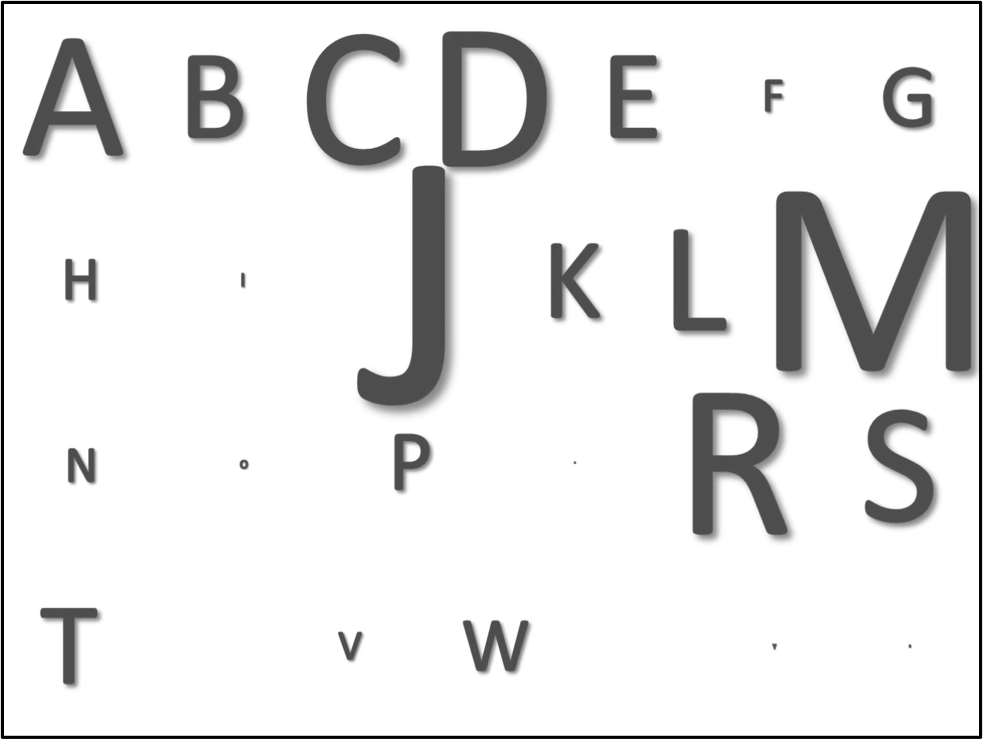
[P]sychologist Jesse Chandler and his colleagues found that people donate significantly more money to hurricanes that share their initials. So Roberts, Ralphs and Roses donated on average 260% more to the Hurricane Rita relief fund than did people without R initials. Also in 2005, people with K initials donated 150% more to the Katrina relief fund, and in 2004 people with I initials donated 100% more to the Ivan relief fund.
This information isn’t just idly interesting. Since we know that people are more likely to donate to hurricanes that share their first initials, the World Meteorological Organization has the power to increase charitable giving just by changing the composition of its hurricane name lists. In the United States, for example, more than 10% of all males have names that begin with the letter J—names like James and John (the two most common male names), Joseph and Jose, Jason, and Jeffrey. Instead of beginning just one hurricane name with the letter J each year (in 2013, that name will be Jerry), the World Meteorological Organization could introduce several J names each year. Similarly, more American female names begin with M than any other letter—most of them Marys, Marias, Margarets, Michelles, and Melissas—so the Organization could introduce several more M names to each list.
Alter provides the above figure, which “illustrates the relative frequency of each first name initial in the U.S. population by linking the size of each letter to its frequency as an initial.”
Pareene wonders whether they will make an appearance in 2016:
The question for someone considering whether or not to support Clinton in 2016 is, will a Clinton 2016 campaign pass the Mark Penn Test? The Mark Penn Test, which I just invented, determines whether or not a person should be trusted with the presidency, based solely on one criterion: Whether or not they pay Mark Penn to do anything for their campaign. Paying Mark Penn means you’ve failed the Mark Penn Test.
His larger point:
Mark Penn is just the worst example of the general Clinton family habit of associating with the most repulsive party hacks the Democrats have to offer. Her campaign was a dream team of generally useless hacks, from sweatered communications director Howard Wolfson to charmless fundraiser Terry McAuliffe to ill-tempered Harold Ickes (who, unlike the rest of the campaign, at least seemed mostly competent). These are the same Clintons who are responsible for the national stature, such as it is, of Dick Morris.
Fraggle Rock was even more morbid than you remember:
Update from a reader:
I loved Fraggle Rock when my kids were small in the ’80s. It was soooo well done. It was genuinely amusing for them and for me. There was always a thoughtful issue – something concerning the competing populations or something universal to all of them – gently introduced in each episode in interesting and sympathetic ways kids could consider. I’ve thought many times over the years that it’s really quite amazing that it hasn’t come back for subsequent generations. Beats any of the programming available to my grandson today hands down! It’s a great loss.
(Hat tip: Scott Beale)
 The Dish