How Scientific Is Psychiatry?

Not very, according to Gary Greenberg:

A detailed understanding of the brain, with its hundred billion neurons and trillions of synapses, remains elusive, leaving psychiatry dependent on outward manifestations for its taxonomy of mental illnesses. Indeed, it has been doubling down on appearances since 1980, which is when the American Psychiatric Association created a Diagnostic and Statistical Manual of Mental Disorders (D.S.M.) that intentionally did not strive to go beyond the symptom. In place of biochemistry, the D.S.M. offers expert consensus about which clusters of symptoms constitute particular mental illnesses, and about which mental illnesses are real, or at least real enough to warrant a name and a place in the medical lexicon. But this approach hasn’t really worked to establish the profession’s credibility. In the four revisions of the D.S.M. since 1980, diagnoses have appeared and disappeared, and symptom lists have been tweaked and rejiggered with troubling regularity, generally after debate that seems more suited to the floors of Congress than the halls of science. The inevitable and public chaos—diagnostic epidemics, prescription-drug fads, patients labelled and relabelled—has only deepened psychiatry’s inferiority complex.
The Nature Of The Crowd

Will Glovinsky reflects on attitudes toward crowds in literary history and digital modernity:

[A]mid the talk of “the riffraff” and the pervasive anxiety that from this rabble the revolution might spontaneously recur, [19th century French poet] Charles Baudelaire stood apart with his famous dictum épouser la foule (literally, “marry the crowd”). Baudelaire could register as well as anyone the terror of the crowd, but what made him different was his wish to be truly at home in the dirty, swarming city, and to do that he needed to embrace the frisson of crowds. Above all, it was Baudelaire’s willingness to explore the often erotic allure of anonymity and the pleasure of suppressed individuality that allowed him to investigate the logic of crowds — a logic that bears equally on our digital throngs.

In particular, Baudelaire was acutely sensitive to the fantasy of escape into otherness that crowds provide. In one of his prose poems he writes that the man who marries the crowd “adopts as his own all of the professions, all of the joys and miseries that circumstances present to him.” The person in the crowd takes up cares, pleasures, and tasks without a thought of one’s personal business or even one’s credentials. The bricklayer fights in the revolution; the butcher helps dislodge a cart from the mud; and so too the Redditor plays detective by heatedly comparing the eyebrows and jawlines of Tripathi and Tsarnaev….

For denizens of the digital space, the lesson of épouser la foule is not that we should all spend more time in the bowels of Reddit, but rather that we must recognize that we, like Baudelaire, wish to be at home in our new, crowded world. This entails coming to terms with not just the wisdom but also the idiocy, hyperbole, and prejudice of crowds. It means that we need to know beforehand the feverish, speculative nature of the virtual crowd, so that when a slanderous rumor is tweeted at least established news outlets will check their sources.

Despair On The Page

Daniel Matthew Varley reads William Styron’s Darkness Visible alongside David Foster Wallace’s writings on depression, finding the latter the more able guide to despair:

With Styron, we got the sense that he went through something terrible, came out of it and then wrote about it a head-scratching way as if describing some alien spaceship that fell in his backyard. Wallace comes off as someone going through it, describing something that was and always be inside of him. Wallace writes because he needs our support just as much as we need his. We identify with Wallace’s pain, and it enables us to conceive of others identifying with our own. That is powerful and full of beautiful incandescent meaning and creates a crazy-glue bond between an author and reader.

It also comes back to human nature, I guess. Who wants to hang out with the know-it-all who’s got his life together, writing his perfected prose on the back of a doily? Or would you rather be with the the guy who’s a lot more like you, still figuring things out, having moments of brilliance interspersed with royal fuck-ups but still searching for grace? If you answered the latter, you’re probably like a lot of other people who feel a strong bond to Wallace.

To the Wonder‘s Reading List

Processed by: Helicon Filter;

Bilge Ebiri offers a fascinating behind-the-scenes look at how Terrence Malick made To the Wonder, including these details about how the director used art and literature to inspire cast and crew:

As prompts for the actors, Malick shared representative works of art and literature. For Affleck, he suggested Fitzgerald, Tolstoy, and Dostoevsky. (Affleck read Martin Heidegger on his own, having known that Malick had translated one of the German philosopher’s works as a grad student.) For Kurylenko, he also recommended Tolstoy and Dostoevsky — specifically, Anna Karenina, The Brothers Karamazov, and The Idiot. “Those books were, in a way, his script,” she says. But he did more than give the actors the books; he suggested ways to approach the texts and characters to focus on. So, for example, he recommended that Kurylenko read The Idiot with a particular eye on two characters: the young and prideful Aglaya Yepanchin, and the fallen, tragic Nastassya Filippovna. “He wanted me to combine their influences — the romantic and innocent side, with the insolent and daring side. ‘For some reason, you only ever see that combination in Russian characters,’ he said to me.”

In fact, Malick will use existing works of art and literature as touch-points with virtually all of his cast and crew. “It enables them to have a common vernacular on set that’s not about technique, but emotion — a shared memory,” Gonda says. For example, with the producers, the director often referenced paintings. With camera operator Widmer, who is also an accomplished musician, the references were often musical. With his editing team, Malick often passed out books such as Flaubert’s Madame Bovary and Walker Percy’s The Moviegoer. But he would also reference other films: Truffaut’s Jules and Jim, with its heavy and unique use of voice-over, was a constant reference point. (At one point, the score for Truffaut’s film was used as part of a temp soundtrack.) Malick is also a huge fan of Jean-Luc Godard and often referenced Godard films such as Breathless, Pierrot le Fou, and Vivre Sa Vie, for their elliptical narrative and editing styles.

Previous Dish on the film here, here, here and here.

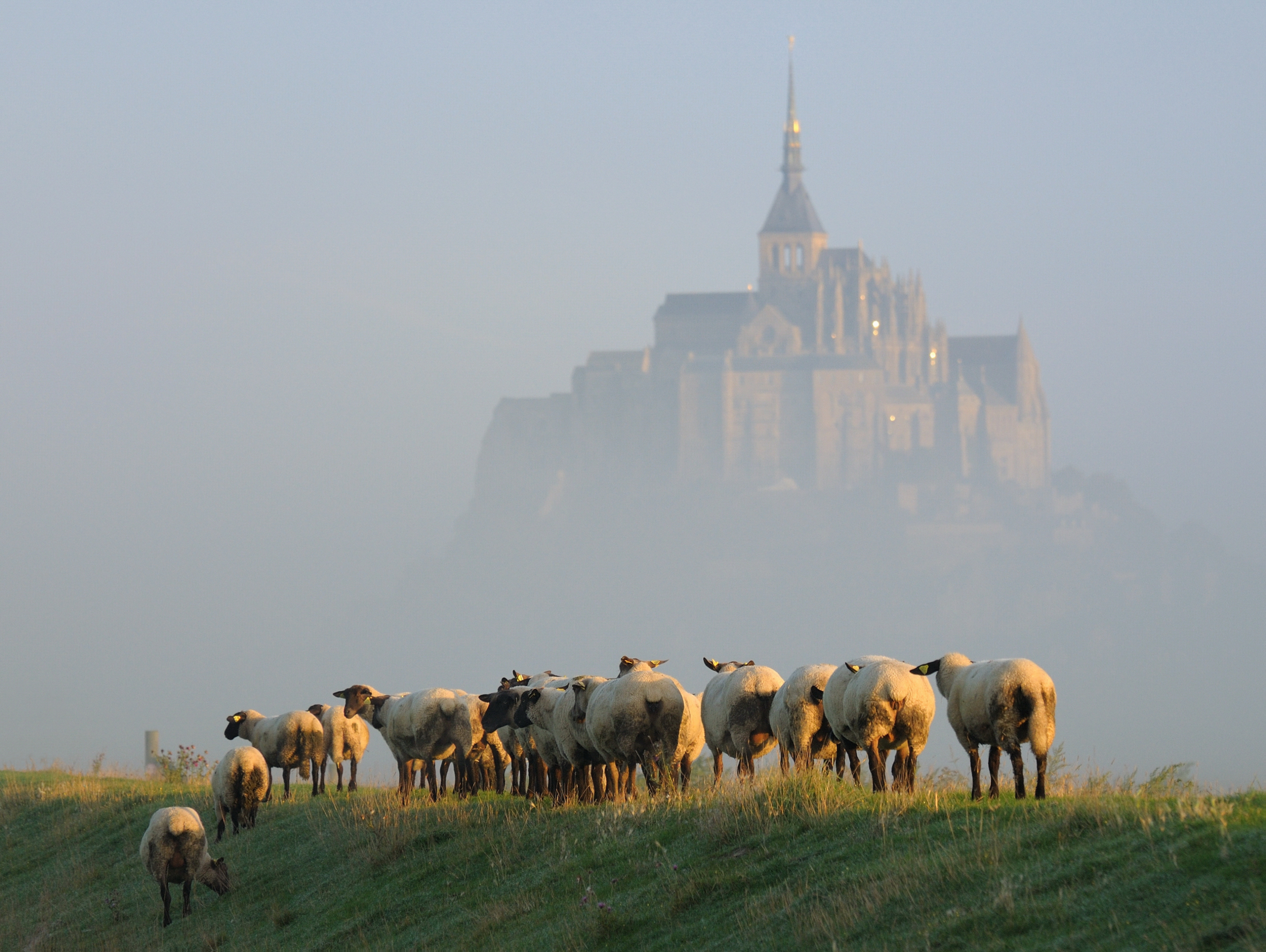
(Photo of Mont Saint-Michel, featured prominently in To the Wonder, via Wikimedia Commons)

To Doubt Is Christian

Christopher Hutton argues that doubt and skepticism are not just for atheists and agnostics, but should be embraced by Christians as an integral part of a fully-lived faith:

Doubt is a thing which many Christians see as opposing their faith. Many have fought it and its prevalence in the modern minds of man. 19th century pastor Robert Turnbull once  stated that “Doubt, indeed, is the disease of this inquisitive, restless age.” Many people react negatively towards any feelings of doubt that they may have, fearing that this doubt means that they aren’t fully committed to God.

However, this fear of doubt is dreadfully dangerous. Not every man who doubts his faith loses it. And if they look at most human lives, they’ll find that if one doesn’t doubt, then one isn’t human. It is a necessary idea for any believer, for it acts as the catalyst and tool for a man or woman to grow.

He goes on to highlight this passage from Timothy Keller:

A faith without some doubts is like a human body without any antibodies in it. People who blithely go through life too busy or indifferent to ask hard questions about why they believe as they do will find themselves defenseless against either the experience of tragedy or the probing questions of a smart skeptic. A person’s faith can collapse almost overnight if she has failed over the years to listen to her own doubts, which should only be discarded after long reflection. Believers should acknowledge and wrestle with doubts—not only their own but their friends’ and neighbors’.

Faces Of The Day

fotd4-28

For Colors magazine, photographer Jen Osborne followed two therapy llamas on their rounds:

Animals have been used in medical settings for more than a hundred years, according to NPR’s Julie Rovner, but scientists have only recently discovered the link between exposure to animals and increased oxytocin levels—which can lead to feelings of happiness and trust. Household pets like dogs and cats are commonly trained as therapy animals, as are dolphins and horses. Llamas, however, are a novelty, as Osborne found out on her one-day assignment.

(Jen Osborne for COLORS №83 — Happiness: a survival guide)

The Is And The Ought

Thomas de Zengotita offers a lengthy, searching critique of evolutionary psychology, summarizing a core feature of his argument this way:

It comes down to this: we cannot find truly ethical guidance in a nature shaped by evolution. Natural selection is random—random as to the mutations that produce variation, random as to the accidents of circumstance that make one variant adaptive and another fatal. Natural selection may indeed be responsible for something like a “mother instinct” that inspires tender mammalian behaviors of which we all approve. But natural selection may also be responsible for our instinctive tendency to fear what is strange and attack what is feared, thus contributing to the pageant of slaughter that has been human history. Ethical thought must take into account what Darwinian nature has made of us, and political provision must be made for that. But nothing ethical per se—nothing good or bad or even meaningful is to be found there.

The Second Miracle Of John Paul II

POLAND-RELIGION-POPE JOHN PAUL II-SCULPTURE

Vatican doctors have given it their stamp of approval:

[T]he medical council of the Congregation for the Causes of Saints has recognized as inexplicable one healing attributed to the blessed John Paul II. A supposed “miracle” that, if it is also approved by theologians and the cardinals (as it is very likely), will bring the Polish Pope, who died in 2005, the halo of sainthood in record time, just eight years after his death.

Fr. John Zuhlsdorf explains what the medical council’s finding indicates:

Keep in mind that in the long process of coming to a reasonable surety that a miracle was worked by God through the intercession of the Blessed or Venerable in question, when it is a matter of a healing miracle, there is a board of medical doctors and experts that look at the evidence to try to determine a) what were the conditions, b) what actually happened and c) whether it is explicable in terms of the normal workings of nature and medicine. So, the approval of the “consulta medica” is a big step, but not the last step.

(Photo: Workers put together elements of a 13,8m tall sculpture of late Pope John Paul II in Czestochowa, southern Poland on April 7, 2013. By Janek Skarzynski/AFP/Getty Images.)