Face Of The Day

by Chris Bodenner

President And Mrs. Obama Host Annual Easter Egg Roll At White House

President Barack Obama stands in front of the Easter Bunny while he participates in the annual Easter Egg Roll on the White House tennis court on April 1, 2013. Thousands of people are expected to attend the 134-year-old tradition of rolling colored eggs down the White House lawn that was started by President Rutherford B. Hayes in 1878. By Mark Wilson/Getty Images.

When The Punishment Doesn’t Fit The Crime

by Patrick Appel

Taibbi covers the fight against stupidly harsh mandatory minimum laws, such as California’s infamous Three Strikes law:

Like wars, forest fires and bad marriages, really stupid laws are much easier to begin than they are to end. As the years passed and word of great masses of nonviolent inmates serving insanely disproportionate terms began to spread in the legal community, it became clear that any attempt to repair the damage done by Three Strikes would be a painstaking, ungainly process at best. The fear of being tabbed “soft on crime” left politicians and prosecutors everywhere reluctant to lift their foot off the gas pedal for even a moment, and before long the Three Strikes punishment machine evolved into something that hurtled forward at light speed, but moved backward only with great effort, fractions of a millimeter at a time.

Art For Tyrants

by Brendan James

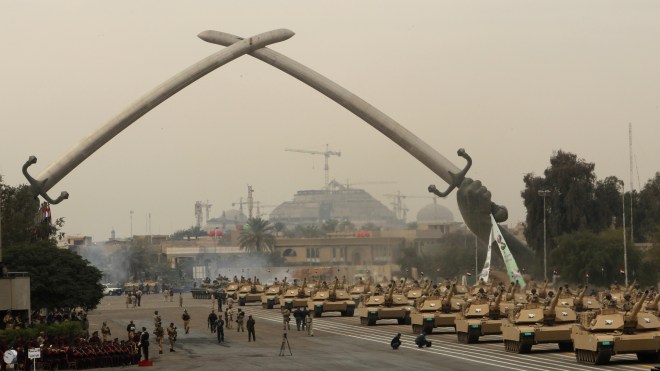
Iraqi army MIA1 Abrams tanks march under

Kanan Makiya reviews Igor Golomstock’s Totalitarian Art, now updated with a new section on Makiya’s homeland of Iraq:

One cannot think of a more perfect example of the totalitarian artistic impulse than Saddam’s insistence that a cast of his own forearms be used as the mold from which the Victory Arch was to be made. But in general, depictions of the leader, perhaps the most common subject of total realism, had to be mythologized. It would not do, for example, for a Soviet artist to depict Stalin as the short, pockmarked, bandy-legged man that he really was. His physical attributes, as in F. S. Shurpin’s portrait The Morning of Our Fatherland, had to undergo the same transformation as Stalin’s version of history, to be turned into what the writer Milan Kundera so eloquently referred to as “the beautifying lie.”

He takes issue with Golomstock’s dismissal of art under Saddam:

Totalitarian art is only interesting when the best artistic talent engages in it, and this is what happened in Iraq.

Under Hitler, many of the best artists went into exile, continuing modernism on the more welcoming shores of the Unite[d] States. (The consequences of choosing not to flee can be severe: the poet Mayakovsky stayed on in Stalin’s Russia, which may have had something to do with why he shot himself in 1930.) In Iraq, by contrast, most of the talented artists of the 1950s and 1960s collaborated with the new regime. Ghani Hikmat and Khalid al-Rahal, two of the most promising young Iraqi talents in the 1960s, went on to carry out such total realist monstrosities as the Victory Arch and the Monument to the Unknown Soldier in the 1980s. They did so because their project of the reappropriation of Iraqi turath, or “heritage,” was hijacked by the Baath Party, which found it politically parallel to its own idea of a Baathist-led “renaissance” of Arabness.

It’s also likely that the lack of a coherent, monolithic ideology in Baathist Iraq allowed for more varied and interesting art. Iraq was always a totalitarian state in practice, but never really in theory: unlike its Stalinist and fascist forebears, it never sported a pure, overarching mythology on par with Marxism-Leninism or Hitler’s Nietzschean race theory—just a vision of brutal Arab nationalism with Saddam as messiah.

As a result, the state had no real literary or artistic doctrine to enforce and no need to purge the artistic class for ideological credentials. You either had the talent to glorify Saddam, or you didn’t. It seems much closer to the status of art under Mussolini, as described by Makiya:

Whereas Hitler and Stalin used both threats and rewards to co-opt artists, Mussolini used only the latter, and so pre-Fascist Italian culture was never laid to waste the way German and Russian culture were.

Of course, as Makiya also notes, the boundaries of Saddam’s hodgepodge ideology left no room for a true Arab renaissance. Under the interrogation lights, all art will eventually wither away, and before long, proper tributes to the president have to be designed by the president himself. Whether in Stalin’s imperium or a tiny Arab prison-state, the words of Czeslaw Milosz apply:

This way of treating literature (and every art) leads to absolute conformism. Is such conformism favorable to serious artistic work? That is doubtful. The sculptures of Michelangelo are completed acts that endure. There was a time when they did not exist. Between their non-existence and existence lies the creative act, which cannot be understood as a submission to the “wave of the future.” The creative act is associated with a feeling of freedom that is, in its turn, born in the struggle against an apparently invincible resistance. Whoever truly creates is alone.

And you’re never alone with Big Brother around.

(Photo: Iraqi army MIA1 Abrams tanks march under the victory Arch landmark during a parade to mark the 91st Army Day in Baghdad on January 6, 2012, weeks after US troops completed their pullout. By Ali Al-Saadi/AFP/Getty Images)


Can’t We Get An EZ-Pass For Restaurants? Ctd

by Chris Bodenner

A reader writes:

I learned that it’s easy enough to short-circuit the ritual that Tomasky complains about. I’ll ask for the check when I know we’ll be adding nothing else to it, even if we are still eating. Or I’ll say, “…and we’ll take the check, too,” when the waiter is walking away with coffee orders. And when the check comes, I’m all set with my credit card, handing it over immediately so I don’t have to wait for the waitress to come back yet again. (Yes, it’s possible there is an error on the check, but that’s rare, and it can be dealt with even after the card is run.)

I don’t do this when I’m out with casual friends or in a too-large group, because I don’t want to be seen as an anal-retentive clod. But when I’m with my family? Or, especially, on my own? It’s nice to reclaim those 20 minutes.

Two readers recommend apps:

I think your headline just described LevelUp.

You get an app on your phone with a QR code which changes based on the tip percent. If everything works out, you can turn on the app and the wait staff can come by with another phone, take a picture of the code, and the transaction goes through, with a receipt emailed to you. Oh, and:

– LevelUp combines purchases and charges you once every week or two (like iTunes) to reduce draconian credit card interchange fees

– For now, at least, LevelUp charges no credit card fees to restaurants

– Restaurants provide “rewards,” so if you spend $100 you get a $10 bonus (and the restaurant pays an additional percentage here, but remember, they only pay it when you’ve already spent $100 and they’ve saved on interchange fees the whole time). It’s sort of like reverse Groupon: the restaurant gets you in the door, and you get a reward after you’ve given them continued business, not up-front.

I’m not a shill for LevelUp, I just use it a lot, and it works very well. And they claim it’s safer than using a credit card.

The other:

I’m emailing you at 2:40am Eastern so clearly I work in a restaurant and have had my after-work drinks (ahem, forgive typos) so: many restaurants already do this! I’m not shilling for one particular product, but we use Tabbedout in the restaurant where I work. It’s even better than the “hand-held” credit device the author wants. You just use a free app on your phone. Your credit card number is encrypted so it’s safe and really convenient. You (the customer) pay whenever you want and … leave. Seriously, it takes :30 seconds, not 20 minutes.

But, ya know what? Consumers aren’t ready – yet. I push this fantastic app every single night at every single table. The general response: HORROR! NO WIRES! CREDIT CARD STOLEN! Ok, a bit exaggerated, but nonetheless, I could easily map a sociological study about who is ready to embrace this technology. People under 30 = cool, let’s try it! Those 30-40 = interested but must do intensive research. Those 40+ = Huh, I just learned how to text and take pics with my smartphone so there is NO WAY I will pay a restaurant bill with this “new” contraption.

Look, I am a 53-year-old server who is clearly not a millennial. I freak my friends out (even the really young ones!) when I deposit printed checks via a mobile banking app (glorious, I will never need to walk inside a bank again), so I am not the obvious demographic for mobile payment apps. But they exist and work really well. It’s a combo of restaurants not understanding how awesome and inexpensive this is and consumers still – still! – thinking that it’s a risk to pay by phone. The funniest/ironic thing is this: as a server, you give me your credit card. I process it. I could easily steal the number (it happens it all the time, unfortunately, Google it) and use it. When paying via a mobile app, I never see your credit card number. It can’t be stolen. And you don’t have to wait for me. Open app, pay your tab, leave.

So, that dude at The Daily Beast who wrote this article is simply uninformed. I know he got stats from the NRA (the other NRA), but he was talking about a device attachment. There is an app for that and it works great. Catch up to the times, restaurant diners!

That Broken Leg

by Doug Allen

Duke v Louisville

Louisville sophomore Kevin Ware’s extreme compound fracture yesterday was probably the most disturbing injury I’ve ever seen in person or televised, and after seeing the replays I was unable to watch the rest of the game. Ian Crouch analyzes other reactions:

Ware’s injury quickly became about a variety of other things. It was a media story: When did CBS decide to stop airing replays? Did it do the right thing? And a tech story: How does social media capture and shape cultural responses to live events? It became an infrastructure story: Did the elevated court on which the game was played, installed largely for aesthetic purposes, contribute to the way in which Ware jumped and fell? And it has become a question about ethics: Ware’s immediate pain, and the long-term physical challenges he will face, make the mounting questions about the compensation (or lack of it) and exploitation of college players all the more significant.

Barry Petchesky provides a thorough rundown of how TV networks addressed airing the injury. Despite its gruesome nature, Will Leitch doesn’t blame sites like Buzzfeed and Deadspin for posting the footage:

Whether or not you think it’s right or wrong for Deadspin and The Big Lead and Buzzfeed and Yahoo to profit off the incident, it is undeniable that people desperately wanted to see it. You can hardly call those sites rogue or somehow sadistic, unless you are willing to call the vast majority of humanity that (and you might be). But those sites aren’t peddling drugs to children; they’re running footage of a nationally televised event that tons of people were watching. Don’t blame them for the video — blame the rest of us.

That’s to say: Blame human nature. Even now, knowing how horrific the video is, having been told by so many people to stay far away… I’m still curious to watch it.

David Sirota worries about Ware’s future:

[His injury] will likely be remembered alongside Joe Theismann’s career-ender as one of the most tragically gruesome in sports history. But that’s not the only tragic and gruesome part of this episode, because unlike Theismann, who was working under a guaranteed contract, Ware was an NCAA athlete helping to generate millions of dollars for the NCAA, but not automatically guaranteed a four-year education scholarship. As in so many other similar cases, that means his injury in service to the NCAA’s multimillion-dollar machine could spell the end of his financial aid and massive healthcare bills to boot.

(Photo: Russ Smith #2, Gorgui Dieng #10, Chane Behanan #21 and assistant coach Kevin Keatts of the Louisville Cardinals react after Kevin Ware #5 suffered a compound fracture to his leg in the first half against the Duke Blue Devils during the Midwest Regional Final round of the 2013 NCAA Men’s Basketball Tournament at Lucas Oil Stadium in Indianapolis, Indiana on March 31, 2013. By Andy Lyons/Getty Images)

Sexy Sneezing

by Zoe Pollock

Romantic thoughts or actions can trigger a sneeze:

[N]ot all sneezes are actually triggered through the nose. In fact, there appear to be multiple pathways involved. [Mahmood Bhutta, a Research Fellow at the University of Oxford who published a paper in 2008 titled “Sneezing induced by sexual ideation or orgasm: an under-reported phenomenon”] makes a pretty strong case for the parasympathetic nervous system as a common variable among the more bizarre sneezing triggers: photic sensitivity (sneezing when exposed to light, otherwise known as ACHOO syndrome); an exceptionally full stomach (otherwise known as snatiation, a portmanteau of “sneeze” and “satiation,” also an acronym among smug jerks in the medical community that stands for “Sneezing Noncontrollably At a Tune of Indulgence of the Appetite — a Trait Inherited and Ordained to be Named”); and, of course, sexy thoughts.

Essentially, the autonomic nervous system is so old and lizard-brain-like that it functions without our input. It formed before just about everything else in our bodies did, and because it’s so basic, certain pathways never really separated as our bodies developed.

Mental Health Break

by Chris Bodenner

A pricey way to keep your pets occupied:

Update from a reader:

If you’re saying it’s a pricey way to keep pets occupied because of the damage incurred to iPads, I have to tell you that after hours of fun with our cats and said apps we haven’t a single scratch on the screen.  iPad screens are really tough.

Disclosure: This content is not sponsored by Apple.

Gay Rights Around The Globe

by Patrick Appel

It’s not just the West that has made progress:

The World Values Survey data do suggest that Asia and Africa remain more homophobic than the Americas and Europe, but change has been rapid nonetheless. In the 2006 wave of surveys, the majority of Indians and Chinese remained firmly against homosexuality. But the proportion of people who thought homosexuality was never justifiable fell from 93 percent to 64 percent in India from 1993 to 2006 and from 92 percent to 74 percent in China.

Related Searches

by Zoe Pollock

Christopher Jobson spotlights a mesmerizing work of art:

I’m Google is an ongoing digital art project by Baltimore artist Dina Kelberman that documents digital patterns through non-artistic photography found on Google Image Search. When I first started scrolling through her Tumblr I wasn’t quite sure what I was looking at: frame after frame of airplanes pouring orange fire retardant on fires which slowly morphed into an orange kayak and then an orange bridge and on and on until I realized every single image shared a slight visual characteristic with the image before it. … I cannot urge you strongly enough to spend a few minutes scrolling through this impeccably curated collection of seemingly mundane photography that collectively creates something visually transcendent.

“Do The Time Or Snitch”

by Zoe Pollock

Rob Walker recounts the heartbreaking story of 46-year-old fast-food employee John Horner, who was caught by a police informant for selling painkillers. Under Florida law, Horner would be sentenced to 25 years unless he became an informant:

Horner says the problem for him, as someone with no previous drug arrests, was finding drug dealers to inform on.

“You start running the streets. You go to the places where drug dealers go, trying to find drugs. “I had gotten to the point at the end, I was desperate, I didn’t care who went to jail. I would have taken anybody down, just so I could be with my family,” says Horner.

[Law professor Alexandra Natapoff] says this is the danger the informant system poses. “We’ve created thousands of little criminal entrepreneurs running around looking for other people to snitch on,” she says. “And when they don’t have information we’ve created a massive incentive for them to create it.”

Horner is serving the full 25 years because he never found anyone to snitch on:

“What snitching does is it rewards the informed, so the lower you are on the totem pole of criminal activity, the less useful you are to the government,” says Natapoff. “The higher up in the hierarchy you are, the more you have to offer.”