Fareed Zakaria is, as usual, a sane voice in the escalating crisis:
Would U.S. intervention–no-fly zones, arms, aid to the opposition forces–make things better? It depends on what one means by better. It would certainly intensify the civil war. It would also make the regime of Bashar Assad more desperate. Perhaps Assad has already used chemical weapons; with his back against the wall, he might use them on a larger scale. As for external instability, Landis points out that if U.S. intervention tipped the balance against the Alawites, they might flee Syria into Lebanon, destabilizing that country for decades. Again, this pattern is not unprecedented. Large numbers on the losing side have fled wars in the Middle East, from Palestinians in 1948 to Iraq’s Sunnis in the past decade.
If the objective is actually to reduce the atrocities and minimize potential instability, the key will be a political settlement that gives each side an assurance that it has a place in the new Syria. That was never achieved in Iraq, which is why, despite U.S. troops and arms and influence, the situation turned into a violent free-for-all. If some kind of political pact can be reached, there’s hope for Syria. If it cannot, U.S. assistance to the rebels or even direct military intervention won’t change much: Syria will follow the pattern of Lebanon and Iraq–a long, bloody civil war. And America will be in the middle of it.
Anyone who wants to insert the US into such a bloody, violent, increasingly sectarian civil war needs his or her head examined. We couldn’t control or even understand one while we were occupying Iraq – and, as Fareed notes, scores of thousands were murdered under our very noses, with millions of refugees. An entire country is afflicted with communal PTSD of the most severe kind. Last month, the deaths in Iraq’s continuing civil war reached a post-occupation record of 700. And that’s after we invaded, occupied and tried to set up a non-sectarian government. What are the odds we can guide yet another sectarian civil war from the skies?
Brent Sasley claims that the recent Israeli strikes on Syria can succeed where the US can’t because their goals are pragmatic and limited:
[Israel’s] goal is to prevent weapons and technology from reaching its primary enemy in this specific arena, namely, Hezbollah (the Syrian military is no match for Israel). It doesn’t see itself as responsible for everything else, including interfering in the succession process being played out so violently, protecting civilians from the horrific atrocities being committed against them, and influencing the outcome of the civil war and, from there, the region. All this is reserved for later consideration or others to deal with. Jerusalem defines its responsibilities, rather, as its immediate security needs and the near-term future effects of its actions. Washington’s abilities are much greater, its goals are much broader, and its responsibilities are much bigger. Comparing Israel to the US under these conditions isn’t helpful for understanding America’s actions thus far or its capabilities for doing more.
Michael Koplow agrees – and goes further:
[T]o those who incessantly insist that Israel is of absolutely no strategic worth to American interests and is nothing but an albatross around the neck of the U.S., I’d submit that having the Israeli military around to prevent transfers of Iranian-furnished weapons to Hizballah and to make sure that Assad’s delivery systems for chemical weapons also stay right where they are, all while battlefield-testing American weapons in the process, is pretty useful right about now.
Justin Logan adds that “only a terrifically secure country could have as poor and astrategic a debate about war as the one we’re having” on Syria:
In fairness to [liberal hawks], they are carrying the torch of a time-honored American tradition of foreign policy thinking. Historically, debates over foreign intervention in the United States have featured liberal analysts against realists and the military. In the 1950s, President Eisenhower reportedly had to admonish his activist Secretary of State John Foster Dulles to calm down: “Don’t do something, Foster, just stand there!”
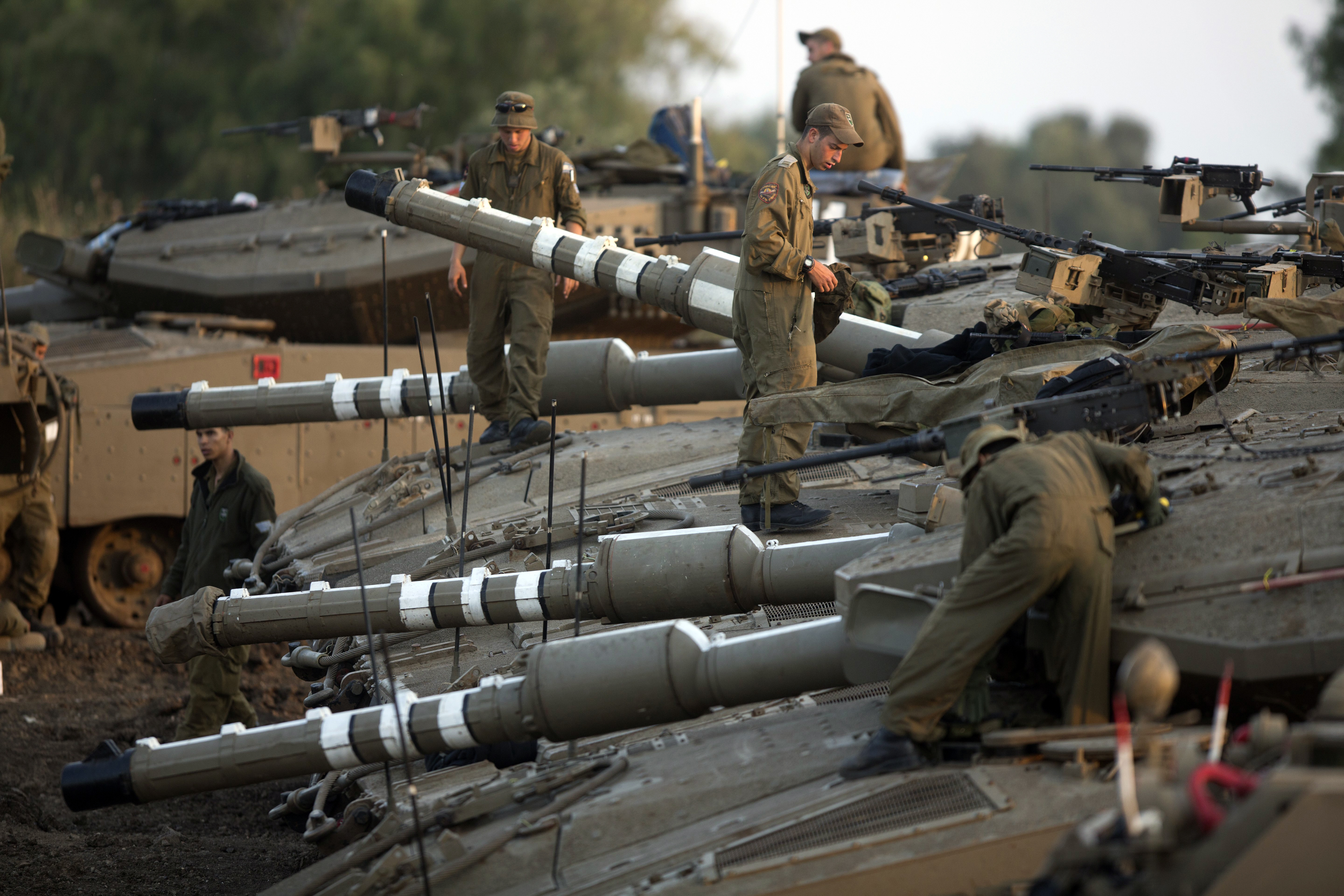
(Photo: Israeli soldiers walk on the top of their Merkava tanks deployed in the Israeli annexed Golan Heights near the border with Syria, on May 6, 2013. UN chief Ban Ki-moon has appealed for restraint after Israeli air strikes on targets near Damascus which prompted Syrian officials to warn ‘missiles are ready’ to retaliate. By Menahem Kahana/AFP/Getty Images)
 The Dish