From our reader poll (blue=yes, orange=no):

That 39% jumps to 50% among readers 35 and older, while only 28% of millennials say they use cursive. Among female readers, 63% use cursive, while only 30% of male readers do the same. And among all readers, a minority of 41% believe teachers should stop teaching cursive to children. Below are some remaining thoughts on the popular thread:
Cursive defenders all point to the supposed note-taking benefits of cursive. That’s absurd – if we wanted to teach a useful form of writing for transcription, we’d teach shorthand. Beyond that, writing faster encourages the wrong kind of note-taking. We shouldn’t be trying to transcribe whatever we’re listening to, but instead to synthesize it and take down notes about the key points. A professor of mine in law school banned laptops for exactly that reason – it encouraged transcription, not note-taking. Once I stopped trying to write down everything, my notes were far more useful, because the only thing they contained were the important parts.
These days, I take notes constantly just as part of being a lawyer. I do it on paper, with a pen. In print. Cursive wouldn’t help, so why did I learn it? The last time I wrote in cursive was the sworn statement on the bar exam. Before that, on the LSAT. It just has no relevance to modern life. For everything that isn’t taking a verbatim transcript, print is at least as good as cursive (and typically easier for others to read). For verbatim transcripts, shorthand is better. For long-form writing, typing is better. What benefit does cursive have left?
Another reader:
The only reason we’re having this discussion is because most of us, for more than 100 years, have been taught only the (frankly horrible) “Palmer System” of cursive handwriting.
The Palmer Method is a style of cursive composed of an entirely different set of letterforms than the manuscript (“printing”) we start with, and requires a dexterity unattainable to most 3rd graders. The result? Most people never give a thought to any remedial handwriting practice, and they rarely pass beyond whatever facility they may have had when they were eight.
Austin Palmer’s primary goal was to sell his textbooks and materials. In this, he was wildly successful. The Palmer Method’s quirky letterforms are an artifact of this (the better to differentiate your product). And they’re just plain difficult to achieve – born of an era that considered denial of the body a virtue, no thought was given to natural movement.
Compare this to the various types of Italic/Humanist miniscule. These are easily formed, easily read letters, and for the most part, the only difference between the manuscript and cursive forms are whether or not your raise your pen. No entirely new alphabets, no frankly tortured letterforms-as-trademark (I’m still confounded by Palmer’s capital F and lowercase r). Thornton’s Handwriting in America: A Cultural History is a nice overview of what Palmer hath writ, and Inga Dubay has made several very good instructional works that serve as wonderful introductions to a more suitable hand.
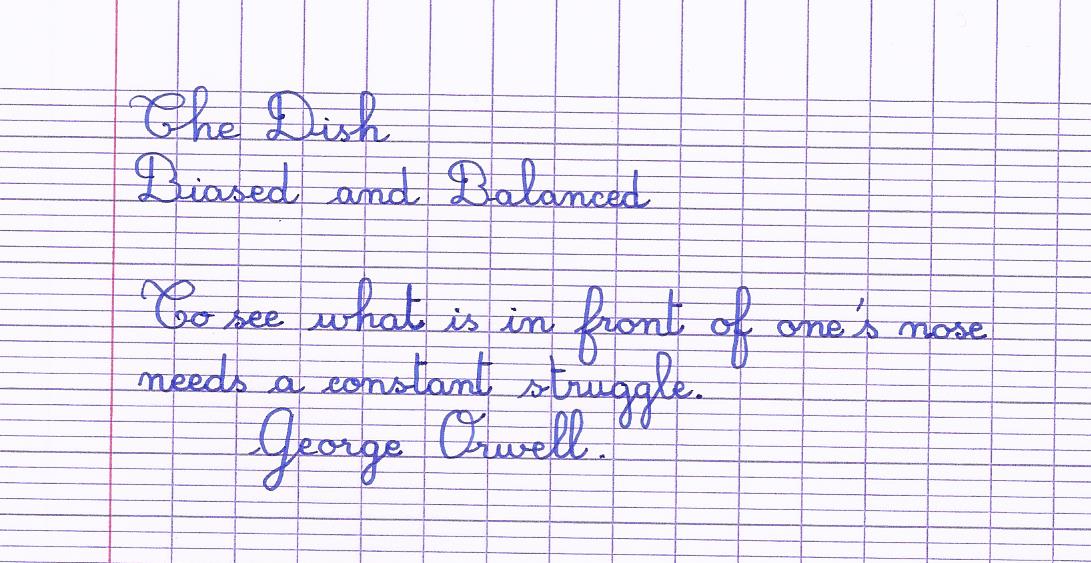
Another reader injects some cursive in the Dish:
Another:
Wow, your anti-cursive-teaching readers are talking about cursive like it’s copperplate calligraphy! It’s just cursive, folks! It’s actually lazier than print! You don’t have to pick up your pen. As someone who, quite literally, cannot draw a straight line without a ruler, I’m sympathetic to the people who had a hard time with cursive, but I think their bad experience doesn’t mean it shouldn’t be taught. I think it means teachers should allow that a small fraction of their students will never master it and stop docking their work for being a bit unsightly.
My case for why learning cursive is not a waste of time:
1) It’s taught in elementary school, where part of the goal is to get you familiar with how your hands work, learn about what’s in the larger world, and learn a useful skill. Doing drills is good for practicing fine motor skills, whether or not you ever succeed in the task. Cursive is used extensively in the world, and one needs to know it.
2) Cursive is one of the few times in early ed when we learn that there are multiple solutions to a problem. Yes, keyboarding is another solution to the problem of putting words to paper. But I remember having my mind blown a little bit in third grade when I learned that a giant, curly 2 was actually a Q. That a printed and cursive “f” were very different. After learning cursive, I was even able to puzzle out other fonts, whereas before I had no clue. But once I knew the various forms each letter could take, the number of written items I had independent access to, without having to get an adult to read it for me, went up enormously.
3) Any number of documents throughout the years have been written in cursive or other script. Anyone wanting to do genealogy or historical research had better have some familiarity with cursive. And without the drilling in it in elementary school, they probably wouldn’t.
4) Cursive aside, writing clearly is a useful skill. Whether or not you use it beyond that class is up to you, but the vast majority of us write things down. Cursive – or some pidgen version of it – is generally faster than print. Learning to write faster is useful. It’s not like calligraphy, with specific styles and harder rules, and slower execution. Third graders don’t have much room to negotiate with teachers, but maybe they should. We had one kid in our 5th grade class that was allowed to turn in assignments from a dot-matrix printer due to his abysmal handwriting, and the fact that his family had an early computer. Because our teachers were reasonable people. He tried, they negotiated, and came to a workable solution. Everyone else could write sufficiently well. Even me with my spastic fingers.
Morgan Polikoff gets the last word:
Since my quote started the Dish thread on cursive, I thought I’d go one more round. Before I start, I thought I’d mention just how amazing this story is to me. I did a one-off interview with the LA Times about cursive, and it’s become the most talked-about thing I’ve done or written (somewhat humbling to this academic who’s trying to do good research on other, much more important policies). The key point to me is that every single pro-cursive argument that’s made is very easy to rebut. Just running through the ones that have appeared in this thread:
1) Handwriting builds muscles and hand/eye coordination. True, but this applies to print and cursive – no evidence cursive is better than print.
2) There is a need write quickly and legibly. Actually, there rarely is (basically note-taking and test-taking in school is the only time in life this is needed). But if speed was the concern, keyboards are way faster than cursive. And if keyboards aren’t nearby and speed is paramount, we should teach kids shorthand.
3) Handwritten notes are more meaningful than typed. I agree with this, but again it applies to print and cursive.
4) Signatures need cursive for security. Actually this is not true. But if we were really concerned about security, we’d have moved past signatures now anyway – they’re not very secure at all. How about retina scans or fingerprints?
5) It can be beautiful. This one I agree with, but it’s hardly a reason to spend lots of instructional time on it. Needlepoint is also beautiful.
6) There’s plenty of time to do it. Well, to do it well takes a lot of time, and our teachers are already very strapped for instructional time. Furthermore, cursive isn’t included in the new Common Core content standards adopted by 45 states. Asking teachers to add things on top of the content standards dilutes the messages of those standards and leads to a cluttered, mile-wide inch-deep curriculum (which we already have).
7) Writing beautifully deepens our connection with the language. Not sure exactly what this means, but I don’t see why it wouldn’t also apply to print. Calligraphy is more beautiful than cursive – let’s teach that.
8) Not everything we teach has to be “useful.” This one I can buy as well. But it’s not an argument for keeping cursive per se, just an argument for a different philosophy about what to teach in general.
9) Research says it helps the brain. Actually almost all of the research is about handwriting instruction in general, not cursivehandwriting in particular. Including basically every study linked in the article cited by your reader.
10) Dyslexic kids learn well from cursive. This one does have some merit, but then the Yale Dyslexia Center says keyboarding is much better than cursive.
I could go on, but you get the point. There just isn’t a compelling reason that cursive should be taught to every student. Irealize this is some kind of cultural hornet’s nest I’ve stumbled into, but can we please just move on and let this thing die? As with gay marriage, we all know it’s going to happen sooner or later. Let’s get there sooner and save everyone the grief.
 The Dish