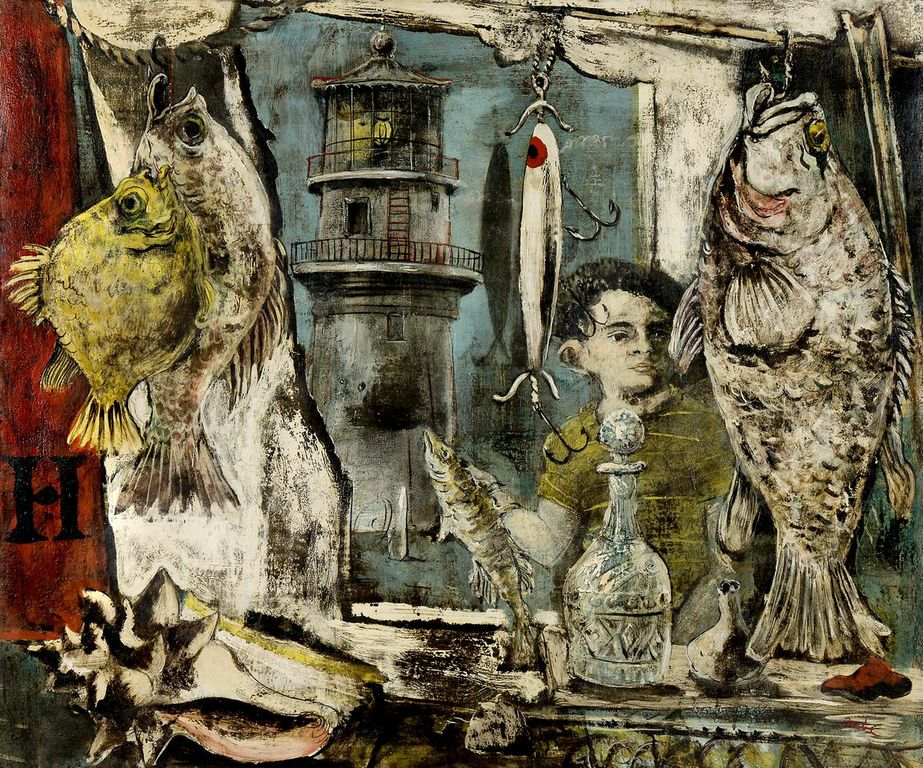
Advancing American Art was a 1946 art collection selected by US State Department; the shows were intended to fight the Cold War by promoting American cultural values abroad. The experiment was a domestic flop:
The highly conservative radio host Fulton Lewis Jr derided the art as “so far advanced that it’s completely out of sight and no one in his sane mind is ever going to try and catch up to it”. Upset citizens wrote letters to their elected representatives, deriding the use of taxpayers’ money for the project. Those politicians in turn spoke out in the press and on Capitol Hill.
The objections to the works took various forms. Complaints were made against the darkness of the works, both in palette and content, by those who felt that they failed to portray the nation as a thriving war victor. The “foreign-sounding” names of many of the artists, many of whom were in fact immigrants, was also an issue.
Perhaps most troubling for some protestors was the political orientation of many of the artists. … [T]he unfamiliar style, and hence artistic merit, of the work was called into question. Perhaps the most damning derision in this area came from none other than President Harry Truman, who in a letter to a State Department official leaked to the press, dismissed the art as “merely the vaporings of half-baked lazy people”.
The controversy came to a head in a series of Congressional hearings. While artists and museum officials around the country convened to try and save the programme, their counter protest was to no avail. Threats of State Department funding cuts put their other programmes at risk, which by that time included the popular Voice of America radio broadcasts, the Fulbright Programme and Unesco involvement. The outcomes of the hearings were the recall of the art to home, the dismissal of [State Department member Joseph LeRoy] Davidson and the elimination of his position.
A recreation of the exhibition can be seen at the University of Oklahoma through June 2nd. From there, it travels to Indiana University and the University of Georgia.
(Pictured: Around The Lighthouse, Karl Zerbe, n.d.)
 The Dish