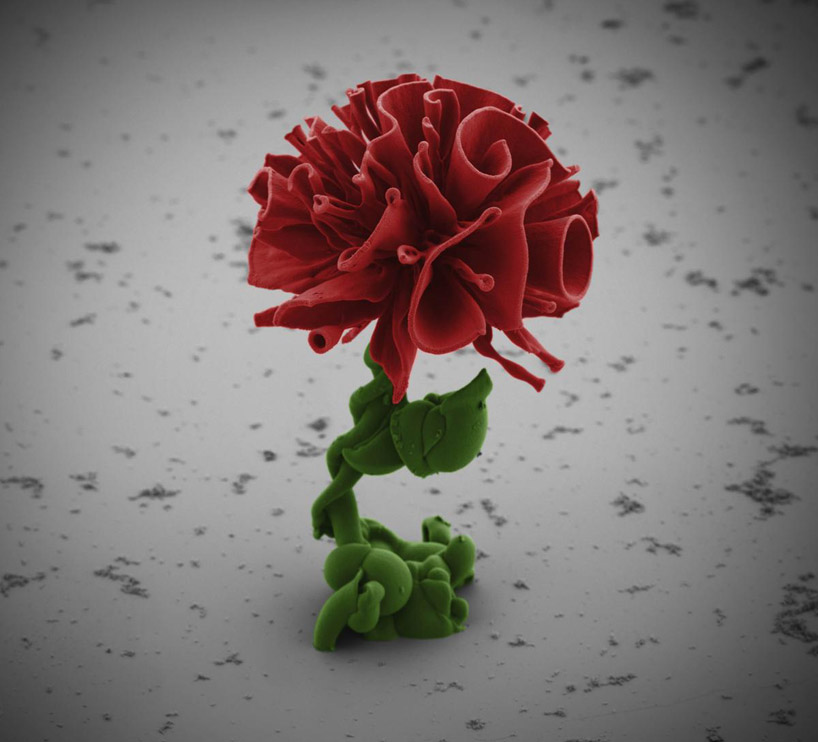
Harvard researcher Wim L. Noorduin has developed a process that creates self-assembling “flowers” comprised of microscopic crystals:
The process calls for dissolving barium chloride and sodium silicate in a container of water. A chemical reaction then forms barium carbonate crystals (thanks to carbon dioxide in the air). From there, the shape of these crystals can be manipulated with small pH changes to the solution.
One formed, they’re placed under an electron microscope and the final product resembles a field of flowers on a flat surface – which are actually glass plates, razor blades, and even pennies. “When you look through the electron microscope, it really feels a bit like you’re diving in the ocean, seeing huge fields of coral and sponges,” says Noorduin. “Sometimes I forget to take images because it’s so nice to explore,” he continued.
(Image courtesy of Wim L. Noorduin, Harvard University)
 The Dish