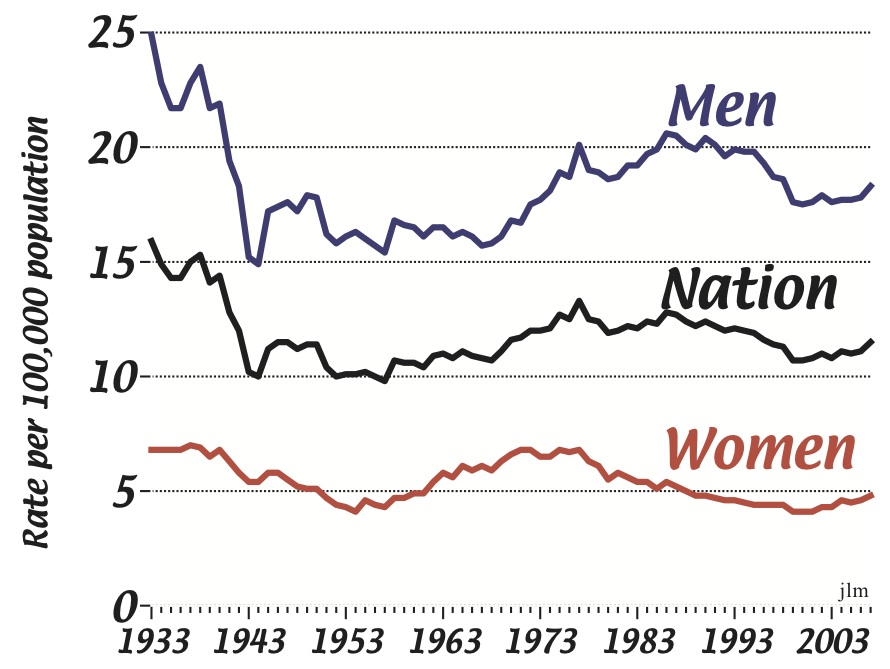
Tony Dokoupil claims we do:
[T]he last decade isn’t just a statistical blip, a function of a bad recession, unlocked gun cases, or an aging counterculture. It’s much darker, and deeper than all that. This is the “new epidemiology of suicide,” as [Julie Phillips, a sociologist at Rutgers University,] puts it, one where the tectonic changes of the last decade—socially, culturally, economically—have created a heavy burden of suicide, growing heavier by the year.
Nate Cohn, who posts the above chart, disagrees:
[T]alk of a “suicide epidemic” borders on sensationalism. Dokoupil’s piece is generally sound, but he contends that we live in a dystopic era of “unprecedented despair,” and that “we have never been more burdened by sadness.” Suicide rates have, indeed, climbed since 1999, a year that represented the all-time low for suicide in the United States, but today’s suicide rates are roughly comparable to those between 1940 and 1990, and below the rates of the 1930s.
That trendline corresponds with long-term trends in the national economy, adding credibility to the economic explanation for the suicide surge.
Sean Trende slices the data on suicide differently:
As it turns out, once you control for gun ownership, religiosity does have a statistically significant relationship with suicide … in a hypothetical state with no guns and no religion, we’d expect a suicide rate of 17 (per 100,000), give or take a few points. In a state where everyone had guns, and no one practiced religion, we’d expect a suicide rate of 39. If everyone were religious, but no guns: 11. Everyone religious, everyone owns a gun: 21. From a political perspective, there’s really something for both the left and right to like here.
 The Dish