Suspicion is mounting over government interference in the now stalled Chilcot Inquiry exploring the former prime minister’s role in hyping the Iraqi threat in 2002:
The central allegation against Mr Blair is that he gave a private assurance in early 2002 to President Bush that Britain would join the United States in an invasion of Iraq. Thereafter, it is said, all was decided. Even though Mr Blair later highlighted Saddam Hussein’s alleged weapons of mass destruction, and misrepresented what he was being told by the intelligence services to the House of Commons, it was of little significance to him, because the die had been cast anyhow.
Hence the central importance of access to those conversations. They are likely to cast much-needed light on whether or not the allegations that the prime minister struck a private deal with the president are true. Yet, amazingly, the Chilcot Inquiry’s website states that it has “not yet” even “begun its dialogue” with government over the treatment of these Blair/Bush conversations.
David Owen, former foreign secretary, has launched an attack, accusing Blair and Cameron of a secret deal to prevent the truth coming out:
Speaking at a public meeting, Lord Owen said that the inquiry “is being prevented from revealing extracts that they believe relevant from exchanges between President Bush and Prime Minister Blair”. The culprits, he said, are Tony Blair and David Cameron: “Publication of the Bush extracts would not be blocked if Tony Blair had not objected, nor if that objection had not been supported by the present prime minister, David Cameron. Both men are hiding behind conventions that are totally inappropriate given the nature of the inquiry.”
I agree. It is of critical importance in a democracy that a declaration of war – the gravest decision a leader has to make – is made transparently, that the case be built on facts, and that the process of deliberation is a real one – and not effectively a farce because of a secret deal to go to war regardless of the arguments. If people cannot trust their own governments to be open and truthful on these matters, then the entire democratic project is in jeopardy. Massie, always worth reading, nonetheless sticks up for Blair:
The war may have proved a grievous blunder and those who opposed it look more prescient (in some ways) than those who backed it. But later mistakes – including, of course, the failure to find WMD – do not actually mean the argument for “dealing” with Saddam Hussein was based upon arguments that were known to be untrue at the time they were being made.
And so, what is the point of “revealing” these conversations [between Bush and Blair]? What, indeed, is the point of the Chilcot Inquiry? Who can it satisfy or whose mind can it possibly change? Some people will not be persuaded because they cannot be persuaded.
If there’s an irony here it is that there were people a decade ago who took any suggestion Saddam might not have active WMD programmes as evidence of Saddam’s utter deviousness. It was proof he could not be trusted and therefore, perversely, evidence he was up to no good. Ten years later we see the same thing: the absence of evidence against Blair is proof of the former Prime Minister’s cunning. He must have been up to something, otherwise why the need for secrecy? And so down the rabbit hole we merrily go.
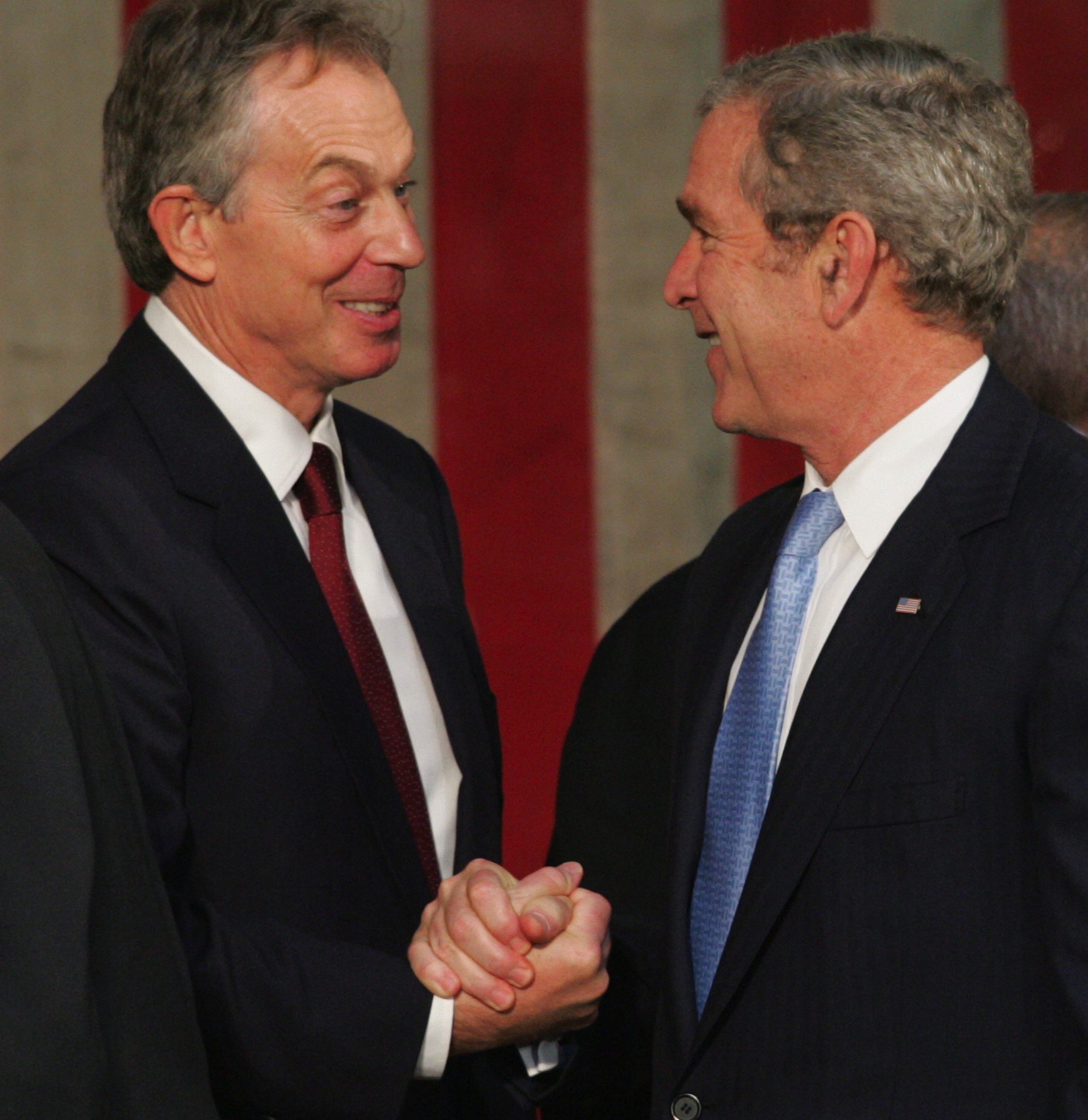
(Photo: Former British Prime Minister and Middle East Quartet Envoy Tony Blair greets US President George W. Bush following speeches during the Annapolis Conference in Memorial Hall at the United States Naval Academy in Annapolis, Maryland on November 27, 2007. By Saul Loeb/AFP/Getty Images)
 The Dish